Types of Liquor Licenses Explained (2026): the Four Families
There is no national list. Each state names its own classes, but they sort into four families. Here is the map.
There is no national set of liquor license types. Each state writes its own classes with its own names and numbers, so a "Type 47" in California means nothing in Texas. What does carry across every state is a small set of families the classes sort into. Learn the families and you can read any state's list, then open your state page for its exact names.
Every retail liquor license answers two questions and sits in one place in the supply chain. Sort by those and the dozens of state-specific names collapse into a map you can hold in your head. Below are the four families, then the two questions that narrow any state's list down to your class.

Family 1: where it is consumed (on-premise or off-premise)
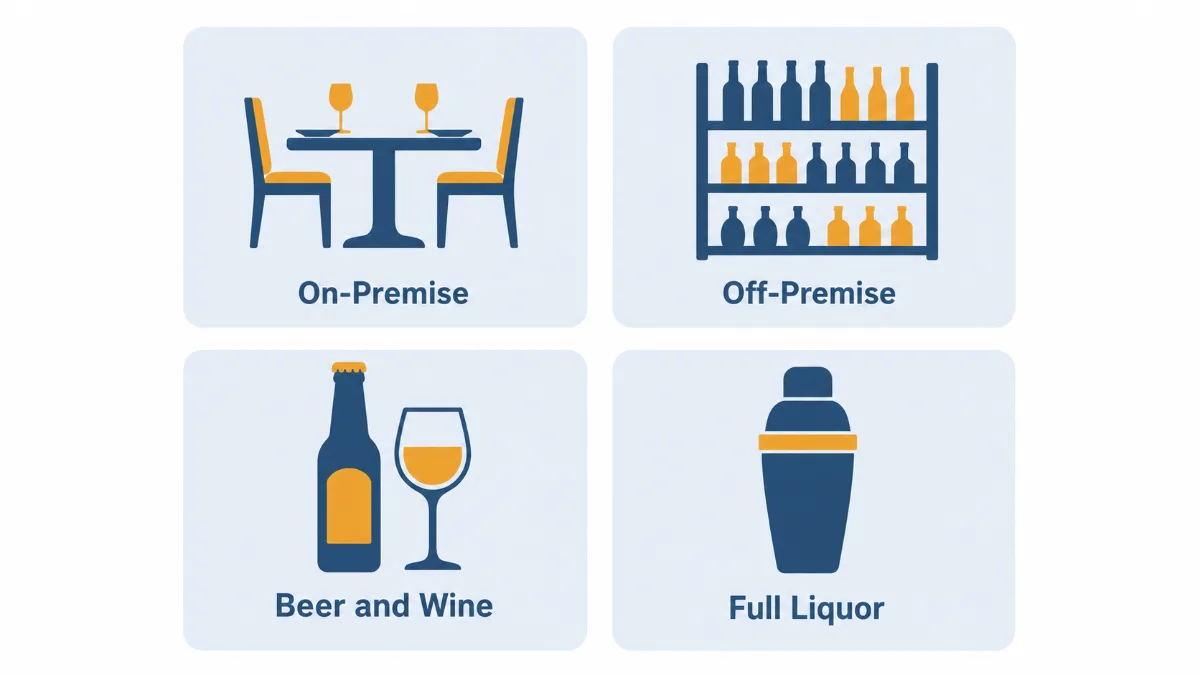
The first split is where the alcohol is drunk. An on-premise license covers drinks consumed where they are sold: a bar, a restaurant, a tavern or a club. An off-premise license covers sealed containers sold to take away: a liquor store, a grocery or a convenience store. Some classes cover both. This split comes first because it decides which half of your state's list you even read. A bar needs an on-premise class and a bottle shop needs an off-premise class. The two rarely overlap in fee or rule.
Family 2: what it covers (beer and wine, or full spirits)
The second split is the beverage tier. A beer-and-wine class covers fermented drinks, beer and wine and often cider, but not distilled spirits. A full-spirits class, sometimes called a general or all-alcohol license, adds liquor. The gap matters for two concrete reasons. The full-spirits class usually carries a higher fee. And in a quota state it is the class the cap falls on, while a beer-and-wine class often sits outside the cap and can be applied for directly. That is why many first restaurants open on a beer-and-wine class. The cost estimator sorts each state's classes by exactly this split, so you can see where a beer-and-wine class sits versus a full-spirits one in your state.
Put your state's application in order
From the team behind this library
The Liquor License Application Kit
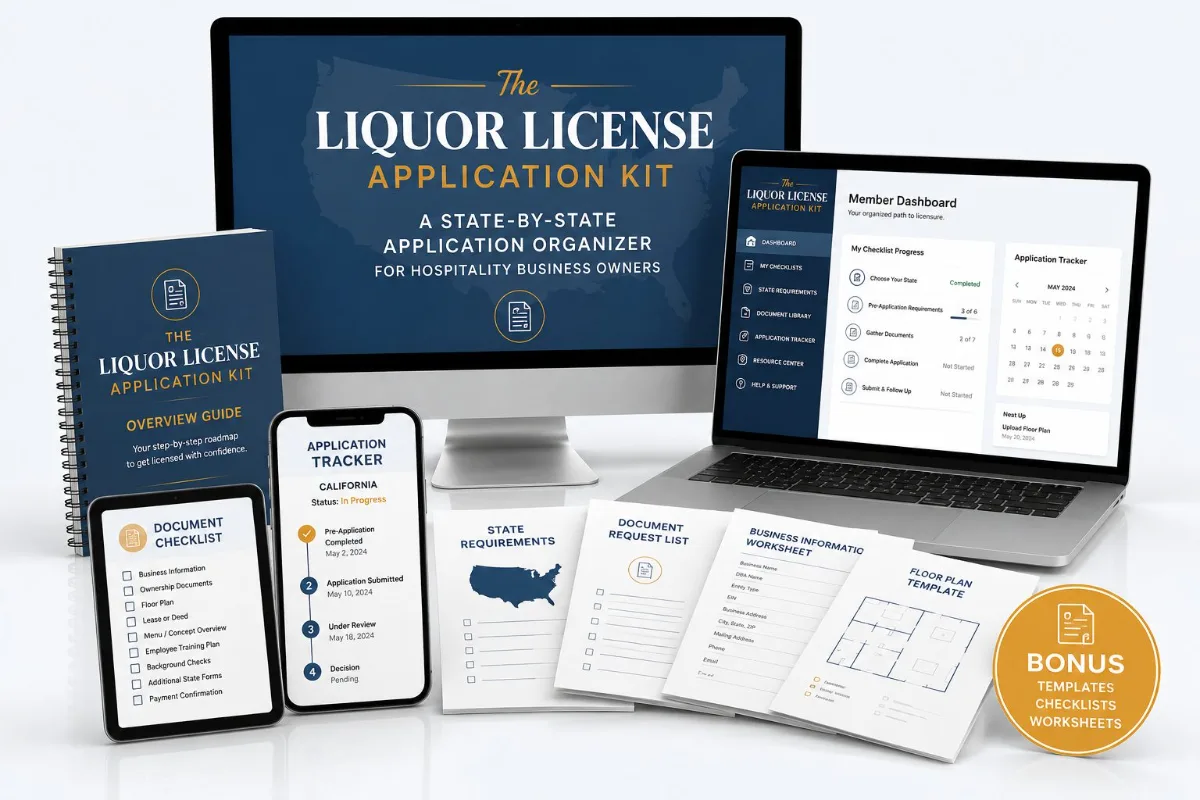
Want the whole path in one place? The Liquor License Application Kit hands you the done pieces for your state: the 51-jurisdiction directory and state selector, the license-class decoder, the dependency-ordered filing checklist, the document-gathering organizer, the deadline and public-notice tracker and an honest do-you-need-a-lawyer decision guide.
Family 3: where you sit in the chain (retail, or manufacturer and wholesaler)
Every state licenses three tiers separately, a structure the country has used since Prohibition ended: producers (breweries, wineries and distilleries), wholesalers who distribute and retailers who sell to the public. This library covers the retail tier, the bar, restaurant or store selling to a customer. A manufacturer or wholesaler license is a separate track with its own rules, named here only so a reader who searched "types of liquor licenses" can see the whole map and tell which part applies. If you are opening a taproom that sells its own product, that is a manufacturer class, not the retail class this library covers.
Family 4: the niche classes (club, temporary and special)
Around the four corners sit the special classes: a club license for a members-only organization, a temporary or special-event permit for a one-day festival or fundraiser, a caterer's permit and venue-specific classes for a hotel, a theater, a stadium or a resort. Several of these sit outside a state's quota, which is why they come up in the quota guide. A one-day event permit is a different category from the first-time fixed-premises retail license this library covers, so if that is what you need, your state authority handles it on a separate form.
Florida: the series letters decoded
Florida names its classes with a number and a letter code, which is unreadable until someone tells you the two abbreviations. COP means consumption on premises. APS means alcoholic beverage package sales, so sealed containers to take away. The leading number is the beverage tier: 1 is beer, 2 is beer and wine, 4 is beer, wine and liquor. Put those together and the whole list opens up. A 1APS is a beer-only package store class. A 2COP is a beer-and-wine bar or restaurant. A 4COP is a full-liquor on-premise class. A 3PS series, lettered by county population tier, is the packaged-spirits class a liquor store holds.
The split that matters in Florida is the quota. The 4COP through 8COP on-premise series and the 3PS through 3DPS package series are capped at one license per 7,500 county residents, with a new one opening as the certified county population crosses each further increment, awarded by an annual random selection drawing when applicants outnumber the licenses available. The beer and beer-and-wine classes, 1COP, 2COP, 1APS and 2APS, sit outside the cap entirely. So does the SRX special restaurant license, a non-quota route to full spirits for a restaurant that draws at least 51 percent of gross revenue from food and non-alcoholic beverages and meets the floor-space and seating minimums; it does not permit package sales, it stops alcohol sales when food service is unavailable and it cannot move to a new location. Open the Florida page for the fee tiers and the current drawing window.
California: what the Type numbers mean
California numbers its licenses rather than naming them. The numbers are genuinely arbitrary, so the only way to read the list is to learn the handful that matter for retail. The word that does the real work is general: a general license includes distilled spirits. A general license is also the one the county quota falls on.
- Type 20, off-sale beer and wine. A store selling beer and wine to take away. Minors allowed on the premises. Not a general license, so no county quota.
- Type 21, off-sale general. A liquor store, grocery or convenience store selling beer, wine and spirits to take away. Capped at one per 2,500 county inhabitants under the off-sale general quota statute.
- Type 40, on-sale beer. A beer-only bar. Snacks or sandwiches must be available, a full meal is not required. Minors allowed. No quota.
- Type 41, on-sale beer and wine, eating place. The common first license for a small restaurant that does not pour spirits, requiring a bona fide eating place with a real kitchen and substantial meal sales. Minors allowed. No quota, which is why it is so often the practical choice.
- Type 42, on-sale beer and wine, public premises. A beer-and-wine bar with no food requirement. Minors may not enter and remain, apart from a narrow musician exception. No quota.
- Type 47, on-sale general, eating place. A restaurant pouring spirits, with the same bona fide eating place conditions as a Type 41. Capped at one per 2,000 county inhabitants under the on-sale general quota statute.
- Type 48, on-sale general, public premises. A bar or nightclub pouring spirits with no food requirement. Minors may not enter and remain. Same quota as the Type 47.
The consequence for a first venue is concrete. A Type 41 can be applied for directly and carries an application fee of about $1,135. A Type 47 in a county at its ratio goes through the state's annual priority drawing, where the general-license application fee runs near $19,840, or through buying an existing license on the secondary market at a price the market sets rather than the department. Annual fees are far closer than that gap suggests: $565 for a Type 41 against $985 to $1,545 for a Type 47 or 48. Open the California page for the current schedule and the drawing window, or compare the two tiers directly in the beer and wine against full liquor guide.
How to read your own state's list
Two questions narrow any state's list to your class. Where are the drinks consumed, on-premise or off-premise? And what do you serve, beer and wine or full spirits? Answer those two and a list of thirty state classes collapses to the one or two that fit you. Your state page lays out its classes with the venue each one fits. The estimator does the sorting for you.
If you would rather be walked through it, the which liquor license do I need tool asks the same questions one at a time, adds the two that decide the niche classes and names the family your operation lands in.
This guide is educational information, not legal advice and it does not tell any applicant what to do. Class names, tiers and rules are set state by state and change; confirm the exact class for your venue with your state before you apply. See what actually decides how involved the process is, or read how we verify every page.
Types of liquor licenses FAQ
How many types of liquor license are there?
There is no fixed national number, because each state writes its own classes with its own names. What carries across every state is a small set of families: on-premise or off-premise, beer-and-wine or full-spirits, retail or manufacturer and wholesaler, plus niche classes like club and temporary permits. A given state might list a handful of retail classes or a few dozen.
What is the difference between an on-premise and an off-premise license?
An on-premise license covers alcohol consumed where it is sold: a bar, a restaurant, a tavern or a club. An off-premise license covers sealed containers sold to take away: a liquor store, a grocery or a convenience store. Some classes cover both. It is the first split to settle because it decides which class even fits your venue.
What is the difference between a beer and wine license and a full liquor license?
A beer-and-wine class covers fermented drinks like beer and wine, plus cider in many states, but not distilled spirits. A full-spirits or general class adds liquor. The full-spirits class usually carries a higher fee and, in a quota state, is the class the cap falls on, so many first restaurants open on a beer-and-wine class and add spirits later.
Which liquor license do I need for a restaurant?
Most restaurants that pour drinks need an on-premise class. If you serve only beer and wine, a beer-and-wine on-premise class usually fits and costs less. If you pour cocktails, you need a full-spirits on-premise class, which in a quota county can mean buying an existing license. Your state page names the exact class a restaurant uses.