How to Get a Liquor License in Massachusetts (2026): Cost, Classes and Steps
How do you get a liquor license in Massachusetts?
In Massachusetts, a first-time retail applicant files locally with the Local Licensing Authority (LLA) in the city or town where the business will operate. The license only becomes final once the state Alcoholic Beverages Control Commission (ABCC) approves what the LLA has already granted. On-premise applicants seek a section 12 license (all alcoholic beverages for full spirits, or a smaller wine and malt beverages class), while off-premise applicants seek a section 15 package store license. Massachusetts is a quota state: each municipality's number of licenses is capped by a population-based formula set in 1933, so an open license is not guaranteed to exist in every city or town.
In Massachusetts, retail liquor licenses go through the Alcoholic Beverages Control Commission. A first-time applicant files locally, because the city or county is the issuing authority here. Massachusetts caps the number of retail licenses, so a first-time applicant often buys an existing license and transfers it rather than obtaining a brand-new one. Work the page top to bottom and the whole path is visible before any single deadline is due.
Server training is required for some classes or roles. Every owner, officer and significant investor clears a background check. A city or county sign-off is part of the path. Each piece has its own section below, with the official source beside it.
A Boston home-rule petition took effect September 11, 2024. Massachusetts still runs its 1933 population formula for retail licenses, but Boston secured a home-rule petition to add 225 new licenses phased over three years, aimed at specific neighborhoods. This page reflects the rule in force today; the full history sits in the law-updates log.
Which liquor license does a Massachusetts bar, restaurant or store need?
The retail license classes Massachusetts issues, what each covers and the venue each fits. Match your venue to the class before anything else.
| Class | Covers | Who it fits |
|---|---|---|
| Section 12, All Alcoholic Beverages On-premise all alcoholic beverages (pouring) license | on-premise, full spirits | Covers common victuallers (restaurants), innholders (hotels), taverns, clubs and general on-premise businesses. The main class for a bar or full-service restaurant. Subject to the municipality's population quota under section 17 |
| Section 12, Wine and Malt Beverages On-premise wine and malt beverages license | on-premise, beer and wine | Common first license for a small restaurant that does not pour spirits. Subject to its own, separate population-based quota under section 17. It can be converted to a non-transferable all-alcohol license at local option under the newer section 12D |
| Section 15, All Alcoholic Beverages Off-premise package store license, full spirits | off-premise, full spirits | The liquor-store class. Subject to a population quota under section 17. One owner may hold at most 9 of these statewide and no more than 1 per town or 2 per city. Applicant must be a Massachusetts resident |
| Section 15, Wine and Malt Beverages Off-premise wine and malt beverages license | off-premise, beer and wine | Used by grocery and convenience stores that sell only beer and wine for off-premise consumption. Also population-quota-limited under section 17 |
Is Massachusetts a quota or control state?
Whether Massachusetts caps how many licenses exist, how a capped license is obtained and whether the state runs any part of retail itself. This is where the real cost of a Massachusetts license can hide.
| Item | Massachusetts rule |
|---|---|
| Quota state? | Yes, the number of licenses is capped |
| How the cap works | Set by M.G.L. c.138 section 17. Outside Boston, a city or town may issue on-premise all-alcohol licenses (section 12) at 1 per 1,000 population plus 1 more per 10,000 population above the first 25,000, with a floor of at least 14 regardless of size. Off-premise package store licenses (section 15) run at 1 per 5,000 population with a floor of at least 2. On-premise wine-and-malt-only licenses run under a separate formula, 1 per 5,000 population with a floor of at least 5. Boston has its own fixed statutory totals instead of the population formula: 677 all-alcohol on-premise licenses, 250 package store licenses and up to 320 wine and malt licenses. Population is fixed at the most recent federal census figure (the 2020 census sets the current quotas) and a quota never decreases because of a later population loss |
| New licenses issued by | none; Massachusetts does not run a lottery or drawing for new quota licenses. A municipality that has reached its quota can only gain more licenses through a special act of the state legislature (a home rule petition), which is how Boston obtained 225 additional licenses over three years under a law signed September 11, 2024 |
| Buying an existing license | Existing quota licenses can be bought and sold privately with Local Licensing Authority and ABCC transfer approval. Market-reported prices for an all-alcohol license run roughly $300,000 to $500,000 in Boston and $150,000 to $400,000 in nearby Middlesex County cities such as Cambridge, according to license broker and attorney sources; these are market-reported figures, not an official state or local fee |
| State control | No, private licensing throughout. Massachusetts licenses private retail sellers for both on-premise and off-premise alcohol. There is no state-run retail store for spirits, wine or beer |
How much does a liquor license cost in Massachusetts?
| Item | Massachusetts |
|---|---|
| State and local fees to apply | $200 state processing fee plus a local license fee that most municipalities set well under $1,000 and that can run toward $3,500 or more in a high-demand city such as Boston. Total government fees commonly run a few hundred to several thousand dollars before any secondary-market license purchase in a quota-full municipality |
| Renewal | the same local annual license fee the Local Licensing Authority set at issuance; an exact statewide figure is unverifiable because each municipality sets its own fee schedule |
| What drives the range | The $200 ABCC processing fee is fixed statewide. The license fee itself is not fixed statewide: M.G.L. c.138 section 12 leaves the amount to the Local Licensing Authority, so the real range depends on the city or town and the license class |
The itemized fees a first-time Massachusetts applicant can expect from the state.
| Fee | Amount |
|---|---|
| ABCC processing fee for a new or transfer retail application | $200 flat; covers multiple retail transactions filed together as one submission |
| Local license fee (on-premise or off-premise, set annually by the municipality) | varies by city or town; the Local Licensing Authority sets the amount |
| Additional ABCC fee when a package store applicant's new or transferred license would bring that owner's total above 3 package store licenses | up to $5,000 |
How long it takes. The statutory local and forwarding steps alone run roughly 40 to 60 days (a 10-day hearing-notice window, a hearing held 10 to 30 days after filing, a 30-day Local Licensing Authority decision window, a 3-day forward to the ABCC and a 7-day license issuance after ABCC approval). Neither the ABCC nor a Local Licensing Authority publishes a statutory deadline for the ABCC's own investigation. Industry sources report a new, non-transfer license commonly taking 3 to 8 months from filing to issuance. What extends the range: the ABCC's background and financing investigation, any continuance or opposition at the local hearing and, in a quota-full municipality, the added wait for a license to become available or for a home rule petition to pass
From the team behind this library
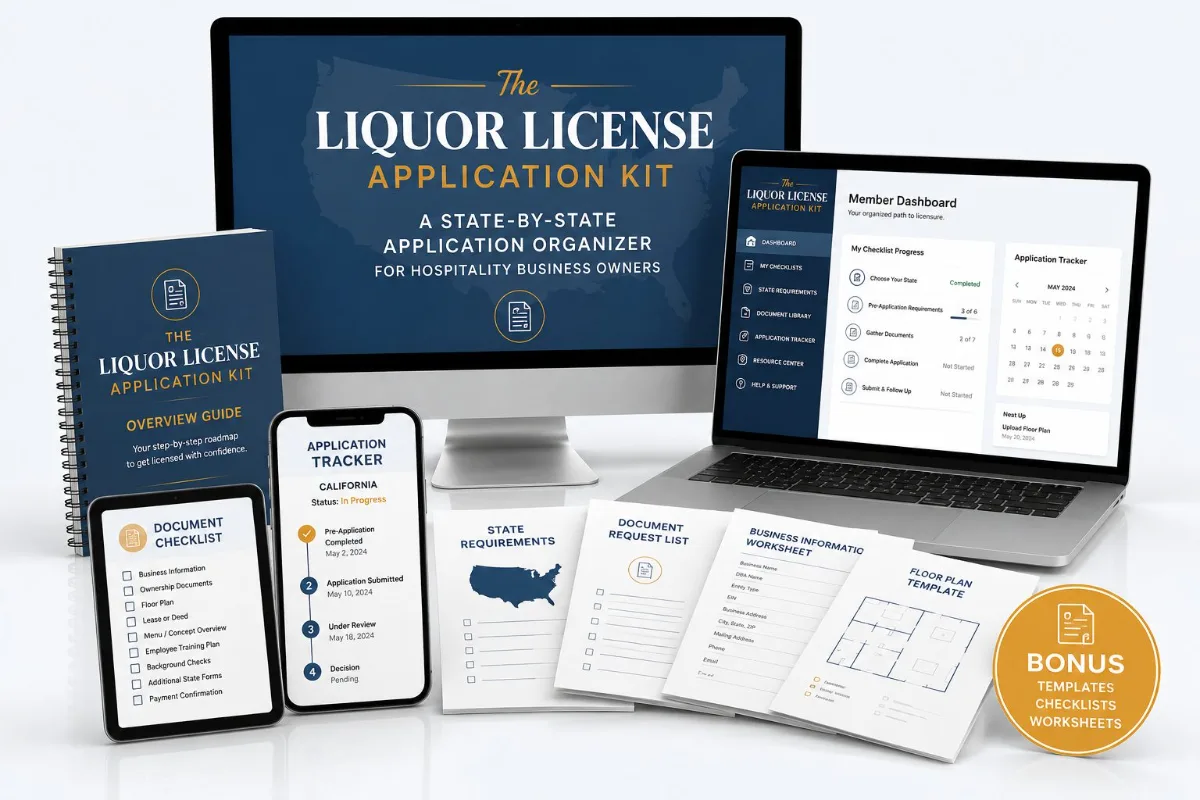
The Liquor License Application Kit
This page shows you the steps. The kit fills them in for Massachusetts. Your license class decoded, every document named and tracked, the deadline and public-notice windows dated and a straight answer on the one or two points that actually need a lawyer. The reference pages stay free. The kit is the evening of assembly you skip.
How to apply for a liquor license in Massachusetts, step by step
Several of these steps gate the ones after them, so the order matters as much as the list.
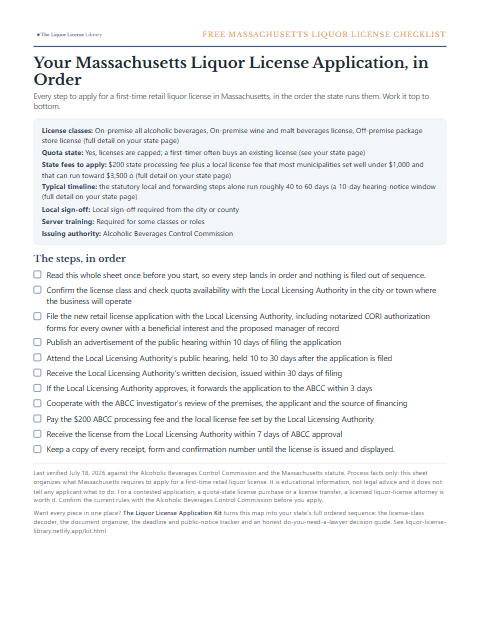
- Confirm the license class and check quota availability with the Local Licensing Authority in the city or town where the business will operate
- File the new retail license application with the Local Licensing Authority, including notarized CORI authorization forms for every owner with a beneficial interest and the proposed manager of record
- Publish an advertisement of the public hearing within 10 days of filing the application
- Attend the Local Licensing Authority's public hearing, held 10 to 30 days after the application is filed
- Receive the Local Licensing Authority's written decision, issued within 30 days of filing
- If the Local Licensing Authority approves, it forwards the application to the ABCC within 3 days
- Cooperate with the ABCC investigator's review of the premises, the applicant and the source of financing
- Pay the $200 ABCC processing fee and the local license fee set by the Local Licensing Authority
- Receive the license from the Local Licensing Authority within 7 days of ABCC approval
Local approval and public notice in Massachusetts
The city or county layer on top of the state license, plus any notice you must post or publish. The public-notice window is often the shortest clock in the whole process.
| Item | Massachusetts rule |
|---|---|
| Local sign-off required? | Yes, a city or county sign-off is part of the path |
| What the local layer does | Every new retail application is filed with the city or town's Local Licensing Authority (for example a Select Board or City Council; the Boston Licensing Board in Boston). The Local Licensing Authority must grant it first before the ABCC will approve it |
| Public notice | the Local Licensing Authority must publish an advertisement of the public hearing within 10 days of the application being filed; the hearing itself is then held 10 to 30 days after filing |
| Worth knowing | Filing is always local-first, through the Local Licensing Authority, before the ABCC becomes involved. Individual cities and towns add their own local requirements on top of the state process, such as a zoning sign-off or a neighborhood notice; those local add-ons vary by municipality and are not uniform statewide |
Server training in Massachusetts
Whether the people pouring or selling alcohol must certify through a state program, plus the deadline.
| Item | Massachusetts rule |
|---|---|
| Required for a first-time retailer? | Required for some classes, roles or local mandates |
| Who must certify | n/a at the state level; where a municipality or an insurer requires it, typically all staff who serve or sell alcohol |
| State program | n/a; Massachusetts has no state-mandated server training program and no state-approved provider list for retail licensees |
| Worth knowing | The state does not require alcohol server training as a licensing condition. A number of municipalities, Boston and Plymouth among them, require it locally. Many liquor liability insurers also require a training certification such as TIPS or a state-approved food-safety alcohol course as a condition of coverage, which functions as a practical mandate even though it is not a state law |
Background check and renewal in Massachusetts
Background check
| Item | Massachusetts rule |
|---|---|
| Background check required? | Yes |
| Who is checked | every individual with a beneficial interest in the applicant entity and the proposed manager of record complete a notarized CORI (Criminal Offender Record Information) authorization form. A corporate or LLC applicant must also meet the citizenship or qualified-alien and residency standard for its directors or managers |
| Disqualifiers | an on-premise (section 12) applicant may not have been convicted of a federal or state narcotic drugs law violation, with no time limit on that disqualification. An off-premise package store (section 15) applicant may not have been convicted of a felony. Every applicant must be at least 21 years old, of good character and either a United States citizen or a qualified alien under the Immigration and Nationality Act |
| Worth knowing | Massachusetts removed the flat United States citizenship requirement for individual license holders and managers of record in November 2024 under H.5100. A green card holder or other qualified alien can now hold a license or serve as manager of record directly; previously only a partnership or corporation structure gave a non-citizen an ownership path. Massachusetts residency is still generally required for an individual license holder. |
Renewal
| Item | Massachusetts rule |
|---|---|
| Renewal cycle | annual |
| Worth knowing | Renewal applications for section 12 (on-premise) and section 15 (off-premise) annual licenses must be filed within the month of November each year through the Local Licensing Authority. |