How to Get a Liquor License in Hawaii (2026): Cost, Classes and Steps
How do you get a liquor license in Hawaii?
Hawaii has no state liquor authority. Each county issues its own retail licenses under Hawaii Revised Statutes chapter 281: the Honolulu Liquor Commission and the departments of liquor control of Maui, Hawaii and Kauai counties. A first-time bar or restaurant applies for a Class 2 restaurant or Class 5 dispenser license and a package store applies for a Class 4 retail dealer license, all granted after a public hearing with neighbor protest rights rather than under any quota.
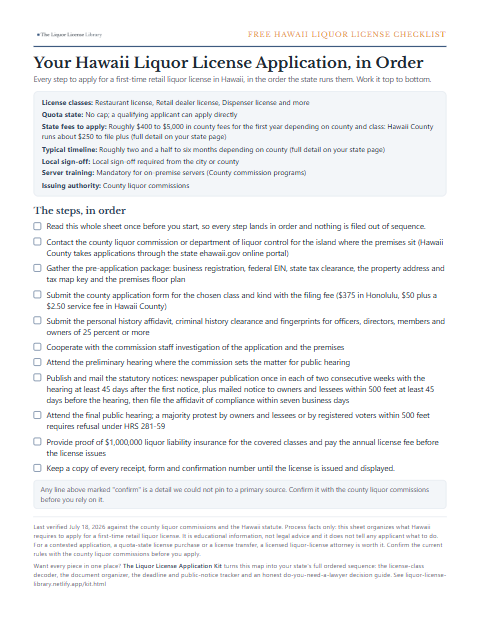
Hawaii runs its retail liquor licensing through the county liquor commissions. The application runs through the state with a local sign-off alongside it. Hawaii sets no cap on the number of retail licenses, so there is no slot to wait for and no existing license to buy out. The page below lays the pieces out in the order the state runs them.
On-premise servers must certify through the state's named training program within its window. Every owner, officer and significant investor clears a background check. A city or county sign-off is part of the path. Each piece has its own section below, with the official source beside it.
The parts a Hawaii applicant most often misses are the public-notice window, which runs on the state's schedule rather than yours and the order of the steps, since several gate the ones after them. The sections below take them in order.

Which liquor license does a Hawaii bar, restaurant or store need?
The retail license classes Hawaii issues, what each covers and the venue each fits. Match your venue to the class before anything else.
| Class | Covers | Who it fits |
|---|---|---|
| Class 2 Restaurant license | on-premise, full spirits in the general kind, or beer and wine | For restaurants; the state floor is at least 30 percent of gross revenue from food sales under HRS 281-31(c)(4) and a county may set a higher local threshold by rule. Limited takeout of sealed beer or cider is allowed and licensees engaged in meal service may sell unopened beer, wine and prepackaged cocktails with food to go under HRS 281-31(u) |
| Class 4 Retail dealer license | off-premise, full spirits in the general kind, or beer and wine | The package store class; sales in original sealed packages for consumption off the premises. Not quota-limited |
| Class 5 Dispenser license | on-premise, full spirits in the general kind, beer and wine, or beer | The bar class; on-premise consumption without the restaurant food-revenue test. Categories cover standard bars and entertainment venues |
| Class 12 Hotel license | on-premise, full spirits | For hotels; covers room service and minibars. Related classes include Class 6 club, Class 14 brewpub and Class 18 small craft producer pub |
Is Hawaii a quota or control state?
Whether Hawaii caps the number of licenses and whether the state runs any part of retail itself. Both answers are no here, which is a big part of why Hawaii is one of the simpler states to enter.
| Item | Hawaii rule |
|---|---|
| Quota state? | No, there is no cap on the number of licenses |
| State control | No, private licensing throughout. Private license state. No state-run retail or wholesale; the counties license private manufacturers, wholesalers and retailers under HRS chapter 281 |
How much does a liquor license cost in Hawaii?
| Item | Hawaii |
|---|---|
| State and local fees to apply | Roughly $400 to $5,000 in county fees for the first year depending on county and class: Hawaii County runs about $250 to file plus a $150 to $600 annual fee, Kauai runs about $455 to file (application, service fee and publication deposit) plus a $180 to $480 annual fee for common retail classes, while Honolulu runs a $2,375 filing package plus a $1,380 to $2,640 annual fee for common retail classes |
| Renewal | Roughly $150 to $600 per year in Hawaii County, $180 to $1,200 in Kauai and $1,380 to $5,940 in Honolulu by class, plus a percentage fee on gross liquor sales where the county assesses one |
| What drives the range | Every figure is set by county commission rule under HRS 281-17 and 281-54, so the spread between counties is wide. There is no quota purchase price anywhere in the state. Maui's own new-license and annual fee schedule was not located in a fetchable primary document |
The itemized fees a first-time Hawaii applicant can expect from the state.
| Fee | Amount |
|---|---|
| Application filing package, Honolulu (new license) | $2,375 total: a $375 non-refundable filing fee plus a $2,000 publication fee |
| Application fee, Hawaii County | $50 plus a $2.50 online service fee, both non-refundable, with a $200 publication deposit |
| Application fee, Kauai County | $100 plus a $5 online service fee, both non-refundable, with a $350 publication deposit |
| Annual license fee, Honolulu | $1,380 to $2,640 for the common retail classes (restaurant beer and wine $1,380; restaurant, retail dealer and dispenser general $1,800; hotel $5,940) |
| Annual license fee, Hawaii County | $150 to $600 by class and kind (restaurant $150 to $600, retail dealer $260 to $560, dispenser $150 to $600) |
| Annual license fee, Kauai County | $180 to $480 for the common retail classes (restaurant, retail dealer and dispenser each run $180 in the beer and wine kind to $480 in the general kind), full county range $180 to $1,200 by class |
| Gross liquor sales percentage fee | varies by county and class, assessed on annual gross liquor sales above a county threshold |
| Server training and liquor card, Honolulu | $10 processing fee for the Certificate of Registration |
How long it takes. Roughly two and a half to six months depending on county; Kauai and Hawaii County publish an estimate of about two and a half to three months for an uncontested application, while Honolulu and Maui do not publish a committed range. Kauai's own liquor control FAQ states the application process takes approximately two and a half to three months; Hawaii County's licensing portal states the process may take up to three months or more. The statutory floor behind these estimates is structural: newspaper notice runs in two consecutive weeks with the hearing at least 45 days after the first notice, mailed notice goes out at least 45 days before the hearing and Honolulu runs a preliminary hearing before the public hearing. Contested applications and protest tabulation extend the range well past the published estimate
Not published as one current figure. Confirm the exact amount with the county liquor commissions before you budget for it.
From the team behind this library
The Liquor License Application Kit
This page shows you the steps. The kit fills them in for Hawaii. Your license class decoded, every document named and tracked, the deadline and public-notice windows dated and a straight answer on the one or two points that actually need a lawyer. The reference pages stay free. The kit is the evening of assembly you skip.
How to apply for a liquor license in Hawaii, step by step
Several of these steps gate the ones after them, so the order matters as much as the list.
- Contact the county liquor commission or department of liquor control for the island where the premises sit (Hawaii County takes applications through the state ehawaii.gov online portal)
- Gather the pre-application package: business registration, federal EIN, state tax clearance, the property address and tax map key and the premises floor plan
- Submit the county application form for the chosen class and kind with the filing fee ($375 in Honolulu, $50 plus a $2.50 service fee in Hawaii County)
- Submit the personal history affidavit, criminal history clearance and fingerprints for officers, directors, members and owners of 25 percent or more
- Cooperate with the commission staff investigation of the application and the premises
- Attend the preliminary hearing where the commission sets the matter for public hearing
- Publish and mail the statutory notices: newspaper publication once in each of two consecutive weeks with the hearing at least 45 days after the first notice, plus mailed notice to owners and lessees within 500 feet at least 45 days before the hearing, then file the affidavit of compliance within seven business days
- Attend the final public hearing; a majority protest by owners and lessees or by registered voters within 500 feet requires refusal under HRS 281-59
- Provide proof of $1,000,000 liquor liability insurance for the covered classes and pay the annual license fee before the license issues
Local approval and public notice in Hawaii
The city or county layer on top of the state license, plus any notice you must post or publish. The public-notice window is often the shortest clock in the whole process.
| Item | Hawaii rule |
|---|---|
| Local sign-off required? | Yes, a city or county sign-off is part of the path |
| What the local layer does | In Hawaii the county layer is the whole system: the county commission is the licensing authority, checks zoning and building compliance through its investigation and may deny an on-premise license within 500 feet of a school or public playground under HRS 281-39.5, where protests from 40 percent of the surrounding owners, lessees or voters require denial |
| Public notice | Newspaper publication once in each of two consecutive weeks with the hearing at least 45 days after the first notice, plus applicant-mailed notice to owners and lessees within 500 feet (and to registered voters and small businesses in Honolulu) at least 45 days before the hearing, with a compliance affidavit filed within seven business days of mailing |
| Worth knowing | No wet or dry local option exists; every county licenses. A majority protest by either the owners and lessees or the registered voters within 500 feet defeats the application under HRS 281-59 |
Confirm the local sign-off and any public-notice window for your jurisdiction with your city or county before you file.
Server training in Hawaii
Whether the people pouring or selling alcohol must certify through a state program, plus the deadline.
| Item | Hawaii rule |
|---|---|
| Required for a first-time retailer? | Yes, mandatory for on-premise servers |
| Who must certify | Set by county rule and the coverage varies: Honolulu requires managers, assistant managers and bartenders to complete commission server training, pass the exam and hold a Certificate of Registration (liquor card); Kauai requires managers and assistant managers to hold a blue card for on-premise or a red card for off-premise premises; Maui requires a certified approved person supervising whenever the premises is open |
| State program | County commission programs, not a state scheme: Honolulu Liquor Commission server training (three sessions weekly by Zoom), the Maui County certification exam and the Kauai Department of Liquor Control card exams |
| Deadline | Before working in a covered role in Honolulu; timing rules in the other counties are set by county rule |
| Worth knowing | Card validity varies by county (Maui cards run four years and Kauai cards five). Honolulu charges $10 for the card. There is no statewide server certification law; HRS 281-17 lets each commission set employment conditions by rule |
Background check and renewal in Hawaii
Background check
| Item | Hawaii rule |
|---|---|
| Background check required? | Yes |
| Who is checked | Officers, directors, LLC members and holders of 25 percent or more of the applicant entity file a personal history affidavit and a criminal history record clearance with fingerprinting (Honolulu forms LIQ-LIC-129 and LIQ-LIC-132); commission staff investigate every application |
| Disqualifiers | Under HRS 281-45 no license issues to a minor or to a person convicted of a felony and not pardoned, to an entity whose covered officers or 25 percent owners are disqualified, to an applicant without a state tax clearance or to an applicant whose license was revoked within the prior two years |
| Worth knowing | Covered classes must also show $1,000,000 in liquor liability insurance before issuance under HRS 281-45. The statute sets no residency or citizenship requirement for licensees |
Renewal
| Item | Hawaii rule |
|---|---|
| Renewal cycle | annual |
| Worth knowing | Licenses run on a July 1 to June 30 county license year. Renewal is by application without a hearing under HRS 281-61 unless noise complaints or documented criminal activity trigger one. Maui takes renewals from April 1 to June 15 and Hawaii County from May 15 to June 30; annual gross liquor sales reports feed the percentage fee where the county assesses one |