How to Get a Liquor License in Arizona (2026): Cost, Classes and Steps
How do you get a liquor license in Arizona?
In Arizona, retail liquor licenses are issued by the Department of Liquor Licenses and Control after a recommendation from the city, town or county where the premises sits. A restaurant, a hotel or a beer and wine store can apply for a new license outright, while a bar, beer and wine bar or liquor store needs a county-limited quota license bought on the open market or won through the state lottery at fair market value. State fees for common classes run about $1,700 to $2,100 and a quota license adds its fair market value on top.
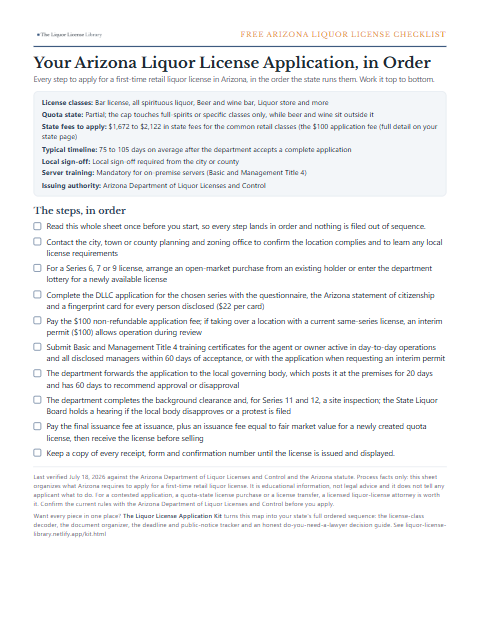
In Arizona, retail liquor licenses go through the Arizona Department of Liquor Licenses and Control. A first-time applicant files with the state directly. Arizona caps only its full-spirits or specific classes, while a beer or beer-and-wine class usually sits outside the cap. Work the page top to bottom and the whole path is visible before any single deadline is due.
On-premise servers must certify through the state's named training program within its window. Every owner, officer and significant investor clears a background check. A city or county sign-off is part of the path. Each piece has its own section below, with the official source beside it.
The parts an Arizona applicant most often misses are the public-notice window, which runs on the state's schedule rather than yours, which classes fall under the cap and which do not and the order of the steps, since several gate the ones after them. The sections below take them in order.
Which liquor license does an Arizona bar, restaurant or store need?
The retail license classes Arizona issues, what each covers and the venue each fits. Match your venue to the class before anything else.
| Class | Covers | Who it fits |
|---|---|---|
| Series 06 Bar license, all spirituous liquor | both, full spirits | Quota license for bars; on-sale of all spirituous liquor with off-sale allowed up to 30 percent of on-sale spirituous liquor sales; obtained by open-market purchase or the lottery; transferable within the county |
| Series 07 Beer and wine bar | both, beer and wine | Quota license for beer and wine bars; off-sale allowed up to 30 percent of on-sale sales; obtained by open-market purchase or the lottery; transferable within the county |
| Series 09 Liquor store | off-premise, full spirits | Quota license for package stores selling all spirituous liquor in the original sealed container; sampling privileges available by separate application; obtained by open-market purchase or the lottery; transferable within the county |
| Series 10 Beer and wine store | off-premise, beer and wine | Non-quota; issued on application; common first license for a convenience or grocery store; sampling privileges available by separate application |
| Series 11 Hotel-motel license | on-premise, full spirits | Non-quota; for a hotel or motel with a restaurant serving food on the premises; site inspection and records-for-audit form required |
| Series 12 Restaurant license | on-premise, full spirits | Non-quota; requires at least 40 percent of gross revenue from food sales with department audit exposure; site inspection and records-for-audit form required; not transferable |
Is Arizona a quota or control state?
Whether Arizona caps how many licenses exist, how a capped license is obtained and whether the state runs any part of retail itself. This is where the real cost of an Arizona license can hide.
| Item | Arizona rule |
|---|---|
| Quota state? | Partial, the cap touches some classes only |
| How the cap works | Only Series 6 bar, Series 7 beer and wine bar and Series 9 liquor store licenses are capped by county population. The department issues one new license of each type for each 10,000 person increase in a county's population, measured against a July 1, 2010 baseline using state Office of Economic Opportunity estimates each July 1. Restaurant, hotel-motel and beer and wine store licenses sit outside the quota. |
| New licenses issued by | When more people enter than licenses are available for a county and series, an independent accounting firm runs a public random drawing to set priority. Entries are filed in an announced window with a non-refundable fee per entry ($250 in the 2025 cycle) and each person may enter no more times than the number of licenses available. Winners pay an issuance fee equal to the license's fair market value. Where entries do not exceed supply, licenses go first come first served and unclaimed licenses become readily available at the current fair market value. |
| Buying an existing license | Series 6, 7 and 9 licenses trade privately through brokers and transfer person to person or to a new location within the same county with department approval ($100 application plus $300 issuance). The department publishes an appraisal-based fair market value by county and series each lottery cycle; in the 2025 cycle those posted values ranged from a low of $5,233 for a beer and wine bar license in Gila County to a high of $930,600 for a liquor store license in Maricopa County. A privately negotiated sale price can differ from the posted fair market value and is market-reported, not an official fee. |
| State control | No, private licensing throughout. Private license state; no state-run retail or wholesale |
How much does a liquor license cost in Arizona?
| Item | Arizona |
|---|---|
| State and local fees to apply | $1,672 to $2,122 in state fees for the common retail classes (the $100 application fee, $22 per fingerprint card and a full-year issuance fee of $1,550 to $2,000 by series), before local fees |
| Renewal | $120 to $585 per year by series, plus a $150 late fee when overdue |
| What drives the range | The series drives the range; a quota license (Series 6, 7 or 9) adds the private purchase price or the fair market value issuance fee on top of state fees; see the quota field |
The itemized fees a first-time Arizona applicant can expect from the state.
| Fee | Amount |
|---|---|
| Application fee (non-refundable) | $100 |
| Fingerprint card DPS fee | $22 per card, one per disclosed person |
| Issuance fee, Series 12 restaurant | $2,000 full year ($1,750 half year) |
| Issuance fee, Series 11 hotel-motel | $2,000 full year ($1,750 half year) |
| Issuance fee, Series 06 bar | $1,650 full year ($1,575 half year) |
| Issuance fee, Series 07 beer and wine bar | $1,575 full year ($1,537.50 half year) |
| Issuance fee, Series 09 liquor store and Series 10 beer and wine store | $1,550 full year ($1,525 half year) |
| Interim permit (existing licensed location only) | $100 |
| Person-to-person transfer (quota purchase path) | $100 application plus $300 issuance |
| Lottery entry fee | $250 per entry in the 2025 cycle (entry window July 14 to August 1, 2025, drawing August 27, 2025) |
| Fair market value issuance fee on a newly created quota license | varies by county and series; set from prior-year open-market sales or appraisal |
| Annual renewal by series | $120 (Series 9 and 10) to $585 (Series 12); late fee $150 |
| Local government fees | varies by city, town or county |
How long it takes. 75 to 105 days on average after the department accepts a complete application. A.R.S. 4-201 gives the State Liquor Board 105 days from filing to approve or deny. The local governing body has 60 days to recommend and the department waits 15 days after the recommendation before final review. Public or department protests and a local disapproval extend the process.
From the team behind this library
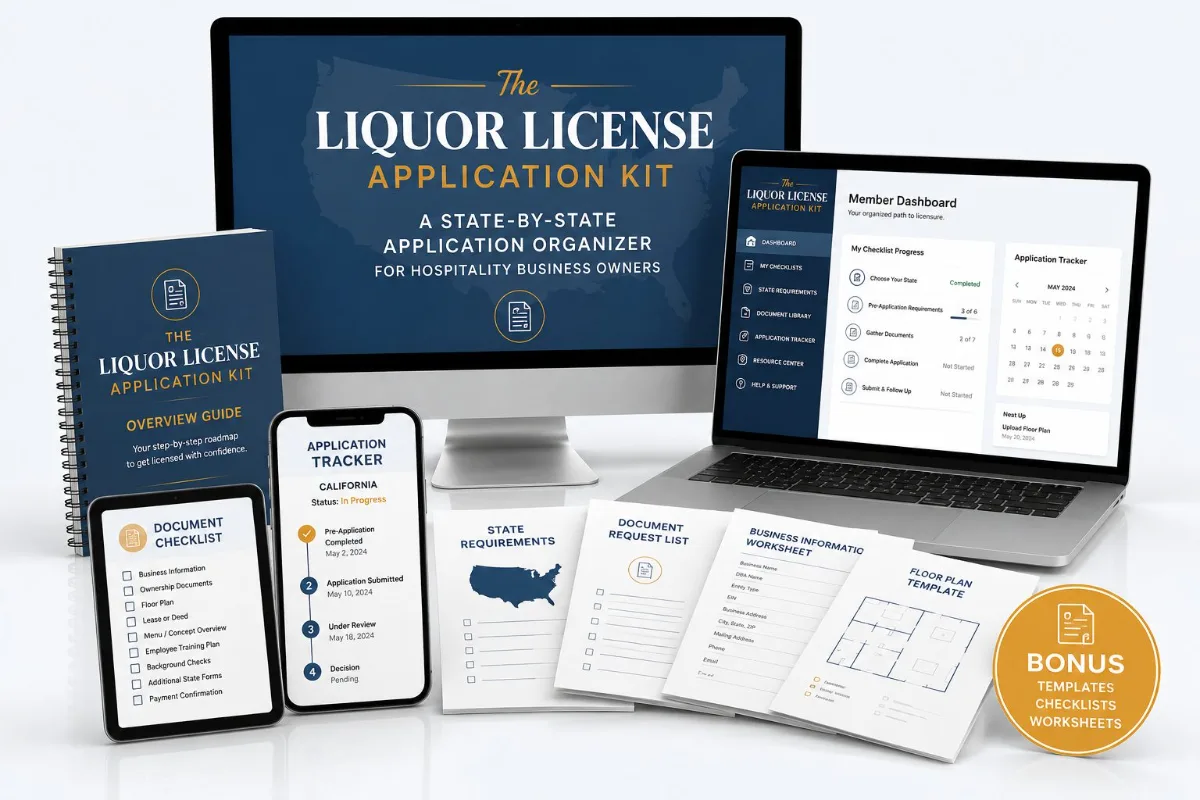
The Liquor License Application Kit
This page shows you the steps. The kit fills them in for Arizona. Your license class decoded, every document named and tracked, the deadline and public-notice windows dated and a straight answer on the one or two points that actually need a lawyer. The reference pages stay free. The kit is the evening of assembly you skip.
How to apply for a liquor license in Arizona, step by step
Several of these steps gate the ones after them, so the order matters as much as the list.
- Contact the city, town or county planning and zoning office to confirm the location complies and to learn any local license requirements
- For a Series 6, 7 or 9 license, arrange an open-market purchase from an existing holder or enter the department lottery for a newly available license
- Complete the DLLC application for the chosen series with the questionnaire, the Arizona statement of citizenship and a fingerprint card for every person disclosed ($22 per card)
- Pay the $100 non-refundable application fee; if taking over a location with a current same-series license, an interim permit ($100) allows operation during review
- Submit Basic and Management Title 4 training certificates for the agent or owner active in day-to-day operations and all disclosed managers within 60 days of acceptance, or with the application when requesting an interim permit
- The department forwards the application to the local governing body, which posts it at the premises for 20 days and has 60 days to recommend approval or disapproval
- The department completes the background clearance and, for Series 11 and 12, a site inspection; the State Liquor Board holds a hearing if the local body disapproves or a protest is filed
- Pay the final issuance fee at issuance, plus an issuance fee equal to fair market value for a newly created quota license, then receive the license before selling
Local approval and public notice in Arizona
The city or county layer on top of the state license, plus any notice you must post or publish. The public-notice window is often the shortest clock in the whole process.
| Item | Arizona rule |
|---|---|
| Local sign-off required? | Yes, a city or county sign-off is part of the path |
| What the local layer does | State-first filing with a mandatory local layer. The department remits the application to the city, town or county, which has 60 days to recommend approval or disapproval after considering zoning and community input. A local disapproval or no recommendation sends the decision to the State Liquor Board. Retail premises generally may not sit within 300 horizontal feet of a K-12 school building or its adjacent fenced recreational area, with exemptions for restaurant, hotel-motel, government and special event series and certain performing arts and golf locations. |
| Public notice | The local clerk posts a copy of the application in a conspicuous place on the front of the premises for 20 days; residents or property owners within one mile may file written arguments for or against |
| Worth knowing | Cities, towns and counties often charge their own license fees on top of state fees. Applicants are directed to verify local requirements before filing with the state. |
Server training in Arizona
Whether the people pouring or selling alcohol must certify through a state program, plus the deadline.
| Item | Arizona rule |
|---|---|
| Required for a first-time retailer? | Yes, mandatory for on-premise servers |
| Who must certify | The agent or owner actively involved in day-to-day operations and every manager disclosed to the department; Arizona law does not require every server or clerk to hold a certificate |
| State program | Basic and Management Title 4 (Arizona liquor law) training through department-approved providers under A.R.S. 4-112(G)(2) |
| Deadline | Within 60 days after the department accepts the application, or with the application when requesting an interim permit; certificates are valid for three years |
| Worth knowing | Basic certification is a prerequisite for the management course. Many licensees put line staff through approved courses voluntarily and some local jurisdictions layer their own expectations. |
Background check and renewal in Arizona
Background check
| Item | Arizona rule |
|---|---|
| Background check required? | Yes |
| Who is checked | Every person disclosed on a questionnaire submits a fingerprint card for state and FBI checks, including individual owners, general partners, corporate officers and 10 percent or greater stockholders, LLC managing members and 10 percent or greater members and all disclosed managers |
| Disqualifiers | A felony conviction within five years before application (in any state), a license revocation within one year and failure to make full financial disclosure. An individual applicant must be a US citizen or legal resident alien and a bona fide Arizona resident; the designated agent and managers must be US citizens and bona fide Arizona residents. |
| Worth knowing | Beyond the checklist items the director must find the applicant capable, qualified and reliable and, for retail licenses, that public convenience and the community's best interest support issuance under A.R.S. 4-203 |
Renewal
| Item | Arizona rule |
|---|---|
| Renewal cycle | annual |
| Worth knowing | Licenses expire annually with renewal fees set by series ($120 to $585 for common retail classes) and a $150 late fee. A license may renew for a two-year period when no compliance penalties were issued at the location during the year before renewal. |