How to Get a Liquor License in Alabama (2026): Cost, Classes and Steps
How do you get a liquor license in Alabama?
In Alabama, every retail alcohol license comes from the Alabama Alcoholic Beverage Control Board, the same agency that runs the state ABC liquor stores. A bar applies for a Lounge Retail Liquor license, a full-service restaurant for the Restaurant Retail Liquor license and a package store for the off-premises Lounge Class II license, with separate beer and table wine classes for venues that skip spirits. Alabama is a control state, not a quota state: no license cap exists but the city council or county commission must approve every retail application before the board can grant it.
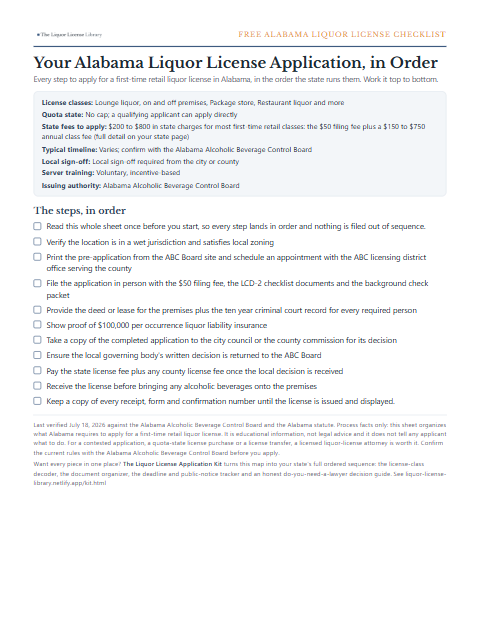
In Alabama, retail liquor licenses go through the Alabama Alcoholic Beverage Control Board. A first-time applicant files with the state directly. Alabama sets no cap on the number of retail licenses, so there is no slot to wait for and no existing license to buy out. Work the page top to bottom and the whole path is visible before any single deadline is due.
Alabama is a control state, so a private applicant cannot open a full-spirits package store; spirits move through state stores and the private retail license covers beer, wine or on-premise service. Server training is voluntary here, an incentive rather than a licensing condition. Every owner, officer and significant investor clears a background check. Each piece has its own section below, with the official source beside it.
The parts an Alabama applicant most often misses are the public-notice window, which runs on the state's schedule rather than yours and the order of the steps, since several gate the ones after them. The sections below take them in order.
Which liquor license does an Alabama bar, restaurant or store need?
The retail license classes Alabama issues, what each covers and the venue each fits. Match your venue to the class before anything else.
| Class | Covers | Who it fits |
|---|---|---|
| Lounge Retail Liquor Class I Lounge liquor, on and off premises | both, full spirits | The bar class. Sells beer, wine and spirits for on-premises consumption plus sealed original containers to go. No quota applies. $300 state fee. |
| Lounge Retail Liquor Class II Package store | off-premise, full spirits | Off-premises sales only in original unopened containers. Package store rules require at least 500 square feet of sales floor plus a liquor or wine inventory of at least $5,000 at wholesale cost from at least two distilleries and two wineries. $300 state fee. |
| Restaurant Retail Liquor Restaurant liquor | on-premise, full spirits | For locations habitually and principally used for preparing and serving meals with a fully equipped operational kitchen. The common first license for a full-service restaurant. License code 020. $300 state fee. |
| Retail Beer Retail beer, on or off premises | both, beer | Issued in an on-or-off-premises version and an off-premises-only version. Common for stores and casual venues. $150 state fee. |
| Retail Table Wine Retail table wine, on or off premises | both, table wine | Issued in an on-or-off-premises version and an off-premises-only version. Pairs with the beer class for a store or cafe that skips spirits. $150 state fee. |
| Club Liquor Class I and Class II Club liquor | on-premise, full spirits | Class I covers bona fide nonprofit member clubs at a $300 state fee. Class II covers other clubs at $750. Membership records and an annual member meeting are required. |
| Special Retail and Special Events Retail Short-term retail licenses | on-premise, full spirits | Special Retail runs $100 for 30 days or less or $250 for longer periods. Special Events Retail is $150 and issues only for a bona fide special event. |
Is Alabama a quota or control state?
Whether Alabama caps the number of licenses and whether the state runs any part of retail itself. Alabama sets no cap, though its control structure still shapes which license a private business can hold.
| Item | Alabama rule |
|---|---|
| Quota state? | No, there is no cap on the number of licenses |
| Buying an existing license | n/a. Alabama sets no cap on the number of retail licenses, so no private license market exists; a new applicant applies directly to the board. |
| State control | Yes, a control state. The ABC Board runs the state ABC retail liquor stores and is the control channel for spirits at wholesale. Private package stores operate under the Lounge Retail Liquor Class II license and source spirits through the board, subject to the 500 square foot floor and $5,000 minimum inventory rules. |
How much does a liquor license cost in Alabama?
| Item | Alabama |
|---|---|
| State and local fees to apply | $200 to $800 in state charges for most first-time retail classes: the $50 filing fee plus a $150 to $750 annual class fee, before city and county license taxes that vary by location |
| Renewal | $150 to $750 per year in state fees by class plus local license taxes; fees are not pro-rated |
| What drives the range | The class drives the range, not county population. Beer and wine classes sit at the bottom, the liquor classes at $300 and Club Class II at the top. Because Alabama has no quota there is no license purchase price on top of these fees. |
The itemized fees a first-time Alabama applicant can expect from the state.
| Fee | Amount |
|---|---|
| Filing fee, every original application | $50, nonrefundable |
| Lounge Retail Liquor Class I or Class II annual state fee | $300 |
| Restaurant Retail Liquor annual state fee | $300 |
| Retail Beer or Retail Table Wine annual state fee | $150 per class |
| Club Liquor annual state fee | $300 Class I, $750 Class II |
| County and municipal license taxes | varies by city and county |
| Late renewal penalty after October 20 | 50 percent of the state and county license and filing fees |
How long it takes. Varies. The board publishes no processing commitment. The sequence sets the clock: the district office appointment and background review, then the local governing body's decision on its own meeting calendar before the board can issue. Council agenda cycles and local hearings are the common extenders.
From the team behind this library
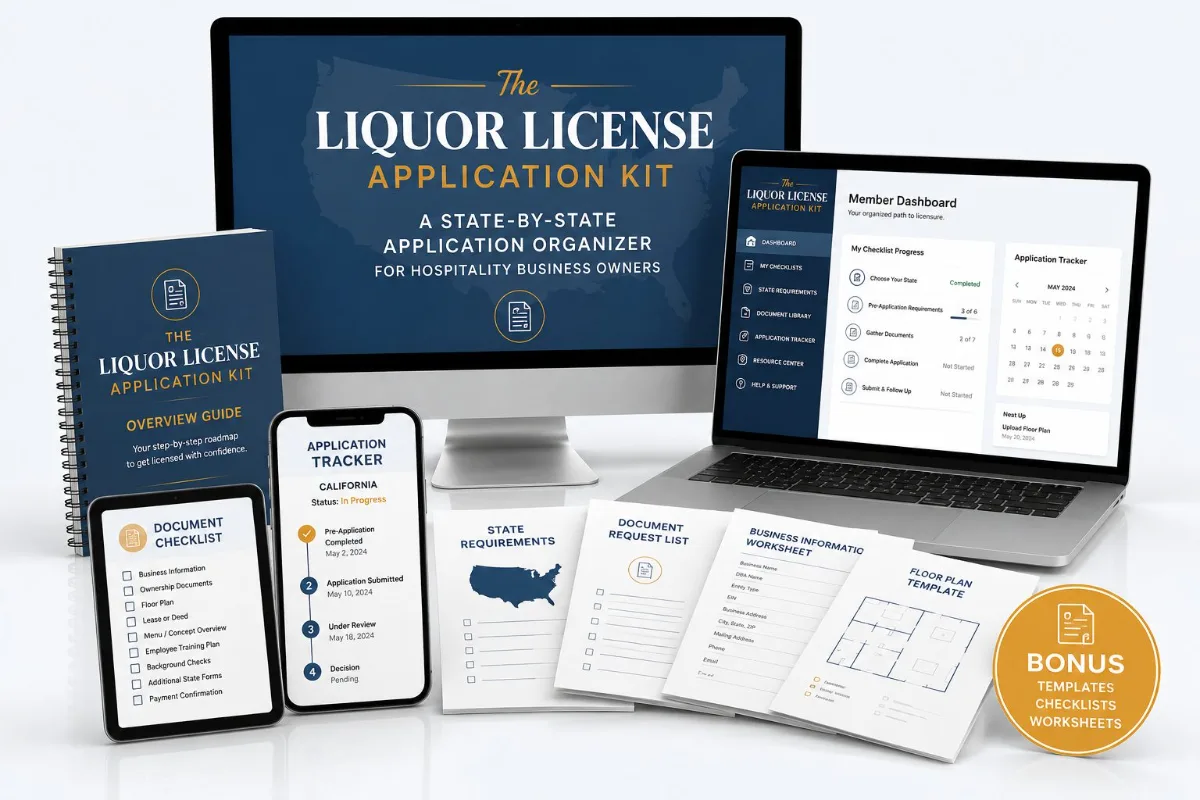
The Liquor License Application Kit
This page shows you the steps. The kit fills them in for Alabama. Your license class decoded, every document named and tracked, the deadline and public-notice windows dated and a straight answer on the one or two points that actually need a lawyer. The reference pages stay free. The kit is the evening of assembly you skip.
How to apply for a liquor license in Alabama, step by step
Several of these steps gate the ones after them, so the order matters as much as the list.
- Verify the location is in a wet jurisdiction and satisfies local zoning
- Print the pre-application from the ABC Board site and schedule an appointment with the ABC licensing district office serving the county
- File the application in person with the $50 filing fee, the LCD-2 checklist documents and the background check packet
- Provide the deed or lease for the premises plus the ten year criminal court record for every required person
- Show proof of $100,000 per occurrence liquor liability insurance
- Take a copy of the completed application to the city council or the county commission for its decision
- Ensure the local governing body's written decision is returned to the ABC Board
- Pay the state license fee plus any county license fee once the local decision is received
- Receive the license before bringing any alcoholic beverages onto the premises
Local approval and public notice in Alabama
The city or county layer on top of the state license, plus any notice you must post or publish. The public-notice window is often the shortest clock in the whole process.
| Item | Alabama rule |
|---|---|
| Local sign-off required? | Yes, a city or county sign-off is part of the path |
| What the local layer does | Under Ala. Code section 28-3A-23 each retail application must be approved by the governing authority of the municipality, or by the county commission for locations outside city limits, before the board has authority to grant the license. The statutory mandate reads that each retail liquor license application must be approved by the local governing body before the board shall have authority to grant the license. Zoning and any local distance practices apply through this layer. |
| Public notice | No statewide posting or newspaper requirement appears in the licensing code for a new retail application; notice and hearing practice belongs to the local approval layer and varies by city |
| Worth knowing | Alabama keeps a wet and dry local option system and the ABC Board maintains a wet cities list. Filing order is state first, local second: the application starts at the ABC district office, goes to the local body for its decision and returns to the board for issuance. Local governments also levy their own license taxes. |
Server training in Alabama
Whether the people pouring or selling alcohol must certify through a state program, plus the deadline.
| Item | Alabama rule |
|---|---|
| Required for a first-time retailer? | Voluntary, an incentive rather than a licensing condition |
| State program | Alabama Responsible Vendor Program, run by the ABC Board under the Responsible Vendor Act |
| Worth knowing | Certification is optional but carries a concrete perk: certified holders of a restaurant retail liquor license and certain other classes may employ servers aged 18 to 20 under Ala. Code section 28-1-5, where the default rule requires servers who dispense alcohol to be 21. Separately, drivers under a Delivery Service license must complete a board-approved training program and re-certify every 24 months. |
Background check and renewal in Alabama
Background check
| Item | Alabama rule |
|---|---|
| Background check required? | Yes |
| Who is checked | The application discloses every person with a proprietary or profit interest and requires a ten year criminal court record for the applicant, for anyone with more than a 10 percent interest and for each officer or director of a corporate applicant. DUI and reckless driving must be disclosed while minor traffic offenses may be omitted. The board runs its own criminal background analysis and treats a check generated within two years as current. |
| Disqualifiers | The licensing chapter publishes no fixed felony lookback for retail licenses. The board holds broad discretion to grant or deny, restaurant liquor licenses issue only to reputable persons and false or incomplete answers are independent grounds for denial or revocation. |
| Worth knowing | A background check application packet is part of the filing. Fingerprint mechanics are not spelled out on the board's public pages. Owners must also show evidence of the source of funds on request and licensees accept warrantless inspection of the licensed premises as a condition of the license. |
Renewal
| Item | Alabama rule |
|---|---|
| Renewal cycle | annual |
| Worth knowing | Every license runs the October 1 to September 30 license year and expires September 30. Under Ala. Code section 28-3A-5 a renewal application must be filed, with the appropriate license fees, at least 60 days before the September 30 expiration, which puts the statutory renewal deadline on or about August 1. The renewal then becomes delinquent if the license is not secured by October 20, after which a 50 percent penalty on the state and county license and filing fees is collected at issuance. A license never renewed by the following September 30 terminates with no renewal privilege and the business must start over with a new application. Fees are not pro-rated and proof of current dram shop insurance is required at every renewal. The online renewal portal opens ahead of the deadline and the precise portal-open date is set by board rule. |