How to Get a Liquor License in South Dakota (2026): Cost, Classes and Steps
How do you get a liquor license in South Dakota?
In South Dakota, retail liquor licenses are approved first by the city or county where the business sits and then licensed at the state level by the Department of Revenue. On-sale licenses (bars and restaurants selling for consumption on site) and off-sale licenses (package and liquor stores) are both capped by a population formula the local governing body applies each year, while a malt beverage and South Dakota farm-winery wine retailer license and a few other classes sit outside that numeric cap. A first-time applicant files locally, passes a published public hearing and a suitability review and then receives the state license.
In South Dakota, retail liquor licenses go through the South Dakota Department of Revenue. A first-time applicant files locally, because the city or county is the issuing authority here. South Dakota caps only its full-spirits or specific classes, while a beer or beer-and-wine class usually sits outside the cap. Work the page top to bottom and the whole path is visible before any single deadline is due.
South Dakota runs a partial control system, handling some spirits wholesale or retail itself while private retailers hold the on-premise and off-premise licenses. Server training is required for some classes or roles. Every owner, officer and significant investor clears a background check. Each piece has its own section below, with the official source beside it.
The parts a South Dakota applicant most often misses are the public-notice window, which runs on the state's schedule rather than yours, which classes fall under the cap and which do not and the order of the steps, since several gate the ones after them. The sections below take them in order.
Which liquor license does a South Dakota bar, restaurant or store need?
The retail license classes South Dakota issues, what each covers and the venue each fits. Match your venue to the class before anything else.
| Class | Covers | Who it fits |
|---|---|---|
| Class 4 (On-Sale) On-sale license | on-premise, full spirits | Covers a bar or restaurant selling alcoholic beverages, including beer, wine and spirits, for consumption on the premises. Numerically capped by municipal or county population under SDCL 35-4-11 and 35-4-11.1. |
| Class 3 (Off-Sale) Off-sale (package) license | off-premise, full spirits | Covers a liquor store or package retailer. Available only in an incorporated city, town, community improvement district or county. Numerically capped by population under SDCL 35-4-10 and 35-4-11.1. |
| Malt Beverage & South Dakota Wine Retailer Malt beverage and South Dakota wine retailer license | both, malt beverages and South Dakota farm-winery wine | A lower-barrier, non-quota license fitting a small restaurant, taproom or grocery-type retailer that does not need a full bar. Its scope is narrow: SDCL 35-4-2(16) reaches malt beverages plus wine produced by a South Dakota farm winery licensee, so it does not authorise ordinary wine. General wine sits in the separate $500 wine and cider retailer class under SDCL 35-4-2(12). Fee paid to the local governing body. |
| Class 12 (Wine and Cider Retailer) Wine and cider retailer license | both, wine and cider | A non-quota retail license for wine and cider, operating as both a package (off-sale) and on-sale dealer of wine and cider under SDCL 35-4-2(12), for a fixed five hundred dollar fee. It sits outside the population cap. A licensee may hold it alongside other retail license types at the same premises under SDCL 35-4-2.8. SDCL 35-4-2.4 separately makes a municipality that holds an off-sale license eligible for this class. |
Is South Dakota a quota or control state?
Whether South Dakota caps how many licenses exist, how a capped license is obtained and whether the state runs any part of retail itself. This is where the real cost of a South Dakota license can hide.
| Item | South Dakota rule |
|---|---|
| Quota state? | Partial, the cap touches some classes only |
| How the cap works | On-sale and off-sale licenses are capped by population: no more than three licenses for the first 1,000 residents (or fraction), plus one additional license for each additional 1,500 residents (or fraction), set annually by resolution or ordinance of the municipality (SDCL 35-4-11) or the county for unincorporated areas (SDCL 35-4-11.1). A 1981 grandfather floor keeps existing licenses from being denied reissuance solely for exceeding a later population-based limit. County off-sale licenses may not be located within three miles of an incorporated municipality's boundary. |
| New licenses issued by | State law sets the numeric cap but does not mandate a single allocation method for awarding scarce quota licenses; each local governing body decides how to award them within that cap. Some cities have historically used a lottery. Sioux Falls replaced its on-sale license lottery with a competitive sealed-bid sale starting in 2023, a city-level choice rather than a statewide mandate. There is no statewide lottery cadence. |
| Buying an existing license | Existing on-sale and off-sale quota licenses transfer privately with local governing body and Department of Revenue approval. In Sioux Falls, market-reported prices for an on-sale license have run from a $240,646 city minimum bid (2025) to a $450,001 winning bid (2024), reflecting scarcity once a municipality's quota is full; these are city-specific, market-reported figures and not an official statewide fee. |
| State control | Partial control. South Dakota is a private-license state overall. There is no state-run store system and no state monopoly on wholesale or retail alcohol sales. A municipality may itself hold an off-sale license under SDCL 35-4-2(5) and either operate a municipal liquor store directly or contract the operation out through an operating agreement with a private operator. This is a local option each municipality chooses on its own and does not apply to the standard private Class 3 off-sale or Class 4 on-sale path most first-time retail applicants use. |
How much does a liquor license cost in South Dakota?
| Item | South Dakota |
|---|---|
| State and local fees to apply | $150 to $500 in fixed statutory local fees for a non-quota class such as malt beverage and wine retailer ($300), wine and cider retailer ($500) or off-sale delivery ($150). For a quota-capped on-sale or off-sale class, the statutory floor is $1 per municipal resident, so the price of a newly available on-sale license in a populous city can run into six figures before any local bidding is added; see the quota field for how that plays out in practice. |
| Renewal | $150 to $500 for most non-quota and off-sale classes; on-sale renewal is capped by statute at $1,500 regardless of city size |
| What drives the range | Class and municipal or county population drive the range. Where a quota class is full, the effective cost of obtaining a license is set by local competitive allocation or a private secondary-market purchase rather than the statutory minimum fee. |
The itemized fees a first-time South Dakota applicant can expect from the state.
| Fee | Amount |
|---|---|
| Off-sale (package) license, initial local fee | not less than $300 (local governing body sets the exact fee at or above this floor) |
| Off-sale (package) license, renewal | may not exceed $500 |
| On-sale license, initial local fee | not less than $1 for each person residing in the municipality by the last federal census (local governing body sets the exact fee at or above this floor) |
| On-sale license, renewal | may not exceed $1,500 |
| Malt beverage and South Dakota farm-winery wine retailer license | $300 |
| Wine and cider retailer license (Class 12) | $500 (fixed; the statute sets a flat five hundred dollar fee, not a floor) |
| Off-sale delivery license (Class 23) | $150 |
| Sioux Falls on-sale license (city example, not a statewide figure) | $240,646 minimum sealed-bid price in 2025; competitive bids have reached $450,001 in 2024 |
How long it takes. Varies. The Department of Revenue does not publish a fixed statewide processing-day commitment. The public hearing notice must be published at least one week before the hearing (SDCL 35-2-5), which sets a practical floor. Total time depends on the local governing body's meeting calendar, whether the class is capped (a local sealed-bid or lottery process for an available slot adds time) and the pace of the Department of Revenue's state-level review after local approval.
From the team behind this library
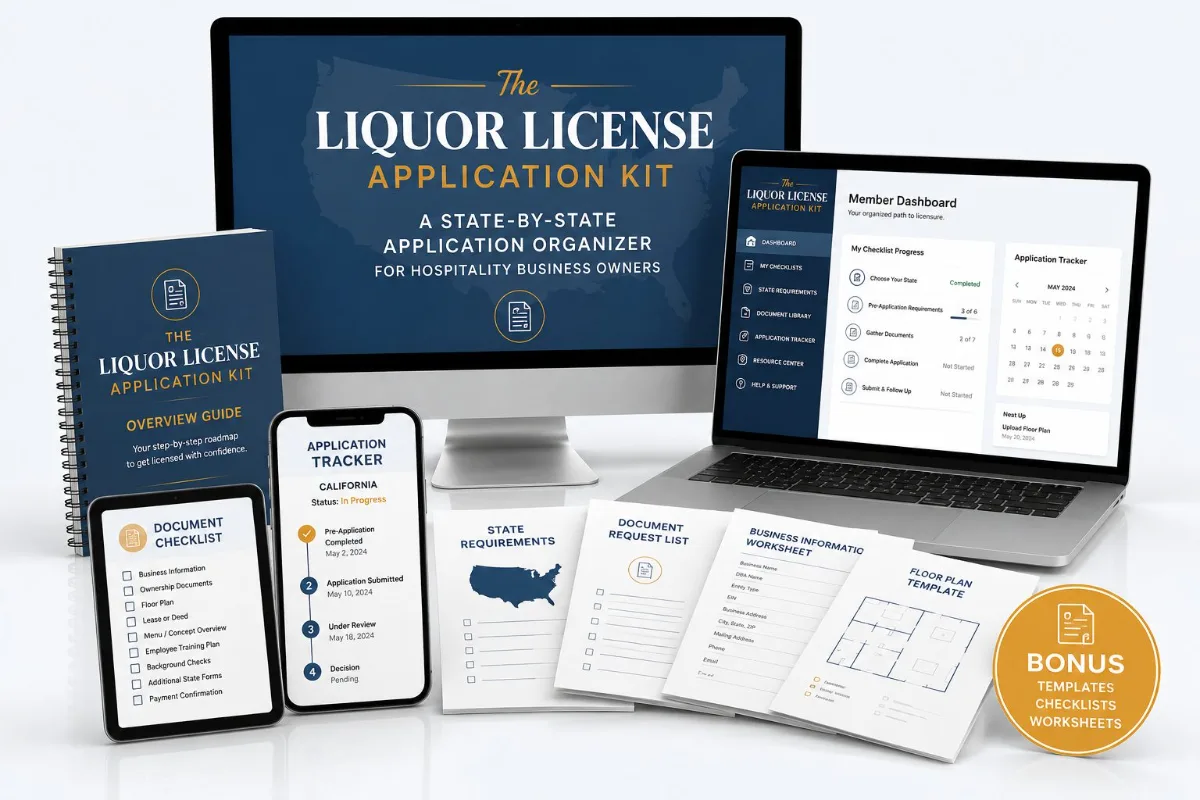
The Liquor License Application Kit
This page shows you the steps. The kit fills them in for South Dakota. Your license class decoded, every document named and tracked, the deadline and public-notice windows dated and a straight answer on the one or two points that actually need a lawyer. The reference pages stay free. The kit is the evening of assembly you skip.
How to apply for a liquor license in South Dakota, step by step
Several of these steps gate the ones after them, so the order matters as much as the list.
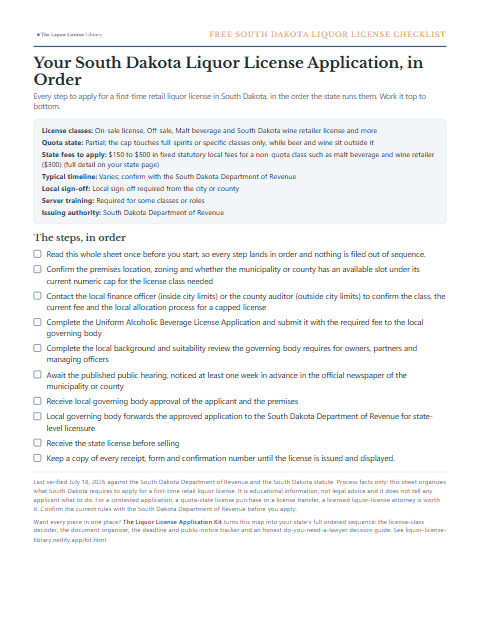
- Confirm the premises location, zoning and whether the municipality or county has an available slot under its current numeric cap for the license class needed
- Contact the local finance officer (inside city limits) or the county auditor (outside city limits) to confirm the class, the current fee and the local allocation process for a capped license
- Complete the Uniform Alcoholic Beverage License Application and submit it with the required fee to the local governing body
- Complete the local background and suitability review the governing body requires for owners, partners and managing officers
- Await the published public hearing, noticed at least one week in advance in the official newspaper of the municipality or county
- Receive local governing body approval of the applicant and the premises
- Local governing body forwards the approved application to the South Dakota Department of Revenue for state-level licensure
- Receive the state license before selling
Local approval and public notice in South Dakota
The city or county layer on top of the state license, plus any notice you must post or publish. The public-notice window is often the shortest clock in the whole process.
| Item | South Dakota rule |
|---|---|
| Local sign-off required? | Yes, a city or county sign-off is part of the path |
| What the local layer does | The municipal governing body, acting through the finance officer inside city limits, or the county commission, acting through the county auditor outside city limits, sets the number of licenses, sets the fee within the statutory floor and approves or disapproves each applicant and premises for suitability under SDCL 35-2-1.2. A capped license also requires the governing body's own allocation method, such as a sealed-bid sale, when demand exceeds the numeric cap. |
| Public notice | A hearing notice headed 'Notice of Hearing Upon Applications for Sale of Alcoholic Beverages' is published once in the official newspaper of the municipality or county at least one week before the hearing (SDCL 35-2-5). A resident may also file a written request for individual mailed notice of a specific application's hearing (SDCL 35-2-4). |
| Worth knowing | Renewal applications skip the hearing unless the licensee had a criminal penalty for an alcohol-law violation or a license suspension in the past year (SDCL 35-2-1.2). No single licensee may hold more than one-third of a jurisdiction's available licenses if the governing body finds that concentration against the public interest. |
Server training in South Dakota
Whether the people pouring or selling alcohol must certify through a state program, plus the deadline.
| Item | South Dakota rule |
|---|---|
| Required for a first-time retailer? | Required for some classes, roles or local mandates |
| Who must certify | Not required statewide for an adult (21 and over) server or seller. A bartender aged 18 to 20 must complete a nationally recognized alcohol server management program before tending bar, under SDCL 35-4-79.4. |
| State program | No single state-run program. The state accepts certification from a nationally recognized alcohol server training or management program for the 18-to-20 bartender exception. Voluntary responsible-server training elsewhere in the state can cut in half the civil penalty for a first or second clerk sale to a minor within a 24-month period. |
| Deadline | Before an employee aged 18 to 20 tends bar; not applicable to other servers. |
| Worth knowing | A local licensee or an insurer may require training as a condition of employment even though the state does not mandate it broadly for adult servers. |
Background check and renewal in South Dakota
Background check
| Item | South Dakota rule |
|---|---|
| Background check required? | Yes |
| Who is checked | Owners, partners and managing corporate officers must be of good moral character and never convicted of a felony (SDCL 35-2-6.2). The local governing body determines applicant and premises suitability under SDCL 35-2-1.2 and in practice commonly arranges a background check, including fingerprinting through local law enforcement or the state Division of Criminal Investigation, as part of that review. |
| Disqualifiers | A felony conviction disqualifies an applicant, or a corporation's managing officers, outright under SDCL 35-2-6.2. Some local ordinances add crimes of violence, sex offenses, drug trafficking or other moral-turpitude convictions as case-by-case disqualifiers. |
| Worth knowing | The fingerprinting method and any associated fee are set locally rather than by one uniform statewide Department of Revenue fee schedule |
Renewal
| Item | South Dakota rule |
|---|---|
| Renewal cycle | annual |
| Worth knowing | Most retail licenses run from midnight December 31 to midnight the next December 31, with a three-day grace period if the renewal application is filed before December 31 (SDCL 35-4-41). Manufacturer licenses and farm winery licenses under subdivision 35-4-2(16) instead run midnight June 30 to midnight the next June 30. Renewal is normally approved without a new public hearing unless the licensee had a violation or suspension within the past year. |