Beer and Wine License vs Full Liquor License (2026)
The cheaper class is not a lesser version of the same thing. In a capped state it is often the only class you can actually get.
A beer-and-wine license covers fermented drinks. A full-spirits license adds distilled liquor. The fee gap between them is usually modest. It is almost never the reason the choice matters. The reason it matters is structural: in most capped states the quota falls on the spirits class while beer and wine sits outside it, so the two classes can differ not by a few hundred dollars but by whether a license is available to you at all.
This page sets the two classes side by side on the things that actually differ: what each one lets you sell, what the state charges, whether the class is capped and what you give up by starting with the cheaper one. Montana and West Virginia get their own sections because they are the two clearest illustrations of the point, in opposite directions.
What each class covers
- Beer and wine. Beer and wine, plus cider in most states. No distilled spirits, which means no cocktails. States name it many ways: a limited on-premises license in Oregon, a Type 41 on-sale beer and wine eating place in California, a restaurant wine license in New York, a city beer and wine license in Montana, a 2COP in Florida.
- Full spirits. Beer, wine and liquor. Named a full on-premises license in Oregon, an on-sale general Type 47 or 48 in California, an on-premises liquor license in New York, an all-beverages license in Montana, a 4COP in Florida.
- The off-premises versions of both. The same split runs on the store side: a beer-and-wine store class against a packaged-spirits class. In the control states the packaged-spirits half of that split does not exist for a private business at all, which the control states guide covers.
Every state names these classes differently and writes the boundary between them in its own words. Find your state in the directory for its class names, which of them are capped and what each one costs.
The fee gap, in real numbers
State fees for the two classes in five states, each figure from that state's own schedule or statute and stated in full on its state page.
| State | Beer and wine against full spirits |
|---|---|
| Oregon | Limited on-premises sales at $400 a year against full on-premises sales at $800 a year. An off-premises sales license, which covers packaged beer, wine and cider but not spirits, is $200. Neither class is capped by a population quota. |
| California | The widest gap in the country. The drawing rather than the paperwork is what opens it. A non-general class such as Type 20, 40, 41 or 42 carries an application fee of about $1,135. A general class such as Type 21, 47 or 48 obtained through the priority drawing carries an application fee near $19,840. Annual fees are far closer: $565 for a Type 41 against $985 to $1,545 for a Type 47 or 48. |
| New York | A restaurant wine license runs $960 for a full two-year term in the New York City counties and $480 elsewhere. An on-premises liquor license for the same term runs $4,352 in Manhattan, Brooklyn, the Bronx and Queens, down to $1,792 in the rest of the state. The filing fee also differs: $100 for the wine and beer classes, $200 for the liquor classes. |
| West Virginia | A nonintoxicating beer retail dealer license is $150 a year and a wine retailer license is $150 a year. The off-premise retail liquor license is $2,000 a year plus a $100 operational fee. It runs through an entirely separate system described below. |
| Montana | Almost no gap in the fee at all: a city beer and wine license is $400 while an all-beverages license runs $400 to $800 a year by city population. The real difference in Montana is not the fee, it is the auction. |
Three rows carry a condition. In West Virginia beer and wine are two separate licenses at $150 a year each and the spirits figure adds a $100 operational fee. The New York pair is the full two-year term in the New York City counties and the same licenses cost less elsewhere in the state. In Montana the two annual fees nearly overlap, because what separates the classes there is the competitive bid rather than the fee. A published winning bid is a transaction price rather than a state fee, so no auction figure is plotted here. All three are stated in full, with their sources, in the table above.
Montana, where the fee is trivial and the license is not
Montana is the clearest case in the country of a state where reading the fee schedule tells you almost nothing. Both the all-beverages class and the city beer and wine class are capped by a population quota. When a new one becomes available the Department of Revenue runs a competitive bidding process rather than a lottery, with a minimum bid set at 75 percent of the department's assessment of market value for comparable licenses in that quota area.
What makes Montana unusually useful is that the department publishes the results. Its own competitive bid page lists awarded bids: a beer and wine license in Belgrade with a $205,500 minimum that closed at $315,000, a beer and wine license in Bozeman with a $165,000 minimum that closed at $365,000, a restaurant beer and wine license in Ennis with a $22,375 minimum that closed at $38,333 and a beer and wine license in Clyde Park with a $14,500 minimum that closed at $20,550. These are published state auction results rather than broker estimates, which is rare. They show something worth absorbing: in a tight Montana market even the beer-and-wine class carries a six-figure entry price, so "start with beer and wine" is not automatically the cheap route everywhere.
Montana does keep one genuinely uncapped retail class. An off-premises beer and table wine retail sales license, the grocery and bottle-shop class, sits outside the quota entirely. Spirits do not: off-premise spirits retail runs only through the state's separate agency liquor store franchise system, awarded by a competitive procurement rather than by filing a license application.
Put your own state's application in order
From the team behind this library
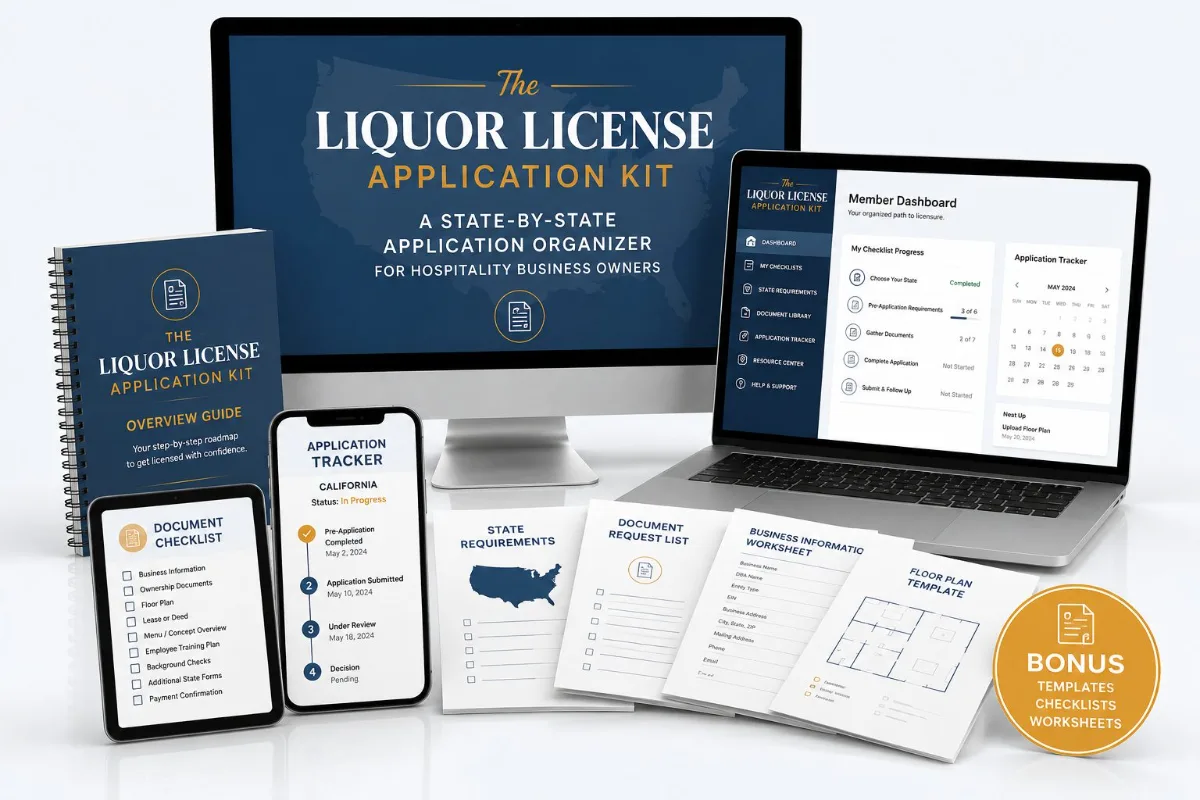
The Liquor License Application Kit
Want the whole path in one place? The Liquor License Application Kit hands you the done pieces for your state: the 51-jurisdiction directory and state selector, the license-class decoder, the dependency-ordered filing checklist, the document-gathering organizer, the deadline and public-notice tracker and an honest do-you-need-a-lawyer decision guide.
West Virginia, where they are two different systems rather than two tiers
West Virginia shows the other shape the split can take. Beer and wine are ordinary retail licenses: a nonintoxicating beer retail dealer license at $150 a year under the beer chapter of the code, a wine retailer license at $150 a year under the wine article. Neither is capped, neither goes through an auction and a business that sells only beer or only wine, or both, never touches the state's liquor system at all.
Spirits are a different animal. West Virginia privatised retail liquor sales in 1990 but kept the structure of a control state around them, so a store that sells distilled spirits holds a Class A or Class B retail liquor license under a separate article of the code, organised into market zones, carrying its own $2,000 annual fee plus a $100 operational fee, awarded through sealed competitive bidding for ten-year terms. The current term runs to 30 June 2030. On the on-premise side, a bar or restaurant serving liquor by the drink goes the private club route instead, which requires a bona fide club of at least 100 members, a kitchen, mandatory food service and a $5,000 surety bond. A wine-only restaurant license is the lighter alternative.
The practical read is that in West Virginia the beer-and-wine decision is not a budget decision at all. It decides which licensing system you are in.
Where the split decides whether you can open at all
Across the country the pattern repeats: the cap lands on spirits. In California the county quota reaches general licenses only, so a Type 41 beer-and-wine eating place can be applied for directly while a Type 47 in a full county goes through the annual priority drawing or a private purchase. In Florida the 4COP quota series is capped at one per 7,500 county residents while the 1COP, 2COP, 1APS and 2APS beer and wine classes sit outside it entirely. In New Jersey the consumption quota runs at roughly one license per 3,000 residents, which is why so many New Jersey restaurants operate without alcohol at all. In Utah every on-premise class is capped, including the beer-only ones, just by different divisors.
Read your own state page for whether your target class is capped before you plan a beer-and-wine opening with spirits added later. In an uncapped state that upgrade really is a fresh application. In a capped one it can mean buying a license at whatever the local market asks, which the quota states guide covers in full.
What you actually give up
Three things. Each is worth naming plainly. Cocktails, which for some concepts is the whole business and for others is a rounding error. The spirits margin, which is generally the highest-margin category behind a bar. And, in a capped state, the option value of the license itself, because an existing full-spirits license is an asset that can be sold while a beer-and-wine class in an uncapped state usually is not. Against that sits the reason most first venues start here anyway: a class that is available now, at a fee you can pay this month, beats a class that is not available at any price in your county.
Find your state
Open your state page for its exact class names, the fee for each, whether the beer-and-wine class sits inside or outside the quota and what the spirits class actually requires.
This guide is educational information, not legal advice and it does not tell any applicant which class to apply for. Fees and quota rules are set state by state and change; confirm the current schedule with your state before you rely on any figure here. The Montana auction results are published state bid outcomes rather than a fee schedule. They describe past auctions rather than what any future license will cost.
Beer and wine license FAQ
What is the difference between a beer and wine license and a full liquor license?
A beer-and-wine class covers fermented drinks, beer and wine and usually cider, but not distilled spirits. A full-spirits class, often called a general or all-beverage license, adds liquor. Two things separate them in practice. The state fee for the spirits class is usually higher, sometimes dramatically. And in a capped state the quota almost always falls on the spirits class while the beer-and-wine class sits outside it or under a looser cap of its own, which is what really decides whether you can open this year.
Is a beer and wine license cheaper?
Usually yes, though the size of the gap varies enormously. In Oregon a limited on-premises license runs $400 a year against $800 for full on-premises. In California the gap is the extreme case: about $1,135 in application fees for a beer-and-wine class against roughly $19,840 for a general license obtained through the priority drawing. In Montana the annual fees are almost the same, so the money difference is not in the fee at all, it is in what the license itself trades for.
Can you serve cocktails with a beer and wine license?
No. A beer-and-wine class covers fermented drinks only, so cocktails made with distilled spirits are outside it. Some states allow low-alcohol or wine-based products that read like cocktails. The boundary is written differently in each state, so check your own state page rather than assume. If cocktails are central to the concept, the full-spirits class is the one you need and the quota question comes with it.
Should I start with a beer and wine license?
That is a business decision rather than something this library can answer for you, but the factual position is worth knowing. Many first restaurants open on a beer-and-wine class because it is the class that is available and affordable, then look at spirits later. The honest caution is that in a quota state, adding spirits later is not a form: it can mean buying a capped license at market price. Read your state page for whether your target class is capped before you plan around a later upgrade.