How to Get a Liquor License in New Mexico (2026): Cost, Classes and Steps
How do you get a liquor license in New Mexico?
In New Mexico, retail liquor licenses are issued by the Alcoholic Beverage Control Division of the Regulation and Licensing Department. A package store or a full bar needs a retailer's or dispenser's license. Both are capped by a strict statewide population quota that leaves little to no room for a brand-new license in most cities and counties. A restaurant can instead get a non-quota restaurant A license for beer and wine or a restaurant B license for beer, wine and spirits, subject to a food-revenue rule and a per-visit spirits limit.
New Mexico runs its retail liquor licensing through the Alcoholic Beverage Control Division, New Mexico Regulation and Licensing Department. The application is filed with the state. New Mexico caps the number of retail licenses, so a first-time applicant often buys an existing license and transfers it rather than obtaining a brand-new one. The page below lays the pieces out in the order the state runs them.
On-premise servers must certify through the state's named training program within its window. Every owner, officer and significant investor clears a background check. A city or county sign-off is part of the path. Each piece has its own section below, with the official source beside it.
The NM-PLUS portal rollout took effect August 1, 2024. New Mexico moved all license applications onto its NM-PLUS online portal and stopped accepting paper filings. This page reflects the rule in force today; the full history sits in the law-updates log.

Which liquor license does a New Mexico bar, restaurant or store need?
The retail license classes New Mexico issues, what each covers and the venue each fits. Match your venue to the class before anything else.
| Class | Covers | Who it fits |
|---|---|---|
| Dispenser's license Full liquor, on-premise and off-premise | both, full spirits | Quota class under the population cap; sells by the drink and in sealed packages. New issuance is rare where a district is already at its cap; most first-time applicants buy or lease an existing one. |
| Retailer's license Package store | off-premise, full spirits | Quota class under the same population cap as the dispenser's license; sells sealed packages only, not for on-site consumption. |
| Restaurant A license Restaurant, beer and wine | on-premise, beer and wine | Non-quota. Requires a current food service permit and at least 60 percent of gross receipts from food; sales stop when food service ends or at 11pm, whichever is earlier. |
| Restaurant B license Restaurant, full spirits | on-premise, full spirits | Non-quota. Same food-revenue and hours rule as restaurant A, plus a limit of three 1.5-ounce spirits drinks per patron per visit; available by default in a local option district unless that district's governing body adopted an opt-out ordinance. |
| Club license Private club license | on-premise, full spirits | Non-quota; for a qualifying membership club, not transferable to a new owner and not for a general public retail business. |
Is New Mexico a quota or control state?
Whether New Mexico caps how many licenses exist, how a capped license is obtained and whether the state runs any part of retail itself. This is where the real cost of a New Mexico license can hide.
| Item | New Mexico rule |
|---|---|
| Quota state? | Yes, the number of licenses is capped |
| How the cap works | By NMSA 1978 60-6A-18, each local option district (an incorporated municipality, or the unincorporated area of a county) is capped at one dispenser's license or one retailer's license for every 2,000 inhabitants or major fraction thereof, based on population estimates from the state economic development department. An existing licensee may keep renewing above the cap; the cap only limits new issuance. |
| New licenses issued by | When more applicants seek a new license than the district's cap allows, the director runs a random selection process under 60-6B-2(H) through (J): up to ten applicants per open license are drawn in random priority order and each gets a qualification hearing in that order until the opening is filled. |
| Buying an existing license | Because most populated local option districts are already at or near their statutory cap, a first-time applicant for full spirits typically buys or leases an existing dispenser's or retailer's license from a current holder, subject to the division's approval. Market-reported prices for these licenses commonly range from the low hundreds of thousands of dollars into the $500,000-plus range in higher-demand counties; this is a privately negotiated market price, not an official state fee. |
| State control | No, private licensing throughout. New Mexico is a license state, not a control state. Alcohol is sold through private wholesalers and retailers; there is no state-run store system for spirits. |
How much does a liquor license cost in New Mexico?
| Item | New Mexico |
|---|---|
| State and local fees to apply | roughly $1,250 to $10,200 in state application and first-year license fees depending on class, plus fingerprint-vendor and local newspaper publication costs the state does not itemize; a dispenser's or retailer's license also requires buying or leasing an existing license on the private market since new quota licenses are almost never available, see the quota field |
| Renewal | $1,050 to $10,000 per year by class, unchanged from the initial license fee |
| What drives the range | Restaurant B is the highest annual fee by far because it is the state's non-quota route to full spirits. A temporary fee waiver currently applies to some legacy license holders; see the notes field for the sunset dates. |
The itemized fees a first-time New Mexico applicant can expect from the state.
| Fee | Amount |
|---|---|
| Application fee, new license | $200 nonrefundable |
| Retailer's license, annual | $1,300 |
| Dispenser's license, annual | $1,300 |
| Restaurant A license, annual | $1,050 |
| Restaurant B license, annual | $10,000 |
| Club license, annual | $250 (250 members or fewer) to $1,250 (more than 250 members) |
| Restaurant A New Mexico spirituous liquors permit (add limited craft-distiller spirits to an existing restaurant A) | $500 |
How long it takes. Roughly 90 to 180 days after a complete application. The statutory floor already runs several months: the department must hold its own public hearing within 30 days of a complete application, the notice sign must be posted for 20 continuous days before preliminary approval. The local governing body then has 45 days after preliminary-approval notice to hold its hearing plus 30 more days to decide. A contested local hearing, an incomplete fingerprint packet or a quota random-selection process extends this further. The division does not publish a single official processing-time guarantee.
From the team behind this library
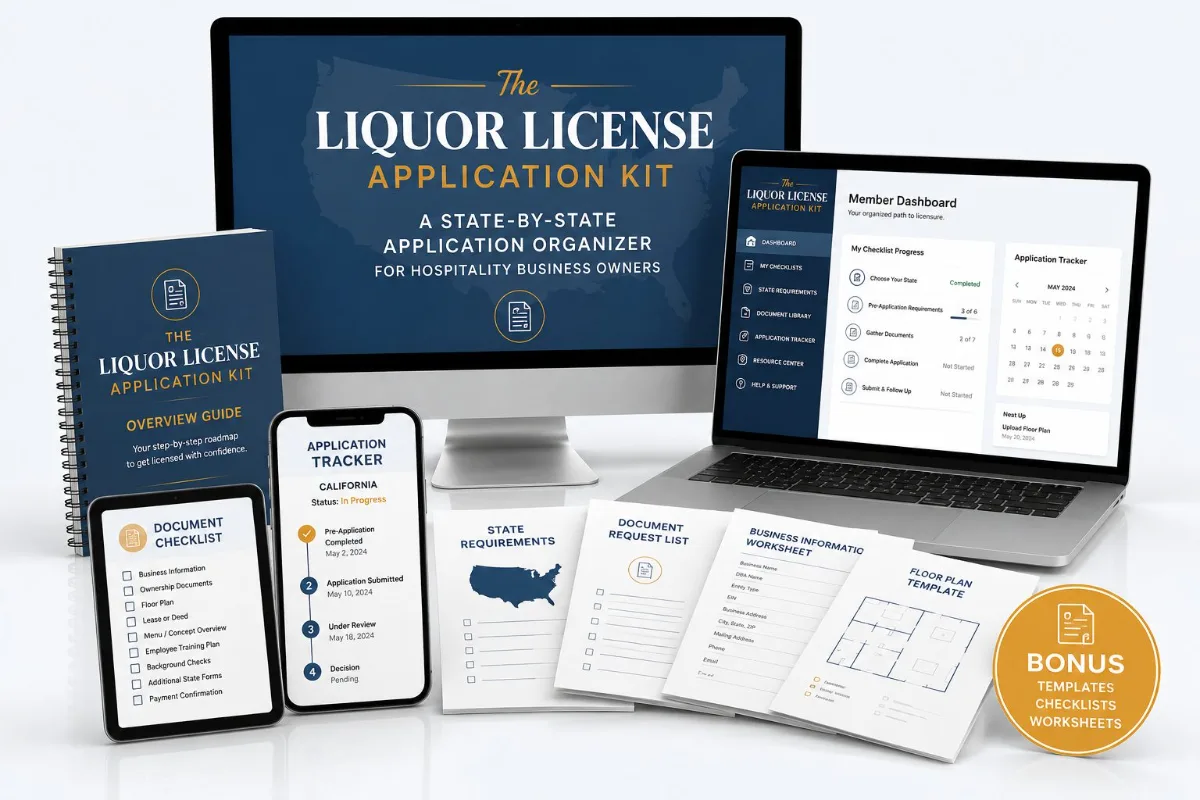
The Liquor License Application Kit
This page shows you the steps. The kit fills them in for New Mexico. Your license class decoded, every document named and tracked, the deadline and public-notice windows dated and a straight answer on the one or two points that actually need a lawyer. The reference pages stay free. The kit is the evening of assembly you skip.
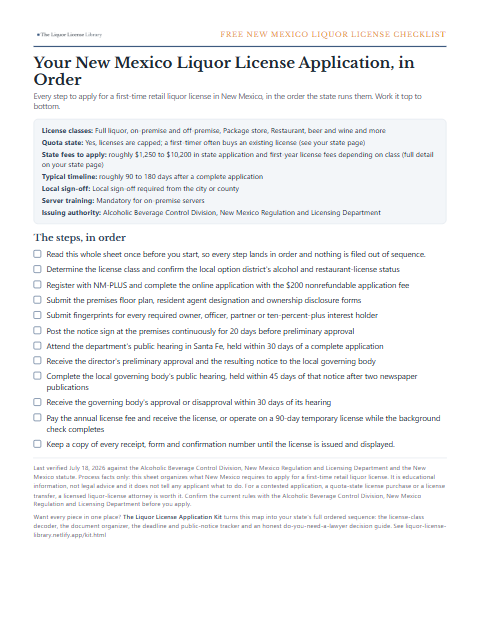
How to apply for a liquor license in New Mexico, step by step
Several of these steps gate the ones after them, so the order matters as much as the list.
- Determine the license class and confirm the local option district's alcohol and restaurant-license status
- Register with NM-PLUS and complete the online application with the $200 nonrefundable application fee
- Submit the premises floor plan, resident agent designation and ownership disclosure forms
- Submit fingerprints for every required owner, officer, partner or ten-percent-plus interest holder
- Post the notice sign at the premises continuously for 20 days before preliminary approval
- Attend the department's public hearing in Santa Fe, held within 30 days of a complete application
- Receive the director's preliminary approval and the resulting notice to the local governing body
- Complete the local governing body's public hearing, held within 45 days of that notice after two newspaper publications
- Receive the governing body's approval or disapproval within 30 days of its hearing
- Pay the annual license fee and receive the license, or operate on a 90-day temporary license while the background check completes
Local approval and public notice in New Mexico
The city or county layer on top of the state license, plus any notice you must post or publish. The public-notice window is often the shortest clock in the whole process.
| Item | New Mexico rule |
|---|---|
| Local sign-off required? | Yes, a city or county sign-off is part of the path |
| What the local layer does | The governing body of the local option district (city council or county commission) holds a public hearing on every new license and can disapprove it if the location is legally dry, violates a zoning ordinance, or the body finds it detrimental to public health, safety or morals. |
| Public notice | The governing body must publish notice of its hearing at least twice in a newspaper of general circulation, with the first notice at least 30 days before the hearing, plus posting on the district's website if it has one. Separately, before preliminary approval the applicant must post a 30-by-40-inch notice sign at the premises continuously for 20 days. |
| Worth knowing | Whether a municipality or county allows alcohol sales at all was originally set by a wet or dry local option election under NMSA 1978 60-5A-1; most populated New Mexico districts have already adopted local option. All costs of the required publication and posting are paid by the applicant. |
Server training in New Mexico
Whether the people pouring or selling alcohol must certify through a state program, plus the deadline.
| Item | New Mexico rule |
|---|---|
| Required for a first-time retailer? | Yes, mandatory for on-premise servers |
| Who must certify | Every server must hold a valid server permit from an approved provider. Under the statutory definition of server at 60-6E-3, this reaches any owner, lessee or manager who manages, directs or controls the sale or service of alcohol; a corporate officer or owner who does not manage, direct or control alcohol sales is expressly excluded. |
| State program | Alcohol Server Education program under NMSA 1978 60-6E-2 through 60-6E-9; the division maintains a list of approved training providers. |
| Deadline | Within 30 days of employment as a server, per 60-6E-4. License renewal also requires proof that every server held a valid permit throughout the prior license year, per 60-6E-9. |
| Worth knowing | This is a binding state training mandate for the licensed business, not a voluntary program. A lapse can hold up license renewal. |
Background check and renewal in New Mexico
Background check
| Item | New Mexico rule |
|---|---|
| Background check required? | Yes |
| Who is checked | Fingerprint-based state and FBI background checks for the applicant. For an entity this extends to every principal officer, director, general or limited partner holding 10 percent or more, managing member or ten-percent-plus member, plus any trustee or controlling beneficiary of a trust. |
| Disqualifiers | A felony conviction, two or more misdemeanor or petty misdemeanor Liquor Control Act violations within one calendar year, being a minor, having a spouse convicted of a felony who will be involved in operating the license, or being a foreign corporation not qualified to do business in New Mexico. A felony disqualification can be lifted by the governor or by the director on terms that include a $2,500 administrative penalty per license held. |
| Worth knowing | A sworn affidavit that the applicant has no felony conviction allows a 90-day temporary license (extendable once) to operate while the fingerprint-based check is still pending. A false affidavit is referred for perjury prosecution. |
Renewal
| Item | New Mexico rule |
|---|---|
| Renewal cycle | annual |
| Worth knowing | Dispenser's, retailer's and canopy licenses run on a license year ending June 30, with the renewal application and fee due April 1. Restaurant, club, wholesaler and manufacturer licenses run on a license year ending October 31, with renewal due August 1. Renewal is blocked if the licensee owes state taxes. It also requires proof every server held a valid Alcohol Server Education permit throughout the prior year. |