Which liquor license do I need?
Answer four questions to see the broad license category that fits your operation, then open your state page for the exact class.
How to use it
-
Answer four questions.
Your business type, where the alcohol is consumed, what you plan to serve and how long you need it.
-
Read your category family.
The broad family your answers point to, with what usually drives its cost and its timing.
-
Open your state page.
Your state names the exact class and its fee. This tool never guesses either one.
The six license category families
The guided questions need JavaScript, so here is the same map without it. Find the family that describes your operation, then open your state page for the class name your state actually uses.
On-premises
For alcohol consumed where it is sold, such as at a bar or a restaurant.
Off-premises
For sealed alcohol sold for a customer to take away, such as at a package store or a grocery.
Beer and wine only
For an operation that does not need distilled spirits privileges. The state still decides whether the class is on-premises or off-premises.
Catering
For a caterer serving alcohol away from its main licensed base, under whatever permission the state provides.
Special event
For temporary alcohol service or sales tied to one event, place or period.
Club
For an eligible membership organization serving its members and permitted guests.
Find your state page or open the cost estimator for your state's own fee band and timeline.
The Liquor License Library | educational category guide
Your likely category family
Why this category fits
What typically drives the cost
What typically drives the timing
Your answers
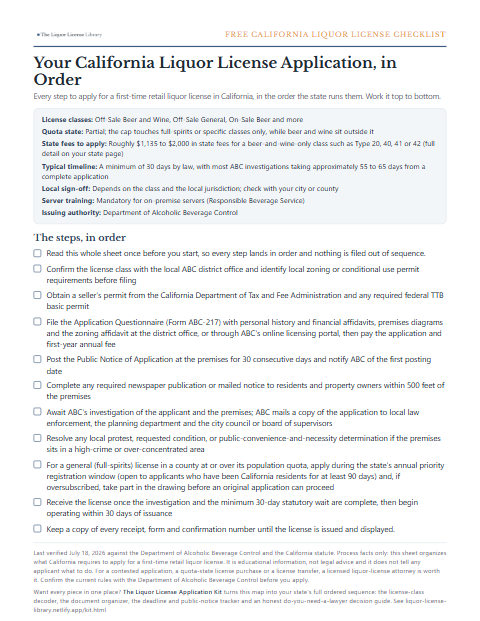
Email me the free application checklist for my state
What arrives in your inbox is the free one-page checklist for the state you pick, the application steps in the order that state runs them.
Only your email address, the state you pick and the category this tool showed you are sent. Instant download, plus rule-change alerts for your state. Unsubscribe anytime.
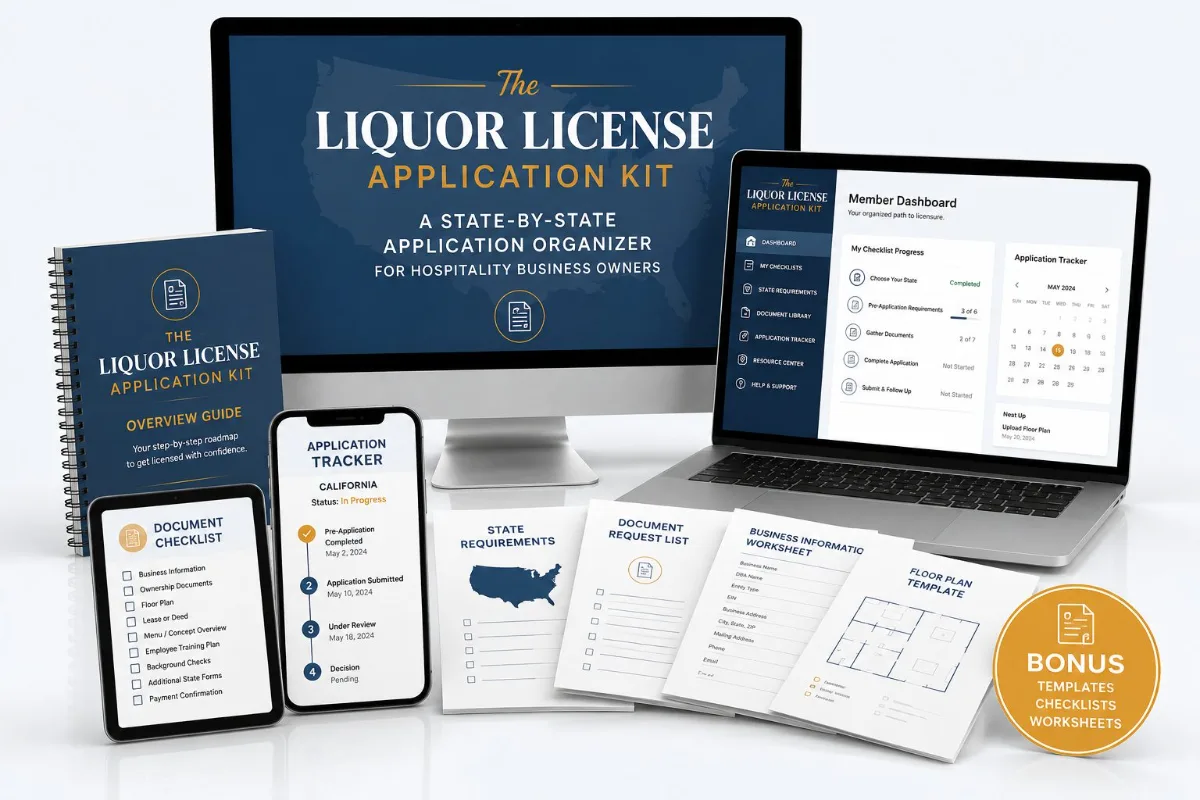
This tool points you at the right shelf. The Liquor License Application Kit is what fills the application in. The done pieces for your state: the license-class decoder, the dependency-ordered filing checklist, the document-gathering organizer, the deadline and public-notice tracker and an honest do-you-need-a-lawyer decision guide. The reference stays free; the kit is the evening of assembly you skip.
Which liquor license do you need?
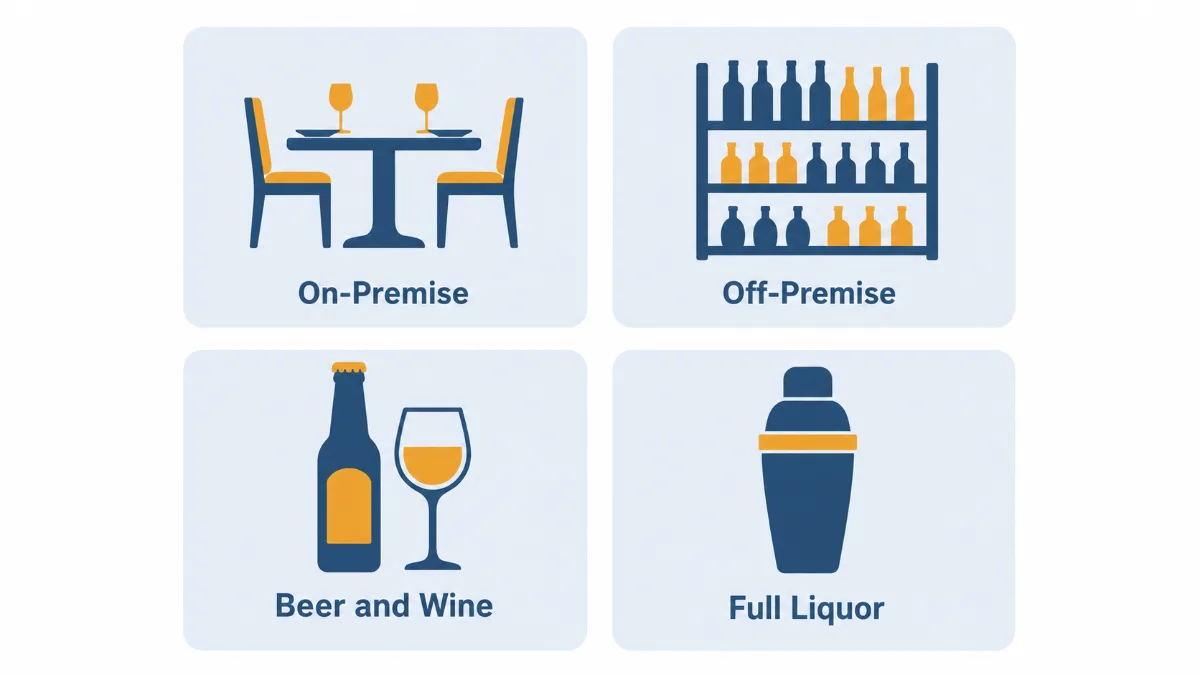
For most first-time applicants the answer sorts into six broad families: on-premises, off-premises, beer and wine only, catering, special event and club. Which one fits turns on four things: what kind of business you run, whether the alcohol is drunk where you sell it or carried away sealed, whether you pour distilled spirits and whether you need the permission for one event or for an ongoing operation. Answer those four above and the tool names the family. Your state then names the class inside it.
No national tool can name your exact license, because there is no national list. A state writes its own classes with its own numbers and letters, so a Type 47 in California means nothing in Texas. What travels is the shape of the question, which is what this tool walks you through.
How the four questions map to a category
The questions are not weighted equally, because in practice one answer can settle the category on its own. Duration comes first: a permission for a single event or a short run is a different document from a standing retail license nearly everywhere, so a temporary answer lands on the special event family whatever the venue serves. Next come the two operating shapes that get their own family in most states: a caterer serving away from its base and a members-only club. After those, the beverage tier decides, because a great many licensing systems split beer and wine privileges from full spirits then, in a capped state, hang the cap on the spirits class rather than the beer-and-wine one. Only when full spirits are in play does the last question matter. It then separates drinking at the premises from carrying sealed bottles away.
That ordering is also why a category is the honest stopping point. A family tells you which part of your state's list to read and roughly what the application will ask about. It cannot tell you the class number, the fee or the wait, because those are set state by state. For the figures, open the cost estimator, which reads your state's own published fee band, quota status and timeline, or go straight to your state page. For the families in more depth, including how Florida's series letters and California's type numbers decode, read types of liquor licenses explained.
Questions about the result
Does this tool name the exact license I need?
No. It names a broad category family. Each state names and divides its licenses differently, so the exact class comes from your own state page rather than from any national tool.
What is the difference between an on-premises and an off-premises license?
An on-premises category generally covers alcohol consumed at the licensed location, such as a bar or a restaurant. An off-premises category generally covers sealed alcohol taken away for consumption somewhere else, such as a package store or a grocery.
Why does beer and wine only appear as its own category?
Many licensing systems separate beer and wine privileges from full spirits privileges. In a capped state the cap usually falls on the full-spirits class rather than the beer-and-wine one. The exact names and boundaries still come from your state.
Which license does a restaurant need?
A restaurant that pours drinks needs an on-premises category. The fork that matters is whether you pour spirits: a beer-and-wine class usually costs less and often sits outside a quota, while a full-spirits class can mean buying an existing license in a capped county. Your state page names the exact class.
What affects liquor license cost and timing?
The category scope, the application review, the ownership checks, the premises review, local approvals and license availability can all matter. Your state and locality set the real figures, which is what the cost estimator reads for you.
How this tool works
Everything happens in your browser. Nothing you answer is sent anywhere unless you fill in the checklist form yourself. The tool holds no state data at all: it sorts your four answers into one of six families and then hands you to the pages that do carry verified state facts. That boundary is deliberate. A tool that named your state's class or quoted a fee from a national average would be guessing, which is worth less than nothing when the answer decides an application. Read how to get a liquor license for the six steps that follow once you know your class.
This wizard is educational information, not legal advice and it does not tell any applicant what to do. It names a general category from the answers you provide. It does not determine eligibility or approval. Your state and locality set the exact license class, privileges, fees, application steps and timing. Confirm the current rules on your state page and with the relevant licensing authority. For a contested application, a quota-state license purchase or a license transfer, talk to a licensed liquor-license attorney.