How to Get a Liquor License in Michigan (2026): Cost, Classes and Steps
How do you get a liquor license in Michigan?
In Michigan, retail liquor licenses are issued by the Michigan Liquor Control Commission, a bureau within the Department of Licensing and Regulatory Affairs. A first-time on-premise applicant needs a population-capped Class C license for full spirits or a Tavern license for beer and wine, while a first-time off-premise applicant needs an SDD license for spirits or an SDM license for beer and wine. Michigan runs a population quota on both the on-premise and off-premise classes. Most populated cities and townships already sit at their population cap for Class C and Tavern licenses, so a first-time on-premise applicant commonly acquires an existing license through a transfer rather than receiving a brand new one.
In Michigan, retail liquor licenses go through the Michigan Liquor Control Commission. The application runs through the state with a local sign-off alongside it. Michigan caps the number of retail licenses, so a first-time applicant often buys an existing license and transfers it rather than obtaining a brand-new one. Work the page top to bottom and the whole path is visible before any single deadline is due.
Michigan runs a partial control system, handling some spirits wholesale or retail itself while private retailers hold the on-premise and off-premise licenses. On-premise servers must certify through the state's named training program within its window. Every owner, officer and significant investor clears a background check. Each piece has its own section below, with the official source beside it.
The parts a Michigan applicant most often misses are the public-notice window, which runs on the state's schedule rather than yours, the quota, which can make the license itself a far bigger cost than the state fee and the order of the steps, since several gate the ones after them. The sections below take them in order.

Which liquor license does a Michigan bar, restaurant or store need?
The retail license classes Michigan issues, what each covers and the venue each fits. Match your venue to the class before anything else.
| Class | Covers | Who it fits |
|---|---|---|
| Class C Class C license | on-premise, full spirits | Covers beer, wine, mixed spirit drink and spirits for consumption on the premises; a bar or restaurant's standard license. Population-quota class under MCL 436.1531; most populated local units are already at capacity, so a first-time applicant usually buys an existing license rather than receiving a new one |
| Tavern Tavern license | on-premise, beer and wine | Beer, wine and mixed spirit drink only, no spirits. Same population-quota mechanism as Class C |
| SDD Specially Designated Distributor license | off-premise, full spirits | For a liquor store or similar retailer selling spirits in the original package for off-premise consumption. Quota is 1 per 3,000 population of the local governmental unit, waivable by the commission if no SDD already operates within 2 miles |
| SDM Specially Designated Merchant license | off-premise, beer and wine | For a grocery store, convenience store, party store, pharmacy or gas station selling beer, wine and mixed spirit drink for off-premise consumption. Quota is 1 per 1,000 population, with statutory exemptions for a license issued alongside an eligible on-premise license, a store of 20,000 square feet or more with at least 20% of gross receipts from food, a licensed pharmacy, or a qualifying marina |
Is Michigan a quota or control state?
Whether Michigan caps how many licenses exist, how a capped license is obtained and whether the state runs any part of retail itself. This is where the real cost of a Michigan license can hide.
| Item | Michigan rule |
|---|---|
| Quota state? | Yes, the number of licenses is capped |
| How the cap works | On-premise Class C and Tavern licenses are capped at 1 per 1,500 population of the local governmental unit under MCL 436.1531. Off-premise SDD licenses are capped at 1 per 3,000 population and SDM licenses at 1 per 1,000 population; the commission can waive either off-premise cap if no license of that type already operates within 2 miles of the proposed location |
| New licenses issued by | none. Michigan does not run a lottery or drawing for a new quota license. When a slot opens through population growth or an escrowed license returning to a local unit, the local legislative body adopts a resolution and the commission works applications in the order filed |
| Buying an existing license | Existing Class C and Tavern licenses trade privately once a local unit's quota is full. A license from a closed business goes into escrow for up to 5 years before it can transfer to a new location within the same county. Market-reported Class C prices of roughly $50,000 to $200,000 or more depending on the area appear in license-broker and attorney sources; this is a market figure, not an official state fee |
| State control | Partial control. The commission is the sole wholesaler of distilled spirits sold in Michigan and sets spirits pricing through its own distribution system, which private Authorized Distribution Agents warehouse and deliver under state contract; the state runs no retail stores. Beer and wine move through licensed private wholesalers. A retail licensee still buys spirits through the state's distribution system, but the retail license itself is privately held and operated |
How much does a liquor license cost in Michigan?
| Item | Michigan |
|---|---|
| State and local fees to apply | roughly $170 to $670 in state fees depending on class before any local fee (SDM totals about $170 with the inspection fee, Class C about $670) |
| Renewal | $100 to $600 a year by class, with SDD adding a per-purchase-volume surcharge above $25,000 in annual spirits purchases |
| What drives the range | Driven by license class. These are state fees only; a municipality may add its own local application or hearing fee. For an on-premise quota class where no new slot is open, the realistic cost also includes a secondary-market purchase price that sits outside these state figures, see the quota field |
The itemized fees a first-time Michigan applicant can expect from the state.
| Fee | Amount |
|---|---|
| Nonrefundable inspection fee, per new license, transfer or premises-change request | $70 |
| Class C annual license fee (on-premise, full spirits) | $600 |
| Tavern annual license fee (on-premise, beer and wine) | $250 |
| SDD annual license fee (off-premise spirits) | $150 plus $3.00 per $1,000, or major fraction, of spirits purchased from the commission over $25,000 a year |
| SDM annual license fee (off-premise beer and wine) | $100 per location |
| Conditional license fee, optional, to operate while the full application is under review | $300 |
How long it takes. MCL 436.1525 requires the commission to issue or deny a completed initial or renewal application within 90 days, refunding the fee and cutting the next renewal fee by 15% if it misses that window. The commission's own retailer guidance cautions that actual processing time varies by application and that files are worked in the order received. Applications move through document review, then an Enforcement Division investigation and applicant interview, then Commission consideration; a local hearing, an incomplete fingerprint packet or a missing local resolution can extend the process beyond the statutory 90-day figure
From the team behind this library
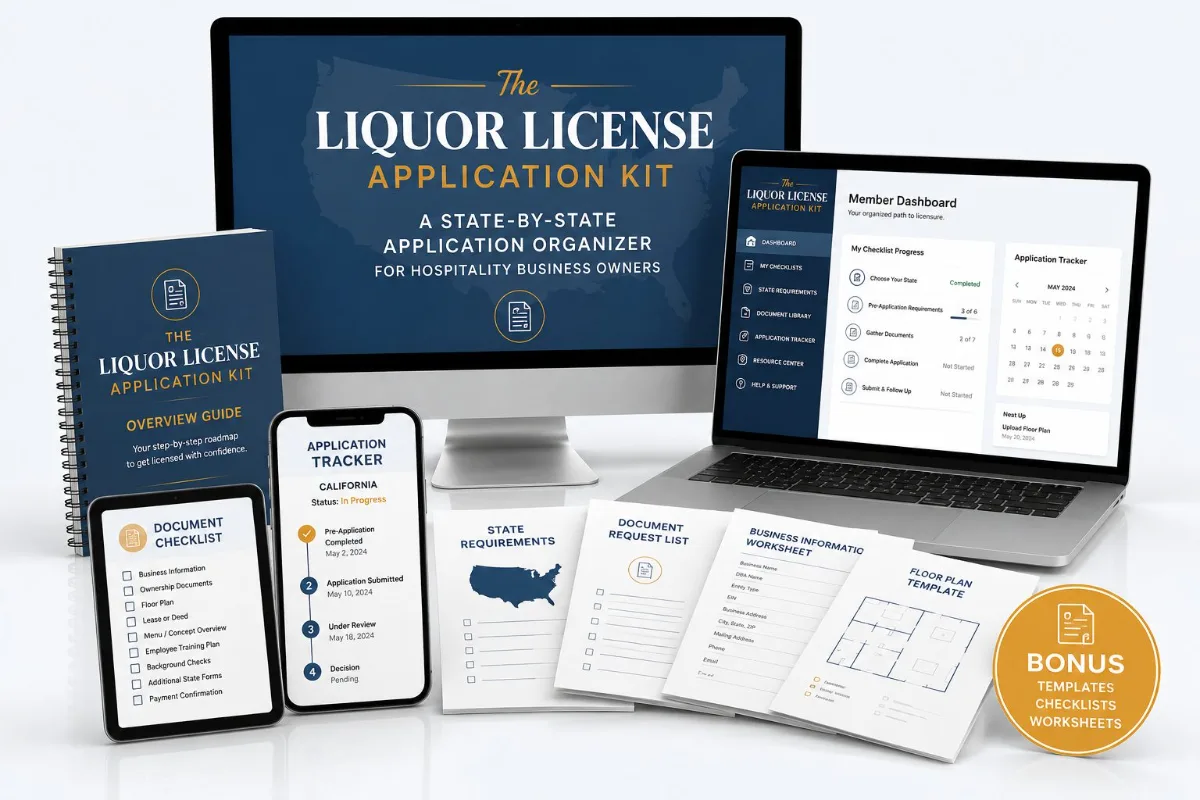
The Liquor License Application Kit
This page shows you the steps. The kit fills them in for Michigan. Your license class decoded, every document named and tracked, the deadline and public-notice windows dated and a straight answer on the one or two points that actually need a lawyer. The reference pages stay free. The kit is the evening of assembly you skip.
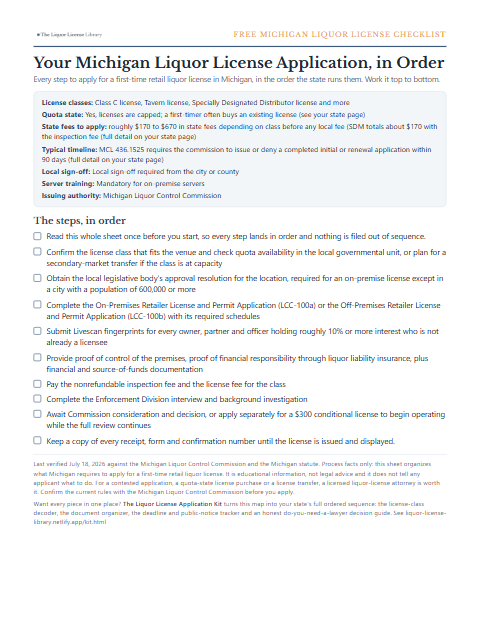
How to apply for a liquor license in Michigan, step by step
Several of these steps gate the ones after them, so the order matters as much as the list.
- Confirm the license class that fits the venue and check quota availability in the local governmental unit, or plan for a secondary-market transfer if the class is at capacity
- Obtain the local legislative body's approval resolution for the location, required for an on-premise license except in a city with a population of 600,000 or more
- Complete the On-Premises Retailer License and Permit Application (LCC-100a) or the Off-Premises Retailer License and Permit Application (LCC-100b) with its required schedules
- Submit Livescan fingerprints for every owner, partner and officer holding roughly 10% or more interest who is not already a licensee
- Provide proof of control of the premises, proof of financial responsibility through liquor liability insurance, plus financial and source-of-funds documentation
- Pay the nonrefundable inspection fee and the license fee for the class
- Complete the Enforcement Division interview and background investigation
- Await Commission consideration and decision, or apply separately for a $300 conditional license to begin operating while the full review continues
Local approval and public notice in Michigan
The city or county layer on top of the state license, plus any notice you must post or publish. The public-notice window is often the shortest clock in the whole process.
| Item | Michigan rule |
|---|---|
| Local sign-off required? | Yes, a city or county sign-off is part of the path |
| What the local layer does | For an on-premise license (Class C, Tavern) the local legislative body of the city, village or township must approve the application by resolution before the commission grants it, except in a city with a population of 600,000 or more, under MCL 436.1501. For a renewal, local approval is presumed unless the local body files an objection at least 30 days before the license expires. A proposed location within 500 feet of a church or school, measured along the center line of the street between the two buildings, is denied under MCL 436.1503 unless the license was already operating there before March 1, 2017, or the affected church or school does not object; SDM licenses are exempt from the 500-foot rule |
| Public notice | Local units commonly hold a public hearing on the approval resolution with newspaper or premises posting, but the statute does not set one uniform statewide notice window, so timing and format follow the local unit's own procedure |
| Worth knowing | Local zoning can still restrict where a licensed premises may operate even after the license class and state approval are in place |
Server training in Michigan
Whether the people pouring or selling alcohol must certify through a state program, plus the deadline.
| Item | Michigan rule |
|---|---|
| Required for a first-time retailer? | Yes, mandatory for on-premise servers |
| Who must certify | On-premise licensees (Class C, Tavern and hotel-class retailers, plus manufacturers with a tasting room) must have at least one trained supervisor on site during every hour alcohol is served. Off-premise SDD and SDM sellers are not covered by this requirement |
| State program | An MLCC-approved alcohol server training program under MCL 436.1906; the commission lists multiple approved providers including TAM, TIPS, ServSafe Alcohol and Rserving Michigan. This is a reference to the statutory approval list, not a vendor recommendation |
| Deadline | Within 180 days of the license being issued, or of a transfer of 50% or more ownership interest |
Background check and renewal in Michigan
Background check
| Item | Michigan rule |
|---|---|
| Background check required? | Yes |
| Who is checked | Owners, partners, officers and anyone holding roughly 10% or more interest who is not already a Michigan liquor licensee submit Livescan fingerprints for a state and FBI criminal history check. The Enforcement Division holds an in-person interview reviewing identification, financial records and, for a purchase, the executed purchase agreement |
| Disqualifiers | The commission applies a statutory good moral character standard under MCL 338.41 to 338.47 rather than one enumerated felony lookback window; arrest and conviction history is one factor weighed alongside financial information and local government opinion. The exact list of disqualifying offenses beyond this general standard was not independently confirmed and is treated as an ambiguity, not a guess |
| Worth knowing | Applicants must be at least 21 years old. Financial documentation typically includes recent tax returns and proof of the source of funds for the purchase |
Renewal
| Item | Michigan rule |
|---|---|
| Renewal cycle | annual |
| Worth knowing | Michigan license years run May 1 to April 30 with a flat, non-prorated fee. The online renewal portal opens March 1 and renewal is due by April 30; renewal notices are mailed by mid-March. The same MCL 436.1525 90-day processing requirement and 15% late-issuance discount applies to a completed renewal application. The exact penalty mechanics for a licensee who renews late were not independently confirmed |