How to Get a Liquor License in Kentucky (2026): Cost, Classes and Steps
How do you get a liquor license in Kentucky?
In Kentucky, first-time retail liquor licenses are issued by the Department of Alcoholic Beverage Control, with a required local sign-off from the city or county ABC administrator before the state will process the application. An off-premise wine and liquor store needs a quota retail package license, capped by county population, while an on-premise bar or restaurant serving spirits applies for a quota retail drink license or a nonquota class such as NQ2, neither of which carries a population cap since the state repealed the drink-license quota in 2018. A beer-only business uses a separate, uncapped malt beverage class.
In Kentucky, retail liquor licenses go through the Kentucky Department of Alcoholic Beverage Control. The application runs through the state with a local sign-off alongside it. Kentucky caps only its full-spirits or specific classes, while a beer or beer-and-wine class usually sits outside the cap. Work the page top to bottom and the whole path is visible before any single deadline is due.
Server training is required for some classes or roles. Every owner, officer and significant investor clears a background check. A city or county sign-off is part of the path. Each piece has its own section below, with the official source beside it.
The parts a Kentucky applicant most often misses are the public-notice window, which runs on the state's schedule rather than yours, which classes fall under the cap and which do not and the order of the steps, since several gate the ones after them. The sections below take them in order.

Which liquor license does a Kentucky bar, restaurant or store need?
The retail license classes Kentucky issues, what each covers and the venue each fits. Match your venue to the class before anything else.
| Class | Covers | Who it fits |
|---|---|---|
| Quota Retail Package License Quota retail package license | off-premise, full spirits and wine | Wine and liquor by the bottle, case or package for off-site consumption. This is the license class that still carries a county population cap; fits a standalone liquor store. |
| Quota Retail Drink License Quota retail drink license | on-premise, full spirits and wine | Wine and liquor by the drink. Despite the class name, the population cap on this class was repealed in 2018, so it is issued on application without a numeric quota; fits a bar. |
| NQ2 Nonquota type 2 retail drink license | on-premise, full spirits | Covers restaurants, hotels, motels, airports, riverboats, distilleries, small farm wineries and entertainment destination centers selling by the drink. Never subject to a numeric cap. |
| Limited Restaurant License (LR50/LR100) Limited restaurant license | on-premise, full spirits, wine and beer | For a restaurant with at least 70 percent food sales and a minimum seating capacity of 50 (LR50) or 100 (LR100) people at tables; not subject to a numeric cap. |
| NQ Retail Malt Beverage Package License Nonquota retail malt beverage package license | off-premise, beer | Beer by the bottle, crowler, growler, case or package for off-site consumption; fits a convenience store, grocery store or gas station selling beer only. Not subject to a numeric cap. |
| NQ4 Nonquota type 4 retail malt beverage drink license | on-premise, beer | Beer by the drink only, for a taproom or bar that does not serve wine or spirits. Not subject to a numeric cap. |
Is Kentucky a quota or control state?
Whether Kentucky caps how many licenses exist, how a capped license is obtained and whether the state runs any part of retail itself. This is where the real cost of a Kentucky license can hide.
| Item | Kentucky rule |
|---|---|
| Quota state? | Partial, the cap touches some classes only |
| How the cap works | The numeric population cap now applies only to the quota retail package license, the off-premise class. General ratio: one license per 2,300 residents in a wet city or county (default set by 804 KAR 9:040), one per 1,500 residents in a county containing a city of the first class or a consolidated local government (KRS 241.065), with a minimum of two licenses per city or county. The quota retail drink license (on-premise) kept its class name but lost its population cap when the ABC Board repealed the underlying quota regulation in December 2017, a change codified by Senate Bill 110 in the 2018 session (2018 Ky. Acts ch. 154) that preserved a population quota for the retail package license only; it and every other on-premise or malt beverage class now issue on application without a numeric ceiling. |
| New licenses issued by | No lottery or periodic drawing was found in the primary sources reviewed. A new quota retail package license appears to issue on application within whatever numeric slots the population ratio allows and a city or county in a dry county can petition the department for a specific higher quota number under KRS 241.069. |
| Buying an existing license | Before the 2017-2018 drink-license quota repeal, a scarce quota retail drink license was market-reported to trade privately for $20,000 or more in built-out counties; this is a market-reported historical figure, not an official fee. |
| State control | No, private licensing throughout. Kentucky licenses every stage of the trade, distiller, rectifier, winery, wholesaler and retailer, as a private license under KRS Chapter 243. The department's own license type list carries no state-operated retail store, so an off-premise applicant competes against other private license holders, not a state store system. |
Not fully settled in one published place. Confirm the exact quota status and, where a cap applies, how a new or existing license is obtained with the Kentucky Department of Alcoholic Beverage Control before you rely on it.
How much does a liquor license cost in Kentucky?
| Item | Kentucky |
|---|---|
| State and local fees to apply | roughly $650 to $2,800 in combined state and local license fees depending on the class and whether the city or county sets its fee at the statutory cap, plus the $50 nonrefundable state application fee and the newspaper notice cost |
| Renewal | roughly $610 to $2,780 per year, the same combined state and local license fee for the class, since the application fee and newspaper notice are largely one-time costs |
| What drives the range | Every license carries a state fee (KRS 243.030 for distilled spirits and wine classes, KRS 243.040 for malt beverage classes) plus a separate local fee the city or county sets up to the cap in KRS 243.060 (county) or KRS 243.070 (city). A city license replaces the county license for that premises rather than stacking on it. Add-on licenses such as Sunday sales or extended hours carry their own state and local fees on top of the primary class. |
The itemized fees a first-time Kentucky applicant can expect from the state.
| Fee | Amount |
|---|---|
| Quota retail package license, state fee | $570 per year |
| Quota retail drink license, state fee | $620 per year |
| Nonquota type 2 (NQ2) retail drink license, state fee | $830 per year |
| Limited restaurant license (LR50/LR100), state fee | $780 per year |
| Nonquota retail malt beverage package license, state fee | $210 per year |
| Nonquota type 4 (NQ4) malt beverage drink license, state fee | $210 per year |
| State application fee, nonrefundable, credited to the license fee if issued | $50 |
| County license fee, quota retail package license | up to $1,000 to $1,200 per year depending on the county |
| County license fee, quota retail drink license | up to $1,000 to $1,600 per year depending on the county |
| County license fee, NQ2 retail drink license | up to $1,000 to $1,800 per year depending on the county |
| County license fee, limited restaurant license | up to $1,400 to $2,000 per year depending on the county |
| Newspaper notice of intention to apply | varies by newspaper, plus the affidavit of publication |
How long it takes. At least 60 days for state review after a complete application, on top of the 30-day newspaper notice and protest window that must run before a license can issue. The 60-day figure is the state ABC office's own minimum processing commitment once it has a complete application; local administrator review time and any protest filed in the 30-day notice window run separately and can extend the total well past 90 days.
Not published as one current figure. Confirm the exact amount with the Kentucky Department of Alcoholic Beverage Control before you budget for it.
From the team behind this library
The Liquor License Application Kit
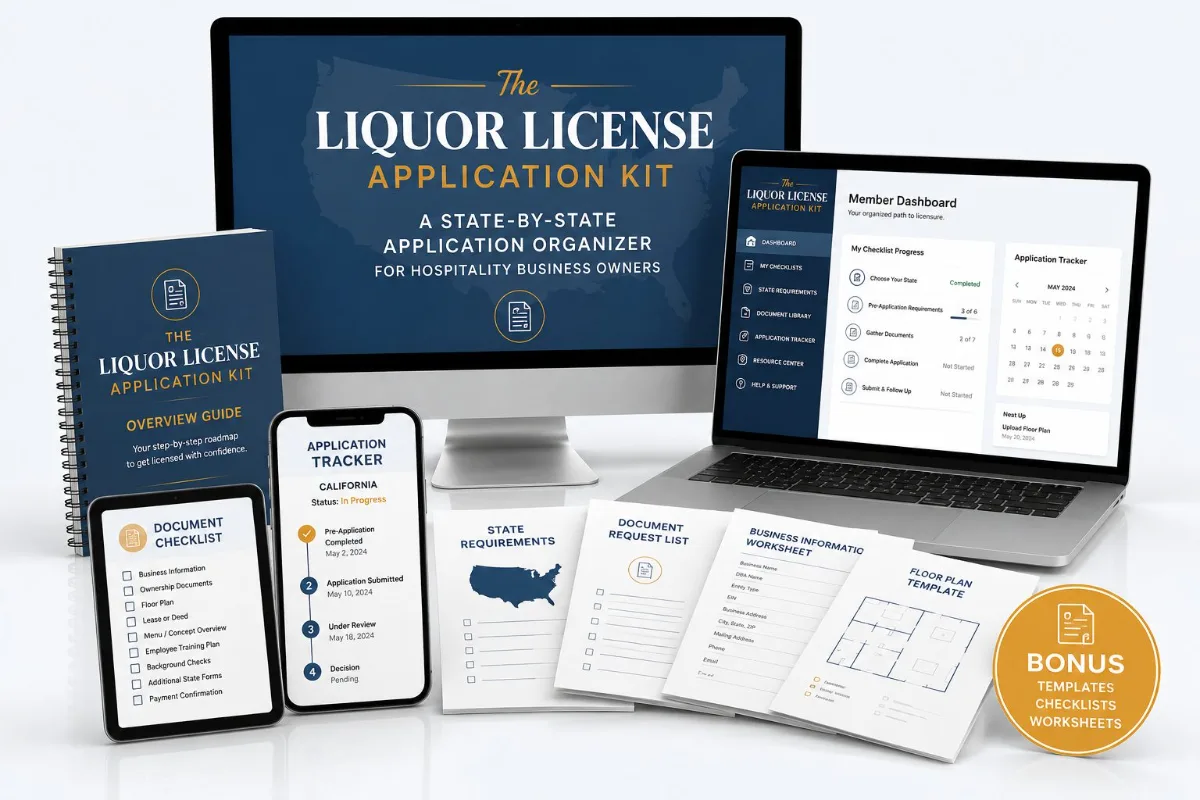
This page shows you the steps. The kit fills them in for Kentucky. Your license class decoded, every document named and tracked, the deadline and public-notice windows dated and a straight answer on the one or two points that actually need a lawyer. The reference pages stay free. The kit is the evening of assembly you skip.
How to apply for a liquor license in Kentucky, step by step
Several of these steps gate the ones after them, so the order matters as much as the list.
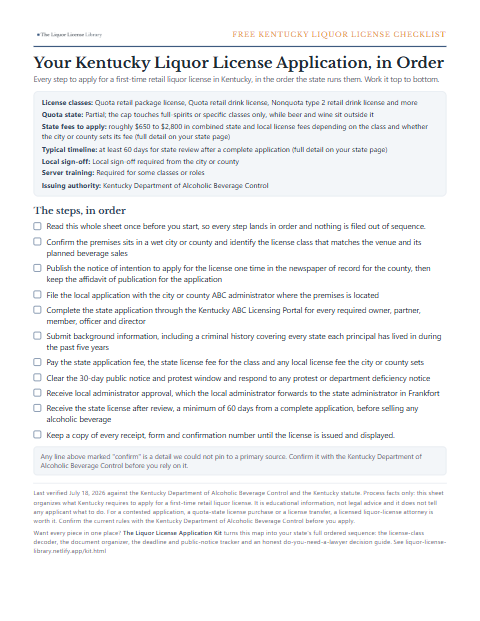
- Confirm the premises sits in a wet city or county and identify the license class that matches the venue and its planned beverage sales
- Publish the notice of intention to apply for the license one time in the newspaper of record for the county, then keep the affidavit of publication for the application
- File the local application with the city or county ABC administrator where the premises is located
- Complete the state application through the Kentucky ABC Licensing Portal for every required owner, partner, member, officer and director
- Submit background information, including a criminal history covering every state each principal has lived in during the past five years
- Pay the state application fee, the state license fee for the class and any local license fee the city or county sets
- Clear the 30-day public notice and protest window and respond to any protest or department deficiency notice
- Receive local administrator approval, which the local administrator forwards to the state administrator in Frankfort
- Receive the state license after review, a minimum of 60 days from a complete application, before selling any alcoholic beverage
Local approval and public notice in Kentucky
The city or county layer on top of the state license, plus any notice you must post or publish. The public-notice window is often the shortest clock in the whole process.
| Item | Kentucky rule |
|---|---|
| Local sign-off required? | Yes, a city or county sign-off is part of the path |
| What the local layer does | A local ABC administrator for the city or county where the premises sits (in larger jurisdictions such as Louisville Metro or Lexington-Fayette this is a dedicated local ABC office) reviews and approves the application before the state administrator in Frankfort will process it. Local option status (whether the city or county is wet) and any local zoning sign-off are part of this layer. |
| Public notice | One-time publication of the notice of intention to apply in the newspaper of record for the county, with a completed affidavit of publication attached to the application. A license cannot issue until at least 30 days after publication and any person, association or corporation may file a written protest with the department within that 30-day window. |
| Worth knowing | Kentucky local option runs by city and by county under KRS Chapter 242, so a wet city can sit inside a dry county and vice versa; a wet city located in a dry county can petition for its own higher quota number under KRS 241.069. Local fees under KRS 243.060 (county) and KRS 243.070 (city) run alongside, not instead of, the state fee, though a county may not charge a licensee who already holds a city license for the same premises. |
Confirm the local sign-off and any public-notice window for your jurisdiction with your city or county before you file.
Server training in Kentucky
Whether the people pouring or selling alcohol must certify through a state program, plus the deadline.
| Item | Kentucky rule |
|---|---|
| Required for a first-time retailer? | Required for some classes, roles or local mandates |
| Who must certify | n/a statewide; where a local ordinance mandates it, typically every server or seller of alcohol at the licensed premises |
| State program | Server Training in Alcohol Regulation (STAR), the department's own responsible beverage server program; state law does not require it statewide |
| Deadline | n/a statewide; local ordinances that mandate training commonly set a deadline of 30 days from hire |
| Worth knowing | Kentucky has no statewide mandatory server training law. A large number of individual Kentucky cities and counties (Lexington and Bowling Green among them) have local ordinances requiring servers to complete STAR or another approved responsible beverage server program, so this depends on which city or county the premises sits in. |
Background check and renewal in Kentucky
Background check
| Item | Kentucky rule |
|---|---|
| Background check required? | Yes |
| Who is checked | Every owner, partner, member, officer and director of the applicant, including anyone with a direct or indirect ownership interest, is checked. Applications commonly require a criminal background check covering every state each principal has resided in during the past five years. |
| Disqualifiers | Under KRS 243.100: a felony conviction bars licensing until five years after the conviction, release, parole or probation completion, whichever is later. A misdemeanor conviction under the controlled substances chapter (KRS Chapter 218A) within the two years before application is disqualifying, as is a misdemeanor conviction directly or indirectly tied to alcohol use within the two years before application. An applicant must be at least 21. A license previously revoked for cause bars new licensing for two years from the revocation. The statute also blocks evading a disqualification by applying under a different name or through another person. |
| Worth knowing | For a partnership, LLC or corporation, every principal owner, partner, member, officer and director must individually meet the qualification standard, not just the entity itself. Residency and U.S. |
Renewal
| Item | Kentucky rule |
|---|---|
| Renewal cycle | annual |
| Worth knowing | License periods run for up to one year and are staggered by county so that not every license in the state expires at once. A licensee who does not renew, or attempt to renew, within 30 days after expiration cannot renew late and must apply as a new applicant instead. KRS 243.090 was itself amended in 2025. |