How to Get a Liquor License in Minnesota (2026): Cost, Classes and Steps
How do you get a liquor license in Minnesota?
In Minnesota, first-time retail liquor licenses are issued locally, by the city council or, for an unincorporated area, the county board. A bar or restaurant applies for an on-sale intoxicating liquor license, a liquor store applies for an off-sale intoxicating liquor license and a restaurant that does not pour spirits can instead hold an on-sale wine license. The state Alcohol and Gambling Enforcement Division inside the Department of Public Safety does not pre-approve a city on-sale license, which takes effect when the city issues it with only a ten-day notice to the division, but an off-sale, on-sale wine, club or county on-sale license is not effective until the division gives final approval on the forwarded application. Minnesota is a partial quota state: state law caps the number of standard on-sale intoxicating liquor licenses each city may issue by population, though restaurant wine licenses, club licenses and most off-sale licenses fall outside that cap.
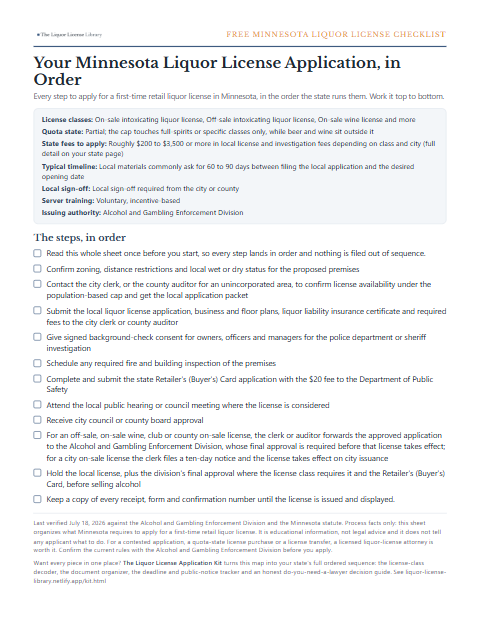
In Minnesota, retail liquor licenses go through the Alcohol and Gambling Enforcement Division. A first-time applicant files locally, because the city or county is the issuing authority here. Minnesota caps only its full-spirits or specific classes, while a beer or beer-and-wine class usually sits outside the cap. Work the page top to bottom and the whole path is visible before any single deadline is due.
Server training is voluntary here, an incentive rather than a licensing condition. Every owner, officer and significant investor clears a background check. A city or county sign-off is part of the path. Each piece has its own section below, with the official source beside it.
Minnesota Laws 2026 chapter 48 took effect April 21, 2026. Minnesota clarified that a senior-living setting can serve residents without a license and adjusted the school-distance and zoning language in section 340A.412. This page reflects the rule in force today; the full history sits in the law-updates log.
Which liquor license does a Minnesota bar, restaurant or store need?
The retail license classes Minnesota issues, what each covers and the venue each fits. Match your venue to the class before anything else.
| Class | Covers | Who it fits |
|---|---|---|
| On-Sale Intoxicating Liquor On-sale intoxicating liquor license | on-premise, full spirits | For a bar, restaurant or similar venue selling liquor for consumption on the premises. Counted against the city's population-based cap under section 340A.413 unless the venue instead qualifies for an exempt class such as a restaurant wine license, club license or brewery taproom license. |
| Off-Sale Intoxicating Liquor Off-sale intoxicating liquor license | off-premise, full spirits | For a liquor store selling packaged beer, wine and spirits for consumption away from the premises. Capped by statute only in first class cities, at one license per 5,000 population; other cities and counties set their own off-sale limits. |
| On-Sale Wine On-sale wine license | on-premise, wine up to 24 percent ABV, plus strong beer for a qualifying restaurant | For a restaurant with seating for at least 25 guests, issued with commissioner approval, permitting wine up to 24 percent alcohol by volume. Sits outside the on-sale intoxicating liquor cap. Under section 340A.404 subdivision 5 a holder that also holds an on-sale 3.2 percent malt liquor license may be authorized by municipal ordinance to sell full-strength intoxicating malt liquor (strong beer) without a further license; current law sets no food-sales percentage condition and no experience-based entertainment condition for that authorization. |
| Club Club license | on-premise, full spirits | For an incorporated club or a congressionally chartered veterans organization. The fee is capped by statute on a sliding scale by membership size. Sits outside the on-sale intoxicating liquor cap. |
| 3.2 Percent Malt Liquor 3.2 percent malt liquor license, on-sale and off-sale | both, beer at 3.2 percent or less | A legacy class still on the books alongside the on-sale wine license strong-beer add-on described above. Most stores now sell full-strength beer directly under other classes since Minnesota's 2017 strong-beer sales law, so first-time retail use of this class is limited today. |
Is Minnesota a quota or control state?
Whether Minnesota caps how many licenses exist, how a capped license is obtained and whether the state runs any part of retail itself. This is where the real cost of a Minnesota license can hide.
| Item | Minnesota rule |
|---|---|
| Quota state? | Partial, the cap touches some classes only |
| How the cap works | Minnesota Statutes 340A.413 caps the number of on-sale intoxicating liquor licenses each city may issue on a population formula: one license per 1,500 population up to 200 in a first class city, 18 plus one for every 2,500 population over 45,000 in a second class city, 12 in a third class city, seven in a fourth class city and three to six in a statutory city by population bracket. Off-sale licenses are capped only in first class cities, at one license per 5,000 population; other cities and counties set their own off-sale limits without a statewide formula. |
| New licenses issued by | none. Minnesota does not run a state lottery or drawing for capped licenses. A city issues its available on-sale licenses at its own discretion up to its statutory cap. A city already at its cap can add licenses only through a voter referendum or a special law passed by the legislature for that city. |
| Buying an existing license | unverifiable. No primary source describing a private resale market or market-reported pricing for capped Minnesota on-sale licenses was found. When a city is at its cap, the documented paths to a new license are a local referendum or special state legislation, not a described private sale process. |
| State control | No, private licensing throughout. Minnesota is a license state with private retail and wholesale liquor sales; there is no statewide government spirits monopoly. A city of 10,000 population or less, or a city that already ran one before July 1 1967, may choose under section 340A.601 to operate its own municipal liquor store, a local option adopted in some smaller and rural communities rather than a statewide condition. |
How much does a liquor license cost in Minnesota?
| Item | Minnesota |
|---|---|
| State and local fees to apply | Roughly $200 to $3,500 or more in local license and investigation fees depending on class and city, plus the $20 state Retailer's Buyer's Card fee. Off-sale and wine fees are capped by state statute; on-sale intoxicating fees are set locally with no statewide cap and run higher in larger cities. |
| Renewal | An annual local renewal fee similar in size to the initial license fee, plus a local renewal investigation fee where the city charges one, commonly $100 to $200. |
| What drives the range | Driven by license class, city population class and local ordinance. The state-level fee is minimal; nearly all of the cost is set locally. See the quota field for the population-based license cap that applies to on-sale intoxicating licenses, separate from the fee amount. |
The itemized fees a first-time Minnesota applicant can expect from the state.
| Fee | Amount |
|---|---|
| State Retailer's (Buyer's) Card application fee | $20 |
| Local license investigation fee (example) | commonly a few hundred dollars for a new application; example $300 initial and $150 renewal in Stillwater |
| Local on-sale intoxicating liquor license fee | set by the city or county, no statewide cap; example $3,200 annually in Stillwater |
| Local off-sale intoxicating liquor license fee | capped by statute at $240 to $1,500 per year by city population class, $800 maximum for a county or town; example $200 in Stillwater |
| On-sale wine license fee | capped at the lesser of half the city's on-sale intoxicating liquor fee or $2,000 per year |
| Club license fee | capped by statute from $300 to $3,000 per year depending on club membership size |
| Compliance incentive fee reduction | $100 reduction available for a licensee meeting the state's employee-training, ID-check policy and incentive-program conditions |
How long it takes. Local materials commonly ask for 60 to 90 days between filing the local application and the desired opening date. The local background investigation, any required inspections and a city council or county board hearing set the pace. For an off-sale, on-sale wine, club or county on-sale license the commissioner's final approval is also required before the license takes effect under Minnesota Rules 7515.0440; a city on-sale license takes effect on city issuance with a ten-day notice to the commissioner. At annual renewal the forms for an approval-required license are forwarded to the commissioner 30 days before the license year ends.
From the team behind this library
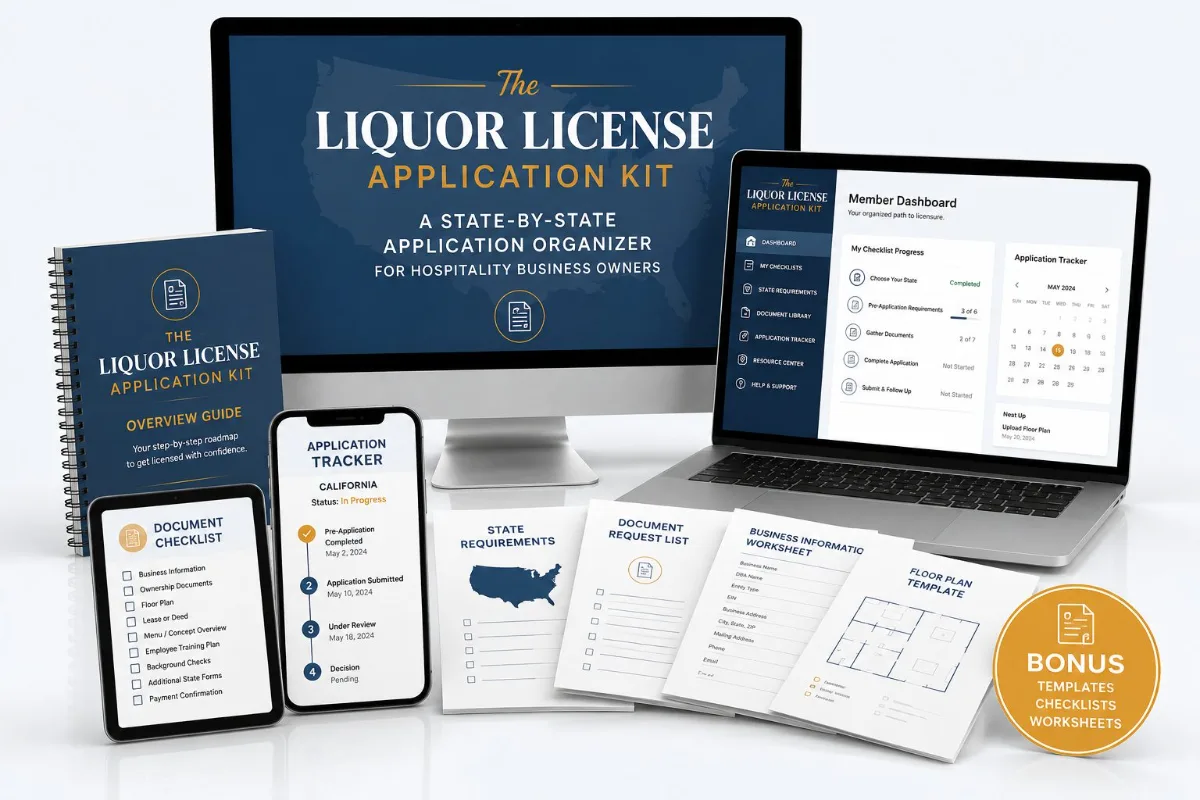
The Liquor License Application Kit
This page shows you the steps. The kit fills them in for Minnesota. Your license class decoded, every document named and tracked, the deadline and public-notice windows dated and a straight answer on the one or two points that actually need a lawyer. The reference pages stay free. The kit is the evening of assembly you skip.
How to apply for a liquor license in Minnesota, step by step
Several of these steps gate the ones after them, so the order matters as much as the list.
- Confirm zoning, distance restrictions and local wet or dry status for the proposed premises
- Contact the city clerk, or the county auditor for an unincorporated area, to confirm license availability under the population-based cap and get the local application packet
- Submit the local liquor license application, business and floor plans, liquor liability insurance certificate and required fees to the city clerk or county auditor
- Give signed background-check consent for owners, officers and managers for the police department or sheriff investigation
- Schedule any required fire and building inspection of the premises
- Complete and submit the state Retailer's (Buyer's) Card application with the $20 fee to the Department of Public Safety
- Attend the local public hearing or council meeting where the license is considered
- Receive city council or county board approval
- For an off-sale, on-sale wine, club or county on-sale license, the clerk or auditor forwards the approved application to the Alcohol and Gambling Enforcement Division, whose final approval is required before that license takes effect; for a city on-sale license the clerk files a ten-day notice and the license takes effect on city issuance
- Hold the local license, plus the division's final approval where the license class requires it and the Retailer's (Buyer's) Card, before selling alcohol
Local approval and public notice in Minnesota
The city or county layer on top of the state license, plus any notice you must post or publish. The public-notice window is often the shortest clock in the whole process.
| Item | Minnesota rule |
|---|---|
| Local sign-off required? | Yes, a city or county sign-off is part of the path |
| What the local layer does | The city council, or the county board for a premises in an unincorporated area, must approve the license after a police department or sheriff background investigation and often a fire and building inspection. State distance restrictions apply from state hospitals and similar institutions and from a public school not within a city. No license issues in a town or municipality where voters last rejected liquor sales, or within one half mile of one. |
| Public notice | State law requires a public hearing with notice to interested parties and to any city within three miles of the premises specifically for a county-issued off-sale license. For city-issued licenses, public notice practice such as newspaper publication, mailed notice to nearby property owners and a council hearing is common but set by local ordinance rather than a single uniform state mandate, so it varies by city. |
| Worth knowing | Minnesota keeps local liquor referendums, wet or dry, in effect at the town and municipality level under section 340A.412. Local license and investigation fees are set entirely by the city or county. Local approval and the local application come before the state Alcohol and Gambling Enforcement Division review, not in parallel. |
Server training in Minnesota
Whether the people pouring or selling alcohol must certify through a state program, plus the deadline.
| Item | Minnesota rule |
|---|---|
| Required for a first-time retailer? | Voluntary, an incentive rather than a licensing condition |
| Who must certify | n/a statewide. No Minnesota law requires servers, sellers or licensees to hold a state alcohol-server certification. Some cities layer their own mandatory local training rule on top of the voluntary state framework. |
| State program | No named statewide certification program. Minnesota Statutes 340A.408 authorizes a $100 local license-fee reduction for a licensee that agrees to have a private vendor train all employees within 60 days of hire and annually after, post an under-30 identification-check policy and run an internal compliance incentive and penalty program. |
| Deadline | n/a statewide; a participating licensee's own vendor-training deadline is 60 days from hire under the fee-reduction condition. Any additional deadline is set by local ordinance where a city mandates training |
| Worth knowing | As one example, Edina's city code requires at least 75 percent of alcohol-serving employees to complete approved training within 30 days of a new license and again before each annual renewal, a local mandate layered on the voluntary state incentive. |
Background check and renewal in Minnesota
Background check
| Item | Minnesota rule |
|---|---|
| Background check required? | Yes |
| Who is checked | Every retail applicant gives signed written consent to a background check. The city police chief investigates for a city-issued license, the county sheriff for a county-issued license and the commissioner for a state-issued license. Fingerprints may be forwarded for a Bureau of Criminal Apprehension and FBI criminal history check at the issuing authority's discretion. |
| Disqualifiers | No license to a person under 21 years of age. No license to a person whose license was revoked within the past five years, or who lacks good moral character and repute. A municipality may deny a new license or a renewal to a person convicted of a felony or of a willful violation of an alcoholic beverage law within the past five years, or to a person convicted of an illegal cannabis sale at an alcohol-selling business. No license to a person with a direct or indirect interest in a liquor manufacturer, brewer or wholesaler. |
| Worth knowing | The cannabis-sale disqualifier was added to Minnesota Statutes 340A.402 by a 2023 amendment, following the state's broader cannabis legalization law. |
Renewal
| Item | Minnesota rule |
|---|---|
| Renewal cycle | annual |
| Worth knowing | Most cities run the license year from July 1 to June 30, though a city can set a different local license year, for example Northfield runs April 1 to March 31. Renewal deadlines are set locally, for example November 1 in Stillwater and May 1 in Victoria. Fees are typically prorated for a license issued mid-year. |