How to Get a Liquor License in Kansas (2026): Cost, Classes and Steps
How do you get a liquor license in Kansas?
In Kansas, retail liquor licenses are issued by the Alcoholic Beverage Control division of the Kansas Department of Revenue. A standalone liquor store applies for an off-premise Retailer's License, while a bar or restaurant applies for an on-premise Drinking Establishment license; both cover full-spirits sales rather than splitting out a separate beer-and-wine class. Kansas does not cap the number of either license by population or any other quota, though a Drinking Establishment premises must sit in a county that has approved liquor-by-the-drink sales.
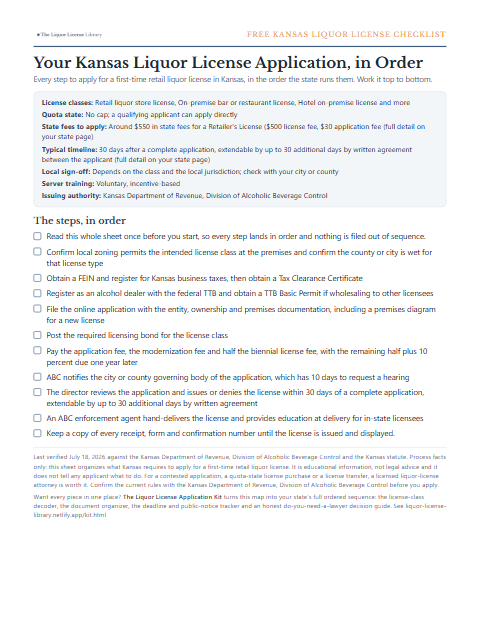
In Kansas, retail liquor licenses go through the Kansas Department of Revenue, Division of Alcoholic Beverage Control. A first-time applicant files with the state directly. Kansas sets no cap on the number of retail licenses, so there is no slot to wait for and no existing license to buy out. Work the page top to bottom and the whole path is visible before any single deadline is due.
Server training is voluntary here, an incentive rather than a licensing condition. Local involvement depends on the class and the jurisdiction. Each piece has its own section below, with the official source beside it.
The parts a Kansas applicant most often misses are the public-notice window, which runs on the state's schedule rather than yours and the order of the steps, since several gate the ones after them. The sections below take them in order.
Which liquor license does a Kansas bar, restaurant or store need?
The retail license classes Kansas issues, what each covers and the venue each fits. Match your venue to the class before anything else.
| Class | Covers | Who it fits |
|---|---|---|
| Retailer's License Retail liquor store license | off-premise, full spirits | Package sales of sealed original containers for consumption off the premises; the fit for a standalone liquor store. Not quota-limited. A standard business corporation cannot hold this class by statute; an individual, partnership, LLC or qualifying trust can hold it, with every partner, member or beneficiary required to independently meet the statutory qualifications. |
| Drinking Establishment (DE) On-premise bar or restaurant license | on-premise, full spirits | Sells and serves alcoholic liquor and cereal malt beverage for consumption on the premises, plus limited off-premise sales and free samples. Not quota-limited. The premises must sit in a county that has approved liquor-by-the-drink sales and local zoning must permit a drinking establishment at that address. |
| Drinking Establishment, Hotel Hotel on-premise license | on-premise, full spirits | Same DE privileges scoped to a hotel property; carries a higher biennial license fee than a standalone DE. |
| Class A Club / Class B Club Private club license | on-premise, full spirits | Members-only service with limited guest privileges; a Class A club may host specified non-member events and a Class B club may not. Fits a membership-based establishment rather than an open-to-the-public bar or restaurant. |
| Caterer License Caterer license | on-premise, full spirits | Covers serving alcoholic liquor at a temporary event on premises the licensee does not otherwise hold a license for; often combined with a DE license at a higher combined biennial fee. |
Is Kansas a quota or control state?
Whether Kansas caps the number of licenses and whether the state runs any part of retail itself. Both answers are no here, which is a big part of why Kansas is one of the simpler states to enter.
| Item | Kansas rule |
|---|---|
| Quota state? | No, there is no cap on the number of licenses |
| How the cap works | n/a. Neither the Retail Liquor Store Handbook nor the Handbook for Drinking Establishments describes a population ratio, numeric cap or moratorium on the number of Retailer's or Drinking Establishment licenses the state will issue. |
| Buying an existing license | n/a. Kansas retail liquor licenses are not bought and sold on a secondary market the way a numerically capped state's licenses are. A new applicant who meets the statutory qualifications applies directly to the state rather than waiting for a lottery or purchasing an existing license. |
| State control | No, private licensing throughout. Kansas is a private-license state for retail alcohol sales. Retail liquor stores and drinking establishments are privately owned and licensed rather than state-operated. The state does not run its own spirits retail or wholesale operation. |
How much does a liquor license cost in Kansas?
| Item | Kansas |
|---|---|
| State and local fees to apply | Around $550 in state fees for a Retailer's License ($500 license fee, $30 application fee, $20 modernization fee) and around $2,050 for a standard Drinking Establishment ($2,000 license fee, $30 application fee, $20 modernization fee), plus a local occupation tax charged by the city or township, $200 to $600 for a Retailer's License and $200 to $500 for a Drinking Establishment. |
| Renewal | Around $530 for a Retailer's License and around $2,030 for a standard Drinking Establishment ($10 renewal application fee plus the $20 modernization fee and the same biennial license fee), plus the same local occupation tax range. |
| What drives the range | The biennial license fee can be split, with half due at application and the remaining half plus 10 percent due one year later. These ranges exclude the licensing bond (a $2,000 escrow or surety bond for a Retailer's License, or the greater of $1,000 or 25 percent of estimated annual tax liability for a Drinking Establishment), which is a bond rather than a spent fee. |
The itemized fees a first-time Kansas applicant can expect from the state.
| Fee | Amount |
|---|---|
| Retailer's License biennial license fee | $500 |
| Retailer's License application fee, new | $30 |
| Retailer's License application fee, renewal | $10 |
| Modernization fee, all license types, new or renewal | $20 |
| Retailer's licensing bond | $2,000 (escrow or surety) |
| Drinking Establishment biennial license fee, standard | $2,000 |
| Drinking Establishment plus Caterer combined biennial license fee | $3,000 |
| Drinking Establishment, Hotel biennial license fee | $6,000 |
| Drinking Establishment liquor drink tax bond | the greater of $1,000 or 25 percent of estimated annual tax liability |
| Local occupation tax, city or township | Retailer's License $200 to $600 per K.S.A. 41-310; Drinking Establishment $200 to $500 per K.S.A. 41-2622; set by the city or township |
How long it takes. 30 days after a complete application, extendable by up to 30 additional days by written agreement between the applicant and the director. The 30-day clock starts once all required documentation is received. A city or county governing body notified of the application has 10 days to request a hearing, which runs alongside rather than before the state review. An incomplete application, a requested local hearing or an ABC deficiency notice all extend the practical timeline.
From the team behind this library
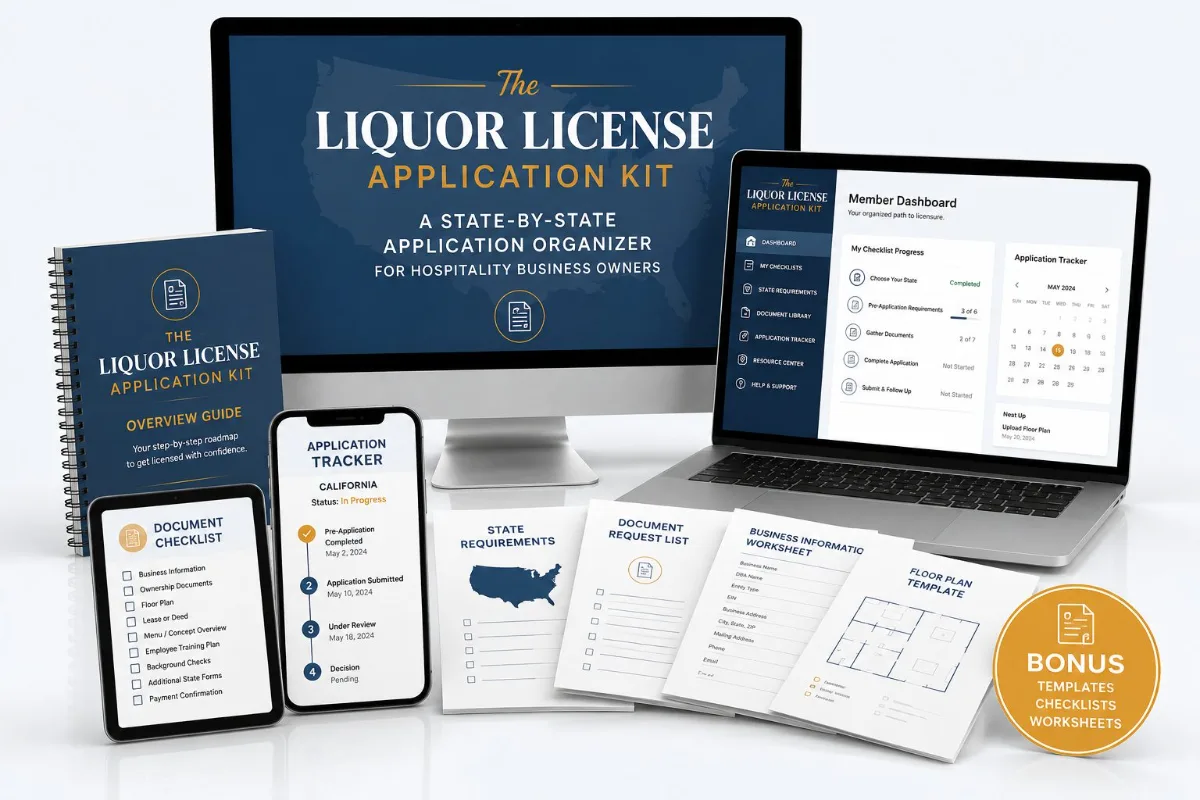
The Liquor License Application Kit
This page shows you the steps. The kit fills them in for Kansas. Your license class decoded, every document named and tracked, the deadline and public-notice windows dated and a straight answer on the one or two points that actually need a lawyer. The reference pages stay free. The kit is the evening of assembly you skip.
How to apply for a liquor license in Kansas, step by step
Several of these steps gate the ones after them, so the order matters as much as the list.
- Confirm local zoning permits the intended license class at the premises and confirm the county or city is wet for that license type
- Obtain a FEIN and register for Kansas business taxes, then obtain a Tax Clearance Certificate
- Register as an alcohol dealer with the federal TTB and obtain a TTB Basic Permit if wholesaling to other licensees
- File the online application with the entity, ownership and premises documentation, including a premises diagram for a new license
- Post the required licensing bond for the license class
- Pay the application fee, the modernization fee and half the biennial license fee, with the remaining half plus 10 percent due one year later
- ABC notifies the city or county governing body of the application, which has 10 days to request a hearing
- The director reviews the application and issues or denies the license within 30 days of a complete application, extendable by up to 30 additional days by written agreement
- An ABC enforcement agent hand-delivers the license and provides education at delivery for in-state licensees
Local approval and public notice in Kansas
The city or county layer on top of the state license, plus any notice you must post or publish. The public-notice window is often the shortest clock in the whole process.
| Item | Kansas rule |
|---|---|
| Local sign-off required? | It depends on the class and the jurisdiction |
| What the local layer does | Local city, township or county zoning must permit the license class at that address before the state will approve the application. Outside an incorporated city, the county commission must pass a resolution approving the license. A certified copy of that resolution goes in the application. For a Drinking Establishment, the premises must also sit in a wet county, approved either by a county commission liquor-by-the-drink resolution or by a county voter referendum. A city or county governing body can pass an ordinance restricting hours, or by voter referendum can prohibit retail alcohol sales entirely. |
| Public notice | No newspaper publication or premises-posting requirement was found in the ABC handbooks. Instead, ABC notifies the city or county governing body of a new or renewal application. That governing body then has 10 days from the notice to request a hearing on the application. |
| Worth knowing | Zoning compliance and, for a Drinking Establishment, wet-county status must already be true when the application is filed. The 10-day governing-body hearing window runs in parallel with the state's 30-day review rather than as a separate up-front local licensing step. Some counties historically layered a 30 percent food-sales condition onto a liquor-by-the-drink approval; House Bill 2059 (2023) removed that food-sales condition specifically for cereal malt beverage by-the-drink sales on Sundays. |
Server training in Kansas
Whether the people pouring or selling alcohol must certify through a state program, plus the deadline.
| Item | Kansas rule |
|---|---|
| Required for a first-time retailer? | Voluntary, an incentive rather than a licensing condition |
| Who must certify | n/a. No state law found requiring servers, sellers or managers to complete alcohol training as a condition of employment or licensure. |
| State program | n/a. No Kansas ABC administered or endorsed responsible-vendor training program was found in the primary sources checked. Commercial seller-server training courses that reference Kansas are privately operated, not a state-issued certification. |
| Worth knowing | Kansas law disqualifies an on-premise server from mixing, dispensing or serving alcohol if convicted of any felony, or if the server has three or more alcohol-related violations in five years or two or more furnishing-to-a-minor violations in five years, per the ABC Liquor Licensee Information Brochure. That is a conduct-based eligibility rule for individual servers rather than a training mandate. |
Background check and renewal in Kansas
Background check
| Item | Kansas rule |
|---|---|
| Background check required? | In some cases (see below) |
| Who is checked | Every individual owner, partner, LLC member or, for a Drinking Establishment, officer, director and stockholder with more than a 5 percent interest must meet the statutory qualifications. A non-Kansas-resident applicant must also appoint a Kansas resident as agent for service of process. Secondary sources indicate a non-resident applicant, or an applicant who has not been a Kansas resident for at least one year, must also submit fingerprints for a Kansas Bureau of Investigation and FBI national criminal history record check. This research confirmed a materially identical fingerprint clause in statute for a distributor's license but could not independently confirm the same clause in the text of the retail or drinking-establishment eligibility statute. |
| Disqualifiers | A felony conviction under Kansas law, any other state's law or federal law is a permanent bar to licensure, with no rehabilitation exception currently in Kansas law. Certain misdemeanor-related license revocations can be cured after 10 years. An applicant must be a United States citizen and at least 21 years old. Convictions tied to prostitution, gambling or other statutorily listed morality offenses also disqualify. |
| Worth knowing | A 2025 bill, Senate Bill 15, would have let the director issue a license to a person with a felony conviction more than 10 years old after a rehabilitation finding. It died in committee and never became law, so the felony bar remains permanent with no such exception as of this research. |
Renewal
| Item | Kansas rule |
|---|---|
| Renewal cycle | biennial |
| Worth knowing | The license renews for another two-year term automatically as long as the licensee and premises continue to meet the requirements, unless suspended or revoked. Renewal uses the same fee structure as a new application except the application fee drops to $10 from $30, while the $20 modernization fee and the full biennial license fee still apply, payable half at renewal and the remaining half plus 10 percent one year later. |