How to Get a Liquor License in Montana (2026): Cost, Classes and Steps
How do you get a liquor license in Montana?
In Montana, retail alcohol licenses are issued by the Cannabis and Alcohol Regulation Division inside the Department of Revenue. Most on-premise classes, including an all-beverages license for a full bar, a city beer and wine license and a restaurant beer and wine license, are capped by a population-based quota and, when none is available in the target area, awarded through a competitive bidding process rather than a lottery. Off-premise beer and wine retail is open with no quota, while off-premise spirits sale runs only through the state's separate agency liquor store franchise system.
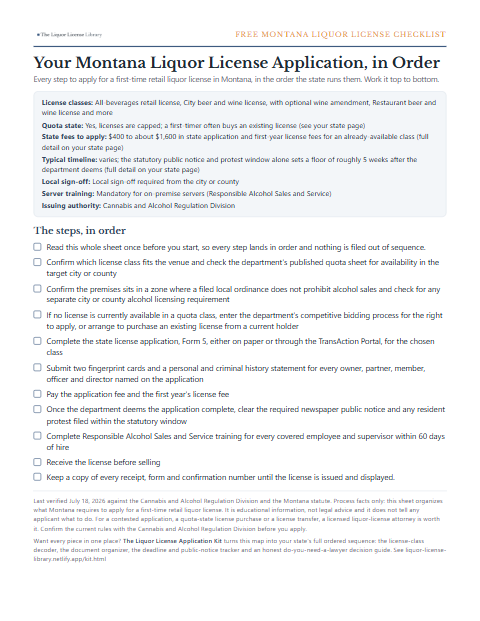
In Montana, retail liquor licenses go through the Cannabis and Alcohol Regulation Division. A first-time applicant files with the state directly. Montana caps the number of retail licenses, so a first-time applicant often buys an existing license and transfers it rather than obtaining a brand-new one. Work the page top to bottom and the whole path is visible before any single deadline is due.
Montana runs a partial control system, handling some spirits wholesale or retail itself while private retailers hold the on-premise and off-premise licenses. On-premise servers must certify through the state's named training program within its window. Every owner, officer and significant investor clears a background check. Each piece has its own section below, with the official source beside it.
The parts a Montana applicant most often misses are the public-notice window, which runs on the state's schedule rather than yours, the quota, which can make the license itself a far bigger cost than the state fee and the order of the steps, since several gate the ones after them. The sections below take them in order.
Which liquor license does a Montana bar, restaurant or store need?
The retail license classes Montana issues, what each covers and the venue each fits. Match your venue to the class before anything else.
Weighing beer and wine against a full bar? Montana is the clearest case in the country of a state where the annual fee barely separates the two classes while the auction does. Compare a beer and wine license with a full liquor license.
| Class | Covers | Who it fits |
|---|---|---|
| All-Beverages License (city, county, resort or airport) All-beverages retail license | on-premise, full spirits | Covers beer, wine and spirits together. Quota-limited class for a bar, tavern or full-liquor restaurant. Outside cities the cap is one license per 750 county residents; inside a city or town the cap is a tiered population table set in statute. |
| City Beer and Wine License City beer and wine license, with optional wine amendment | on-premise, beer and wine | Quota-limited by city population. A common first license for a small bar or tavern that does not serve spirits. |
| Restaurant Beer and Wine License Restaurant beer and wine license | on-premise, beer and wine | Quota-limited. Requires at least 65 percent of the restaurant's annual gross income to come from food rather than alcohol and at least half of total seats in the dining room. Restaurants with 101 or more seats are capped at 25 percent of the restaurant licenses allowed in the quota area. This class also carries a mandatory one-time initial licensing fee set by seating capacity, $5,000 at 60 seats or fewer, $10,000 at 61 to 100 seats and $20,000 at 101 seats or more, which is charged on top of the $400 processing fee and the $400 annual fee. |
| Off-Premises Beer and Table Wine Retail Sales License Off-premises beer and wine license | off-premise, beer and wine | Not subject to quota. Covers grocery stores, convenience stores and dedicated beer or wine shops. Spirits are excluded from this class; a grocery or convenience store cannot sell distilled spirits under it. |
| Agency Liquor Store Franchise Agency liquor store franchise agreement | off-premise, full spirits | Not a Department of Revenue retail license. A 10-year state franchise contract, renewable for further 10-year terms, awarded through a competitive Invitation for Bids under the Montana Procurement Act. This is the only lawful channel for off-premise spirits retail sale in Montana, so a first-time applicant cannot simply file a standard license application to sell packaged spirits. |
Is Montana a quota or control state?
Whether Montana caps how many licenses exist, how a capped license is obtained and whether the state runs any part of retail itself. This is where the real cost of a Montana license can hide.
| Item | Montana rule |
|---|---|
| Quota state? | Yes, the number of licenses is capped |
| How the cap works | One county all-beverages license for every 750 residents living outside incorporated cities and towns and their 5-mile limit. Inside an incorporated city or town, 16-4-201 sets a tiered population table, for example not more than two retail licenses in a town of 500 or fewer, rising in set increments as population grows, plus one additional license for each further increment of population in the largest cities. City beer and wine licenses and restaurant beer and wine licenses use their own population-based quota tables under 16-4-105 and 16-4-420. Off-premises beer and table wine retail licenses sit outside the quota entirely. |
| New licenses issued by | No lottery is currently codified. When a new quota license becomes available, whether from population growth raising a cap or an existing license lapsing, the department runs a competitive bidding process under 16-4-430 rather than a lottery. The highest qualifying bidder, at or above a minimum bid of 75 percent of comparable market value, wins the right to file the license application. Montana used a lottery for this purpose before a 2017 special-session law began replacing it with competitive bidding, a change fully in force by 2019 with further amendment in 2023; the old lottery administrative rule was repealed effective August 11, 2018. A 2026 news report describing an 18-license lottery could not be confirmed against a primary state announcement and may reflect an older, resurfaced story; treat any lottery claim for a current quota opening as unverified against the current statute. |
| Buying an existing license | Existing quota licenses also trade privately and can relocate within a quota area, subject to department transfer approval under 16-4-204. A license obtained through the competitive bidding process is not eligible to offer gambling. Winning competitive-bid prices published on the department's own results page run from $11,250 to $1,400,000 depending on license type and area, with the low end well under six figures (a 2023 Ronan award at $11,250, a 2023 City of Kevin award at $15,000, a 2025 City of Clyde Park award at $20,550); this is a market price for the license right rather than a state fee and is market-reported through the department's own listing rather than set by statute. |
| State control | Partial control. Montana controls the wholesale distribution and retail sale of distilled spirits through a state warehouse system and a network of privately operated agency liquor stores under franchise contract with the state. A private off-premise applicant cannot obtain a standalone department license to sell spirits and must instead pursue an agency liquor store franchise when the state solicits bids. Beer and wine retail and every on-premise license class remain privately owned and operated, though several of those classes are quota-capped. |
How much does a liquor license cost in Montana?
| Item | Montana |
|---|---|
| State and local fees to apply | Most classes run $400 to about $1,600; restaurant beer and wine adds a one-time $5,000 to $20,000 fee; those are the state application and first-year license fees, so a restaurant beer and wine applicant pays $5,800 to $20,800 in total once the $400 processing fee and the $400 annual fee are added, with the one-time fee set at $5,000, $10,000 or $20,000 by seating capacity. The common-class range moves with license type and city population. A resort all-beverages license carries a $100,000 initial state fee. Where the target quota area has no license currently open, a first-time all-beverages, city beer and wine or restaurant beer and wine applicant must also win a competitive bid or arrange a private purchase, at a market-set price that has run from $11,250 to $1,400,000 on the department's published results. |
| Renewal | $200 to $800 a year depending on class and city population, due by June 30 for the quota on-premise classes and on the anniversary month of the original application for off-premises beer and table wine licenses |
| What drives the range | State-published fees alone are modest. The real cost driver for most first-time on-premise applicants is the quota, not the state fee schedule; see the quota field for the competitive-bid and secondary-market figures. Off-premise beer and wine licenses avoid the quota and cost the least of any retail class. |
The itemized fees a first-time Montana applicant can expect from the state.
| Fee | Amount |
|---|---|
| All-beverages license application fee, original application only | $400 |
| All-beverages license fee and renewal fee | $400, higher in larger population quota areas under 16-4-501, up to $800 for cities over 10,000 |
| City beer and wine license application fee, original application only | $400 |
| City beer and wine annual renewal fee | $200 |
| Off-premises beer and wine retailer fee | $200 for beer only or table wine only, $400 for combined beer and table wine retailer |
| Restaurant beer and wine license, one-time initial licensing fee by seating capacity | $5,000 for 60 seats or fewer, $10,000 for 61 to 100 seats, $20,000 for 101 seats or more, on top of the $400 application processing fee and the $400 annual fee |
| Resort retail all-beverages license, initial fee | $100,000 |
| Competitive bid for a newly available quota license | minimum bid set at 75 percent of comparable market value; winning bids on the department's own published results table run from $11,250 to $1,400,000 depending on license type and area, with roughly a third of the 63 published awards below $115,000 and nine below $40,000 |
| Fingerprint and background check packet fee, per individual | Not published; confirm with the Cannabis and Alcohol Regulation Division |
How long it takes. Varies; the statutory public notice and protest window alone sets a floor of roughly 5 weeks after the department deems a new-license application complete, before adding time for the background investigation and, in a quota area with no license currently open, the competitive bidding process. For a new license, 16-4-207 requires newspaper publication once a week for 4 consecutive weeks, with a 10-day window for a resident protest after the final notice. A transfer of ownership or location uses a shorter 2-consecutive-week notice.
From the team behind this library
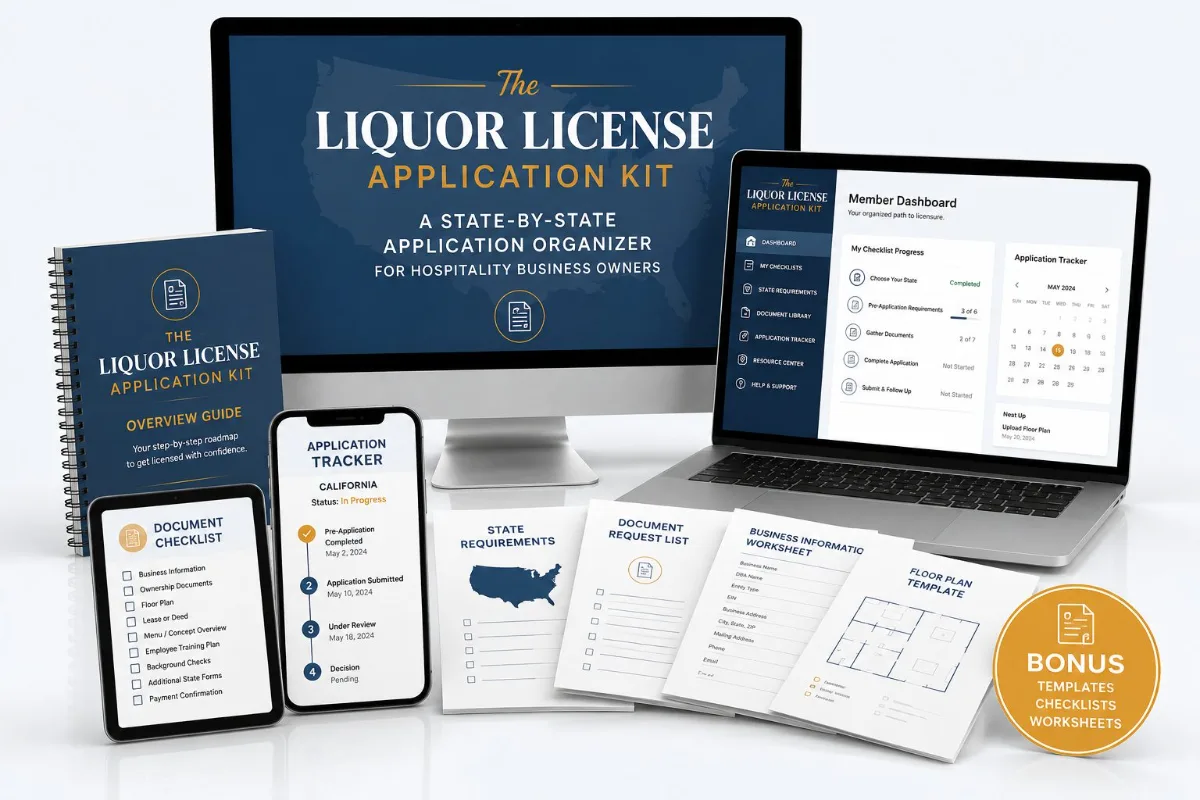
The Liquor License Application Kit
This page shows you the steps. The kit fills them in for Montana. Your license class decoded, every document named and tracked, the deadline and public-notice windows dated and a straight answer on the one or two points that actually need a lawyer. The reference pages stay free. The kit is the evening of assembly you skip.
How to apply for a liquor license in Montana, step by step
Several of these steps gate the ones after them, so the order matters as much as the list.
- Confirm which license class fits the venue and check the department's published quota sheet for availability in the target city or county
- Confirm the premises sits in a zone where a filed local ordinance does not prohibit alcohol sales and check for any separate city or county alcohol licensing requirement
- If no license is currently available in a quota class, enter the department's competitive bidding process for the right to apply, or arrange to purchase an existing license from a current holder
- Complete the state license application, Form 5, either on paper or through the TransAction Portal, for the chosen class
- Submit two fingerprint cards and a personal and criminal history statement for every owner, partner, member, officer and director named on the application
- Pay the application fee and the first year's license fee
- Once the department deems the application complete, clear the required newspaper public notice and any resident protest filed within the statutory window
- Complete Responsible Alcohol Sales and Service training for every covered employee and supervisor within 60 days of hire
- Receive the license before selling
Local approval and public notice in Montana
The city or county layer on top of the state license, plus any notice you must post or publish. The public-notice window is often the shortest clock in the whole process.
| Item | Montana rule |
|---|---|
| Local sign-off required? | Yes, a city or county sign-off is part of the path |
| What the local layer does | The department will not issue a retail license for a premises inside a city, town or county zone where a filed local ordinance prohibits alcohol sales. Many cities also require their own separate business or alcohol license and set their own annual fee by city council resolution, layered on top of the state license. |
| Public notice | For a new license, the department publishes notice once a week for 4 consecutive weeks in a newspaper of general circulation in the applicant's city, town or county. Residents of that county, an adjoining Montana county, or in some cases an adjoining out-of-state county, may file a written protest within 10 days after the final notice. A transfer of ownership or location uses a shorter 2-consecutive-week notice. |
| Worth knowing | Public notice and protest run through the state under 16-4-207 rather than a separate local hearing process, though local zoning and any city-level licensing still apply in parallel. Whether a given city also holds its own council hearing on a new license varies by local ordinance and was not verified for every municipality. |
Server training in Montana
Whether the people pouring or selling alcohol must certify through a state program, plus the deadline.
| Item | Montana rule |
|---|---|
| Required for a first-time retailer? | Yes, mandatory for on-premise servers |
| Who must certify | Every employee authorized to sell, serve or deliver alcoholic beverages in the normal course of employment and that employee's immediate supervisor |
| State program | Responsible Alcohol Sales and Service (RASS) training, certified by the Department of Revenue under 16-4-1006. Since a 2025 law change, the department certifies two separate tracks: a full-length program for employees at locations that allow on-premises consumption and a shorter program for employees at off-premises-only locations that must run at least half the length of the on-premises program. |
| Deadline | Within 60 days of the employee's date of hire and recertification every 3 years after initial training |
| Worth knowing | The licensee must keep employment records proving each covered employee's training completion. The two-track on-premises and off-premises split comes from 2025 session law, Chapter 107 and Chapter 111, with an effective date of January 2026 for the revised program structure. |
Background check and renewal in Montana
Background check
| Item | Montana rule |
|---|---|
| Background check required? | Yes |
| Who is checked | Owners, partners, members, officers and directors named on the license application each submit two fingerprint cards and a personal and criminal history statement, Form 10. The Department of Justice Gambling Control Division runs the state and federal criminal history check and conducts an applicant interview. A 2025 law, House Bill 735, widened the range of license types and ownership roles subject to fingerprinting and background review. |
| Disqualifiers | Under 16-4-401 MCA an applicant must be at least 19 years old and may not have a felony conviction unless the applicant's rights have been restored. The statute sets no fixed lookback window for a prior conviction. Additional statutory bars reach unsuitable funding sources, holding an excessive ownership interest in retail licenses within a quota area and undisclosed tied-house affiliations with a manufacturer, importer or distributor. |
| Worth knowing | The same combined personal and criminal history statement and fingerprint packet is used for gambling operator licensing, reflecting how often a Montana on-premise license is paired with a gambling endorsement. Fingerprints are taken at a local law enforcement agency or the Department of Justice ID Bureau. |
Renewal
| Item | Montana rule |
|---|---|
| Renewal cycle | annual |
| Worth knowing | June 30 is the annual renewal date for the quota on-premise classes (all-beverages, city beer and wine, restaurant beer and wine). Off-premises beer and table wine licenses renew on a different clock: the last day of the month in which the department received the original license application, so the deadline is the licensee's own anniversary month rather than June 30. A graduated late penalty applies to both under 16-4-501: one third of the license fee from day one of delinquency, rising to two thirds a month later and the full fee amount again a month after that. |