How to Get a Liquor License in Delaware (2026): Cost, Classes and Steps
How do you get a liquor license in Delaware?
In Delaware every retail liquor license comes from one statewide office, the Office of the Alcoholic Beverage Control Commissioner. Restaurants, hotels, taverns and taprooms hold on-premise licenses while off-premise bottle sales run through the store license, with the common classes at a $1,000 biennial fee plus a $1,000 application fee. Delaware is not a quota state, though new package stores and taprooms must clear distance separation rules and the cap on package store licenses is two: the Commissioner refuses a license to an applicant who already holds an interest in 2 or more, so a person may hold up to 2 and is barred from a third.
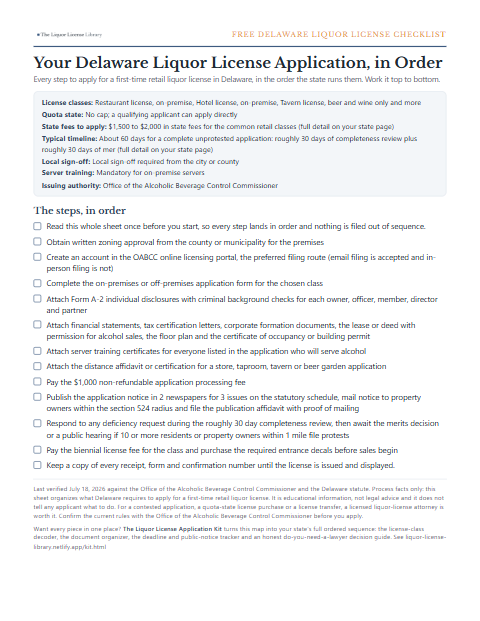
Delaware runs its retail liquor licensing through the Office of the Alcoholic Beverage Control Commissioner. The application is filed with the state. Delaware sets no cap on the number of retail licenses, so there is no slot to wait for and no existing license to buy out. The page below lays the pieces out in the order the state runs them.
On-premise servers must certify through the state's named training program within its window. Every owner, officer and significant investor clears a background check. A city or county sign-off is part of the path. Each piece has its own section below, with the official source beside it.
HB 187 was passed and takes effect August 2026. Delaware enacted HB 187 creating a wine-direct-shipper license. It begins in August 2026; the current retail licensing path is unchanged until then. This page reflects the rule in force today; we update it the day the change takes effect. The full history sits in the law-updates log.
Which liquor license does a Delaware bar, restaurant or store need?
The retail license classes Delaware issues, what each covers and the venue each fits. Match your venue to the class before anything else.
| Class | Covers | Who it fits |
|---|---|---|
| Restaurant Restaurant license, on-premise | on-premise, full spirits | For venues serving complete meals; a menu is part of the application and OABCC Rule 202 sets a 3 to 1 dining-to-bar seating ratio. Non-quota and no distance test. $1,000 biennial fee. Alcohol to go is allowed with a food purchase of at least $10 under section 512. |
| Hotel Hotel license, on-premise | on-premise, full spirits | For hotels serving guests and patrons; complete meal service applies as with restaurants. Non-quota. $1,000 biennial fee. |
| Tavern Tavern license, beer and wine only | on-premise, beer and wine | Beer and wine for on-premise consumption without the restaurant meal framework. Subject to the taproom and tavern distance rules. $500 biennial fee. |
| Taproom Taproom license, on-premise | on-premise, full spirits | The bar-format class with no complete meal requirement. Subject to distance rules: no existing taproom, tavern or beer garden within 1,200 feet by accessible public road in an incorporated city or town or within nine tenths of a mile in an unincorporated or rural area. $1,000 biennial fee, or $500 for a beer and wine taproom. |
| Store Store license, off-premise package sales | off-premise, full spirits | The package store class for bottle sales not consumed on the premises. Subject to distance rules: no existing package store within a half mile by accessible public road in an incorporated city or town or within 3 miles in an unincorporated or rural area. Section 546 caps any person at an interest in 2 package store licenses. $1,000 biennial fee with optional in-store tasting and growler filling endorsements at $150 each. |
Is Delaware a quota or control state?
Whether Delaware caps the number of licenses and whether the state runs any part of retail itself. Both answers are no here, which is a big part of why Delaware is one of the simpler states to enter.
| Item | Delaware rule |
|---|---|
| Quota state? | No, there is no cap on the number of licenses |
| State control | No, private licensing throughout. License state with privately owned retail. The state does not run retail or wholesale liquor operations; private package stores handle off-premise sales under OABCC licenses. |
How much does a liquor license cost in Delaware?
| Item | Delaware |
|---|---|
| State and local fees to apply | $1,500 to $2,000 in state fees for the common retail classes, the $1,000 application fee plus a $500 or $1,000 biennial license fee, before newspaper publication and local zoning costs |
| Renewal | $500 to $1,000 every 2 years by class |
| What drives the range | Class drives the range. A license issued for less than 2 years prorates at one twenty-fourth of the biennial fee per month under section 553. Delaware has no quota purchase layer, so state fees are the whole license cost. |
The itemized fees a first-time Delaware applicant can expect from the state.
| Fee | Amount |
|---|---|
| Application processing fee | $1,000 non-refundable |
| Biennial license fee: restaurant, hotel, taproom or store | $1,000 |
| Biennial license fee: tavern or beer and wine taproom | $500 |
| In-store tasting endorsement (store license) | $150 |
| Growler filling endorsement (store license) | $150 |
| Newspaper publication and mailed notice costs | varies by newspaper and mailing list size |
How long it takes. About 60 days for a complete unprotested application: roughly 30 days of completeness review plus roughly 30 days of merits review. The OABCC FAQ describes an initial review within 30 days of receipt to identify missing items, then about 30 days of merits review once the file is complete. The section 524 protest deadline falls at least 30 days after filing and a public hearing, triggered by 10 or more qualified protests, extends the process.
From the team behind this library
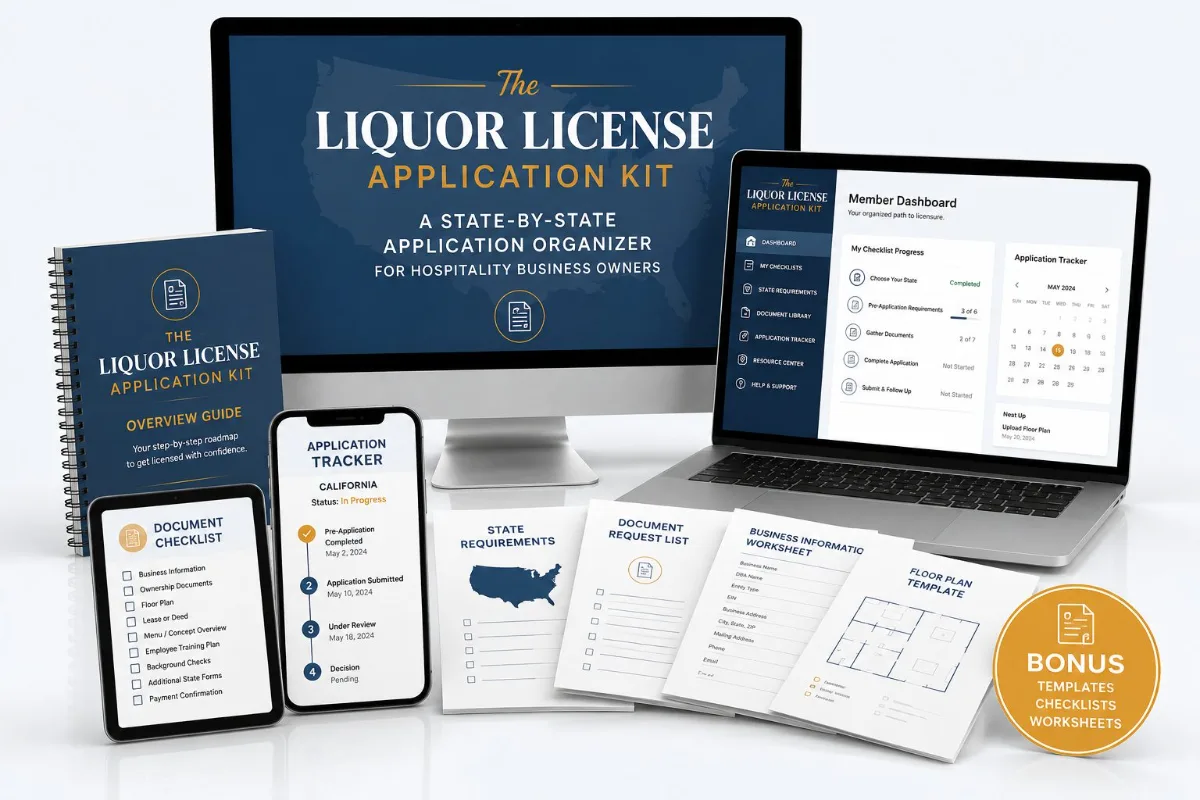
The Liquor License Application Kit
This page shows you the steps. The kit fills them in for Delaware. Your license class decoded, every document named and tracked, the deadline and public-notice windows dated and a straight answer on the one or two points that actually need a lawyer. The reference pages stay free. The kit is the evening of assembly you skip.
How to apply for a liquor license in Delaware, step by step
Several of these steps gate the ones after them, so the order matters as much as the list.
- Obtain written zoning approval from the county or municipality for the premises
- Create an account in the OABCC online licensing portal, the preferred filing route (email filing is accepted and in-person filing is not)
- Complete the on-premises or off-premises application form for the chosen class
- Attach Form A-2 individual disclosures with criminal background checks for each owner, officer, member, director and partner
- Attach financial statements, tax certification letters, corporate formation documents, the lease or deed with permission for alcohol sales, the floor plan and the certificate of occupancy or building permit
- Attach server training certificates for everyone listed in the application who will serve alcohol
- Attach the distance affidavit or certification for a store, taproom, tavern or beer garden application
- Pay the $1,000 non-refundable application processing fee
- Publish the application notice in 2 newspapers for 3 issues on the statutory schedule, mail notice to property owners within the section 524 radius and file the publication affidavit with proof of mailing
- Respond to any deficiency request during the roughly 30 day completeness review, then await the merits decision or a public hearing if 10 or more residents or property owners within 1 mile file protests
- Pay the biennial license fee for the class and purchase the required entrance decals before sales begin
Local approval and public notice in Delaware
The city or county layer on top of the state license, plus any notice you must post or publish. The public-notice window is often the shortest clock in the whole process.
| Item | Delaware rule |
|---|---|
| Local sign-off required? | Yes, a city or county sign-off is part of the path |
| What the local layer does | The state issues the license but the application requires written zoning approval from the county or municipality, a certificate of occupancy or a building permit and any required county or municipal business license. Distance rules from existing like licenses apply to store, taproom, tavern and beer garden applications. |
| Public notice | Notice published in at least 2 newspapers circulated in the community for 3 issues on the statutory schedule plus mailed notice to property owners near the premises, within 200 feet as the standard radius or 1,000 feet for certain premises. Protests are due by the deadline in the notice, at least 30 days after filing. |
| Worth knowing | State-first filing with the local proofs attached. No separate local liquor board exists; the community's voice runs through the section 524 notice and the section 541 protest hearing, which requires 10 or more protest signatures from residents or property owners within 1 mile with at least 5 preregistered to testify. |
Server training in Delaware
Whether the people pouring or selling alcohol must certify through a state program, plus the deadline.
| Item | Delaware rule |
|---|---|
| Required for a first-time retailer? | Yes, mandatory for on-premise servers |
| Who must certify | Covered employees under 4 Del. C. § 1202(d) are those employed at least 30 days who work at least 10 hours a week and who sell, prepare, dispense, serve or deliver alcohol to patrons, plus managers and owner-operators who run the establishment; the mandate covers on-premise licensees from July 1 1992 and off-premise store licensees from January 1 1997 |
| State program | Delaware Responsible Alcoholic Beverage Server Training Program under 4 Del. C. ch. 12, delivered through Commissioner-approved courses |
| Deadline | Under 4 Del. C. § 1202(e) the Commissioner may grant or renew a license conditional on the required certification being provided within 30 days of the grant or renewal. Retaking the course is required at each biennial renewal |
| Worth knowing | Gathering and tasting licenses under sections 514 and 525 are exempt per § 1203(e). The Commissioner can fine a licensee, bar an untrained employee from serving or suspend a server training card for violations. A certification is valid for 2 years, shortened from 4 years by HB 195 in 2026. That 2 year clock runs from the individual's own certification date rather than from the licensee's renewal date (4 Del. C. 1205). |
Background check and renewal in Delaware
Background check
| Item | Delaware rule |
|---|---|
| Background check required? | Yes |
| Who is checked | Each owner, officer, member, director and partner files Form A-2 individual disclosures and the OABCC requires official criminal background checks; each person with an ownership interest of 10 percent or greater also files a financial statement and a tax certification letter |
| Disqualifiers | Section 543 grounds for refusal include an applicant who appears financially irresponsible and certain criminal convictions including drug offenses; the statute does not present a single lookback table and exact windows are not independently confirmed |
| Worth knowing | Existing OABCC licensees may file an affidavit declaring no disqualifying record changes, no state tax liability and no adverse financial change in lieu of some documentation. Financial responsibility proof is part of every new application. |
Renewal
| Item | Delaware rule |
|---|---|
| Renewal cycle | biennial |
| Worth knowing | All licenses run 2 years under section 552 on the schedule in OABCC Rule 701. An October 2024 rule update moved renewals online, set a 30 day renewal notice and added late penalties; an unrenewed license is cancelled. Server retraining is required on each individual's own 2 year certification cycle under 4 Del. C. 1205 rather than on the licensee's renewal date. |