How to Get a Liquor License (2026): the Six Steps, by State
Six pieces, one order and a quota that can reshape the whole budget. Your state page fills in the exact rules.
Getting a retail liquor license is six pieces in a fixed order: match your venue to a license class, clear local zoning and the city or county sign-off, gather the documents and personal-history disclosures, post or publish any required public notice, pass the background check and pay the fees, then wait out the state review. The order matters as much as the list, because several steps gate the ones after them. What changes at the state line is every detail inside those six, which is why the answer always ends at your own state page.
Two forks worth taking before you read on. If you are the person being hired to pour or sell rather than the person opening the venue, the credential you want is the personal one: see the alcohol server permit guide. If you are opening a package store rather than a bar or a restaurant, that class runs on its own rules: see how to open a liquor store.
Getting a retail liquor license means coordinating several offices at once: a state alcohol authority or a local licensing board, your city or county zoning and building departments, sometimes a fire marshal and, where the state requires it, a server-training program. Each publishes its own piece of the process and none of them publishes the order. This guide walks the license side in the sequence it actually runs, so you can see the whole path before you act on any single piece of it. Your state page fills in the exact rules, because every one of these pieces changes at the state line.
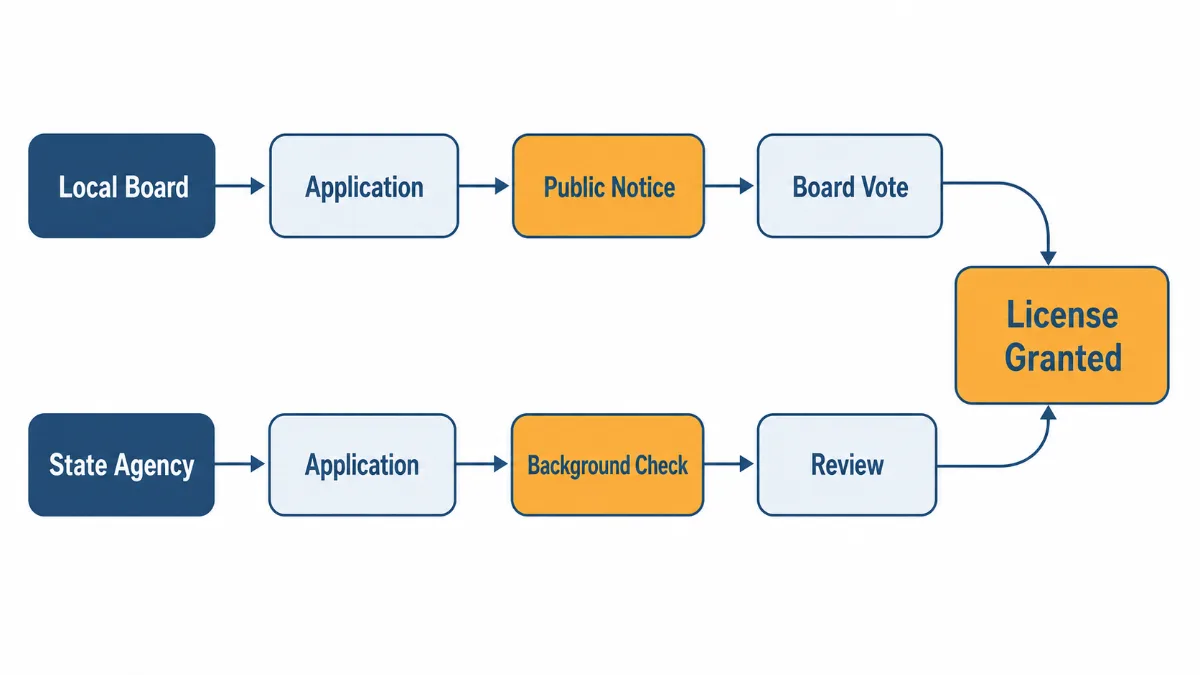
The six pieces of the path, in the usual order
- Match your venue to a license class. A bar, a full-service restaurant, a beer-and-wine cafe and a package store each need a different class. The class decides the fee, the quota exposure and whether server training applies. Getting this wrong at the start is what sends an application back. Your state page lists the classes and the venue each one fits. The license category tool walks you to the family to look for in four questions.
- Confirm local zoning and get the city or county sign-off. In 35 states a city or county board, a zoning certification or a local governing-body approval is part of the path, often obtained before or alongside the state application. A premises the local zoning does not allow cannot be licensed, so this comes early.
- Gather the documents and the personal-history disclosures. The application ties together the lease or deed, a floor plan, entity-formation papers, a tax registration and a personal-history disclosure for every owner and officer. The long-lead items are the disclosures and the fingerprinting, so start those first.
- Post or publish any required public notice. Public notice is near-universal in some form: a premises posting for a set window, newspaper publication, or an abutter or community-board notice. The window is one of the shortest clocks in the process and it runs on the state's schedule, not yours.
- Pass the background check and pay the fees. A fingerprint-based background check on the owners and officers is effectively universal. The state and local fees are due with the application. The fee is rarely the expensive part in a quota state, where the license itself dwarfs it.
- Wait out the review and, in a quota state, secure the license itself. Once the packet is complete, the authority investigates and issues the license. Where a quota is full, that means buying an existing license and applying for a transfer rather than obtaining a new one, a separate track that runs on its own timeline.
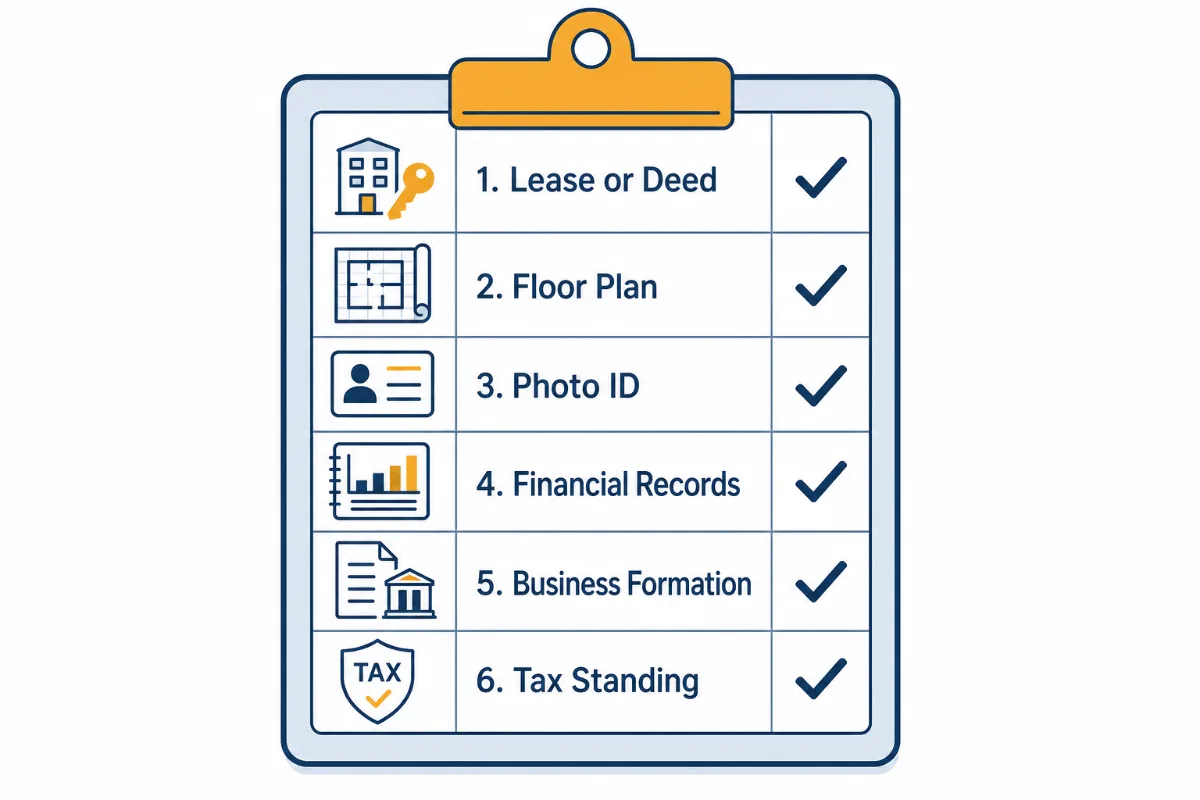
Where the process most often goes wrong
Three patterns come up again and again. The first is order: several steps gate the ones after them, so a document gathered out of sequence, or an application filed before the zoning sign-off, adds waiting time. The second is the public-notice window, which a first-time applicant often does not know is running until it has nearly closed. The third is the quota, where an owner budgets a few hundred dollars in state fees and only later learns the license itself is a capped, privately traded asset. The fix for all three is the same, seeing the whole path for your state before acting on any single piece of it.
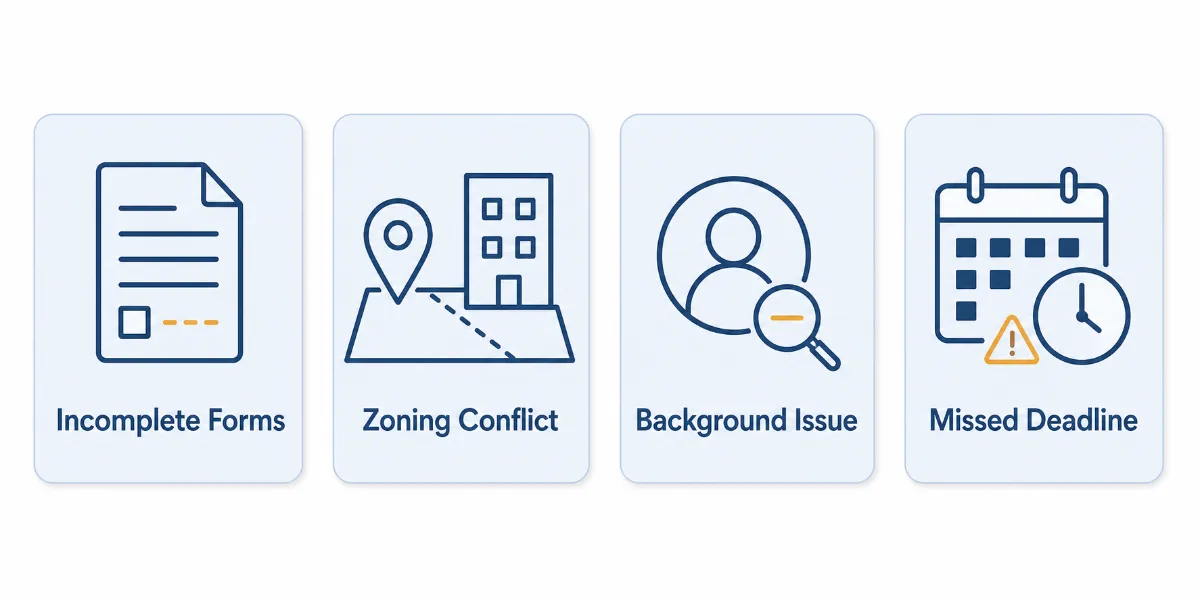
Put the whole application in order in one evening
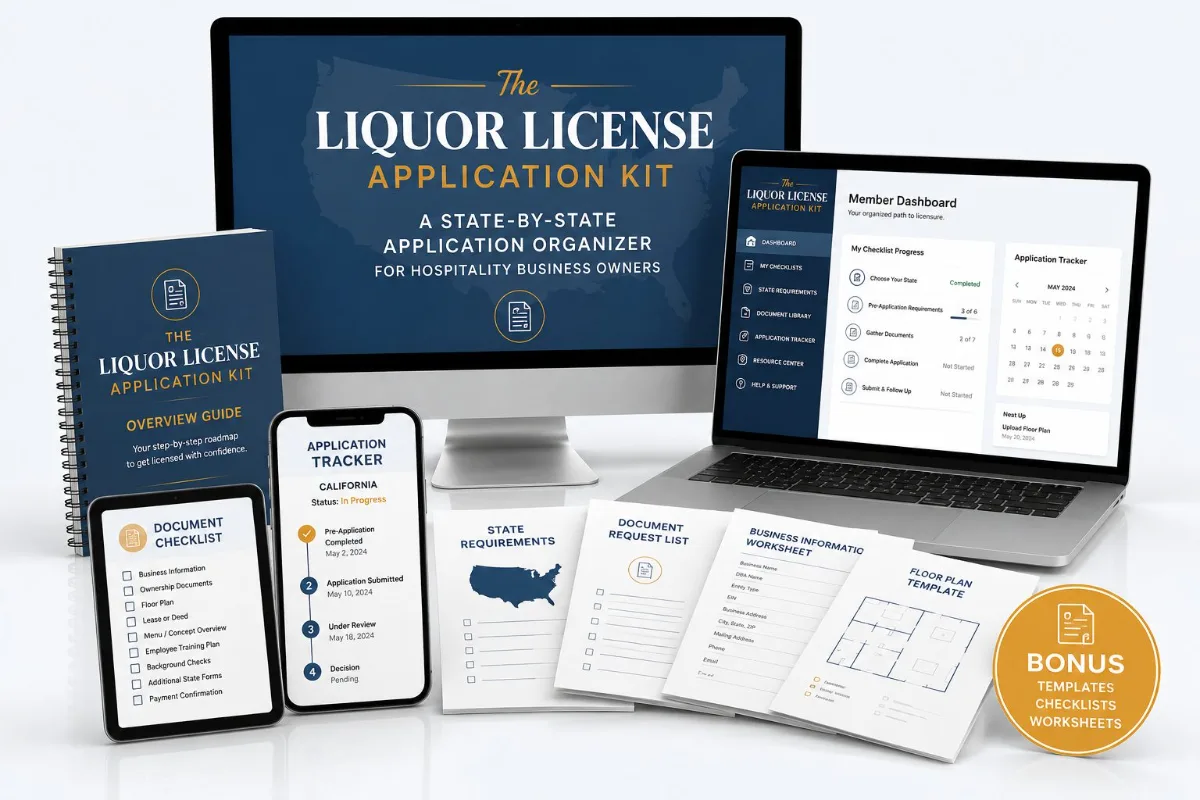
From the team behind this library
The Liquor License Application Kit
Want the whole path in one place? The Liquor License Application Kit hands you the done pieces for your state: the 51-jurisdiction directory and state selector, the license-class decoder, the dependency-ordered filing checklist, the document-gathering organizer, the deadline and public-notice tracker and an honest do-you-need-a-lawyer decision guide.
Your state and county set which license classes are capped and what the fees are. Find your state in the directory for the classes, the quota status and the fees, each cited to that state's statute or alcohol authority.
Find your state
Open your state's page for the license classes, the quota and control-state status, the real fees and timeline and the ordered steps to apply, each cited to the state statute or alcohol authority and dated.
This guide is educational information, not legal advice and it does not tell any applicant what to do. For a contested application, a quota-state license purchase or a license transfer, talk to a licensed liquor-license attorney. Confirm the current rules with your state before you apply.
Getting a liquor license FAQ
How long does it take to get a liquor license?
It depends on the state and the class. A complete application clears in about 10 to 21 days in the fastest states, while a state investigation commonly runs 55 to 90 days elsewhere. A full-spirits license in a quota county can take far longer, because the priority drawing or the private purchase happens first. Local hearings, an incomplete document packet and a public-notice window all extend it.
How much does a liquor license cost?
The state and local fees run from about $50 for a small beer license to several thousand dollars for a full-spirits class, with most first small venues landing in the $200 to $2,000 band. In a quota state the license itself is the real cost, because an existing license trades privately for five or six figures. The cost guide breaks the bands down by state.
Do I need a lawyer to get a liquor license?
For a straightforward first application at a non-quota venue, most of the work is organizing and form-filling that an owner can do without counsel. An attorney earns the fee in specific situations: a contested application, a quota-state license purchase, a license transfer, a prior denial or a complicated ownership or personal-history issue. The honest split is worth knowing before you hand over $6,000 to $15,000 for paperwork.
What is a quota state?
A quota state caps the number of retail liquor licenses, usually by a population ratio or a fixed count, so new licenses are scarce and an existing one is bought and transferred rather than issued fresh. Thirteen states run a hard quota and sixteen more cap only certain classes. The quota states guide explains what that means for a first-time buyer.
Who issues liquor licenses?
Each state runs its own alcohol authority: a state ABC board, a state liquor commission, a department of revenue division or, in a few states, the county or city itself. That agency sits inside the three-tier system the country has used since Prohibition ended, which keeps producers, wholesalers and retailers separate and licenses each tier. A first-time retailer usually deals with the state authority plus a local city or county sign-off. Your state page names the exact agency and links its official site.
Can you apply for a liquor license online?
In some states yes. More are moving that way. New Mexico moved fully to its NM-PLUS portal in 2024 and stopped accepting paper. Ohio moved new permit applications onto its OPAL system in 2025. Florida shifted retail applications to an online-only account. Most states still take a paper or in-person packet for at least part of the filing, often because notarized personal-history affidavits or fingerprinting have to be done in person. Your state page names the filing office and links its portal where one exists.
When should you apply for a liquor license?
As early as your premises and lease are settled, because the license is often the longest lead item in an opening. Build backward from your target opening date and the processing window your state page lists: a fast state clears a complete application in about 10 to 21 days, while a state investigation elsewhere commonly runs 55 to 90 days. A quota-county full-spirits license can take far longer. The public-notice window and any local hearing add fixed time you cannot compress, so starting the paperwork before you sign for fixtures usually pays off.
What disqualifies you from getting a liquor license?
The common bars are a recent felony conviction, a crime involving alcohol or moral turpitude, an unpaid tax or support obligation in some states and being under 21. Most states weigh a conviction case by case rather than as an automatic lifetime ban. Several look back only a set number of years (Florida shortened its felony lookback to 10 years in 2024). A false statement on the application itself is its own ground for denial. Two more checks apply in several states: residency (Iowa asks a sole proprietor to be an Iowa resident, Massachusetts requires it for its store class and Arizona requires applicants and managers to be bona fide state residents) and a recent license revocation, within one year in Arizona or two years in New York, while West Virginia asks whether any owner or manager previously held a revoked or sanctioned license. Your state page names the exact disqualifiers its statute lists.
Can you get a beer and wine license with a felony?
Often yes, though it depends on the state, the offense and how long ago it was. A felony is rarely an automatic lifetime bar to a retail license; most states review the record case by case and weigh how recent and how relevant the conviction is. A beer-and-wine class is judged under the same eligibility rules as a full-liquor class in most states, so the conviction matters more than the beverage tier. Disclose it on the application rather than omit it, because a false statement is itself a separate ground for denial. Your state page lists the disqualifiers and any lookback window.
More questions about applying
What do you need to get a liquor license?
Five things turn up on nearly every application regardless of state. Premises you own, lease or are in the process of acquiring, because most states will not consider an application without an address. Entity papers and a tax registration if you are applying as a company. A floor plan or premises diagram. A personal-history disclosure plus fingerprints for every owner and officer, which is the longest-lead item and the one to start first. And the local sign-off or zoning certification, which in 35 states is part of the path. Your state page lists the exact packet.
How do I apply for a liquor license for a restaurant?
A restaurant applies for an on-premise class. The first decision is whether you pour spirits. A beer-and-wine on-premise class usually costs less and, in a capped state, often sits outside the quota, while a full-spirits class can mean buying an existing license in a capped county. After the class, the path is the same six steps as any other venue. Many states also attach a food-service condition to the restaurant class, such as a minimum share of revenue from food or a requirement to keep meals available during service hours.
Is a liquor license the same as a server permit?
No. A liquor license authorises a business to sell alcohol at a specific address and it is issued to the owner or the entity. A server permit is a personal credential held by the individual who pours or sells. They are separate applications with separate fees. In about 16 states the personal one is mandatory for every server, with several more requiring it of the licensee or a designated manager instead. A bar owner who works behind their own bar often needs both.
Can you apply for a liquor license before you have a location?
In most states, not fully. The application ties to a specific premises, so the address, the lease or deed and the floor plan are usually required. The local zoning sign-off is about that address rather than about you. What you can do early is the part that travels with the person rather than the property: the entity formation, the tax registration, the personal-history disclosures and the fingerprinting, which are the slowest items in the packet. Your state page states which pieces its application requires up front.
Do you need a liquor license for a one-off event?
Usually a different document rather than the full retail license. Most states issue a temporary or special-event permit for a one-day festival, fundraiser or private function, handled on its own short form and often at a small fee. It is a separate category from the first-time fixed-premises retail license this library covers. Your state alcohol authority publishes the temporary permit form separately. A caterer serving at a venue may need its own permit on top.