How to Get a Liquor License in Oklahoma (2026): Cost, Classes and Steps
How do you get a liquor license in Oklahoma?
In Oklahoma, retail alcohol licenses are issued by the Alcoholic Beverage Laws Enforcement Commission, known as the ABLE Commission. A first-time applicant picks an on-premises class such as Mixed Beverage for full spirits or Beer and Wine for a lighter bar or restaurant menu, or an off-premises class such as Retail Spirits, Retail Wine or Retail Beer for a store. Oklahoma sets no statewide quota on how many of these licenses it issues, though the state's main structural quirk is that a Retail Spirits (package store) license can only be held by an individual or a general partnership, never a corporation or an LLC.
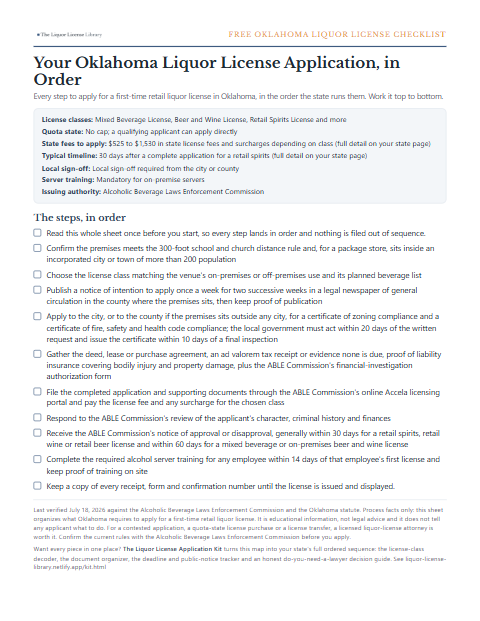
In Oklahoma, retail liquor licenses go through the Alcoholic Beverage Laws Enforcement Commission. A first-time applicant files with the state directly. Oklahoma sets no cap on the number of retail licenses, so there is no slot to wait for and no existing license to buy out. Work the page top to bottom and the whole path is visible before any single deadline is due.
On-premise servers must certify through the state's named training program within its window. Every owner, officer and significant investor clears a background check. A city or county sign-off is part of the path. Each piece has its own section below, with the official source beside it.
The parts an Oklahoma applicant most often misses are the public-notice window, which runs on the state's schedule rather than yours and the order of the steps, since several gate the ones after them. The sections below take them in order.
Which liquor license does an Oklahoma bar, restaurant or store need?
The retail license classes Oklahoma issues, what each covers and the venue each fits. Match your venue to the class before anything else.
| Class | Covers | Who it fits |
|---|---|---|
| MXB Mixed Beverage License | on-premise, full spirits | Standard license for a bar, restaurant or similar venue serving spirits, wine and beer by the drink. Open to a corporation, an LLC, a partnership or an individual. A prospective stockholder, officer, director, manager or majority member is screened for a felony conviction within the 15 years before applying, extended to 25 years for an alcohol-related or violent felony. |
| BAW Beer and Wine License (on-premises) | both, beer and wine | Common first license for a smaller restaurant, bar, golf course or bowling center that will not serve spirits. A golf course, country club or marina holding this license may also sell up to two sealed packages per person for off-premises use. |
| RET Retail Spirits License | off-premise, full spirits | The dedicated liquor or package store license; it also covers wine and beer sold from the same counter. Can be issued only to an individual or a general partnership, never a corporation or an LLC. No person may hold an interest in more than two package stores statewide. The store must also sit inside an incorporated city or town of more than 200 population. |
| REW Retail Wine License | off-premise, wine | Off-premises wine-only license for a grocery, convenience store or similar retailer; capped at wine of 15 percent alcohol by volume or less. |
| REB Retail Beer License | off-premise, beer | Off-premises beer-only license for a convenience store, grocery or gas station; capped at a malt beverage of 15 percent alcohol by volume or less under 37A O.S. 2-109(C) as amended in 2024. |
Is Oklahoma a quota or control state?
Whether Oklahoma caps the number of licenses and whether the state runs any part of retail itself. Both answers are no here, which is a big part of why Oklahoma is one of the simpler states to enter.
| Item | Oklahoma rule |
|---|---|
| Quota state? | No, there is no cap on the number of licenses |
| State control | No, private licensing throughout. Oklahoma runs a fully private three-tier system. Manufacturers, the Wine and Spirits Wholesaler License and Beer Distributor License holders and every retail class are all privately owned and licensed by the ABLE Commission. There is no state-run store and no state wholesale monopoly, so a private off-premises applicant sells under a state license rather than through a state agency. |
How much does a liquor license cost in Oklahoma?
| Item | Oklahoma |
|---|---|
| State and local fees to apply | $525 to $1,530 in state license fees and surcharges depending on class, plus the cost of the required newspaper publication and any local zoning, fire or health certificate fee the city or county charges |
| Renewal | $475 to $1,430 per year by class, the same figure as the initial fee for most classes except mixed beverage and on-premises beer and wine, which renew below their initial fee |
| What drives the range | The retail spirits fee is set by the population of the city or town under the latest Federal Decennial Census, from $455 total in a small town to $1,155 total in a city over 5,000 people. Mixed beverage carries the highest total because of its added $500 administrative fee. |
The itemized fees a first-time Oklahoma applicant can expect from the state.
| Fee | Amount |
|---|---|
| Retail Spirits License, city or town population 200 to 2,500 | $305 license fee plus a $150 surcharge, due annually |
| Retail Spirits License, city or town population 2,501 to 5,000 | $605 license fee plus a $200 surcharge, due annually |
| Retail Spirits License, city or town population over 5,000 | $905 license fee plus a $250 surcharge, due annually |
| Retail Wine License | $1,000 license fee plus a $250 surcharge, due annually |
| Retail Beer License | $500 license fee plus a $250 surcharge, due annually |
| Mixed Beverage License | $1,005 initial or $905 renewal, plus a $25 surcharge and a separate $500 administrative fee |
| On-Premises Beer and Wine License | $500 initial or $450 renewal, plus a $25 surcharge |
| Employee License, required for staff who sell, serve or mix alcohol | $30, valid for two years |
| Denied-application refund deduction | the ABLE Commission refunds a denied applicant's fee minus a 10 percent processing retention |
How long it takes. 30 days after a complete application for a retail spirits, retail wine or retail beer license and 60 days for a mixed beverage, on-premises beer and wine, bottle club or caterer license, either extendable 30 more days for good cause. This is the statutory outer deadline for the ABLE Commission's approval or disapproval notice, not a published average. The two-week newspaper publication step, a pending local zoning or fire and safety certificate and the financial investigation can each add time before the clock the statute sets even starts to run.
From the team behind this library
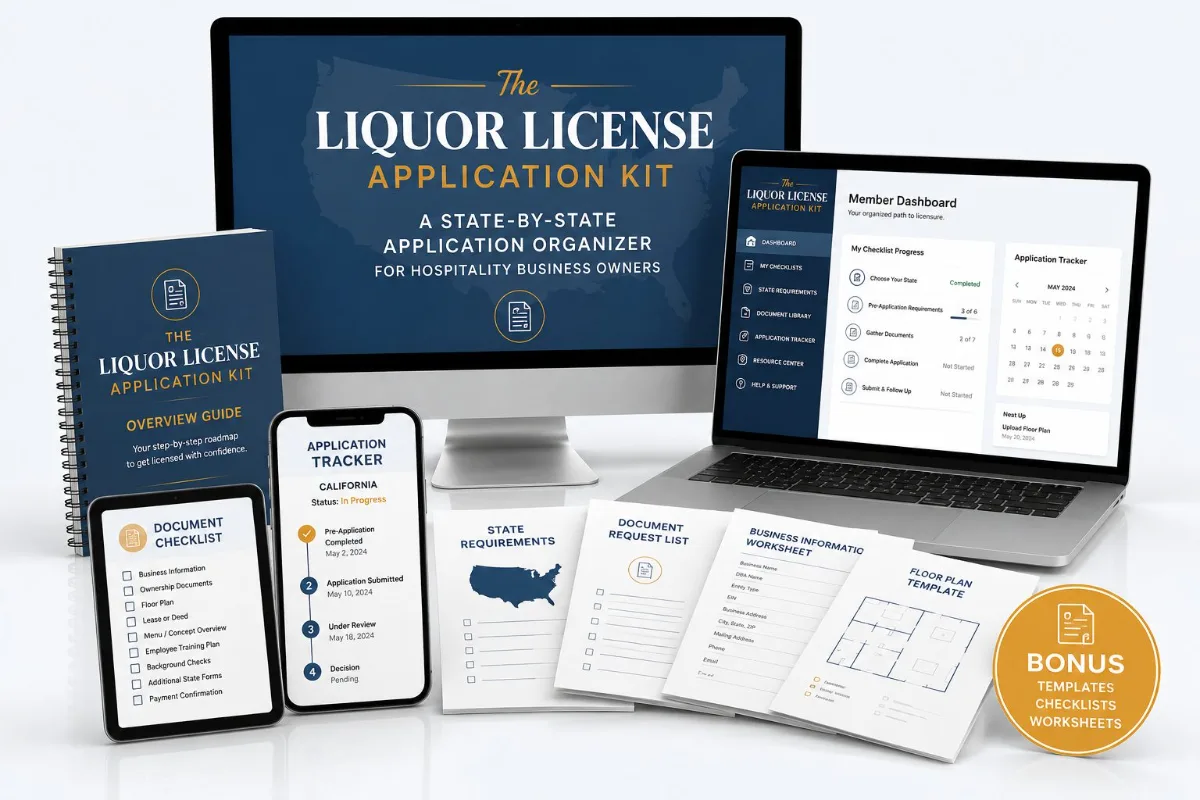
The Liquor License Application Kit
This page shows you the steps. The kit fills them in for Oklahoma. Your license class decoded, every document named and tracked, the deadline and public-notice windows dated and a straight answer on the one or two points that actually need a lawyer. The reference pages stay free. The kit is the evening of assembly you skip.
How to apply for a liquor license in Oklahoma, step by step
Several of these steps gate the ones after them, so the order matters as much as the list.
- Confirm the premises meets the 300-foot school and church distance rule and, for a package store, sits inside an incorporated city or town of more than 200 population
- Choose the license class matching the venue's on-premises or off-premises use and its planned beverage list
- Publish a notice of intention to apply once a week for two successive weeks in a legal newspaper of general circulation in the county where the premises sits, then keep proof of publication
- Apply to the city, or to the county if the premises sits outside any city, for a certificate of zoning compliance and a certificate of fire, safety and health code compliance; the local government must act within 20 days of the written request and issue the certificate within 10 days of a final inspection
- Gather the deed, lease or purchase agreement, an ad valorem tax receipt or evidence none is due, proof of liability insurance covering bodily injury and property damage, plus the ABLE Commission's financial-investigation authorization form
- File the completed application and supporting documents through the ABLE Commission's online Accela licensing portal and pay the license fee and any surcharge for the chosen class
- Respond to the ABLE Commission's review of the applicant's character, criminal history and finances
- Receive the ABLE Commission's notice of approval or disapproval, generally within 30 days for a retail spirits, retail wine or retail beer license and within 60 days for a mixed beverage or on-premises beer and wine license
- Complete the required alcohol server training for any employee within 14 days of that employee's first license and keep proof of training on site
Local approval and public notice in Oklahoma
The city or county layer on top of the state license, plus any notice you must post or publish. The public-notice window is often the shortest clock in the whole process.
| Item | Oklahoma rule |
|---|---|
| Local sign-off required? | Yes, a city or county sign-off is part of the path |
| What the local layer does | A city, or a county for a premises outside any city, must certify that the location complies with local zoning ordinances and with fire, safety and health codes before the ABLE Commission issues an original license; this certificate is required for nearly every retail class and must be furnished with the state application. A package store, mixed beverage establishment, beer and wine establishment or bottle club also cannot sit within 300 feet of a public or private school or of a church regularly used for worship, measured from the nearest property line to the nearest wall of the premises, unless the school, an eligible university or the church waives the distance in writing after published notice. |
| Public notice | The applicant must publish a notice of intention to apply once a week for two successive weeks in a legal newspaper of general circulation in the county where the premises will sit, then file proof of publication with the ABLE Commission before applying. |
| Worth knowing | Every one of Oklahoma's 77 counties has approved on-premises sale of alcoholic beverages by the individual drink, so no county is dry for a mixed beverage or beer and wine license. A separate county-by-county voter referendum governs whether a retail spirits store may sell on Sunday; only some counties have approved it, so a package store in a county that has not stays closed on Sunday. Municipalities and counties may also levy their own annual occupational tax on a licensee, capped at the state license fee for that class. |
Server training in Oklahoma
Whether the people pouring or selling alcohol must certify through a state program, plus the deadline.
| Item | Oklahoma rule |
|---|---|
| Required for a first-time retailer? | Yes, mandatory for on-premise servers |
| Who must certify | Any employee who sells, serves, mixes or otherwise handles alcoholic beverages plus any manager of a mixed beverage, public event or bottle club business regardless of whether that manager handles beverages directly |
| State program | A training program run by the ABLE Commission or by another entity the ABLE Commission has approved, which can include an employer's own in-house training program |
| Deadline | Within 14 days of the employee's first alcohol-related license being issued |
| Worth knowing | Proof of completed training must stay available on site for ABLE Commission inspection. Missing the deadline is a revocable offense for that employee's license. |
Background check and renewal in Oklahoma
Background check
| Item | Oklahoma rule |
|---|---|
| Background check required? | Yes |
| Who is checked | For a retail spirits, retail wine or retail beer license the sole applicant or every partner is screened directly, since a corporation or an LLC cannot hold a retail spirits license. For a mixed beverage or on-premises beer and wine license the screen reaches any stockholder owning 15 percent or more of a corporate applicant, any officer or director, any manager or majority member of an LLC applicant and every partner of a partnership applicant. Every original application also authorizes the ABLE Commission to investigate the applicant's financial status, including bank accounts, loans and financial statements. |
| Disqualifiers | A retail spirits, retail wine or retail beer applicant is disqualified by any felony conviction with no stated lookback window, by a conviction for violating state or federal alcohol law, or by failing the citizenship, Oklahoma-elector and 5-consecutive-year Oklahoma residency test. A mixed beverage, beer and wine, bottle club, public event or caterer applicant is disqualified by a felony conviction within the 15 years before applying, extended to 25 years for an alcohol-related or violent felony. Every class also requires the applicant be 21 or older and of good moral character. The law also bars a law enforcement official or an ABLE Commission employee from holding a license. |
| Worth knowing | A pardon for a felony restores eligibility if the applicant has no other unpardoned felony conviction. The Title 37A text reviewed ties disqualification to the felony and alcohol-law questions built into the application itself and to the financial-investigation authorization; it did not separately describe a fingerprint-submission or FBI records-check mechanic for an owner or partner applicant, so treat that specific mechanic as unconfirmed. |
Renewal
| Item | Oklahoma rule |
|---|---|
| Renewal cycle | annual |
| Worth knowing | Every license stays valid for one year from its date of issuance rather than a fixed calendar date, except an employee license, which stays valid for two years. A licensee who misses the renewal deadline faces a late penalty set by ABLE Commission rule. A licensee who goes more than 60 days past expiration must file a brand new original application rather than a simplified renewal. |