How to Get a Liquor License in District of Columbia (2026): Cost, Classes and Steps
How do you get a liquor license in District of Columbia?
In the District of Columbia, retail liquor licenses are approved by the Alcoholic Beverage and Cannabis Board and administered by the Alcoholic Beverage and Cannabis Administration (ABCA). A bar or restaurant applies for an on-premises retailer's license in Class C for spirits, beer and wine or Class D for beer and wine, while a store applies for an off-premises Class A (full spirits) or Class B (beer and wine) license. There is no numeric license quota, though four neighborhood moratorium zones and 400 foot spacing rules limit where certain new licenses can go.
District of Columbia runs its retail liquor licensing through the Alcoholic Beverage and Cannabis Administration. The application runs through the state with a local sign-off alongside it. District of Columbia sets no cap on the number of retail licenses, so there is no slot to wait for and no existing license to buy out. The page below lays the pieces out in the order the state runs them.
Server training is required for some classes or roles. Every owner, officer and significant investor clears a background check. Each piece has its own section below, with the official source beside it.
The parts a District of Columbia applicant most often misses are the public-notice window, which runs on the state's schedule rather than yours and the order of the steps, since several gate the ones after them. The sections below take them in order.
Which liquor license does a District of Columbia bar, restaurant or store need?
The retail license classes District of Columbia issues, what each covers and the venue each fits. Match your venue to the class before anything else.
| Class | Covers | Who it fits |
|---|---|---|
| Retailer's Class C/R (CR) Restaurant license, full service | on-premise, full spirits | For restaurants with an operating kitchen; carries a statutory annual food-sales threshold of $2,000 per occupant or a qualifying gross-receipts alternative, with quarterly statements. Annual fee $1,000 to $2,600 by capacity tier |
| Retailer's Class D/R (DR) Restaurant license, beer and wine | on-premise, beer and wine | Lower-cost restaurant class with a $1,500 per occupant food-sales threshold or alternative. Annual fee $600 to $1,560 by capacity tier |
| Retailer's Class C/T (CT) Tavern license | on-premise, full spirits | For bars without the restaurant food thresholds; dance floors over 140 square feet need an entertainment endorsement. Annual fee $1,300 to $3,120 by capacity tier. New CT licenses are barred inside certain moratorium zones |
| Retailer's Class C/N (CN) Nightclub license | on-premise, full spirits | Requires a security plan. Annual fee $1,950 to $5,850 by capacity tier. New CN licenses are barred inside certain moratorium zones |
| Retailer's Class C/H (CH) Hotel license | on-premise, full spirits | Covers dining rooms, lounges, banquet halls and guest rooms. Annual fee $2,600 under 100 rooms or $5,200 at 100 rooms and above |
| Retailer's Class A Off-premises retailer, full spirits | off-premise, full spirits | The liquor store class, with a separate Class A grocery variant for qualifying full-service grocery stores. Annual fee $2,600. A new Class A cannot open within 400 feet of an existing same-class store, with grocery and other exceptions |
| Retailer's Class B Off-premises retailer, beer and wine | off-premise, beer and wine | The grocery and market class. Annual fee $1,300. The 400 foot same-class spacing rule applies, with a full-service grocery exception where alcohol stays within a set share of sales |
| Class AI / BI Internet retailer licenses | off-premise, full spirits (AI) or beer and wine (BI) | Delivery-only classes with no public storefront. Annual fee $2,600 (AI) or $1,300 (BI); exempt from the 400 foot school rule |
Is District of Columbia a quota or control state?
Whether District of Columbia caps the number of licenses and whether the state runs any part of retail itself. Both answers are no here, which is a big part of why District of Columbia is one of the simpler states to enter.
| Item | District of Columbia rule |
|---|---|
| Quota state? | No, there is no cap on the number of licenses |
| Buying an existing license | n/a; licenses issue directly from the Board so there is no quota-driven private license market |
| State control | No, private licensing throughout. License jurisdiction with private retail; no government-run stores at any tier |
How much does a liquor license cost in District of Columbia?
| Item | District of Columbia |
|---|---|
| State and local fees to apply | $600 to $2,600 in the first-year license fee for the common restaurant, tavern and store classes plus a $75 one-time application processing fee, due at filing; the largest nightclub and hotel tiers run up to $5,850 per year in license fee alone |
| Renewal | $600 to $5,850 per year by class and capacity on a three-year license cycle, payable annually or for the full period |
| What drives the range | Class and capacity tier drive the range. A venue also budgets $390 for the three-year ABC manager license. DC Code § 25-504 sets lower statutory minimums; the operative figures are the higher Board-set fees on the ABCA schedule |
The itemized fees a first-time District of Columbia applicant can expect from the state.
| Fee | Amount |
|---|---|
| Restaurant CR annual license fee | $1,000 to $2,600 by capacity tier |
| Restaurant DR annual license fee | $600 to $1,560 by capacity tier |
| Tavern CT annual license fee | $1,300 to $3,120 by capacity tier |
| Nightclub CN annual license fee | $1,950 to $5,850 by capacity tier |
| Hotel CH annual license fee | $2,600 or $5,200 by room count |
| Off-premises Class A annual license fee | $2,600 |
| Off-premises Class B annual license fee | $1,300 |
| ABC manager license | $390 per three-year license |
| Stipulated license (operate during the placard period, with ANC support) | $100 |
| New retail license application processing fee | $75, one time, in addition to the first-year license fee (excludes manager and solicitor license applications, which have their own fee) |
| Late renewal penalty | $50 per day, capped at the cost of the license |
| Processing fee retained if an application is denied | the first-year fee is returned minus a prescribed processing fee; ABCA's current new-license processing fee is $75, which is the figure this deduction most plausibly draws on though no single source states the two are the same fee |
How long it takes. Roughly 60 to 90 days for an unprotested application; protested applications commonly run 4 months or longer. The 45 day placard comment period sets the floor and ABCA states the full process may take several months depending on the transaction. A protested case adds a roll call hearing, mediation and a protest hearing; a published 2026 example ran from a March 27 placard to a July 15 protest hearing. A stipulated license with ANC support can allow operation during the notice period
From the team behind this library
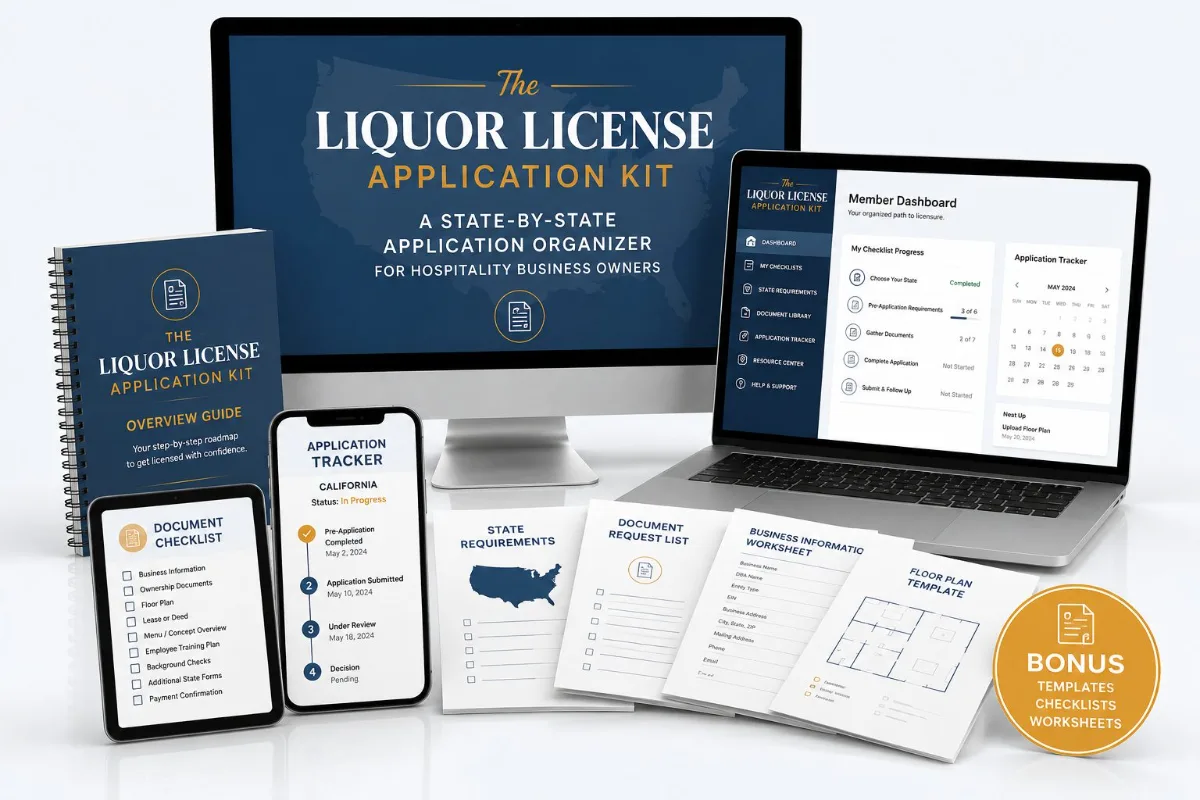
The Liquor License Application Kit
This page shows you the steps. The kit fills them in for District of Columbia. Your license class decoded, every document named and tracked, the deadline and public-notice windows dated and a straight answer on the one or two points that actually need a lawyer. The reference pages stay free. The kit is the evening of assembly you skip.
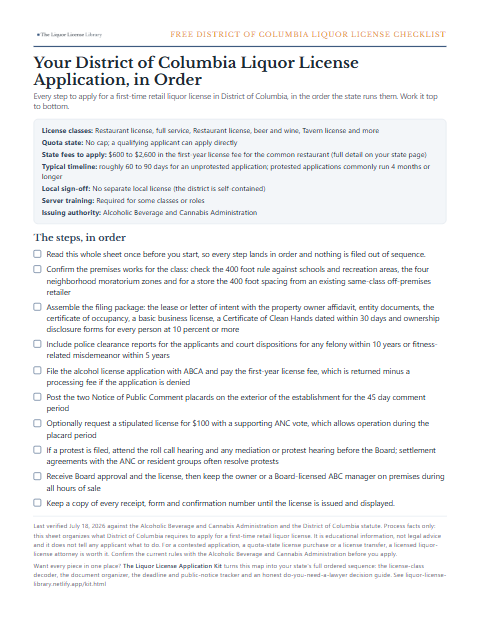
How to apply for a liquor license in District of Columbia, step by step
Several of these steps gate the ones after them, so the order matters as much as the list.
- Confirm the premises works for the class: check the 400 foot rule against schools and recreation areas, the four neighborhood moratorium zones and for a store the 400 foot spacing from an existing same-class off-premises retailer
- Assemble the filing package: the lease or letter of intent with the property owner affidavit, entity documents, the certificate of occupancy, a basic business license, a Certificate of Clean Hands dated within 30 days and ownership disclosure forms for every person at 10 percent or more
- Include police clearance reports for the applicants and court dispositions for any felony within 10 years or fitness-related misdemeanor within 5 years
- File the alcohol license application with ABCA and pay the first-year license fee, which is returned minus a processing fee if the application is denied
- Post the two Notice of Public Comment placards on the exterior of the establishment for the 45 day comment period
- Optionally request a stipulated license for $100 with a supporting ANC vote, which allows operation during the placard period
- If a protest is filed, attend the roll call hearing and any mediation or protest hearing before the Board; settlement agreements with the ANC or resident groups often resolve protests
- Receive Board approval and the license, then keep the owner or a Board-licensed ABC manager on premises during all hours of sale
Local approval and public notice in District of Columbia
The city or county layer on top of the state license, plus any notice you must post or publish. The public-notice window is often the shortest clock in the whole process.
| Item | District of Columbia rule |
|---|---|
| Local sign-off required? | No separate local license (the district is self-contained) |
| What the local layer does | No separate city or county license exists because the District government is both the state and the local layer. Zoning compliance shown by the certificate of occupancy is a filing prerequisite and the affected Advisory Neighborhood Commission receives notice of every application, may protest and has its written recommendations given great weight by the Board |
| Public notice | Two Notice of Public Comment placards posted on the establishment exterior for the 45 day comment period; protests may be filed by the affected ANC, an abutting property owner, a citizens association or a group of at least 5 residents or property owners (3 inside a moratorium zone) |
| Worth knowing | Settlement agreements negotiated with the ANC or resident groups routinely set operating conditions (hours, noise, trash) and attach to the license. The police district commander and custodians of nearby government property also hold protest standing |
Server training in District of Columbia
Whether the people pouring or selling alcohol must certify through a state program, plus the deadline.
| Item | District of Columbia rule |
|---|---|
| Required for a first-time retailer? | Required for some classes, roles or local mandates |
| Who must certify | The owner or a Board-licensed ABC manager must be on the premises during all hours of sale, service or consumption. The ABC manager license itself requires completing Board-approved alcohol awareness training; line servers and bartenders are not individually required to certify |
| State program | ABC Board approved alcohol awareness training providers, listed on the ABCA alcohol awareness training providers page |
| Deadline | The training certificate filed with an ABC manager application must be dated within 6 months of the application submission date; a temporary manager license (issued for 30 days while training is pending, or 90 days while a police clearance report is pending) is canceled and the fee forfeited if the certificate is not filed within that window |
| Worth knowing | The manager license runs three years at $390 ($130 per year). The 6 month and 30 day figures are confirmed on the ABCA ABC Manager License application instructions form |
Background check and renewal in District of Columbia
Background check
| Item | District of Columbia rule |
|---|---|
| Background check required? | Yes |
| Who is checked | Every person holding 10 percent or more of the entity is disclosed on summary-of-interest forms and applicants submit police clearance reports covering DC and their home jurisdiction; the Board may obtain FBI and Metropolitan Police Department criminal history records |
| Disqualifiers | Under DC Code § 25-301 an applicant must be at least 21, of good character, without a felony conviction in the 10 years before filing (5 years for a manager's or solicitor's license) and without a fitness-related misdemeanor conviction in the prior 5 years; District tax delinquency over $100 or unfiled returns also disqualifies |
| Worth knowing | The Board also reviews 10 years of ABCA violation records for the applicant and any establishments the applicant controlled. Court dispositions must accompany the application for any conviction inside the lookback windows |
Renewal
| Item | District of Columbia rule |
|---|---|
| Renewal cycle | triennial |
| Worth knowing | Licenses run three years with all licenses of a type expiring together: restaurant classes renew by March 31 and tavern and nightclub classes by September 30 of their cycle year. The off-premises store classes sit a full year ahead of those on-premises cohorts on ABCA's published schedule: Retailer's Class A (including the grocery variant) expires March 31, 2027 and Retailer's Class B expires September 30, 2026, against March 31, 2028 for the CR, DR and CH restaurant and hotel classes and September 30, 2028 for the CT and CN tavern and nightclub classes. Fees may be paid annually or for the full period; late payment draws $50 per day capped at the license cost |