How to Get a Liquor License in West Virginia (2026): Cost, Classes and Steps
How do you get a liquor license in West Virginia?
In West Virginia, the Alcohol Beverage Control Administration issues most retail licenses, with a bona fide private club or wine restaurant license covering an on-premise bar or restaurant and a Class A or Class B retail license covering an off-premise liquor store. State law sets up a market-zone and competitive-bid framework for those off-premise spirits licenses, though WVABCA's own current published guidance states there is no numeric limit on the number of freestanding Class A stores, so the practical cap only bites when a specific zone is full. A first-time applicant also clears local zoning certification, fingerprinting and a WVABCA premises inspection before the license is mailed.
How much does a liquor license cost in West Virginia? Roughly $250 to $2,750 a year in state fees. The class decides almost all of it. A nonintoxicating beer retail dealer license and a wine retailer license are each $150 a year for the license itself; on the Class A rows that carry the $100 per-location operational fee, such as a tavern selling nonintoxicating beer, that is $250 in total state cost. A private club bar or restaurant runs $1,250 a year under 1,000 members or $2,750 at 1,000 or more, each of those being the authority's published license fee with the same $100 operational fee on top. An off-premise Class A or Class B retail liquor license is $2,000 plus that $100 fee, $2,100 in total. A private club also posts a $5,000 surety bond, which is security rather than a fee. Renewal is billed annually by 30 June and a late renewal adds a $150 reactivation fee. One honest gap: WV Code 60-7-6 prints $1,000 and $2,500 for those two private club tiers, a uniform $150 below the authority's own published fee schedule across the whole table, so confirm the current figure with the agency. Work out your own West Virginia figure in the cost estimator.
In West Virginia, retail liquor licenses go through the West Virginia Alcohol Beverage Control Administration. A first-time applicant files with the state directly. West Virginia caps only its full-spirits or specific classes, while a beer or beer-and-wine class usually sits outside the cap. Work the page top to bottom and the whole path is visible before any single deadline is due.
West Virginia runs a partial control system, handling some spirits wholesale or retail itself while private retailers hold the on-premise and off-premise licenses. Server training is voluntary here, an incentive rather than a licensing condition. Every owner, officer and significant investor clears a background check. Each piece has its own section below, with the official source beside it.
The parts a West Virginia applicant most often misses are the public-notice window, which runs on the state's schedule rather than yours, which classes fall under the cap and which do not and the order of the steps, since several gate the ones after them. The sections below take them in order.
Which liquor license does a West Virginia bar, restaurant or store need?
The retail license classes West Virginia issues, what each covers and the venue each fits. Match your venue to the class before anything else.
Weighing beer and wine against full spirits? In West Virginia those are two different licensing systems rather than two tiers of one. Compare a beer and wine license with a full liquor license.
| Class | Covers | Who it fits |
|---|---|---|
| Class A retail license (WV Code Article 60-3A) Freestanding liquor retail outlet | off-premise, full spirits | Package store selling only WV liquor product, wine, beer, nonintoxicating beer and other alcohol or tobacco related products, on at least 750 square feet of floor space. Must be a corporation, association or LLC rather than an individual or a partnership. WVABCA's own Class A License Facts sheet currently states there is no limit on the number of these outlets, even though the underlying statute organizes issuance by market zone and a competitive bid; see the quota field. |
| Class B retail license (WV Code Article 60-3A) Mixed retail liquor outlet | off-premise, full spirits | A grocery, convenience or drug store that sells liquor alongside other retail goods, with at least 150 square feet of floor space devoted solely to WV product. Same market-zone framework as Class A, statutorily capped at 150 percent of a zone's authorized Class A count. |
| Private Club Bar / Private Club Restaurant (WV Code Article 60-7) Private club license | on-premise, full spirits | The standard route for a new bar or restaurant to serve liquor by the drink. Requires a bona fide club of at least 100 members, a kitchen and dining facility, mandatory food service and a $5,000 surety bond. Not transferable and not a numeric quota class. |
| Private Wine Restaurant (WV Code Article 60-8) Wine restaurant license | both, wine, with beer addable for an extra fee | Lighter-weight non-quota license for a restaurant that wants only wine, or wine and beer, rather than a full private club liquor license. |
| Class A retail dealer, nonintoxicating beer (WV Code Chapter 11-16) On-premise beer retailer | on-premise, beer | Simplest and cheapest first license for a venue serving only beer under the statutory ABV threshold. Sealed-container sales to go are also permitted. Non-quota. |
| Class B retail dealer, nonintoxicating beer (WV Code Chapter 11-16) Off-premise beer retailer | off-premise, beer | Package sales of sealed beer only, issuable to a grocery, deli, caterer or party-supply-type store, with no on-premise consumption. Non-quota. |
Is West Virginia a quota or control state?
Whether West Virginia caps how many licenses exist, how a capped license is obtained and whether the state runs any part of retail itself. This is where the real cost of a West Virginia license can hide.
| Item | West Virginia rule |
|---|---|
| Quota state? | Partial, the cap touches some classes only |
| How the cap works | WV Code Article 60-3A organizes off-premise spirits retail into market zones that may not be modified without legislative authorization. The commissioner issues Class A (freestanding liquor store) and Class B (mixed retail outlet) licenses within each zone, with Class B capped at 150 percent of a zone's Class A count under WV Code 60-3A-7. A separate aggregate limit in WV Code 60-3A-7(f) bars any single person from holding a combination of Class A or Class B licenses that authorizes more than 30 percent of the total retail outlets authorized to operate statewide, not 30 percent of a single zone. Set against that statutory framework, the WVABCA Class A License Facts sheet states verbatim there is no limit on the number of freestanding liquor retail outlets, so in practice a first-time applicant who meets the requirements can apply directly rather than wait for a scheduled opening, unless a specific zone happens to be at its allocated capacity. On-premise private club and wine or beer retail licenses are not capped by population in any source reviewed. |
| New licenses issued by | New off-premise spirits licenses are issued through the commissioner's regular application process rather than a lottery. The statute separately provides for sealed competitive bidding at the start of each ten-year licensing cycle (the current cycle runs to June 30, 2030 under WV Code 60-3A-10b and 60-3A-12), a mechanism that appears to govern reallocation and new zone capacity rather than block routine new applications, based on the current agency guidance; this is an ambiguity between the statute's bid architecture and the agency's plain no-limit statement that could not be fully resolved from public sources. |
| Buying an existing license | An existing active retail licensee can exercise a state-run Purchase Option for up to four store locations under a deferred-payment financing mechanism carried over from the 1990-1991 privatization. Class A and Class B off-premise liquor licenses can otherwise be sold, assigned or transferred privately under WV Code 60-3A-14 with prior written commissioner approval and the buyer must independently qualify; market-reported resale prices are not published by the state. Private club (on-premise) licenses under WV Code Article 60-7 are explicitly non-transferable by statute. |
| State control | Partial control. The commissioner is the sole wholesaler of distilled spirits: every retail licensee must buy liquor other than wine only through the commissioner's state ordering system, at a uniform wholesale markup set to generate at least $6.5 million a year for the General Revenue Fund, with a stated minimum order of 25 cases per delivery. Wine and beer wholesale distribution is privatized through licensed distributors. Retail sale itself has been privately licensed statewide since the state sold its state-owned liquor stores in 1990 and 1991; West Virginia does not run state-owned retail stores. |
Not fully settled in one published place. Confirm the exact quota status and, where a cap applies, how a new or existing license is obtained with the West Virginia Alcohol Beverage Control Administration before you rely on it.
How much does a liquor license cost in West Virginia?
| Item | West Virginia |
|---|---|
| State and local fees to apply | roughly $250 to $2,750 in state fees depending on class, from a beer-only or wine-only Class A license at $250 (a $150 license fee plus the $100 operational fee) up to a private club bar or restaurant with 1,000 or more members at $2,750, plus a separate fingerprinting fee and, for a private club license, a $5,000 surety bond. An off-premise Class A or Class B liquor license sits at $2,100. |
| Renewal | the same annual class fee as initial for most classes, billed every year by June 30; a $150 reactivation fee applies to a late renewal |
| What drives the range | The range is driven by license class and beverage type more than by county. Every Class A private club tier on WVABCA's published schedule sits exactly $150 above the figure in WV Code 60-7-6 and the schedule's own $100 operational fee is charged on top of the published figure, which is where the $1,250 and $2,750 totals come from. WVABCA prints no footnote explaining the $150 uplift; the schedule's beer-only rows are priced at $150, which is an observation about the arithmetic rather than a rule the agency states. Figures exclude a local health permit fee, a local zoning notice fee where a municipality charges one and any secondary-market purchase price for an existing off-premise liquor license, none of which are published by the state. |
The itemized fees a first-time West Virginia applicant can expect from the state.
| Fee | Amount |
|---|---|
| Off-premise Class A or Class B retail liquor license, annual | $2,000, plus the $100 operational fee, $2,100 total |
| Operational fee, per licensed location | $100 |
| Private Club Bar or Private Club Restaurant, annual, under 1,000 members | $1,250 in total state cost: WVABCA's published fee schedule lists $1,150 for this tier and the $100 operational fee is charged on top of it. WV Code 60-7-6 prints $1,000 for the same tier, a uniform $150 below the agency schedule across the whole Class A private club table |
| Private Club Bar or Private Club Restaurant, annual, 1,000 or more members | $2,750 in total state cost: WVABCA's published fee schedule lists $2,650 for this tier and the $100 operational fee is charged on top of it. WV Code 60-7-6 prints $2,500 for the same tier, the same uniform $150 below the agency schedule |
| Private club surety bond | $5,000 corporate surety bond, not a fee |
| Nonintoxicating beer Class A or Class B retail dealer, annual | $150 for the license itself; on the Class A rows that carry the operational fee, such as a Tavern selling nonintoxicating beer, the $100 is charged on top for $250 in total state cost |
| Wine retailer license, annual | $150 for the license itself; on the Class A wine rows that carry the operational fee, the Private Wine Spa and the Private Wine Bed and Breakfast, the $100 is charged on top for $250 in total state cost |
| Reactivation fee for a late renewal | $150 |
| Live Scan fingerprinting fee, per applicant | unverifiable, set by IdentoGO and not published on the WVABCA pages reviewed |
How long it takes. About one month from a complete application, per WVABCA guidance. WVABCA's own process runs application review, a request for missing information if needed, a premises inspection, final review, then a mailed license. Delays commonly come from an incomplete application, a premises not ready for inspection, slow Live Scan fingerprint turnaround or high application volume, since applications are handled in the order received. The 10-day local notice, where required, must run before the state application is even filed, adding to the front end of the timeline.
Not published as one current figure. Confirm the exact amount with the West Virginia Alcohol Beverage Control Administration before you budget for it.
From the team behind this library
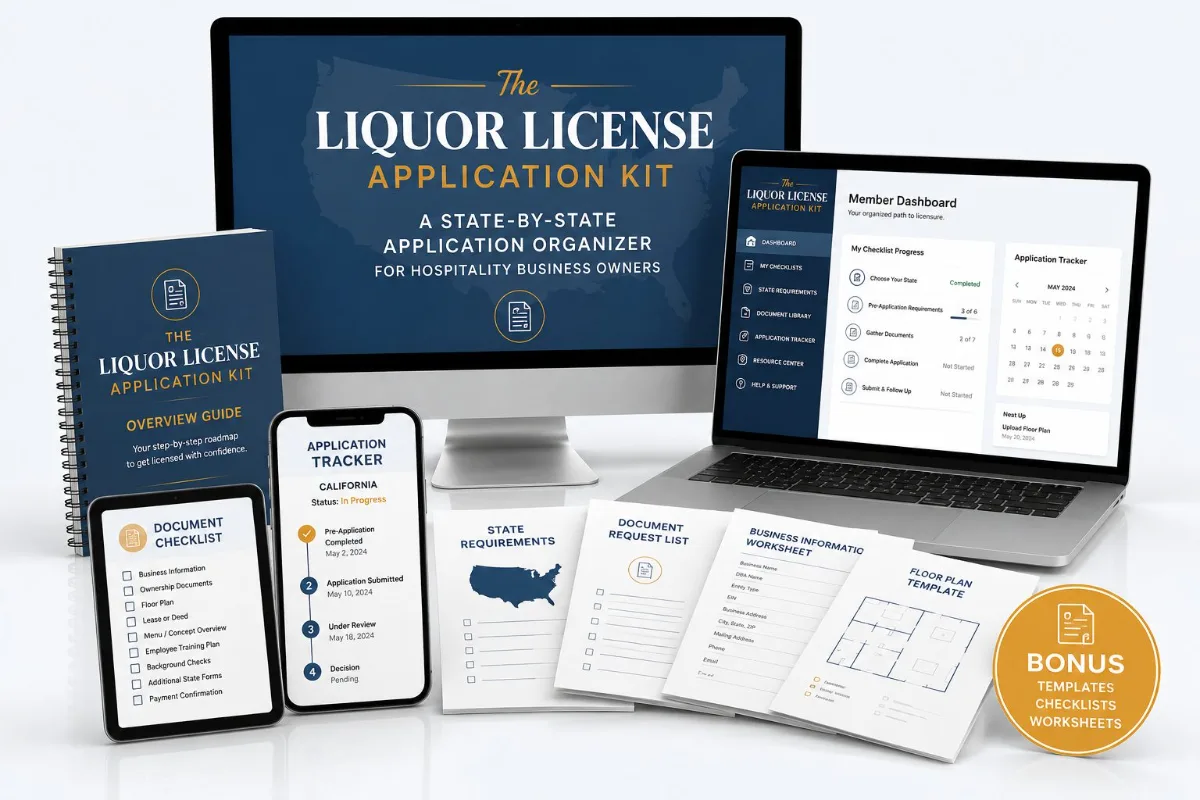
The Liquor License Application Kit
This page shows you the steps. The kit fills them in for West Virginia. Your license class decoded, every document named and tracked, the deadline and public-notice windows dated and a straight answer on the one or two points that actually need a lawyer. The reference pages stay free. The kit is the evening of assembly you skip.
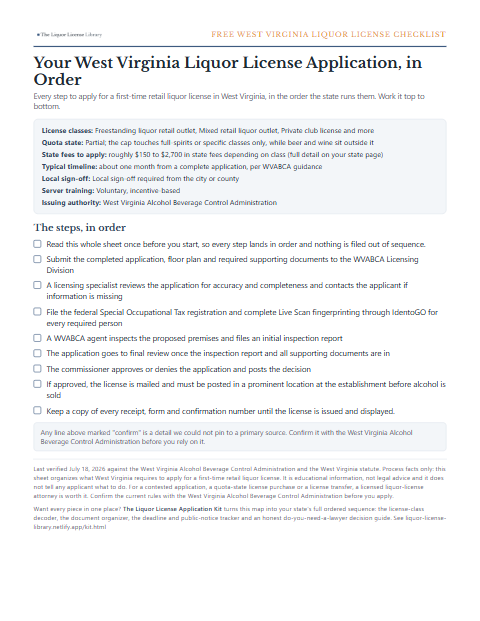
How to apply for a liquor license in West Virginia, step by step
Several of these steps gate the ones after them, so the order matters as much as the list.
- Before submitting, check the premises against both statutory location bars: the 200-foot school and church separation for a Class A nonintoxicating beer license under WV Code 11-16-8(a)(5), measured front door to front door along the street, plus the immediate-vicinity bar on a liquor retail outlet under WV Code 60-3A-16
- Submit the completed application, floor plan and required supporting documents to the WVABCA Licensing Division
- A licensing specialist reviews the application for accuracy and completeness and contacts the applicant if information is missing
- File the federal Special Occupational Tax registration and complete Live Scan fingerprinting through IdentoGO for every required person
- A WVABCA agent inspects the proposed premises and files an initial inspection report
- The application goes to final review once the inspection report and all supporting documents are in
- The commissioner approves or denies the application and posts the decision
- If approved, the license is mailed and must be posted in a prominent location at the establishment before alcohol is sold
Local approval and public notice in West Virginia
The city or county layer on top of the state license, plus any notice you must post or publish. The public-notice window is often the shortest clock in the whole process.
| Item | West Virginia rule |
|---|---|
| Local sign-off required? | Yes, a city or county sign-off is part of the path |
| What the local layer does | A city clerk or, outside a municipality, the county commission must certify that no local zoning or other law prohibits alcohol sales at the proposed location before WVABCA will review the application. The state application also requires a copy of a valid local health permit. Two statutory location bars apply on top of local zoning. No Class A (on-premise) nonintoxicating beer license issues for a premises within 200 feet of a school or church, measured front door to front door along the street; a Class B license is exempt from that bar and a college, university or church may waive it in writing to the commissioner (WV Code 11-16-8(a)(5)). Separately, no liquor retail outlet may be located in the immediate vicinity of a school or church (WV Code 60-3A-16). |
| Public notice | For a Private Club, Private Wine Restaurant, Private Wine Bed and Breakfast, Private Wine Spa or Tavern license inside a municipality, the applicant must file a notice of intent with the municipal clerk or recorder at least 10 days before filing with WVABCA, under WV Code 60-7-4a and 11-16-8(a)(5). |
| Worth knowing | All 55 WV counties are wet as of 2021, with one remaining dry municipality (Brandonville) by local option under Article 60-5. A local option election can add or reverse a wet or dry status county-wide or municipality-wide, is held with a regular primary or general election and cannot repeat in the same jurisdiction within two years. Zoning certification, the health permit and, where required, the municipal notice filing all happen locally before the state application is submitted. |
Server training in West Virginia
Whether the people pouring or selling alcohol must certify through a state program, plus the deadline.
| Item | West Virginia rule |
|---|---|
| Required for a first-time retailer? | Voluntary, an incentive rather than a licensing condition |
| State program | n/a, WVABCA has no statewide mandatory certification program located in a targeted search of WV Code Chapter 60 and Chapter 11, Article 16; commercial seller-server courses such as TIPS, ServSafe Alcohol and Learn2Serve are used voluntarily |
| Worth knowing | WVABCA does not condition a license on completed server or seller training. Some employers, insurers or local venues may require it as a private condition of employment or coverage, which is separate from the state licensing requirement. |
Background check and renewal in West Virginia
Background check
| Item | West Virginia rule |
|---|---|
| Background check required? | Yes |
| Who is checked | Owners, officers, partners, members and anyone holding 20 percent or more ownership, plus the license's listed manager, undergo a background and credit check. Every required person completes Live Scan fingerprinting through IdentoGO using a service code obtained from the WVABCA Licensing Division and results are sent to WVABCA directly by the vendor, not accepted from the applicant. |
| Disqualifiers | For an off-premise Class A or Class B liquor license, WV Code 60-3A-8 bars a felony conviction in the five years preceding the application and bars any conviction for fraud, dishonesty, deceit or violation of state or federal alcohol laws. For a private club (on-premise) license, WV Code 60-7-4 and 60-7-5 require the manager to be at least 21, of good moral character and to pass a background investigation, plus disclosure of any felony or moral-turpitude conviction of governing board members or officers. Wine license applicants face a shorter, roughly three-year lookback for a felony or moral-turpitude conviction per WVABCA application materials. Applicants and managers across classes must be United States citizens of good moral character, with naturalized citizens providing documentation. |
| Worth knowing | Applications also disclose hidden ownership or any undisclosed pecuniary interest and whether any officer, manager or 20-percent-or-greater owner has previously held a WVABCA license that was revoked, suspended or otherwise sanctioned; a false statement or omission is grounds for denial. |
Renewal
| Item | West Virginia rule |
|---|---|
| Renewal cycle | annual |
| Worth knowing | Every WVABCA license period runs July 1 to June 30. Renewal requires the same showing as the initial application plus payment of the class fee. A private club must also refile its $5,000 bond. A $150 reactivation fee applies to a late renewal. Off-premise Class A and Class B liquor licenses additionally carry a 10-year license term tied to the market-zone cycle, currently running to June 30, 2030, on top of the annual fee renewal. |