How to Get a Liquor License in Georgia (2026): Cost, Classes and Steps
How do you get a liquor license in Georgia?
In Georgia every retail alcohol license has two layers: a local license from the city or county governing authority plus a state license from the Department of Revenue's Alcohol and Tobacco Division, applied for together through one Georgia Tax Center application that routes to both at once. A store selling packaged spirits, beer or wine holds a retail package license, a bar or restaurant pouring drinks holds a consumption on premises license and a store or restaurant selling only beer or wine holds a retail dealer license. Georgia sets no statewide numeric quota on the total number of retail licenses, though local option rules decide where each beverage type can be sold at all and a state law caps how many spirits retail licenses one person can hold.
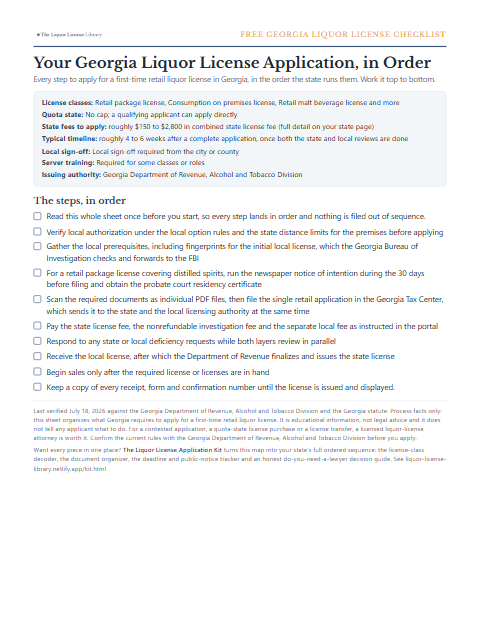
In Georgia, retail liquor licenses go through the Georgia Department of Revenue, Alcohol and Tobacco Division. The application runs through the state with a local sign-off alongside it. Georgia sets no cap on the number of retail licenses, so there is no slot to wait for and no existing license to buy out. Work the page top to bottom and the whole path is visible before any single deadline is due.
Server training is required for some classes or roles. Every owner, officer and significant investor clears a background check. A city or county sign-off is part of the path. Each piece has its own section below, with the official source beside it.
The parts a Georgia applicant most often misses are the public-notice window, which runs on the state's schedule rather than yours and the order of the steps, since several gate the ones after them. The sections below take them in order.

Which liquor license does a Georgia bar, restaurant or store need?
The retail license classes Georgia issues, what each covers and the venue each fits. Match your venue to the class before anything else.
| Class | Covers | Who it fits |
|---|---|---|
| Retail Package Retail package license (package store) | off-premise, full spirits | Covers distilled spirits, wine and malt beverages sold in unbroken packages, not for consumption on the premises, where at least 75 percent of gross sales must come from this packaged retail activity. Requires a liquor bond, the newspaper notice of intention and a probate court certificate of 12 months residency for the individual applicant. Counts toward the statewide two-license ownership cap on spirits retail dealer licenses. |
| Consumption on Premises Consumption on premises license | on-premise, full spirits | Covers distilled spirits, wine and malt beverages sold by the drink for consumption on site. The state fee schedule sets separate tiers for liquor plus beer, liquor plus wine and liquor plus beer and wine, so a restaurant or bar picks the combination it plans to serve. Also counts toward the statewide two-license ownership cap on spirits retail dealer licenses. |
| Retail Dealer, Malt Beverage Retail malt beverage license | both, beer | Beer-only class covering sale either in unbroken packages or for consumption on the premises. A common starting license for a small restaurant, bar or store that does not plan to sell wine or spirits and is not subject to the spirits ownership cap. |
| Retail Dealer, Wine Retail wine license | both, wine | Wine-focused class covering sale either in unbroken packages or for consumption on the premises. It reaches wine only: it is created and taxed inside Title 3 Chapter 6, which does not reach malt beverages, so a retailer selling beer needs the separate retail dealer malt beverage license under Chapter 5 at its own $50 state fee. Typically held alongside that malt beverage class by a store or restaurant that sells beer and wine but not spirits and is not subject to the spirits ownership cap. |
Is Georgia a quota or control state?
Whether Georgia caps the number of licenses and whether the state runs any part of retail itself. Both answers are no here, which is a big part of why Georgia is one of the simpler states to enter.
| Item | Georgia rule |
|---|---|
| Quota state? | No, there is no cap on the number of licenses |
| How the cap works | Georgia sets no statewide numeric cap or population ratio on the total number of retail licenses. Two narrower limits still shape availability. First, O.C.G.A. 3-3-2 gives local governing authorities broad power to set their own ascertainable standards for granting or refusing local licenses, which in practice lets a city or county cap how many licenses it issues by ordinance, a local decision rather than a state formula. Second, O.C.G.A. 3-4-21 caps ownership: no person, counting a household within the first degree of consanguinity or affinity as one person, may hold or have a beneficial interest in more than two retail dealer licenses for distilled spirits (covering retail package and consumption on premises licenses together) anywhere in the state, subject to narrow grandfather exceptions predating April 3, 1978. |
| New licenses issued by | n/a; no statewide lottery or drawing exists for a Georgia retail license |
| Buying an existing license | n/a; state sources describe no statewide secondary market in transferable license quota slots the way a true quota state has |
| State control | No, private licensing throughout. Georgia is a license state, not a control state. It runs a three-tier system where retail package and consumption on premises licenses go to private businesses; there is no state-run retail or wholesale store system for spirits, wine or beer. |
How much does a liquor license cost in Georgia?
| Item | Georgia |
|---|---|
| State and local fees to apply | roughly $150 to $2,800 in combined state license fee, investigation fee and bond for a first-time retail package or consumption on premises license, plus a separate local license fee that varies by county and municipality and is not published in one statewide schedule |
| Renewal | the same state license fee by class, paid annually, plus the local renewal fee the local jurisdiction sets |
| What drives the range | The state figure is driven by license class and beverage combination. The bond applies to the retail package class, not to consumption on premises. Title 3 also sets a separate underlying annual occupational license tax by statute (for example $100 for a distilled spirits retail dealer under O.C.G.A. The local fee is the biggest source of variation and is set independently by each city or county. |
The itemized fees a first-time Georgia applicant can expect from the state.
| Fee | Amount |
|---|---|
| Retail package (package store) posted license fee | $200 |
| Retail malt beverage posted license fee | $50 |
| Retail wine posted license fee | $50 |
| Consumption on premises, liquor plus beer or liquor plus wine | $150 |
| Consumption on premises, liquor plus beer and wine | $200 |
| Investigation fee, all applications | $100, non-refundable |
| Liquor bond, retail package license | $2,500 |
| Statutory annual occupational license tax, retail dealer of distilled spirits | $100 per location |
| Local license fee | varies by county and municipality |
How long it takes. Roughly 4 to 6 weeks after a complete application, once both the state and local reviews are done. A temporary permit can be issued within about 2 to 5 business days after the Department of Revenue's preliminary review of a complete application package, ahead of the full license. The overall timeline depends on the paperwork being complete and correct. It stretches out when the local licensing authority requires a hearing, a public-notice window or its own background investigation before granting the local license the state requires first.
From the team behind this library
The Liquor License Application Kit
This page shows you the steps. The kit fills them in for Georgia. Your license class decoded, every document named and tracked, the deadline and public-notice windows dated and a straight answer on the one or two points that actually need a lawyer. The reference pages stay free. The kit is the evening of assembly you skip.
How to apply for a liquor license in Georgia, step by step
Several of these steps gate the ones after them, so the order matters as much as the list.
- Verify local authorization under the local option rules and the state distance limits for the premises before applying
- Gather the local prerequisites, including fingerprints for the initial local license, which the Georgia Bureau of Investigation checks and forwards to the FBI
- For a retail package license covering distilled spirits, run the newspaper notice of intention during the 30 days before filing and obtain the probate court residency certificate
- Scan the required documents as individual PDF files, then file the single retail application in the Georgia Tax Center, which sends it to the state and the local licensing authority at the same time
- Pay the state license fee, the nonrefundable investigation fee and the separate local fee as instructed in the portal
- Respond to any state or local deficiency requests while both layers review in parallel
- Receive the local license, after which the Department of Revenue finalizes and issues the state license
- Begin sales only after the required license or licenses are in hand
Local approval and public notice in Georgia
The city or county layer on top of the state license, plus any notice you must post or publish. The public-notice window is often the shortest clock in the whole process.
| Item | Georgia rule |
|---|---|
| Local sign-off required? | Yes, a city or county sign-off is part of the path |
| What the local layer does | Every retail applicant needs a local license from the city or county in addition to the state license. The local licensing authority sets its own additional documentation requirements, may hold a hearing and applies any local distance, zoning or wet-dry rules on top of the statewide minimums. State law bars distilled spirits sales within 100 yards of a church building and within 200 yards of a school building. It also bars wine and malt beverage sales within 100 yards of a school building, school grounds or college campus, with exceptions for licenses issued before July 1, 1981 and for certain grocery stores. The Department of Revenue will not issue the state license until the local license is granted. |
| Public notice | For a retail package license covering distilled spirits, O.C.G.A. 3-4-27 requires publishing notice of the application, including the license category, business address and the names of owners or officers, at least once in the county's legal newspaper during the 30 days before filing; proof of publication is submitted with the application. A renewal application is exempt from this notice requirement. Local ordinances commonly add their own posting or hearing notice requirements on top of this state minimum. |
| Worth knowing | Georgia alcohol sales are authorized on a local-option basis: a county or municipality must first permit the sale of the relevant beverage type, by package or by the drink, before a retail license of that kind can be issued there, so some counties and cities remain fully or partly dry. Local fees, local hearing procedures and local wet-dry status all vary by jurisdiction. The local process and the state filing run in parallel through the Georgia Tax Center rather than strictly local-then-state, though local approval is what the state license depends on. |
Server training in Georgia
Whether the people pouring or selling alcohol must certify through a state program, plus the deadline.
| Item | Georgia rule |
|---|---|
| Required for a first-time retailer? | Required for some classes, roles or local mandates |
| Who must certify | No statewide certification requirement exists for on-premise servers or store clerks. Personnel who deliver alcohol to homes under a licensee's delivery privilege must complete an approved responsible delivery training course. Several cities and counties layer their own mandatory server or alcohol handler permit requirement on top of the state's voluntary approach for on-premise service. |
| State program | Department of Revenue approved alcoholic beverage delivery training curriculum for delivery personnel, created under House Bill 879 and published at dor.georgia.gov/alcoholic-beverage-delivery-training-curriculum; the state names no equivalent mandatory program for on-premise servers or off-premise sellers. |
| Deadline | n/a for general on-premise service; delivery personnel must complete the delivery training before making deliveries under a licensee's delivery privilege |
| Worth knowing | Local jurisdictions such as Savannah and Macon-Bibb County are reported to run their own mandatory responsible-service training or permit programs for servers, layered on top of the voluntary state approach, so a first-time applicant should check with the local licensing authority for any local training mandate; this office could not independently confirm the specific city and county list against a primary local-ordinance source. |
Background check and renewal in Georgia
Background check
| Item | Georgia rule |
|---|---|
| Background check required? | Yes |
| Who is checked | Owners, officers and other persons with a beneficial interest in the license are checked. O.C.G.A. 3-3-2 lets local governing authorities require fingerprints for an initial local license application, which the Georgia Bureau of Investigation checks against records for the two years preceding the application and forwards to the FBI. At the state level, applicants submit a notarized personnel statement (Form ATT-17), citizenship verification with a government-issued photo ID and, where applicable, a financial affidavit disclosing beneficial interests. |
| Disqualifiers | Under Ga. Comp. R. and Regs. 560-2-2-.02, no license may issue to a person convicted of a felony who served any part of a sentence, including probation, within the 10 years before the application, or to a person convicted of a misdemeanor who served any part of a sentence, including probation, within the 5 years before the application. Applicants must also be at least 21 years old and a United States citizen, a lawful permanent resident, or otherwise lawfully present under federal immigration law. A retail package license covering distilled spirits additionally requires a probate court certificate that the individual applicant has been a bona fide resident of the county or municipality for at least 12 months, under O.C.G.A. 3-4-23. |
| Worth knowing | The Department of Revenue can also deny a license on a general moral-character or reputation standard, weighing an applicant's business experience, financial standing, associations, arrest record and community reputation. Fingerprinting depth and process can vary by local licensing authority, since Georgia law places that power at the local level rather than centralizing it entirely at the state; the state-level residency certificate under O.C.G.A. 3-4-23 sits alongside a separate rule that a local license does not require the applicant to personally reside in that city or county if a resident designee is named, so the two residency-adjacent rules apply at different levels and do not fully overlap. |
Renewal
| Item | Georgia rule |
|---|---|
| Renewal cycle | annual |
| Worth knowing | Licenses run the calendar year and expire December 31. The Department of Revenue's renewal window typically opens in early September and runs through December 31, with the Department recommending submission by November 1 so the renewed license stays active from January 1 of the following year. Renewal is filed through the same Georgia Tax Center centralized process used for a new application, with separate state and local renewal fees. It skips the newspaper notice step. |