How to Get a Liquor License in Texas (2026): Cost, Classes and Steps
How do you get a liquor license in Texas?
In Texas, retail alcohol licenses and permits are issued by the Texas Alcoholic Beverage Commission. A bar or restaurant that pours spirits needs a Mixed Beverage Permit, a store selling beer, wine and spirits for takeaway needs a Package Store Permit and a beer-only or beer-and-wine-only venue uses a lighter license or permit class instead. Texas sets no statewide quota on the number of retail licenses, though every location must sit in an area that has voted wet for that beverage type under a local option election.
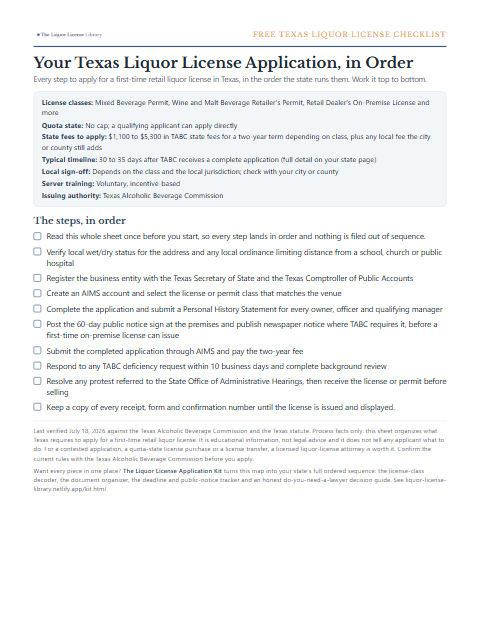
Texas runs its retail liquor licensing through the Texas Alcoholic Beverage Commission. The application is filed with the state. Texas sets no cap on the number of retail licenses, so there is no slot to wait for and no existing license to buy out. The page below lays the pieces out in the order the state runs them.
Server training is voluntary here, an incentive rather than a licensing condition. Every owner, officer and significant investor clears a background check. Local involvement depends on the class and the jurisdiction. Each piece has its own section below, with the official source beside it.
SB 650, the Deshawn Jagwan Act was passed and takes effect September 1, 2027. Texas passed SB 650 requiring most off-premise sellers to scan customer IDs. The bill is law now, but the Alcoholic Beverage Commission does not begin enforcement until September 1, 2027. This page reflects the rule in force today; we update it the day the change takes effect. The full history sits in the law-updates log.

Which liquor license does a Texas bar, restaurant or store need?
The retail license classes Texas issues, what each covers and the venue each fits. Match your venue to the class before anything else.
| Class | Covers | Who it fits |
|---|---|---|
| MB Mixed Beverage Permit | on-premise, full spirits | The standard bar and restaurant permit for distilled spirits, wine, beer and malt liquor from unsealed containers. A restaurant version (RM) pairs it with a required Food and Beverage Certificate. Highest-cost first-time class. |
| BG Wine and Malt Beverage Retailer's Permit | both, beer and wine | Common first license for a small restaurant, wine bar or grocery counter serving or selling beer and wine up to the statutory ABV cap; no spirits. |
| BE Retail Dealer's On-Premise License | on-premise, beer | Beer-only on-premise license; requires adequate seating for customers. |
| P Package Store Permit | off-premise, full spirits | The standard liquor-store permit: spirits, wine and beer in sealed containers for takeaway. Ownership is capped statewide (250 total interests per person, 15 new originals per person per calendar year) and closed to public corporations. |
| Q Wine-Only Package Store Permit | off-premise, beer and wine | Off-premise wine and malt liquor sales without distilled spirits; in a wet-for-wine-only area the holder may stock vinous liquor alone. |
| BQ Wine and Malt Beverage Retailer's Off-Premise Permit | off-premise, beer and wine | Off-premise beer and wine sales for a grocery or convenience store that does not want spirits. |
| BF Retail Dealer's Off-Premise License | off-premise, beer | Beer-only off-premise license, the lowest-cost first-time retail class; common for a convenience store or gas station. |
Is Texas a quota or control state?
Whether Texas caps the number of licenses and whether the state runs any part of retail itself. Both answers are no here, which is a big part of why Texas is one of the simpler states to enter.
| Item | Texas rule |
|---|---|
| Quota state? | No, there is no cap on the number of licenses |
| How the cap works | n/a. TABC issues a license or permit to any qualified applicant in a wet area with no statewide numeric cap tied to population or a fixed license count. |
| Buying an existing license | n/a. Because there is no state-created scarcity, an existing package store or bar changes hands as an ordinary business sale rather than a quota-license transfer at a scarcity premium. |
| State control | No, private licensing throughout. Private three-tier system. All retail sales flow through privately owned distributors and retailers licensed by TABC; the state does not operate any retail or wholesale alcohol store. |
How much does a liquor license cost in Texas?
| Item | Texas |
|---|---|
| State and local fees to apply | $1,100 to $5,300 in TABC state fees for a two-year term depending on class, plus any local fee the city or county still adds |
| Renewal | Same two-year fee as the original for most classes; the Mixed Beverage Permit renews at $2,650 rather than its $5,300 original fee |
| What drives the range | The range is driven mainly by class: a beer-only Retail Dealer's License sits at the low end and an on-premise Mixed Beverage Permit for full spirits sits at the high end. Texas is not a quota state, so this range excludes any secondary-market license purchase, since none applies here. |
The itemized fees a first-time Texas applicant can expect from the state.
| Fee | Amount |
|---|---|
| Mixed Beverage Permit (MB), two-year fee, original | $5,300 |
| Mixed Beverage Permit (MB), two-year fee, renewal | $2,650 |
| Package Store Permit (P), two-year fee | $1,800 |
| Wine-Only Package Store Permit (Q), two-year fee | $1,600 |
| Wine and Malt Beverage Retailer's Permit (BG), two-year fee | $1,900 |
| Retail Dealer's On-Premise or Off-Premise License (BE/BF, beer only), two-year fee | $1,100 |
| Local government fee, Mixed Beverage Permit (MB), original | exempt from a local fee under Alcoholic Beverage Code section 11.38(d) |
| Local government fee, Package Store Permit (P), maximum for the two-year period | $500 |
| Local government fee, Retail Dealer's On-Premise (BE) or Wine and Malt Beverage Retailer's (BG), maximum for the two-year period | $150 to $175 in most counties, up to $1,000 for an original permit in Bexar, Dallas, Harris and Tarrant counties |
How long it takes. 30 to 35 days after TABC receives a complete application; a location that must post the 60-day public notice sign cannot receive its license until the sign has run its full 60 days, which puts a realistic first-time on-premise timeline closer to 60 to 90 days. TABC's own posted estimate is 30 to 35 days for a complete file. A 10-business-day response window applies each time TABC requests missing information. Any formal protest referred to the State Office of Administrative Hearings adds a hearing calendar on top.
From the team behind this library
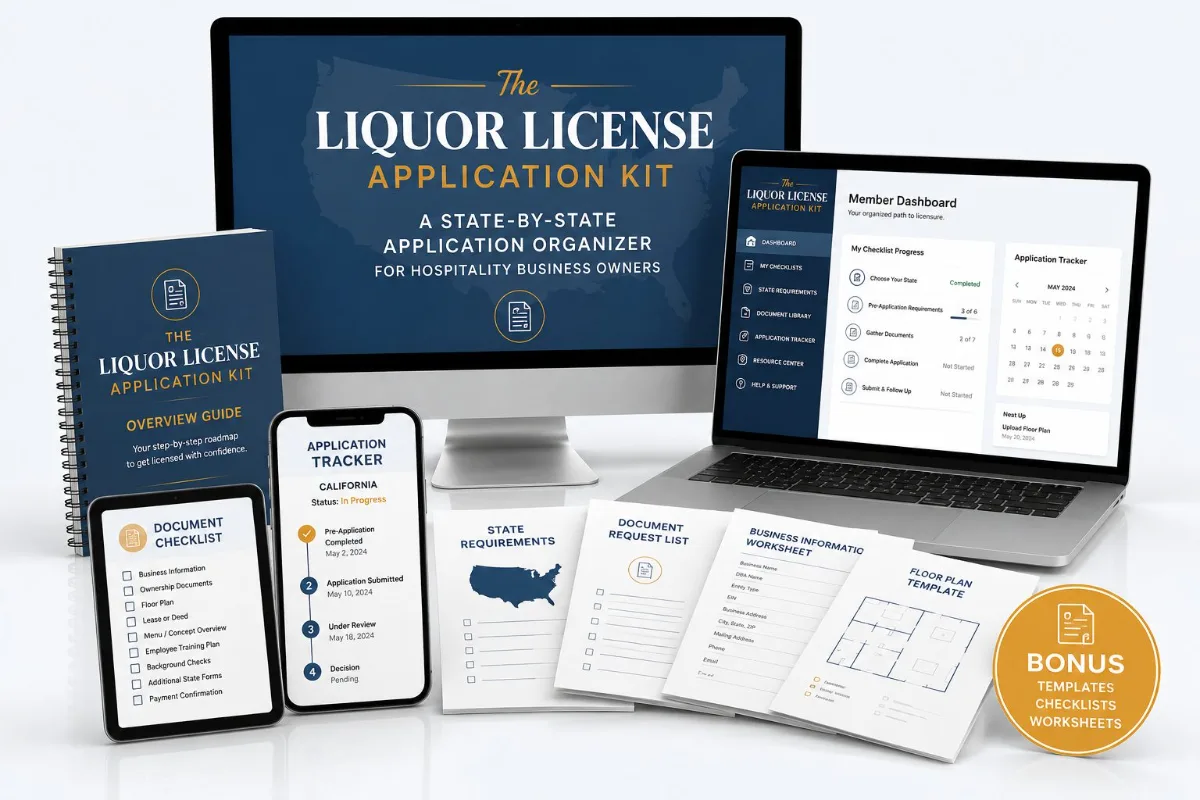
The Liquor License Application Kit
This page shows you the steps. The kit fills them in for Texas. Your license class decoded, every document named and tracked, the deadline and public-notice windows dated and a straight answer on the one or two points that actually need a lawyer. The reference pages stay free. The kit is the evening of assembly you skip.
How to apply for a liquor license in Texas, step by step
Several of these steps gate the ones after them, so the order matters as much as the list.
- Verify local wet/dry status for the address and any local ordinance limiting distance from a school, church or public hospital
- Register the business entity with the Texas Secretary of State and the Texas Comptroller of Public Accounts
- Create an AIMS account and select the license or permit class that matches the venue
- Complete the application and submit a Personal History Statement for every owner, officer and qualifying manager
- Post the 60-day public notice sign at the premises and publish newspaper notice where TABC requires it, before a first-time on-premise license can issue
- Submit the completed application through AIMS and pay the two-year fee
- Respond to any TABC deficiency request within 10 business days and complete background review
- Resolve any protest referred to the State Office of Administrative Hearings, then receive the license or permit before selling
Local approval and public notice in Texas
The city or county layer on top of the state license, plus any notice you must post or publish. The public-notice window is often the shortest clock in the whole process.
| Item | Texas rule |
|---|---|
| Local sign-off required? | It depends on the class and the jurisdiction |
| What the local layer does | Texas has no separate local licensing board vote on an individual application. The applicant gathers city, county, Secretary of State and Comptroller certifications as part of the same state application. The premises must sit in an area that has voted wet for the beverage type under a local option election. A city or county may, but is not required to, bar alcohol sales within a set distance of a school, church or public hospital. |
| Public notice | An outdoor sign at least 24 by 36 inches must be posted at the premises and visible to the public for 60 days before TABC issues a license or permit for a location not licensed for on-premise consumption in the prior two years. Some applications also require newspaper publication. Any person may file a protest that TABC can refer to a hearing before an administrative law judge at the State Office of Administrative Hearings. |
| Worth knowing | Wet or dry status is set county by county, city by city or by justice of the peace precinct through local option elections. TABC publishes an interactive wet/dry map. A city, town or county may also levy its own local fee on top of the state fee, capped by a separate state schedule that runs higher in Bexar, Dallas, Harris and Tarrant counties than elsewhere; a 2025 law now bars that local fee entirely on a food-service premises that already pays a separate local or state food-service fee. |
Server training in Texas
Whether the people pouring or selling alcohol must certify through a state program, plus the deadline.
| Item | Texas rule |
|---|---|
| Required for a first-time retailer? | Voluntary, an incentive rather than a licensing condition |
| Who must certify | No one under state law. For the safe harbor defense described below, every employee who sells, serves or delivers alcohol, plus their immediate managers |
| State program | TABC-approved seller training program under Alcoholic Beverage Code Sec. 106.14 (Safe Harbor) |
| Deadline | n/a under state law; within 30 days of hire to qualify the employer for the safe harbor defense |
| Worth knowing | Certification is not a licensing condition. It shields the employer, not the license itself, from TABC administrative action when a certified employee makes an illegal sale to a minor or an intoxicated person, provided written alcohol-service policies are in place and no three such violations occur in 12 months. A certification is valid for two years from the date issued. |
Background check and renewal in Texas
Background check
| Item | Texas rule |
|---|---|
| Background check required? | Yes |
| Who is checked | Every officer and majority owner completes a notarized Personal History Sheet (TABC Form L-PHS) covering identity, five-year residence and employment history and the source of their investment in the business, sworn before a notary and subject to prosecution for a false statement. A spouse is also disclosed on the same form for BE and BG permits. An applicant who has not lived in Texas for the previous 12 months must submit an official FBI or state police criminal background check for every state lived in during the previous five years. |
| Disqualifiers | Under Alcoholic Beverage Code Sec. 11.46, TABC may deny an application where the applicant was convicted of a Code violation in the 2 years before filing, where fewer than 5 years have passed since a felony sentence ended, where a moral-turpitude violation occurred in the 6 months before filing, or where the application contains a false or missing answer. |
| Worth knowing | Sec. 11.46 also lets TABC deny an application tied to a household member whose permit was cancelled for cause in the past 12 months. It also requires a one-year denial after a mixed beverage or private club permit was cancelled for a shooting, stabbing or other violent act, or a drug, prostitution, trafficking or drink-solicitation offense at the premises. The Form L-PHS itself, read directly from the TABC site, is a sworn name-based disclosure and does not reference fingerprinting; a fingerprint-based step for some classes is described by third-party licensing-service sites but was not found on a direct TABC page, so it stays flagged below rather than stated as fact either way. |
Renewal
| Item | Texas rule |
|---|---|
| Renewal cycle | biennial |
| Worth knowing | A license or permit is valid for two years and expires on the second anniversary of issuance, per TABC's own FAQ; TABC sends a courtesy expiration notice beforehand. Most classes renew at the same two-year fee as the original; the Mixed Beverage Permit is the exception, dropping from a $5,300 original fee to a $2,650 renewal fee. |