How to Get a Liquor License in New Hampshire (2026): Cost, Classes and Steps
How do you get a liquor license in New Hampshire?
In New Hampshire, retail liquor licenses are issued by the New Hampshire Liquor Commission through its Division of Enforcement and Licensing. On-premise restaurants and bars hold a beer-and-wine or full-liquor license, while off-premise stores hold a Combination License for beer and wine or a Retail Wine License for wine and packaged spirits for off-premise sale are handled separately through the commission's own state-run stores rather than a private license. New Hampshire does not cap the number of these retail licenses by population, so it is not a quota state in the way some other states are.
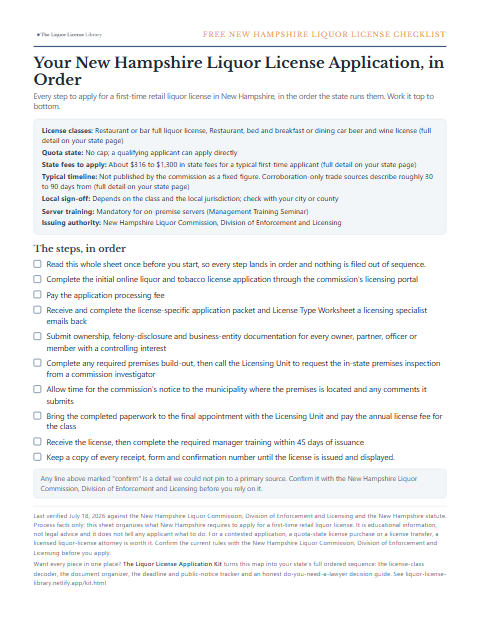
New Hampshire runs its retail liquor licensing through the New Hampshire Liquor Commission, Division of Enforcement and Licensing. The application is filed with the state. New Hampshire sets no cap on the number of retail licenses, so there is no slot to wait for and no existing license to buy out. The page below lays the pieces out in the order the state runs them.
New Hampshire runs a partial control system, handling some spirits wholesale or retail itself while private retailers hold the on-premise and off-premise licenses. On-premise servers must certify through the state's named training program within its window. Every owner, officer and significant investor clears a background check. Each piece has its own section below, with the official source beside it.
A 2025 RSA 178 amendment was passed and takes effect August 1, 2026. New Hampshire created a new $100 limited special license under RSA 178. It is enacted and takes effect August 1, 2026. This page reflects the rule in force today; we update it the day the change takes effect. The full history sits in the law-updates log.
Which liquor license does a New Hampshire bar, restaurant or store need?
The retail license classes New Hampshire issues, what each covers and the venue each fits. Match your venue to the class before anything else.
| Class | Covers | Who it fits |
|---|---|---|
| On-Premises Beverage and Liquor License Restaurant or bar full liquor license | on-premise, full spirits | RSA 178:21. Covers restaurants and hotels serving beer, wine and liquor with meals. A full-service restaurant must show at least 50 percent food sales or at least $75,000 in annual food sales. Annual fee $1,200 for the cocktail and liquor tier. Not quota-limited. |
| On-Premises Beverage and Wine License Restaurant, bed and breakfast or dining car beer and wine license | on-premise, beer and wine | RSA 178:20. For restaurants, bed and breakfasts, dining cars and vessels in a town that has adopted the beer and wine local option under RSA 663:5. Beverages are served only while food is available. Annual fee $840. Not quota-limited. |
| Combination License Grocery and drug store beer and wine license | off-premise, beer and wine | RSA 178:18. Issued only to grocery and drug stores, for beer, table wine and fortified wine sold in the original sealed container for off-premise consumption. No restriction on the number of combination licenses any one person may hold. Annual fee $336 to $812 depending on the number of cash registers. |
| Retail Wine License Off-premise wine license | off-premise, beer and wine | RSA 178:19. Open to any retail outlet, not limited to grocery or drug stores. Covers table and fortified wine sold in the original container for off-premise consumption, kept in a separate area from any on-premise bar in the same building. Annual fee $216 to $648 depending on the number of cash registers. Beverages field lists this class alongside the beer-and-wine group per the schema's category set; the class itself is wine only, it does not cover beer. |
Is New Hampshire a quota or control state?
Whether New Hampshire caps the number of licenses and whether the state runs any part of retail itself. New Hampshire sets no cap, though its control structure still shapes which license a private business can hold.
| Item | New Hampshire rule |
|---|---|
| Quota state? | No, there is no cap on the number of licenses |
| How the cap works | n/a. New Hampshire does not cap the number of on-premise or off-premise beer and wine licenses by town or county population. RSA 178:18 states there is no restriction on the number of combination licenses held by any person and no population-based license-count formula for these retail classes was found in RSA 178 or in the commission's Liq 703 licensing-formula rule, which governs fee calculation, not license counts. |
| Buying an existing license | n/a for the on-premise and off-premise beer and wine classes covered here, since new licenses issue on qualifying application rather than a capped pool. Off-premise spirits work through a different mechanism: a private applicant cannot obtain a standalone off-premise spirits retail license and any one retail licensee may be approved for only one Agency Store contract with the commission. |
| State control | Partial control. The commission itself owns and operates New Hampshire's off-premise spirits retail channel, the NH Liquor & Wine Outlets and also contracts a limited number of private Agency Stores to sell packaged spirits in some towns. A first-time applicant cannot obtain a standard private retail license to sell spirits off-premise. Off-premise wine and off-premise beer and wine together are open to private applicants and are not state-controlled. On-premise sale of beer, wine and liquor by restaurants, bars and hotels is privately licensed and not state-controlled. |
How much does a liquor license cost in New Hampshire?
| Item | New Hampshire |
|---|---|
| State and local fees to apply | About $316 to $1,300 in state fees for a typical first-time applicant, made up of the $100 application processing fee plus the annual license fee for the chosen class ($216 to $1,200 depending on class and register count). For an on-premises applicant the floor is $580, the $100 processing fee plus the $480 Beverages Only tier in RSA 178:29, I. This excludes any local costs, build-out costs and excludes the separate state-run channel for off-premise spirits. |
| Renewal | The same annual license fee scale as the initial license, $216 to $1,200 depending on class, billed each year on the license's expiration month. |
| What drives the range | The license class chosen plus the register count for the off-premise retail wine, combination or beer specialty licenses drive the figure, not county or town population. The on-premises fee table in RSA 178:29, I prices three tiers for a Restaurant, Bed and Breakfast, Dining Car or Vessel: Beverages Only at $480, Beverages and Wine at $840 and, for a Restaurant or Vessel, a Cocktail Lounge tier at $1,200. A "beverage" in RSA 175:1, VIII is the category of drinks at or under 6 percent alcohol by volume (beer, cider, specialty beer and low-alcohol vinous products) rather than beer alone. Separately, the register-tiered $480 to $876 beer specialty fee is an off-premise class under RSA 178:19-d. Fees exclude any secondary-market purchase of an existing license. |
The itemized fees a first-time New Hampshire applicant can expect from the state.
| Fee | Amount |
|---|---|
| Application processing fee (standard) | $100, non-refundable |
| Off-premise Beer Specialty License annual fee (retail outlet whose primary business is the sale of beer, RSA 178:19-d) | $480 to $876 depending on register count |
| On-premise Beverages Only annual license fee (Restaurant, Bed and Breakfast, Dining Car or Vessel) | $480 |
| On-premise beer and wine annual license fee | $840 |
| On-premise full liquor (cocktail and liquor lounge) annual license fee | $1,200 |
| Off-premise Combination License annual fee (beer and wine, grocery or drug store) | $336 to $812 depending on register count |
| Off-premise Retail Wine License annual fee | $216 to $648 depending on register count |
| Limited special license fee (effective Aug. 1, 2026) | $100 |
How long it takes. Not published by the commission as a fixed figure. Corroboration-only trade sources describe roughly 30 to 90 days from a complete application to issuance. The premises inspection only happens once the applicant finishes any build-out and requests it and the commission's notice to the municipality carries no fixed response deadline in the rule reviewed, so either step can extend the process. The specific day-range is not independently confirmed against a primary commission-published timeline.
Not published as one current figure. Confirm the exact amount with the New Hampshire Liquor Commission, Division of Enforcement and Licensing before you budget for it.
From the team behind this library
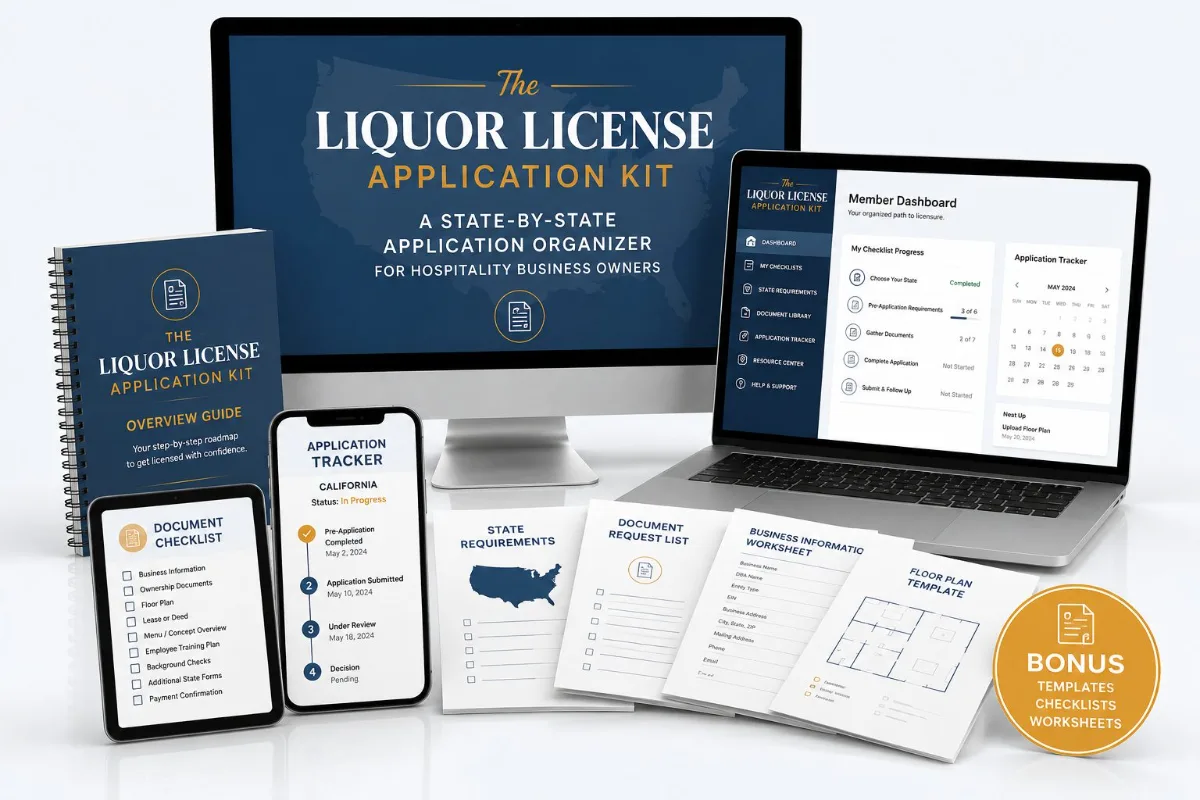
The Liquor License Application Kit
This page shows you the steps. The kit fills them in for New Hampshire. Your license class decoded, every document named and tracked, the deadline and public-notice windows dated and a straight answer on the one or two points that actually need a lawyer. The reference pages stay free. The kit is the evening of assembly you skip.
How to apply for a liquor license in New Hampshire, step by step
Several of these steps gate the ones after them, so the order matters as much as the list.
- Complete the initial online liquor and tobacco license application through the commission's licensing portal
- Pay the application processing fee
- Receive and complete the license-specific application packet and License Type Worksheet a licensing specialist emails back
- Submit ownership, felony-disclosure and business-entity documentation for every owner, partner, officer or member with a controlling interest
- Complete any required premises build-out, then call the Licensing Unit to request the in-state premises inspection from a commission investigator
- Allow time for the commission's notice to the municipality where the premises is located and any comments it submits
- Bring the completed paperwork to the final appointment with the Licensing Unit and pay the annual license fee for the class
- Receive the license, then complete the required manager training within 45 days of issuance
Local approval and public notice in New Hampshire
The city or county layer on top of the state license, plus any notice you must post or publish. The public-notice window is often the shortest clock in the whole process.
| Item | New Hampshire rule |
|---|---|
| Local sign-off required? | It depends on the class and the jurisdiction |
| What the local layer does | New Hampshire does not require a separate municipal license or a local board vote to approve a state retail license application. The commission's own rule requires it to notify the city or town where the premises is located and give that municipality a chance to submit data, views or comments on the appropriateness of the location, the surrounding neighborhood and the number of similar businesses nearby, tracking the factors in RSA 178:3, VII(f). The municipality may request a public comment hearing. The commission, not the municipality, makes the final decision. |
| Public notice | unverifiable, no newspaper-publication or premises-posting requirement was located in RSA 178 or the Liq 700 series administrative rules reviewed |
| Worth knowing | Separately, whether alcohol may be sold at all in a given town or city and which categories such as a state store, retail beer, retail wine or on-premise consumption are allowed, traces back to a local-option vote under RSA 663:5, referenced at RSA 175:7. Most New Hampshire municipalities are wet for all categories, but a small number of towns remain dry for one or more categories under that historical and ongoing local-option vote, separate from the per-applicant municipal notice step described above. |
Confirm the local sign-off and any public-notice window for your jurisdiction with your city or county before you file.
Server training in New Hampshire
Whether the people pouring or selling alcohol must certify through a state program, plus the deadline.
| Item | New Hampshire rule |
|---|---|
| Required for a first-time retailer? | Yes, mandatory for on-premise servers |
| Who must certify | The licensee if a sole proprietor, or one designated manager; all partners in a partnership or one designated manager; a corporate officer or one designated management representative; or the members of an LLC or one designated manager. This covers one person per license, not every individual server or bartender. |
| State program | Management Training Seminar (MTS), the commission's own required training program under RSA 178:2, covering state law, alcohol sales practices, criminal and civil liability and management practices. A licensee may name a designated manager to attend in its place using the commission's MTS designee form. |
| Deadline | Within 45 calendar days of the issuance of the retail license. One-day licenses require attendance before the license's effective date. |
| Worth knowing | The commission provides the training itself at no charge to the licensee. Non-compliance can lead to suspension of the license until training is completed. |
Background check and renewal in New Hampshire
Background check
| Item | New Hampshire rule |
|---|---|
| Background check required? | Yes |
| Who is checked | RSA 178:3 requires the applicant and every partner, officer, member or other person with a controlling interest in the applicant business, to be disclosed and evaluated by the commission. The application form requires certification that this information is true and complete. |
| Disqualifiers | No license may issue to an individual convicted of a felony, or to a partnership, LLC or corporation where a partner, officer, member or other controlling person has been convicted of a felony. The applicant and every person with a controlling interest must be at least 21 years old and of sufficiently good character to leave no substantial doubt the business will be run in strict compliance with state and federal alcohol law. |
| Worth knowing | RSA 178:3 and the Liq 702 application rule describe a felony-conviction disqualifier and a good-character standard based on disclosed information, but neither source reviewed specifies a fingerprint-submission or FBI records-check mechanic for a standard retail license. |
Confirm exactly who is fingerprinted or checked and the current disqualifiers with the New Hampshire Liquor Commission, Division of Enforcement and Licensing before you file.
Renewal
| Item | New Hampshire rule |
|---|---|
| Renewal cycle | annual |
| Worth knowing | Under RSA 178:29 every license, other than a special, seasonal, fair or one-day license, expires on the last day of the month of the individual licensee's birthday, or for a corporation, LLC or partnership, the last day of the month in which it was incorporated or organized. After one year a licensee may select the anniversary month in which to renew; a licensee may change that anniversary renewal month once by written request to the director of enforcement and licensing, then may not change it again for 3 years from the selected month. There is no presumption of renewal; the commission reviews the licensee's qualifications before renewing. |
Confirm the renewal cycle and any late-fee window with the New Hampshire Liquor Commission, Division of Enforcement and Licensing.