How to Get a Liquor License in Florida (2026): Cost, Classes and Steps
How do you get a liquor license in Florida?
In Florida, retail alcoholic beverage licenses are issued by the Division of Alcoholic Beverages and Tobacco (ABT) within the Department of Business and Professional Regulation. A store or venue selling only beer or beer and wine applies for a non-quota 1COP/2COP or 1APS/2APS license, while a bar or package store selling spirits needs a county-population quota license (the 4COP through 8COP series on-premise or the 3PS package series off-premise) obtained through the division's annual drawing or bought on the private market. A qualifying restaurant can instead hold the non-quota SRX license by meeting a food-revenue and size threshold, sidestepping the quota entirely.
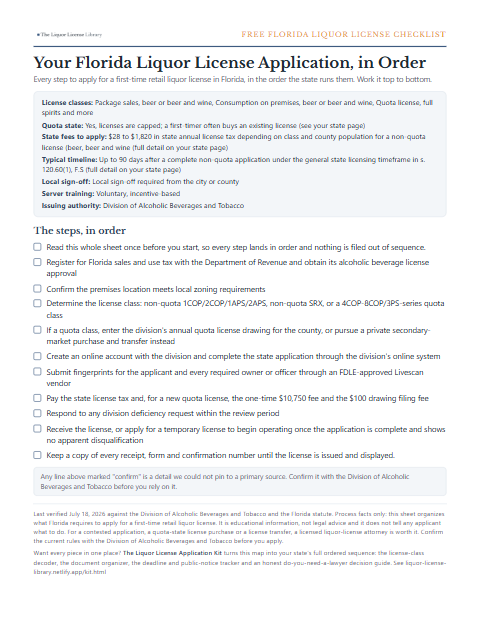
Florida runs its retail liquor licensing through the Division of Alcoholic Beverages and Tobacco. The application is filed with the state. Florida caps the number of retail licenses, so a first-time applicant often buys an existing license and transfers it rather than obtaining a brand-new one. The page below lays the pieces out in the order the state runs them.
Server training is voluntary here, an incentive rather than a licensing condition. Every owner, officer and significant investor clears a background check. A city or county sign-off is part of the path. Each piece has its own section below, with the official source beside it.
HB 1335 took effect July 1, 2024. Florida shortened the felony lookback that can disqualify an applicant from 15 years to 10 and moved retail applications to an online-only account system. This page reflects the rule in force today; the full history sits in the law-updates log.
Which liquor license does a Florida bar, restaurant or store need?
The retail license classes Florida issues, what each covers and the venue each fits. Match your venue to the class before anything else.
| Class | Covers | Who it fits |
|---|---|---|
| 1APS / 2APS Package sales, beer or beer and wine | off-premise, beer and wine | Sealed-container sales only, no on-premise consumption; non-quota; common first license for a convenience or grocery store |
| 1COP / 2COP Consumption on premises, beer or beer and wine | both, beer and wine | Sale by the drink or in sealed containers for package sales; non-quota; common first license for a small restaurant or bar that does not serve spirits |
| 4COP (through 8COP) Quota license, full spirits | both, full spirits | County-population quota class for bars and full-liquor restaurants; both package sales and drink sales allowed; obtained through the annual drawing or a private secondary-market purchase; the specific number (4COP through 8COP) tracks the county's population tier |
| 3PS (3APS / 3BPS / 3CPS / 3DPS) Package sales, full spirits | off-premise, full spirits | County-population quota class for liquor stores; sealed-container sales only, no on-premise consumption; the letter tracks the county's population tier |
| SRX (4COP-SRX) Special restaurant license | on-premise, full spirits | Non-quota; requires at least 51 percent of gross revenue from food and non-alcoholic beverages plus minimum floor space and seating; package sales not permitted; alcohol sales prohibited when food service is unavailable; the license cannot move to a new location |
Is Florida a quota or control state?
Whether Florida caps how many licenses exist, how a capped license is obtained and whether the state runs any part of retail itself. This is where the real cost of a Florida license can hide.
| Item | Florida rule |
|---|---|
| Quota state? | Yes, the number of licenses is capped |
| How the cap works | One quota license issues per 7,500 county residents under s. 561.20(1), F.S., with a new license opening as the certified county population estimate crosses each further 7,500 increment. The quota reaches the on-premise 4COP through 8COP series and the off-premise 3PS through 3DPS package series; the specific class letter for a given county tracks its population tier. |
| New licenses issued by | When more applicants exist than available licenses for a county, the division holds an annual entry period and a random selection drawing. The current cycle is the 2026 drawing: entries run from August 17, 2026 (12:00 A.M. EST) to September 30, 2026 (5:00 P.M. EST) for 63 quota beverage licenses across 30 counties. The $100 filing fee is due per entry to be included in the drawing, not afterward. A selected entrant then has 45 days from the date the division mails the notice of selection to file the full application, with no further fee attached to that step. The division waives the drawing when applications do not exceed the licenses available. |
| Buying an existing license | Existing quota licenses also transfer through private sale with division approval. Market-reported prices vary widely by county, from roughly $20,000 in small rural counties to seven figures in Miami-Dade, Broward and Palm Beach, according to license-broker listings; this is a market price, not an official state fee and was not independently confirmed against a government source. |
| State control | No, private licensing throughout. Private license state; no state-run retail or wholesale of beer, wine or spirits |
Not fully settled in one published place. Confirm the exact quota status and, where a cap applies, how a new or existing license is obtained with the Division of Alcoholic Beverages and Tobacco before you rely on it.
How much does a liquor license cost in Florida?
| Item | Florida |
|---|---|
| State and local fees to apply | $28 to $1,820 in state annual license tax depending on class and county population for a non-quota license (beer, beer and wine, or SRX), or the same $624 to $1,820 quota-class annual tax plus a one-time $10,750 fee and a $100 drawing entry fee for a brand-new quota license |
| Renewal | $28 to $1,820 a year in state license tax by class and county population; the $10,750 and $100 quota-entry fees are one-time and do not recur |
| What drives the range | County population drives the range for every class. The 1APS/1COP/2APS/2COP beer and wine classes carry a 40 percent surcharge on top of the base ss. 563.02 and 564.02 tax, shown as a plus-40-percent line on the DBPR fee chart. The exact statute imposing that surcharge was not pinned; s. 561.342, F.S. distributes the collected license taxes to counties and municipalities rather than imposing the surcharge. A brand-new quota license carries the one-time $10,750 fee on top of the annual tax; a privately purchased existing quota license instead carries its market price, addressed in the quota field. |
The itemized fees a first-time Florida applicant can expect from the state.
| Fee | Amount |
|---|---|
| Annual license tax, 1COP/2COP (beer, or beer and wine, on-premise, non-quota) | $56 to $392 depending on county population, including the 40 percent surcharge the DBPR fee chart applies to the beer and wine classes |
| Annual license tax, 1APS/2APS (beer, or beer and wine, package/off-premise, non-quota) | $28 to $196 depending on county population, including the 40 percent surcharge the DBPR fee chart applies to the beer and wine classes |
| Annual license tax, 4COP through 8COP (quota, full spirits, on-premise) | $624 to $1,820 depending on county population |
| Annual license tax, 3PS-series (quota, full spirits, off-premise) | $468 to $1,365 depending on county population |
| New quota license initial fee (one-time) | $10,750 |
| Quota drawing entry/filing fee | $100 per applicant |
| Temporary license fee | $100 or one-fourth of the annual license fee, whichever is greater |
How long it takes. Up to 90 days after a complete non-quota application under the general state licensing timeframe in s. 120.60(1), F.S.; up to 180 days after the drawing, or after the final filing deadline, for a new quota license under s. 561.19(4), F.S. A completed application that shows no apparent disqualification on its face can operate immediately on a temporary license while the full review continues. The division's 30-day deficiency-notice window under s. 120.60(1), F.S. can extend the process if the initial submission is incomplete.
Not published as one current figure. Confirm the exact amount with the Division of Alcoholic Beverages and Tobacco before you budget for it.
From the team behind this library
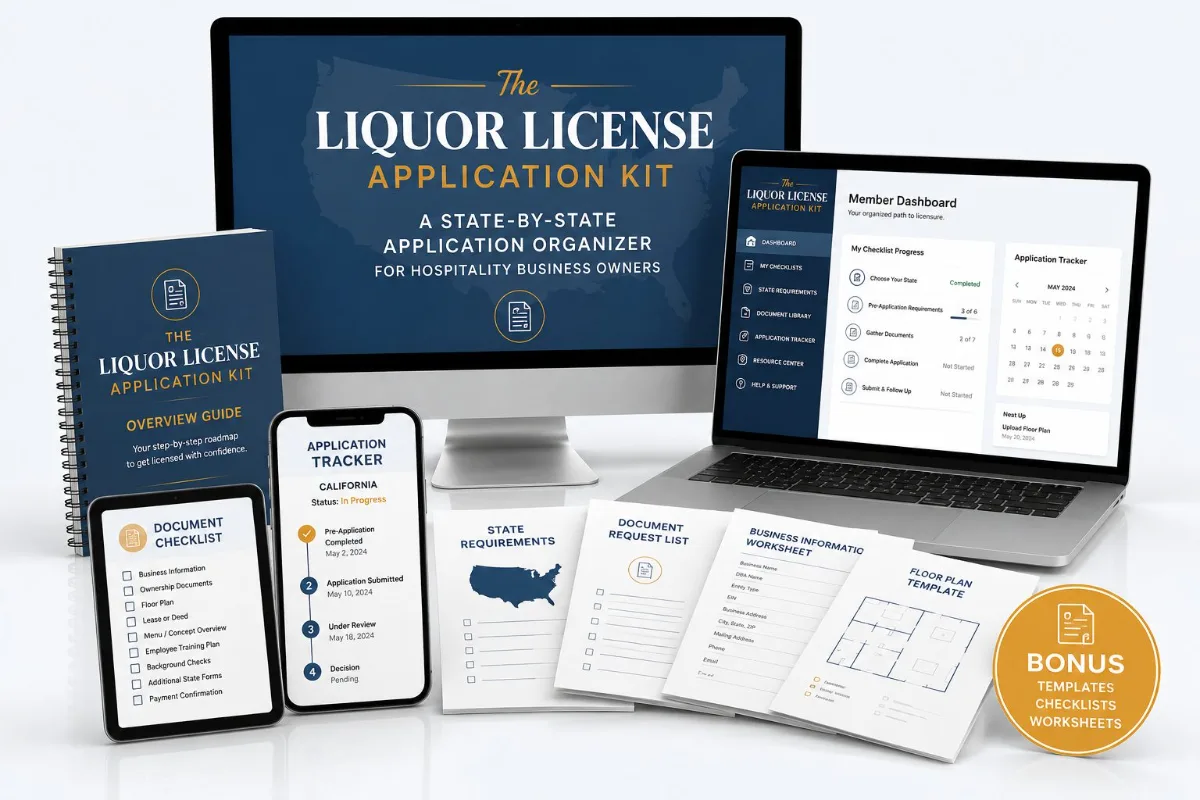
The Liquor License Application Kit
This page shows you the steps. The kit fills them in for Florida. Your license class decoded, every document named and tracked, the deadline and public-notice windows dated and a straight answer on the one or two points that actually need a lawyer. The reference pages stay free. The kit is the evening of assembly you skip.
How to apply for a liquor license in Florida, step by step
Several of these steps gate the ones after them, so the order matters as much as the list.
- Register for Florida sales and use tax with the Department of Revenue and obtain its alcoholic beverage license approval
- Confirm the premises location meets local zoning requirements
- Determine the license class: non-quota 1COP/2COP/1APS/2APS, non-quota SRX, or a 4COP-8COP/3PS-series quota class
- If a quota class, enter the division's annual quota license drawing for the county and pay the $100 filing fee per entry inside the entry period, or pursue a private secondary-market purchase and transfer instead
- Create an online account with the division and complete the state application through the division's online system
- Submit fingerprints for the applicant and every required owner or officer through an FDLE-approved Livescan vendor
- Pay the state license tax and, for a new quota license, the one-time $10,750 fee
- Respond to any division deficiency request within the review period
- Receive the license, or apply for a temporary license to begin operating once the application is complete and shows no apparent disqualification
Local approval and public notice in Florida
The city or county layer on top of the state license, plus any notice you must post or publish. The public-notice window is often the shortest clock in the whole process.
| Item | Florida rule |
|---|---|
| Local sign-off required? | Yes, a city or county sign-off is part of the path |
| What the local layer does | Florida runs no separate local alcohol-license layer. The applicant must show the premises meets local zoning before the division will issue the state license; this is submitted as part of the state application rather than as a standalone local permit. |
| Public notice | none confirmed at the state level |
| Worth knowing | Cities and counties still control business tax receipts, hours of sale and zoning. A dry county under local option can bar sales entirely even where the state quota has room. The division's current fee chart lists Lafayette and Liberty counties as dry. |
Confirm the local sign-off and any public-notice window for your jurisdiction with your city or county before you file.
Server training in Florida
Whether the people pouring or selling alcohol must certify through a state program, plus the deadline.
| Item | Florida rule |
|---|---|
| Required for a first-time retailer? | Voluntary, an incentive rather than a licensing condition |
| Who must certify | n/a at the state level; a business that opts into the Responsible Vendor Program must then train every employee who sells, serves or supervises alcohol service |
| State program | Florida Responsible Vendor Act, ss. 561.701-561.706, F.S., administered by the division |
| Deadline | For a participating business, each nonmanagerial employee who serves alcohol completes the training within 30 days of starting employment; each managerial employee completes it within 15 days |
| Worth knowing | Participation shields a qualifying vendor from license suspension or revocation over an employee's illegal sale to a minor, provided the employee had completed the approved training before the violation. It is an incentive program, not a condition of getting the license. |
Background check and renewal in Florida
Background check
| Item | Florida rule |
|---|---|
| Background check required? | Yes |
| Who is checked | The applicant and, for a corporation, every officer submit fingerprints through an FDLE-approved Livescan vendor for a state and federal criminal history check under the division's ORI number. |
| Disqualifiers | A license may not issue to anyone convicted within the past 10 years of any felony in Florida, another state or the United States (reduced from a 15-year lookback effective July 1, 2024), or within the past 5 years of a beverage-law offense, a prostitution-related offense, keeping a disorderly place, or a controlled-substance violation. A guilty plea, a nolo contendere plea or a bond forfeiture on a qualifying charge counts as a conviction. |
| Worth knowing | The same standards apply to a corporate applicant's officers. Every applicant must also be at least 21 years old and of good moral character. |
Renewal
| Item | Florida rule |
|---|---|
| Renewal cycle | annual |
| Worth knowing | The license year runs October 1 to September 30 in counties marked with an asterisk on the division's fee chart and April 1 to March 31 in all other counties; manufacturers, brokers, sales agents, importers and passenger common carriers renew October 1 to September 30 regardless of county. A license issued mid-cycle pays a half-year rate for its first partial year. |