How to Get a Liquor License in New York (2026): Cost, Classes and Steps
How do you get a liquor license in New York?
In New York, retail liquor licenses are issued by the New York State Liquor Authority, a three-member state board with no numeric quota on the number of licenses it can grant. A first-time on-premises applicant such as a bar or restaurant applies for an on-premises liquor, wine or beer license depending on what it pours, while a first-time off-premises applicant applies for a liquor store or wine store license, since a New York grocery or drug store can be licensed for beer and for wine products under 6 percent alcohol by volume but not for table wine or spirits. Scarcity in dense areas comes from distance rules rather than a population quota: the 200-foot rule bars a retail license near a school or place of worship and the 500-foot rule adds a public-interest review where three or more on-premises liquor licenses already sit nearby.
How much does a liquor license cost in New York? Roughly $430 to $4,552 in state fees. Where the premises sits matters as much as what it sells. The statute tiers the fee by county and city: New York, Kings, Bronx and Queens counties pay the top rate, Richmond County plus Buffalo, Rochester, Syracuse and Yonkers pay the next, a group of mid-size cities pays a third and everywhere else pays the lowest. An on-premises liquor license runs $4,352 for its full two-year term in the four New York City core counties and $1,792 elsewhere. A liquor store license runs $4,098 for a three-year term in those same counties and $1,536 elsewhere. A restaurant wine license is $960 or $480. A grocery store beer license is $330 in every tier. The newer grocery store beer and wine product license runs $594 for a first or second location under class AX-122 and $1,056 from a third location under AX-128. On top sits a non-refundable filing fee of $200 for the liquor classes or $100 for the wine and beer classes. The fee covers the whole multi-year term rather than one year. Work out your own New York figure in the cost estimator.
New York runs its retail liquor licensing through the New York State Liquor Authority. The application is filed with the state. New York sets no cap on the number of retail licenses, so there is no slot to wait for and no existing license to buy out. The page below lays the pieces out in the order the state runs them.
Server training is voluntary here, an incentive rather than a licensing condition. Every owner, officer and significant investor clears a background check. Local involvement depends on the class and the jurisdiction. Each piece has its own section below, with the official source beside it.
The Private For-Profit Club License took effect February 18, 2026. New York created a Private For-Profit Club license priced at $20,000 for a one-year term, aimed at member clubs, after a new Brand Owner's License took effect in December 2025. This page reflects the rule in force today; the full history sits in the law-updates log.
Which liquor license does a New York bar, restaurant or store need?
The retail license classes New York issues, what each covers and the venue each fits. Match your venue to the class before anything else.
Opening a package store rather than a bar? The liquor store license runs on its own rules in New York, including the one-store limit and the ancillary-goods list. Read the liquor store license path.
| Class | Covers | Who it fits |
|---|---|---|
| OP-252 On-Premises Liquor License | on-premise, full spirits (with wine, beer and cider) | The standard license for a bar or restaurant serving spirits by the glass. Two-year term. Subject to the 200-foot and 500-foot rules under ABC Law section 64. Not quota-limited by population. |
| RW-341 Restaurant Wine License | on-premise, beer and wine | Common first license for a small restaurant that does not pour spirits. Two-year term. |
| EB-141 Eating Place Beer License | on-premise, beer | For a restaurant or eating place serving beer only. Three-year term. |
| L-222 Liquor Store License | off-premise, full spirits (with wine and cider) | Package store license for a retail liquor store. Three-year term. ABC Law section 63 limits one license per person and bars the licensee from operating any other business on the premises, with narrow exceptions such as lottery tickets, ice and wine accessories. |
| W-322 Wine Store License | off-premise, wine (with cider) | Off-premises retail wine store license, separate from the liquor store license. Three-year term. |
| A-122 / A-128 Grocery Store Beer License | off-premise, beer | Covers beer sales at a grocery or convenience store. Three-year term; the license fee is higher for a third and later location under the same license. |
| AX-122 / AX-128 Grocery Store Beer and Wine Product License | off-premise, beer and wine products | The wider grocery class under ABC Law section 54-a, open to a grocery store or drug store. It covers beer plus wine products, meaning wine-based drinks under 6 percent alcohol by volume, so ordinary table wine and spirits still need a wine store or liquor store license. Conditions apply on the store itself: food and drugs must make up more than half the inventory and alcoholic beverages no more than a quarter of it. Three-year term; the license fee is higher for a third and later location. |
Is New York a quota or control state?
Whether New York caps the number of licenses and whether the state runs any part of retail itself. Both answers are no here, which is a big part of why New York is one of the simpler states to enter.
| Item | New York rule |
|---|---|
| Quota state? | No, there is no cap on the number of licenses |
| How the cap works | n/a. New York does not cap the number of retail licenses by county population. Practical scarcity in dense areas comes from two distance rules in ABC Law section 64. The 200-foot rule bars an on-premises or off-premises retail license within 200 feet of a school or place of worship on the same street. The 500-foot rule requires an SLA public-interest finding before an on-premises liquor license issues within 500 feet of three or more existing on-premises licenses in a population center of 20,000 or more. |
| Buying an existing license | n/a. Because licenses are not capped by quota, a New York retail license is not bought and sold as a limited asset the way a quota license is in a quota state. A buyer of an existing licensed business is instead buying the operating business and its ability to clear the 500-foot rule at that address. |
| State control | No, private licensing throughout. New York is a licensing state, not a control state. Manufacturing, wholesale and retail sale of alcohol are handled by privately licensed businesses under the three-tier system, with no state-run liquor stores. |
How much does a liquor license cost in New York?
| Item | New York |
|---|---|
| State and local fees to apply | roughly $430 to $4,552 in state filing and license fees depending on class and location. A grocery beer license runs about $330 in license fee plus a $100 filing fee and the wider grocery beer and wine product license runs $594 plus the same $100 filing fee, while a first on-premises liquor license in the New York City core counties runs $4,352 in license fee plus a $200 filing fee |
| Renewal | the same location-based license fee schedule applies again at renewal, since the fee covers the full multi-year license term rather than a separate lower annual renewal rate |
| What drives the range | Fee tier is set by county or city under ABC Law section 66: the counties of New York, Kings, Bronx and Queens pay the highest tier, Richmond County and the state's larger cities pay the next tier, a group of mid-size cities pays a third tier and all other areas pay the lowest tier. State fees exclude any attorney, zoning or local business-permit costs a first-time applicant may separately incur. |
The itemized fees a first-time New York applicant can expect from the state.
| Fee | Amount |
|---|---|
| Filing fee, liquor classes (on-premises liquor, liquor store, hotel liquor, club liquor) | $200, non-refundable |
| Filing fee, wine and beer classes | $100, non-refundable |
| On-Premises Liquor License fee (OP-252), full 2-year term | $4,352 in New York, Kings, Bronx and Queens counties; $3,072 in Richmond County and the cities of Buffalo, Rochester, Syracuse and Yonkers; $2,432 in Albany, Mount Vernon, New Rochelle, Niagara Falls, Schenectady, Utica and White Plains; $1,792 elsewhere |
| Liquor Store License fee (L-222), full 3-year term | $4,098 in New York, Kings, Bronx and Queens counties; $2,562 in Richmond County and the cities of Buffalo, Rochester, Syracuse and Yonkers; $1,536 elsewhere |
| Restaurant Wine License fee (RW-341), full 2-year term | $960 in New York, Kings, Bronx, Queens and Richmond counties and the cities of Buffalo, Rochester, Syracuse and Yonkers; $480 elsewhere |
| Wine Store License fee (W-322), full 3-year term | $1,920 in New York, Kings, Bronx and Queens counties; $960 in Richmond County and comparable cities; $435 elsewhere |
| Grocery Store Beer License fee (A-122), full 3-year term, first and second location | $330 in all location tiers |
| Grocery Store Beer License fee (A-128), full 3-year term, third and each later location | $660 in all location tiers |
| Grocery Store Beer and Wine Product License fee (AX-122), full 3-year term, first and second location | $594 plus the $100 filing fee |
| Grocery Store Beer and Wine Product License fee (AX-128), full 3-year term, third and each later location | $1,056 plus the $100 filing fee |
| Temporary Retail Permit fee | $128 for on-premises beer, grocery or drug store applicants; $640 for all other retail applicants |
| Fingerprint processing | unverifiable, a per-person fee is charged through the state's authorized electronic fingerprinting vendor and was not confirmed at a current dollar figure |
How long it takes. 22 to 26 weeks for a standard full license application, per the SLA's published processing estimate. A Temporary Retail Permit, processed in roughly 30 days and valid for 180 days, lets a new applicant operate while the full application is pending. The 500-foot rule public-interest hearing, the newspaper and premises-posting notice windows plus the examiner deficiency responses that are each allowed 10 business days can extend the standard timeline.
From the team behind this library
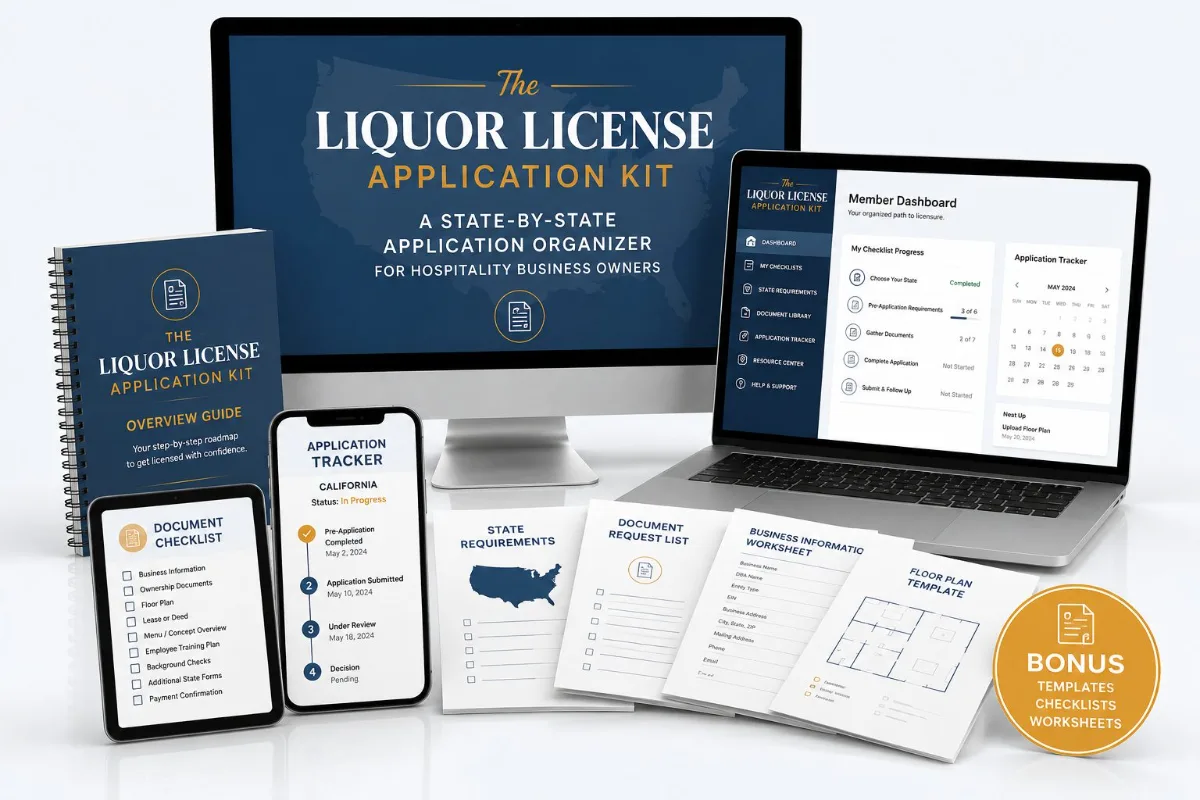
The Liquor License Application Kit
This page shows you the steps. The kit fills them in for New York. Your license class decoded, every document named and tracked, the deadline and public-notice windows dated and a straight answer on the one or two points that actually need a lawyer. The reference pages stay free. The kit is the evening of assembly you skip.
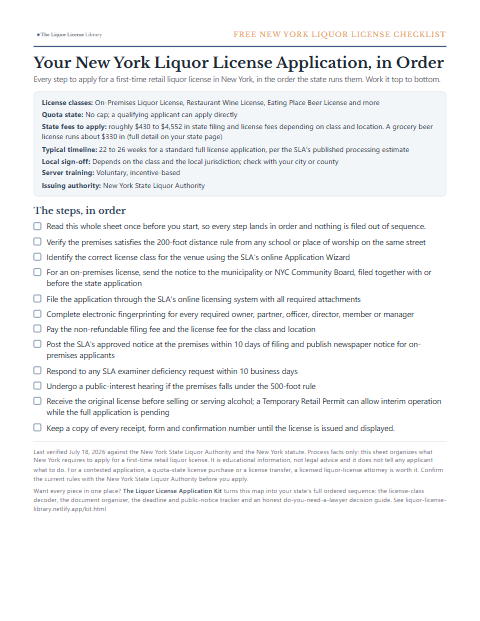
How to apply for a liquor license in New York, step by step
Several of these steps gate the ones after them, so the order matters as much as the list.
- Verify the premises satisfies the 200-foot distance rule from any school or place of worship on the same street
- Identify the correct license class for the venue using the SLA's online Application Wizard
- For an on-premises license, send the notice to the municipality or NYC Community Board, filed together with or before the state application
- File the application through the SLA's online licensing system with all required attachments
- Complete electronic fingerprinting for every required owner, partner, officer, director, member or manager
- Pay the non-refundable filing fee and the license fee for the class and location
- Post the SLA's approved notice at the premises within 10 days of filing and publish newspaper notice for on-premises applicants
- Respond to any SLA examiner deficiency request within 10 business days
- Undergo a public-interest hearing if the premises falls under the 500-foot rule
- Receive the original license before selling or serving alcohol; a Temporary Retail Permit can allow interim operation while the full application is pending
Local approval and public notice in New York
The city or county layer on top of the state license, plus any notice you must post or publish. The public-notice window is often the shortest clock in the whole process.
| Item | New York rule |
|---|---|
| Local sign-off required? | It depends on the class and the jurisdiction |
| What the local layer does | The SLA is the sole license-granting authority and no separate local licensing board votes on the application. For an on-premises applicant, state law requires notice to the municipality or NYC Community Board, which can now be filed at the same time as the state application, with the SLA holding the file for 30 days for local input. A premises within 500 feet of three or more existing on-premises licenses in a population center of 20,000 or more requires an SLA finding that issuance serves the public interest, which functions as a local objection hearing. |
| Public notice | On-premises applicants publish notice in a newspaper once a week for two weeks. On-premises and package store applicants post the SLA's approved notice form at the premises within 10 days of filing. |
| Worth knowing | The municipal or Community Board notice step applies to on-premises applicants. Off-premises liquor store and wine store applicants are not subject to the same 30-day municipal notice requirement. A 2024-2025 reform lets the state application and the municipal notice be filed together, replacing the earlier sequence that required the notice 30 days before filing. |
Server training in New York
Whether the people pouring or selling alcohol must certify through a state program, plus the deadline.
| Item | New York rule |
|---|---|
| Required for a first-time retailer? | Voluntary, an incentive rather than a licensing condition |
| Who must certify | Licensees and any employee who sells or serves alcohol, if the licensee elects to participate. No statewide statute makes completion mandatory for a category of retail licensee. |
| State program | Alcohol Training Awareness Program (ATAP), an SLA-approved curriculum under ABC Law section 17, subdivision 12. Certificates of completion are valid for three years. |
| Worth knowing | Participation is voluntary under the statute. A completed ATAP certificate can reduce a civil penalty in a violation proceeding and can support a limited affirmative defense if a certified server unlawfully serves a minor. Some attorney and industry pages describe employee training as effectively mandatory in practice, or point to a 2023-2024 tightening. This research could not confirm a statute making it a mandatory condition of licensure statewide, so treat any mandatory characterization as unverified against the primary SLA source, which frames it as a recommendation. |
Background check and renewal in New York
Background check
| Item | New York rule |
|---|---|
| Background check required? | Yes |
| Who is checked | Fingerprinting is required for a sole proprietor, every partner in a partnership and, for a corporation or LLC with 10 or fewer shareholders or members, every officer, director, member and manager. For a corporation or LLC with more than 10 shareholders, any shareholder holding 10 percent or more must be fingerprinted. An applicant already licensed by the SLA is not fingerprinted again. |
| Disqualifiers | Statutory grounds include a felony conviction not cured by a Certificate of Relief from Disabilities, a pardon or a Certificate of Good Conduct, a license revocation within the prior two years and a lack of qualifying status as a U.S. citizen, permanent resident alien or citizen of a country with a qualifying reciprocal trade treaty. An applicant must be 21 or older. |
| Worth knowing | Disclosure covers direct and indirect ownership interests in the licensed business, not only the named applicant. |
Renewal
| Item | New York rule |
|---|---|
| Renewal cycle | varies by class: 2 years for most on-premises liquor and wine classes (on-premises liquor, restaurant wine, hotel liquor, club liquor), 3 years for off-premises liquor, wine and beer classes and for on-premises beer-only classes, 1 year for seasonal licenses |
| Worth knowing | The SLA sends a renewal advisory about three months before the license expires. The renewal application must be filed before the current license period ends, or the licensee cannot sell alcohol once it expires. A late renewal requires the SLA's Late Renewal Requirements Form. The dollar amount of any late-filing penalty was not confirmed against a primary source. |