How to Get a Liquor License in Virginia (2026): Cost, Classes and Steps
How do you get a liquor license in Virginia?
In Virginia, retail alcohol licenses are issued by the Virginia Alcoholic Beverage Control Authority, an independent state authority. A restaurant or bar that wants to sell spirits-based drinks applies for a Mixed Beverage Restaurant license, while a venue that only wants beer and wine applies for an on-and-off-premises or off-premises wine and beer license and none of these classes are numerically capped by population. Virginia is also a control state for distilled spirits: private stores cannot sell packaged liquor off-premises at all, since only state-run ABC stores sell spirits at retail.
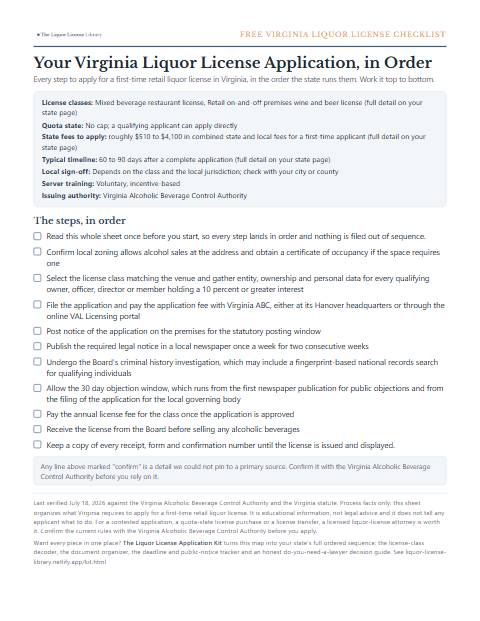
Virginia runs its retail liquor licensing through the Virginia Alcoholic Beverage Control Authority. The application is filed with the state. Virginia sets no cap on the number of retail licenses, so there is no slot to wait for and no existing license to buy out. The page below lays the pieces out in the order the state runs them.
Virginia is a control state, so a private applicant cannot open a full-spirits package store; spirits move through state stores and the private retail license covers beer, wine or on-premise service. Server training is voluntary here, an incentive rather than a licensing condition. Every owner, officer and significant investor clears a background check. Each piece has its own section below, with the official source beside it.
HB 975 took effect July 1, 2026. Virginia replaced its flat 45 percent food-to-beverage ratio for mixed-beverage licensees with a tiered system, effective July 1, 2026. This page reflects the rule in force today; the full history sits in the law-updates log.
Which liquor license does a Virginia bar, restaurant or store need?
The retail license classes Virginia issues, what each covers and the venue each fits. Match your venue to the class before anything else.
| Class | Covers | Who it fits |
|---|---|---|
| Mixed Beverage Restaurant Mixed beverage restaurant license | on-premise, full spirits | For a restaurant or bar serving spirits-based drinks. Subject to the mixed beverage annual review food-to-liquor sales ratio and annual fee is set by seating capacity. As of July 1, 2026 that ratio is tiered by monthly food sales: restaurants selling $48,000 or more in food monthly are exempt from the ratio entirely, restaurants selling $25,000 to $48,000 monthly face a reduced 30 percent ratio and all others remain at the standard 45 percent ratio that previously applied to every mixed beverage restaurant regardless of size. Not quota-limited. |
| On-and-Off Premises Wine and Beer Retail on-and-off premises wine and beer license | both, beer and wine | Common first license for a restaurant, hotel, club or qualifying grocery store that wants to serve wine and beer for on-site consumption and sell closed containers to go. Not quota-limited. |
| Off-Premises Wine and Beer Retail off-premises wine and beer license | off-premise, beer and wine | For a grocery store, delicatessen or similar retailer selling closed containers of wine and beer for off-premises consumption only. Not quota-limited. Does not cover spirits; packaged spirits are sold only through state-run ABC stores. |
| Limited Mixed Beverage Restaurant Limited mixed beverage restaurant license | on-premise, full spirits | Restricted to dessert wines, liqueurs and similar low-volume mixed drinks combined with a non-alcoholic beverage; such sales cannot exceed 10 percent of total receipts. A narrower, lower-cost alternative to the full Mixed Beverage Restaurant license. |
Is Virginia a quota or control state?
Whether Virginia caps the number of licenses and whether the state runs any part of retail itself. Virginia sets no cap, though its control structure still shapes which license a private business can hold.
| Item | Virginia rule |
|---|---|
| Quota state? | No, there is no cap on the number of licenses |
| State control | Yes, a control state. Virginia controls distilled spirits at both wholesale and retail: Virginia ABC operates the state's spirits stores and no private retailer can sell packaged spirits off-premises. Beer and wine are privately distributed and sold by licensed wholesalers and retailers, not state-controlled. A first-time off-premises retail applicant can only be licensed for beer and wine, not spirits. |
Not fully settled in one published place. Confirm the exact quota status and, where a cap applies, how a new or existing license is obtained with the Virginia Alcoholic Beverage Control Authority before you rely on it.
How much does a liquor license cost in Virginia?
| Item | Virginia |
|---|---|
| State and local fees to apply | roughly $510 to $4,100 in combined state and local fees for a first-time applicant, driven mostly by license class and seating capacity |
| Renewal | $300 to $3,100 per year in state license fees by class, plus any local license tax the locality renews alongside it |
| What drives the range | The low end is an off-premises wine and beer license with no local tax; the high end is a large Mixed Beverage Restaurant (over 1,000 seats) in a city that imposes its full local license tax. All figures are state fees; they exclude any real estate, buildout or third-party legal costs. |
The itemized fees a first-time Virginia applicant can expect from the state.
| Fee | Amount |
|---|---|
| Application fee (per license type) | $195, plus the actual cost of processing a criminal history check |
| Background check / fingerprint processing (per qualifying individual) | actual cost charged by the state and federal record systems; corroborating sources report roughly $15 to $27 per person depending on whether a fingerprint-based national check is required |
| Mixed Beverage Restaurant annual license fee, up to 100 seats | $1,050 |
| Mixed Beverage Restaurant annual license fee, more than 1,000 seats | $3,100 |
| On-and-off premises wine and beer annual license fee | $450 |
| Off-premises wine and beer annual license fee | $300 |
| Local license tax (optional, set by the locality up to a statutory ceiling) | up to $800 for a mixed beverage license in a city, or up to $150 for off-premises wine and beer in a city (lower ceilings apply in counties and towns) |
How long it takes. 60 to 90 days after a complete application, an estimate that search-engine indexing of the Authority's own retail-licenses page consistently attributes to abc.virginia.gov; the live page itself returned only bot-blocked content on direct fetch, so this figure carries partial rather than full confirmation. The statutory floor is set by the 30 day local objection window that runs from filing, plus the criminal history investigation; incomplete applications, contested objections or fingerprint delays extend it further.
The state does not publish a single processing time; confirm the current wait with the Virginia Alcoholic Beverage Control Authority.
From the team behind this library
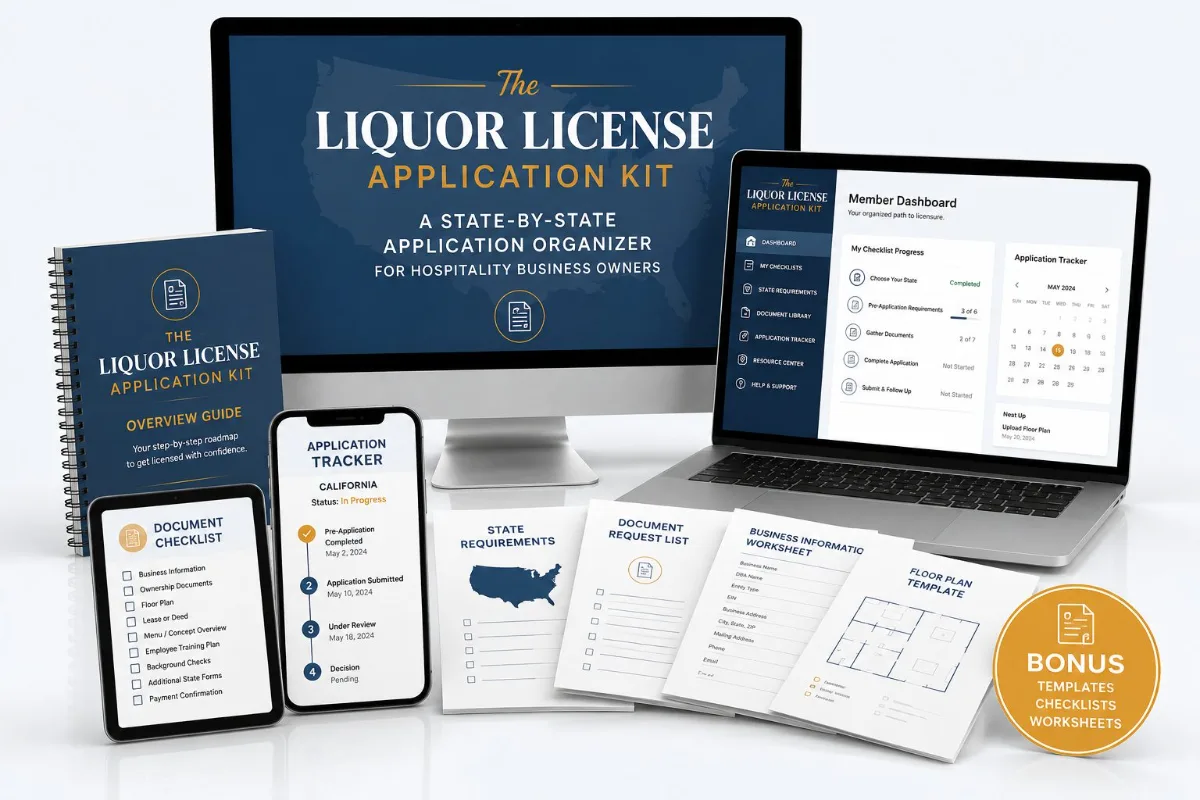
The Liquor License Application Kit
This page shows you the steps. The kit fills them in for Virginia. Your license class decoded, every document named and tracked, the deadline and public-notice windows dated and a straight answer on the one or two points that actually need a lawyer. The reference pages stay free. The kit is the evening of assembly you skip.
How to apply for a liquor license in Virginia, step by step
Several of these steps gate the ones after them, so the order matters as much as the list.
- Confirm local zoning allows alcohol sales at the address and obtain a certificate of occupancy if the space requires one
- Select the license class matching the venue and gather entity, ownership and personal data for every qualifying owner, officer, director or member holding a 10 percent or greater interest
- File the application and pay the application fee with Virginia ABC, either at its Hanover headquarters or through the online VAL Licensing portal
- Post notice of the application on the premises for the statutory posting window
- Publish the required legal notice in a local newspaper once a week for two consecutive weeks
- Undergo the Board's criminal history investigation, which may include a fingerprint-based national records search for qualifying individuals
- Allow the 30 day objection window, which runs from the first newspaper publication for public objections and from the filing of the application for the local governing body
- Pay the annual license fee for the class once the application is approved
- Receive the license from the Board before selling any alcoholic beverages
Local approval and public notice in Virginia
The city or county layer on top of the state license, plus any notice you must post or publish. The public-notice window is often the shortest clock in the whole process.
| Item | Virginia rule |
|---|---|
| Local sign-off required? | It depends on the class and the jurisdiction |
| What the local layer does | There is no separate local retail alcohol license or local board vote in most Virginia localities. Local zoning compliance and any needed certificate of occupancy are practical prerequisites the applicant secures directly with the locality and the Board notifies the local governing body after filing so it can formally object within 30 days. |
| Public notice | Notice posted on the front door of the premises for at least 10 and no more than 30 days, plus publication in a local newspaper once a week for two consecutive weeks. Public objections are due to the Board no later than 30 days from the initial newspaper publication and the local governing body has 30 days from the filing of the application to object, under Code of Virginia 4.1-230 |
| Worth knowing | A small number of Virginia counties and portions of roughly three dozen others are dry by local referendum on mixed beverage sales under Code of Virginia 4.1-124, which is a wet/dry local-option vote rather than a licensing-board approval step. |
Server training in Virginia
Whether the people pouring or selling alcohol must certify through a state program, plus the deadline.
| Item | Virginia rule |
|---|---|
| Required for a first-time retailer? | Voluntary, an incentive rather than a licensing condition |
| Who must certify | n/a; the incentive applies to whichever employees the licensee chooses to train |
| State program | Responsible Sellers & Servers: Virginia's Program (RSVP), plus the Managers' Alcohol Responsibility Training (MART) and Responsible Alcohol Delivery Driver (RADD) programs, all certified in advance by the Board under Code of Virginia 4.1-227(E) |
| Worth knowing | Virginia does not require server or seller training as a condition of licensure. A licensee that provides Board-certified training gets a statutory reduction in the length of any suspension and in the amount of any civil penalty for a violation. Effective July 1 2025, the RSVP curriculum must include a human-trafficking recognition and reporting module developed by the Department of Criminal Justice Services. |
Background check and renewal in Virginia
Background check
| Item | Virginia rule |
|---|---|
| Background check required? | Yes |
| Who is checked | Every owner, general partner, corporate officer, director and any shareholder or LLC member holding a 10 percent or greater interest undergoes a criminal history records search, which may include a fingerprint-based national records check; a local ABC special agent also investigates the application before the Board decides. |
| Disqualifiers | Applicants and qualifying individuals must be 21 or older. The Board may refuse a license for a felony conviction or a conviction for a crime involving moral turpitude, or for an alcohol-law conviction within the past five years. The statute also lets the Board weigh good moral character and repute, a noisy or disorderly establishment, disregard for law and order and inability to communicate adequately in English. |
| Worth knowing | These are discretionary refusal grounds the Board weighs, not automatic bars for every conviction; undisclosed ownership interests and misrepresentation in the application are separate, listed grounds for refusal. |
Renewal
| Item | Virginia rule |
|---|---|
| Renewal cycle | annual |
| Worth knowing | The Board may also issue a license for a multi-year term of up to three years at once, at a small percentage discount off the annual fee. A missed renewal can still be paid within 30 days with a $25 (or 10 percent) penalty, or within an additional 45 days with a $100 (or 25 percent) penalty, whichever is greater in each case, before the license lapses. |