How to Get a Liquor License in Iowa (2026): Cost, Classes and Steps
How do you get a liquor license in Iowa?
In Iowa, the Department of Revenue's Alcohol and Tax Operations Division issues retail alcohol licenses and the local city council or county board of supervisors must review and endorse every application before the department acts on it. A bar or restaurant applies for a class C license to sell full liquor by the drink, or a special class C license if it will only serve beer and wine, while a store applies for a class E license to sell liquor, wine and beer in sealed containers or a class B license for beer and wine only. Iowa sets no state quota on any retail class, so a license issues once the local authority and the department both sign off.
How much does a liquor license cost in Iowa? Between $75 and $7,500 a year in state license fees. Which end you land on is decided by your class, your city's population and your premises square footage. A class B license runs $75 to $750, a special class C runs $195 to $585, a class C runs $715 to $1,625 and a class E off-premise license runs $750 to $7,500. The class C figures already include the 30 percent state surcharge. Renewal is the same schedule rather than a lower rate. Iowa collects one fee and remits 65 to 75 percent of it back to the local authority for the class B, C, F and special C licenses, so there is no separate local license fee stacked on top under state law. A class E applicant may also post a $5,000 to $15,000 bond. Work out your own Iowa figure in the cost estimator.
In Iowa, retail liquor licenses go through the Iowa Department of Revenue, Alcohol and Tax Operations Division. A first-time applicant files locally, because the city or county is the issuing authority here. Iowa sets no cap on the number of retail licenses, so there is no slot to wait for and no existing license to buy out. Work the page top to bottom and the whole path is visible before any single deadline is due.
Iowa runs a partial control system, handling some spirits wholesale or retail itself while private retailers hold the on-premise and off-premise licenses. Server training is voluntary here, an incentive rather than a licensing condition. Every owner, officer and significant investor clears a background check. Each piece has its own section below, with the official source beside it.
The parts an Iowa applicant most often misses are the order of the steps, since several gate the ones after them. The sections below take them in order.
Which liquor license does an Iowa bar, restaurant or store need?
The retail license classes Iowa issues, what each covers and the venue each fits. Match your venue to the class before anything else.
| Class | Covers | Who it fits |
|---|---|---|
| Class C Retail alcohol license, on-premise | on-premise, full spirits | The core license for a bar or restaurant selling liquor, wine and beer by the individual drink; unopened containers may also be sold for off-premise consumption. Not quota-limited. The posted fee already includes a 30 percent state surcharge on top of the scheduled class C rate. |
| Special Class C Retail alcohol license, on-premise beer and wine only | on-premise, beer and wine | A limited on-premise license for a restaurant or bar that will not serve spirits; the license face states the limitation. Same local-approval and dramshop-insurance rules as class C, at a lower fee that also carries the 30 percent surcharge. |
| Class E Retail alcohol license, off-premise | off-premise, full spirits | The single license for a liquor store or a grocery store of at least 5,000 square feet selling liquor, wine and beer in sealed containers for off-premise consumption; also lets the holder sell liquor and high-alcohol beer at wholesale to other retail licensees. Requires a sliding-scale $5,000 to $15,000 bond payable to the department unless purchases are prepaid. |
| Class B Retail alcohol license, off-premise beer and wine only | off-premise, beer and wine | The license for a convenience store or grocery store selling sealed beer and wine only, with no spirits. Lower fee than class E and no bond requirement. |
Is Iowa a quota or control state?
Whether Iowa caps the number of licenses and whether the state runs any part of retail itself. Iowa sets no cap, though its control structure still shapes which license a private business can hold.
| Item | Iowa rule |
|---|---|
| Quota state? | No, there is no cap on the number of licenses |
| How the cap works | n/a. Iowa Code 123.32 states plainly that there is no limit on the number of retail alcohol licenses a local authority may approve for issuance. |
| Buying an existing license | n/a. A retail license issues on a qualifying application rather than trading in a capped market. |
| State control | Partial control. The department is the wholesale source of distilled spirits: a class E off-premise licensee buys alcoholic liquor in original unopened containers from the department only, while a class C on-premise licensee buys its liquor from class E retail licensees, which trace back to the department. Wine and beer wholesale distribution stays private, through licensed class A wine and beer permittees. Retail sale itself is entirely private; the state runs no retail liquor stores. |
How much does a liquor license cost in Iowa?
| Item | Iowa |
|---|---|
| State and local fees to apply | $75 to $7,500 in annual state license fees, depending on class, city population and premises square footage |
| Renewal | same annual fee schedule as the initial fee; class C and special class C carry a 30 percent state surcharge already built into the posted fee |
| What drives the range | The department collects one fee per license and remits 65 to 75 percent of it back to the local authority for class B, C, F and special C licenses, so a first-time applicant does not pay a separate local license fee on top under state law. A class E off-premise applicant may also need the sliding-scale $5,000 to $15,000 bond, while an on-premise class C or special class C applicant separately pays for dramshop liability insurance, which is not a government fee. |
The itemized fees a first-time Iowa applicant can expect from the state.
| Fee | Amount |
|---|---|
| Class C license, annual (includes the 30 percent state surcharge) | $715 to $1,625 depending on city population |
| Special class C license, annual (includes the 30 percent state surcharge) | $195 to $585 depending on city population |
| Class E license, annual | $750 to $7,500 depending on city population and premises square footage |
| Class B license, annual | $75 to $750 depending on city population and premises square footage |
| Class E bond (waived if liquor purchases from the department are prepaid) | $5,000 to $15,000 on a sliding scale set by the department |
How long it takes. Roughly 30 to 90 days from a complete application, with most of the range set by the local review stage. Department guidance, corroborated through a city government's own application instructions, describes applying at least 45 days ahead of the wanted start date so the local authority can approve and forward the application to the department at least 15 days before that date, with department review itself taking about 45 days once a complete application arrives. The bigger variable is the local authority's own meeting calendar: several city clerk pages describe a new license needing two council votes, while a monthly-meeting council can add 4 to 6 weeks on its own.
From the team behind this library
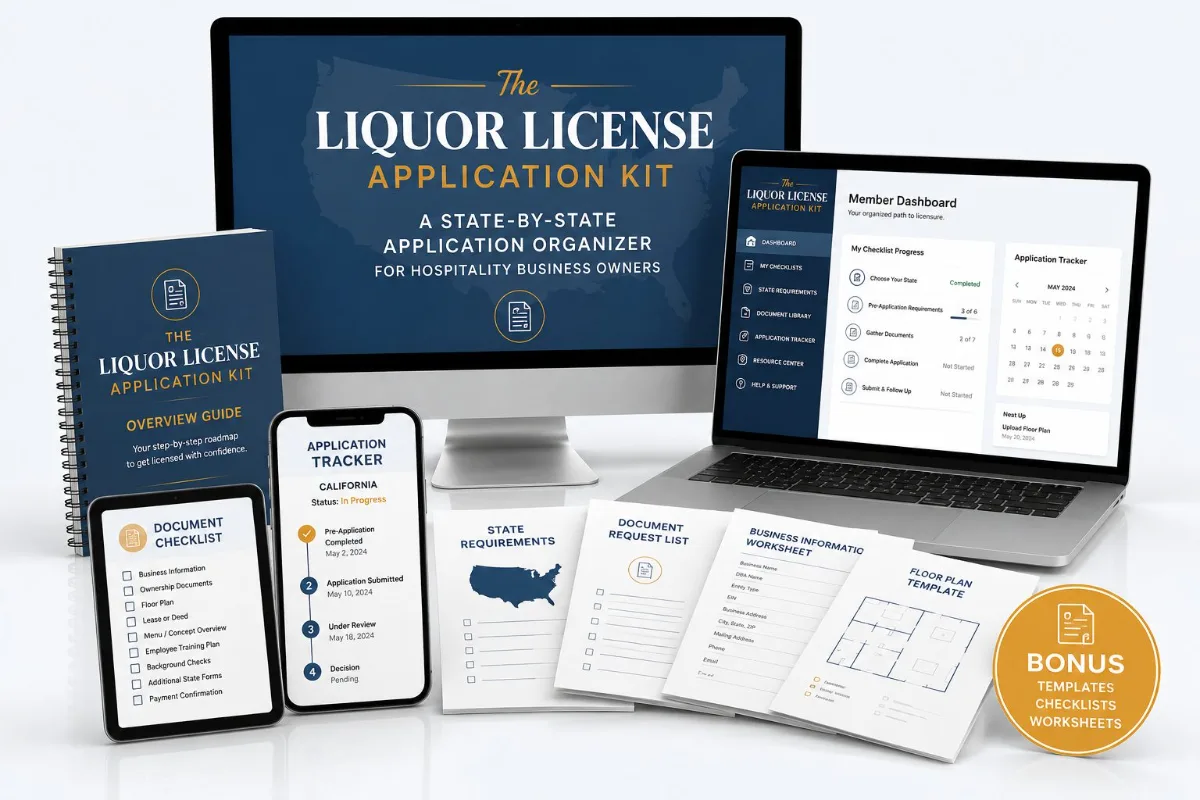
The Liquor License Application Kit
This page shows you the steps. The kit fills them in for Iowa. Your license class decoded, every document named and tracked, the deadline and public-notice windows dated and a straight answer on the one or two points that actually need a lawyer. The reference pages stay free. The kit is the evening of assembly you skip.
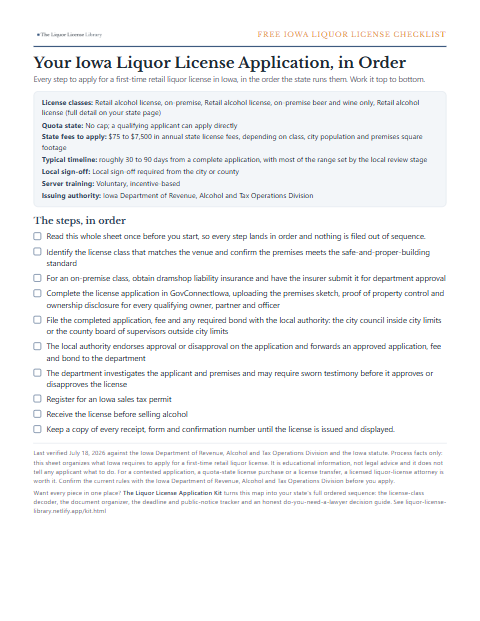
How to apply for a liquor license in Iowa, step by step
Several of these steps gate the ones after them, so the order matters as much as the list.
- Identify the license class that matches the venue and confirm the premises meets the safe-and-proper-building standard
- For an on-premise class, obtain dramshop liability insurance and have the insurer submit it for department approval
- Complete the license application in GovConnectIowa, uploading the premises sketch, proof of property control and ownership disclosure for every qualifying owner, partner and officer
- File the completed application, fee and any required bond with the local authority: the city council inside city limits or the county board of supervisors outside city limits
- The local authority endorses approval or disapproval on the application and forwards an approved application, fee and bond to the department
- The department investigates the applicant and premises and may require sworn testimony before it approves or disapproves the license
- Register for an Iowa sales tax permit
- Receive the license before selling alcohol
Local approval and public notice in Iowa
The city or county layer on top of the state license, plus any notice you must post or publish. The public-notice window is often the shortest clock in the whole process.
| Item | Iowa rule |
|---|---|
| Local sign-off required? | Yes, a city or county sign-off is part of the path |
| What the local layer does | The city council (inside city limits) or the county board of supervisors (outside city limits) reviews and must approve every retail application before the department acts on it, ordinarily as an agenda item at a regular meeting. Iowa Code 123.32 sets no cap on how many licenses a local authority may approve. A local authority may also add its own designated-security-employee training condition for an on-premise license. A local authority in a county with a population over 300,000 must require the licensee to report the premises occupancy rate. |
| Worth knowing | Local review comes first in the filing sequence, before the department acts. |
Server training in Iowa
Whether the people pouring or selling alcohol must certify through a state program, plus the deadline.
| Item | Iowa rule |
|---|---|
| Required for a first-time retailer? | Voluntary, an incentive rather than a licensing condition |
| Who must certify | n/a. No state law requires a server, seller or ID checker to certify as a condition of holding or working under a retail license. |
| State program | I-PACT, the Iowa Program for Alcohol Compliance Training, the alcohol compliance training program established in Iowa Code 123.50A and administered by the Department of Revenue, with department-approved third-party programs accepted as equivalent |
| Worth knowing | Completing I-PACT gives a licensee an affirmative defense against a sale-to-minor violation, usable once in a four-year period, but it is never a condition of getting or keeping the license itself. Separately, a local authority may require a licensed premises to have a designated security employee trained and certified in security methods as its own condition of an on-premise license; that is a security-conduct rule, not general alcohol-server training. |
Background check and renewal in Iowa
Background check
| Item | Iowa rule |
|---|---|
| Background check required? | Yes |
| Who is checked | Every person with a qualifying ownership, partner or officer interest in the applicant discloses their history on the application while the local authority and the department each investigate the applicant and the premises; the application materials describe a disclosure-and-investigation review rather than a fingerprint submission. |
| Disqualifiers | A felony conviction within the 5 years before the application date disqualifies the applicant unless the person's citizenship rights were restored by the governor, in which case the director may still find good moral character; the statute also weighs the applicant's financial standing and any license revoked within the past 2 years against a good-moral-character finding. |
| Worth knowing | Good moral character is defined in Iowa Code 123.3. The application's contents, including the criminal-history disclosure, are set in Iowa Code 123.31. An on-premise applicant separately carries dramshop liability insurance at minimums the department publishes (reported at $50,000 per person and $100,000 per occurrence for bodily injury or death, plus $25,000 per person and $50,000 per occurrence for loss of support, with no policy-life aggregate cap); repeated cancellation of that policy for nonpayment counts against a good-moral-character finding. |
Renewal
| Item | Iowa rule |
|---|---|
| Renewal cycle | annual |
| Worth knowing | License fees are set to be paid to the department annually under Iowa Code 123.36. The Department of Revenue's own alcohol licensing page confirms an automatic renewal program for a licensee that stays in compliance, which reduces the paperwork a renewing licensee resubmits each year. Iowa Code 123.34 separately confirms that seasonal, fourteen-day and five-day licenses are the only shorter retail terms and that none of those short-term licenses may be renewed. |