Alcohol Server Permit by State (2026): Cost, Age and Renewal
The permit is personal. The liquor license belongs to the business. Two different applications, two different fees.
An alcohol server permit is a personal credential that lets you pour, sell or serve alcohol as an employee. A liquor license is a separate permit that belongs to the business. If you are a bartender, a server or a store clerk, the server permit is the one you want. In most states it means a short course, an exam and a fee measured in tens of dollars. If you are opening a bar, a restaurant or a store, that is the business license, a different application entirely.
The two get searched for with the same words, which is why this page exists. Phrases like "OLCC license", "alcohol serving permit", "liquor control commission card" and "bartender license" nearly always mean the personal permit. The rest of this library covers the business license. This guide covers the personal one, state by state, with the fee, the age rule, the term and the deadline for each.
Which one do you need?
- You are being hired to serve, pour or sell. You need the personal permit or certificate. Your employer cannot hold it for you. In most states you must have it within a set number of days of starting. In a growing number of states you need it before your first shift.
- You are opening the venue. You need the business liquor license, which your state page covers in full. If you will also be behind the bar, you need the personal permit as well. Several states separately require the licensee or a designated manager to hold a management-level certificate regardless of whether they pour.
The fee, the term and the deadline are set state by state. Find your state in the directory for the rule where you are, cited to its statute or alcohol authority.
Server permits by state: the ones the searches ask about
The states below either issue an individual permit or card themselves or run a mandate that reaches every server. Each row states what the state issues, what the state charges, how long it lasts and when you must have it. Where a state does not publish a single fee, the row says so rather than quoting a training company's price as a government figure.
| State | What it is, what it costs and when you need it |
|---|---|
| Oregon | The OLCC alcohol service permit. $23 non-refundable to the commission, valid five years. Minimum age 18, with a minor service permit for ages 18 to 20 that does not cover mixing drinks or bartending. Filed online through CAMP only. Since 31 March 2025 the application, the payment, an approved alcohol server education class and the OLCC-proctored test must all be finished before you serve. |
| Tennessee | The TABC server permit, applied for through the RLPS portal. $20 to the commission. Permits issued on or after 1 January 2025 run two years; permits issued before that date keep a five-year term. A new server has 61 days from starting to obtain it, once per person rather than once per employer. The required alcohol-awareness course runs at least three and a half hours. A package store's alcohol manager holds a separate manager permit at $50. |
| Washington | The WSLCB MAST permit under RCW 66.20.310, in two classes: class 12 for applicants 21 and older who mix drinks, manage or deliver, class 13 for applicants aged 18 to 20 who may open, pour and carry but not mix or draw from a tap. Required within 60 days of initial hire, valid five years and not renewable, so the course is retaken at the end. The course price is set by the WSLCB-certified provider rather than by the state. |
| California | RBS certification through the ABC's RBS Portal: register for a server ID, train with an ABC-approved provider then pass the ABC Alcohol Server Certification Exam. Servers and the managers who supervise them must be certified within 60 days of their first date of employment and the certification is valid for three years. ABC charges a registration fee in the portal and the provider charges separately for the course; the current amounts are published on the ABC RBS page. Off-sale-only classes sit outside this on-premises requirement. |
| Utah | No individual state card. Utah requires the alcohol training and education seminar under the Alcohol Training and Education Act, taken through a DABS-approved provider, which issues a certificate tracked in the state training registry. Valid three years. Servers complete it before beginning work; a retail manager completes the manager track within 30 days of hire. DABS does not run or price the training itself, so there is no state fee to quote. |
| New Mexico | A state server permit under the alcohol server education program at NMSA 1978 60-6E, issued through an approved provider. Required within 30 days of employment as a server and valid three years from the class date. A temporary permit covers the 120 days while the permanent card is processed. The division publishes a $10 fee for a duplicate card; the permit fee itself is collected through the approved provider rather than posted as a single state figure. |
| Alaska | An AMCO-approved alcohol server education course card under AS 04.21.025, required within 30 days of being employed and valid three years. Staff must carry the card or a copy while selling or serving. It reaches anyone who sells or serves alcohol or checks patron identification, so store staff are inside the rule. The board approves the providers; the course price is theirs rather than a published state fee. |
| Illinois | BASSET certification under 235 ILCS 5/6-27.1, delivered by trainers licensed by the Illinois Liquor Control Commission. Required within 120 days of starting and valid three years. It covers anyone who sells or serves open containers at retail plus anyone whose job includes checking identification for an alcohol purchase. The trainer sets the course price. |
| Indiana | An employee permit from the Alcohol and Tobacco Commission plus ATC certified server training, which the commission offers free through its own online program. Required within 120 days of the server's start date with a refresher every three years. Since 1 July 2025 the rule reaches door staff who verify age or identification, not only bartenders and servers. An applicant aged 18 to 20 completes the training before the restricted permit issues. |
The two marked rows carry a condition. Washington's permit runs five years and is not renewable, so the course is taken again at the end of it. Tennessee's two-year term applies to permits issued on or after 1 January 2025 and permits issued before that date keep their original five-year term. Both are stated in full, with their source, in the table above. Open your own state page for the current rule.
Oregon in full, because most of these searches are Oregon
The OLCC issues one personal credential, the alcohol service permit. It reaches everyone who mixes, serves or sells alcohol at a premises allowing on-premises consumption, every manager who supervises that service and off-premises staff who fill growlers to take away. There is no separate "bartender license" and no separate "liquor control commission card": those phrases all describe this one permit. The path runs application first, then class, then test. You create a CAMP account and submit the application online, pay the $23 non-refundable fee, take an OLCC-approved alcohol server education class then sit the OLCC-proctored exam. The commission reviews and issues.
Two details catch people out. The first is that the old grace period is gone: House Bill 4138 removed the provisional window that used to let a new hire serve while finishing training, so since 31 March 2025 every step has to be complete before the first shift. The second is that the permit is a five-year credential rather than a lifetime one. Renewal is a fresh application with an approved class taken again. If you are the licensee, note separately that Oregon requires an on-premises licensee to personally hold a service permit or to designate a permit holder with authority over alcohol service.
If you are the one opening the venue
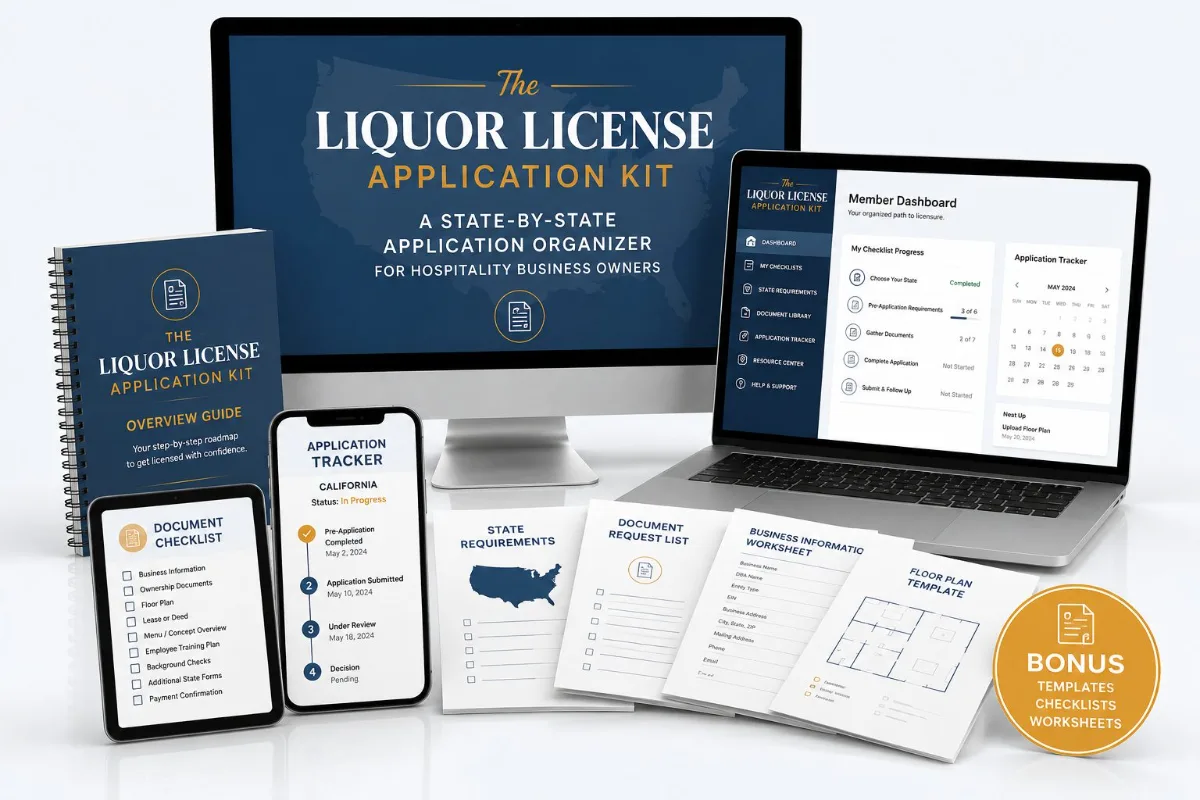
Everything above is the personal side. The business side is a separate application to the same agency, with license classes, fees, a quota question in about a third of states, local sign-off, public notice and a background check. That is what the rest of this library covers. The kit below is the assembled version of it.
From the team behind this library
The Liquor License Application Kit
Want the whole path in one place? The Liquor License Application Kit hands you the done pieces for your state: the 51-jurisdiction directory and state selector, the license-class decoder, the dependency-ordered filing checklist, the document-gathering organizer, the deadline and public-notice tracker and an honest do-you-need-a-lawyer decision guide.
Tennessee, the other cluster
Tennessee runs the closest thing to a classic permit card. The Alcoholic Beverage Commission issues a server permit through its RLPS portal, the fee is $20 and a new server has 61 days from the day they begin serving to obtain it. That grace period belongs to the person rather than the job, so someone who let a previous permit lapse does not get it again. The required course is a commission-certified alcohol awareness program of at least three and a half hours. The curriculum was widened from 1 January 2025 to add sexual assault and human trafficking awareness content. The same 2025 change shortened the server permit term from five years to two for permits issued on or after that date.
The retail side of Tennessee works differently. A package store employee who sells alcohol completes annual responsible vendor training. Whoever manages the alcohol operations of a package store or a retail food store wine licensee holds a separate manager permit at $50 with its own five-year term. So "do I need a permit to work in a liquor store in Tennessee" has a different answer from the bar version of the same question.
Utah, where there is a certificate but no card
Utah mandates training without issuing an individual state permit. Anyone who serves, sells or mixes alcohol completes the alcohol training and education seminar through a DABS-approved provider before beginning work then repeats it every three years. Managers and supervisors have their own track. What you hold at the end is a certificate recorded in the state training registry rather than a card the department mails you. Because DABS neither runs nor prices the training, there is no state fee to look up: the provider sets the price. Failing to keep a manager or a staff member current exposes the business licence to action by the commission, which is why Utah employers usually treat it as a condition of the job rather than a formality.
The rest of the country, honestly summarised
Twenty-three states run a mandatory training or permit requirement in some form. The label matters less than the scope. The scope splits three ways.
- Every server is covered in Alaska, California, Delaware, Illinois, Indiana, Montana, New Mexico, Oklahoma, Oregon, Rhode Island, South Carolina, Tennessee, Utah, Vermont, Washington and Wisconsin, though each writes the boundary a little differently. Rhode Island reaches valet staff and anyone who checks identification. Oklahoma gives 14 days. Vermont requires it before the first shift and will not issue the licence itself until the licensee has trained.
- Only the licensee or a designated manager is covered in Arizona, Connecticut, Maryland, Michigan, North Carolina and New Hampshire. New Hampshire runs its own management training seminar free of charge within 45 days of the licence issuing. Michigan asks for a trained supervisor on site during every hour alcohol is served. North Carolina makes proof of an approved course part of the permit application itself.
- The rule is set by the county rather than the state in Hawaii, where Honolulu, Maui and Kauai each run their own card and exam with their own scope, term and fee. Honolulu charges $10 for its card.
The remaining states either run a voluntary responsible-vendor program that lowers a licensee's exposure without being a condition of employment, or set no state scheme at all and leave it to the employer. A voluntary program is still worth knowing about if you are the owner, because in several states completing it changes what happens after a violation. Your state page states which of the three applies where you are, with the statute or agency behind it.
Where to check your own state
Every state page in this library carries a server training section stating whether the requirement is mandatory, voluntary, conditional or absent, who exactly must certify, the state program name, the deadline and the source it comes from. Open yours for the current rule.
This guide is educational information, not legal advice and it does not tell any applicant what to do. Permit fees, terms and deadlines are set state by state and change; confirm the current rule with your own state's alcohol authority before you rely on any of it. Course prices are set by approved private providers and are not government fees. See how the business license side works or read how we verify every page.
Alcohol server permit FAQ
What is an alcohol server permit?
An alcohol server permit is a personal credential held by the individual who pours, sells or serves alcohol at a licensed business. It is separate from the liquor license, which belongs to the business itself. In most states the permit means completing an approved course, passing an exam and holding a card or certificate for a set number of years. Roughly 23 states require some form of it and the rest either run a voluntary program or leave it to the employer.
Is a server permit the same as a liquor license?
No. A liquor license authorises a business to sell alcohol at a specific address and it is issued to the owner or the entity. A server permit authorises a person to serve or sell alcohol as an employee. They are different applications, different fees and in several states different offices inside the same agency. A bartender needs the permit. The venue needs the license. A bar owner who also pours often needs both.
How do I get an OLCC permit in Oregon?
Oregon calls it an alcohol service permit and the Oregon Liquor and Cannabis Commission issues it. You create a CAMP account and file the application online, because paper applications are no longer accepted, pay the $23 non-refundable fee, complete an OLCC-approved alcohol server education class and pass the OLCC-proctored test. Since 31 March 2025 all of those steps have to be finished before you mix, sell or serve. The permit runs five years and you reapply and retake a class at the end of it.
How old do you have to be to serve alcohol?
It varies by state and often by role. Oregon issues a service permit from age 18, with a minor service permit for applicants aged 18 to 20 that does not allow mixing drinks or bartending. Washington splits its permit in two: a class 12 for applicants 21 and older who mix drinks or manage plus a class 13 for applicants aged 18 to 20 who may open, pour and carry alcohol but not mix or draw from a tap. Check your own state page for the rule where you are.
How much does a bartender license cost?
Where the state issues the permit itself the state fee is usually small: $23 in Oregon and $20 in Tennessee. Most of the rest of the cost is the approved course, which is priced by the training provider rather than by the state, so no state fee schedule covers it. Several states charge no state fee at all and only require you to hold a current certificate from an approved provider. Treat any single national price you see as a course price, not a government fee.
How long does an alcohol server permit last?
Commonly three to five years. Oregon runs five years, Washington five years and not renewable, so the employee retakes the course. Tennessee moved to two years for permits issued on or after 1 January 2025, while permits issued before that date keep their original five-year term. California, Illinois, Utah, New Mexico and Alaska all sit at three years. Your state page carries the exact term and who has to hold one.
Do I need a server permit to work in a liquor store?
It depends on the state and on what the store sells. Several states write the mandate around on-premises service, so a store clerk is outside it. Others reach store staff directly: Alaska covers anyone who sells or serves alcohol or checks identification, Illinois covers anyone whose job includes checking identification for alcohol purchases and Tennessee requires package-store employees who sell alcohol to complete annual responsible-vendor training with a separate manager permit for whoever runs the alcohol side. Read your own state page rather than assume the on-premises rule covers you.