How Much Does a Liquor License Cost? (2026) Fees by State
Two layers: the fees you pay the state, plus in a quota state the price of the license itself. Here is the real spread.
The honest answer to "how much does a liquor license cost?" has two layers and mixing them up is how owners get surprised. The first layer is the fees you pay the state and your locality to apply and hold the license. The second, in about a third of states, is the price of the license itself, which in a quota jurisdiction is a privately traded asset that can dwarf every fee. This guide separates the two so you can budget from real numbers rather than a hopeful guess.
The state and local fees, by band
- The floor, roughly $28 to $150. A small-county beer license can run under $30 a year in Florida. The $50 band covers Missouri and Wisconsin. Louisiana starts around $70, Michigan about $170 and Alabama from $200.
- The typical band, roughly $200 to $2,000. A beer, beer-and-wine or single retail class for a first small restaurant or store clusters here in combined state and local fees across most states.
- Full-spirits and larger classes, roughly $3,000 to $10,500. A bar-and-grill class in Wyoming runs $1,500 to $10,500, New Mexico up to $10,200, Iowa up to $7,500, Nevada over $6,000 and Texas up to $5,300 for a two-year term.
- The statutory outlier, California. A full-spirits general class obtained through the priority drawing carries a state application fee near $19,840 and roughly $20,825 to $21,385 in first-year state fees, against about $1,135 to $2,000 for a beer-and-wine class in the same state. The gap is the drawing, not the paperwork.
The real cost in a quota county is the license itself
Where a quota is full, the state fee is a rounding error next to the license. An existing license trades privately: into six figures in high-demand California counties, into the hundreds of thousands or more in New Jersey. A South Dakota on-sale license reached $450,001 at a 2024 sealed-bid sale. These are market-reported figures between private parties, not official fees. They are exactly why the quota states guide is worth reading before you sign a lease in a capped county. A $37 organizer never replaces a six-figure license purchase. No honest page would suggest it does.
Illinois, Kansas, Massachusetts publish a flat state fee or a locally-set fee rather than a single band, so they are listed in the table below instead of being charted. Open your state page for the current schedule.
| State | State and local fee band | Renewal | Quota class | Confidence |
|---|---|---|---|---|
| Alabama | $200 to $800 | Annual | No | Verified |
| Alaska | $1,800 to $3,100 | Biennial | Yes | Verified |
| Arizona | $1,672 to $2,122 | Annual | Some classes | Verified |
| Arkansas | $350 to $2,500 ○ | Annual | Yes | Verified |
| California | $1,135 to $21,385 ○ | Annual | Some classes | Verified |
| Colorado | $1,350 to $2,800 | Annual, with an optional two-year period available since Senate Bill 24-231 (2024) | No | Verified |
| Connecticut | $290 to $2,120 | Annual | Some classes | Verified |
| Delaware | $1,500 to $2,000 | Biennial | No | Verified |
| District of Columbia | $600 to $2,600 ○ | Triennial | No | Verified |
| Florida | $28 to $1,820 ○ | Annual | Yes | Partial |
| Georgia | $150 to $2,800 | Annual | No | Verified |
| Hawaii | $400 to $5,000 ○ | Annual | No | Partial |
| Idaho | $100 to $1,500 | Annual | Yes | Verified |
| Illinois | Not published as a single state-fee band; see the state page | Annual | No | Verified |
| Indiana | $500 to $1,000 | Annual | Yes | Verified |
| Iowa | $75 to $7,500 | Annual | No | Verified |
| Kansas | Not published as a single state-fee band; see the state page | Biennial | No | Verified |
| Kentucky | $650 to $2,800 ○ | Annual | Some classes | Partial |
| Louisiana | $70 to $1,200 | Annual | No | Verified |
| Maine | $200 to $1,500 | Annual | Some classes | Verified |
| Maryland | $340 to $2,700 ○ | Annual | Some classes | Partial |
| Massachusetts | Not published as a single state-fee band; see the state page | Annual | Yes | Verified |
| Michigan | $170 to $670 | Annual | Yes | Verified |
| Minnesota | $200 to $3,500 | Annual | Some classes | Verified |
| Mississippi | $475 to $1,825 | Annual | No | Verified |
| Missouri | $50 to $300 | Annual | No | Verified |
| Montana | $400 to $1,600 | Annual | Yes | Verified |
| Nebraska | $550 to $950 | Annual | No | Verified |
| Nevada | $500 to $6,000 ○ | Varies by jurisdiction: quarterly in unincorporated Clark County, semi-annual in the City of Las Vegas and the City of North Las Vegas. There is no single statewide cycle because there is no state retail license. | No | Partial |
| New Hampshire | $316 to $1,300 ○ | Annual | No | Partial |
| New Jersey | $450 to $2,700 | Annual | Yes | Verified |
| New Mexico | $1,250 to $10,200 | Annual | Yes | Verified |
| New York | $430 to $4,552 | Varies by class: 2 years for most on-premises liquor and wine classes (on-premises liquor, restaurant wine, hotel liquor, club liquor), 3 years for off-premises liquor, wine and beer classes and for on-premises beer-only classes, 1 year for seasonal licenses | No | Verified |
| North Carolina | $440 to $1,040 ○ | Annual for Mixed Beverages, brown-bagging, special occasion, guest room cabinet and several other retail classes, running May 1 to April 30; indefinite (no expiration date) for on-premise and off-premise malt beverage, unfortified wine, fortified wine and culinary permits, which instead carry an annual registration obligation | No | Partial |
| North Dakota | $100 to $2,100 | Annual | Some classes | Verified |
| Ohio | $350 to $2,600 ○ | Annual | Some classes | Partial |
| Oklahoma | $525 to $1,530 | Annual | No | Verified |
| Oregon | $300 to $1,200 | Annual | No | Verified |
| Pennsylvania | $1,650 to $2,200 | Biennial renewal with an annual validation requirement in the off year | Yes | Verified |
| Rhode Island | $400 to $2,000 ○ | Annual | Yes | Partial |
| South Carolina | $1,650 to $1,950 | Biennial | No | Verified |
| South Dakota | $150 to $500 | Annual | Some classes | Verified |
| Tennessee | $1,150 to $1,650 | Annual | Some classes | Verified |
| Texas | $1,100 to $5,300 | Biennial | No | Verified |
| Utah | $250 to $3,050 ○ | Annual, with the specific expiration date set by license class rather than a licensee-specific anniversary | Yes | Partial |
| Vermont | $140 to $1,095 | Annual | Some classes | Verified |
| Virginia | $510 to $4,100 ○ | Annual | No | Partial |
| Washington | $300 to $2,700 ○ | Annual | Some classes | Verified |
| West Virginia | $150 to $2,750 ○ | Annual | Some classes | Partial |
| Wisconsin | $50 to $500 | Annual | Some classes | Verified |
| Wyoming | $300 to $10,500 | Annual | Some classes | Verified |
The costs that hide beside the fee
Beyond the license fee, budget for the pieces that recur on nearly every application: fingerprinting for each owner and officer, public-notice publication or posting and any bond the state requires. Server training carries its own course cost in the 23 states that mandate it. And the fee recurs: renewal is annual in 39 states, biennial in five and triennial in DC, so the first-year figure is not a one-time cost. Your state page lists the itemized fees and the renewal cycle.
Build your budget from your state's real numbers
From the team behind this library
The Liquor License Application Kit
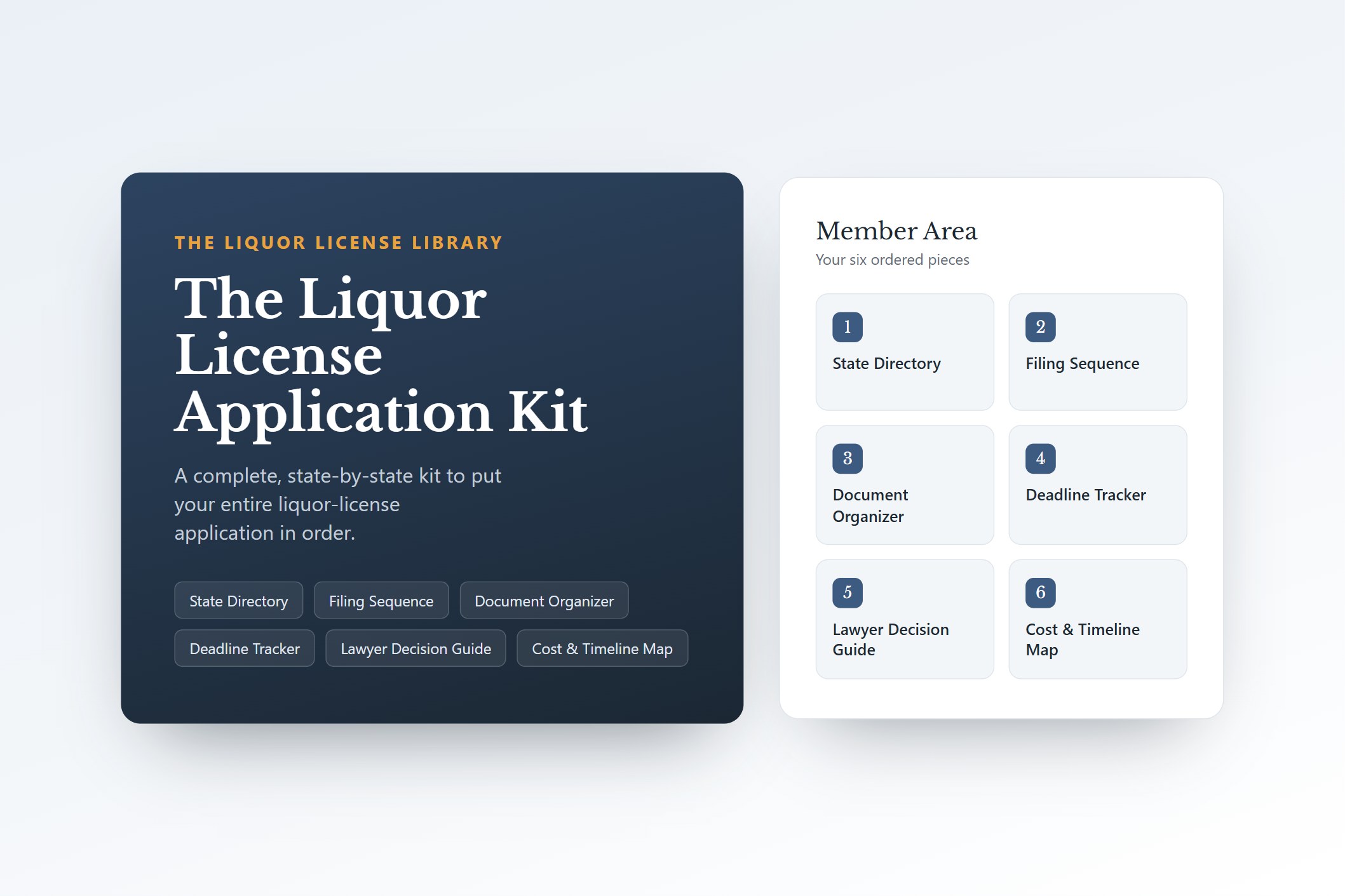
Want the whole path in one place? The Liquor License Application Kit hands you the done pieces for your state: the 51-jurisdiction directory and state selector, the license-class decoder, the dependency-ordered filing checklist, the document-gathering organizer, the deadline and public-notice tracker and an honest do-you-need-a-lawyer decision guide.
This guide is educational information, not legal advice. Fees change and every figure should be confirmed against your state's current schedule; the resale prices are market-reported, not official fees. Open your state page for the itemized costs behind these bands.
Liquor license cost FAQ
How much does a liquor license cost?
For the state and local fees, a small beer or beer-and-wine license commonly runs from about $50 to a few hundred dollars and most first small venues land in the $200 to $2,000 band. A full-spirits or larger class pushes $3,000 to $10,500 in states like Wyoming, New Mexico, Iowa and Texas. Those are the fees you pay the state and locality. In a quota state the license itself is a separate, much larger private cost.
Why are some liquor licenses so expensive?
Two reasons. A full-spirits class simply carries a higher state fee than a beer license. And in a quota state the license is a capped asset that trades privately, so an existing full-spirits license can cost six figures on the secondary market, entirely separate from the state fee. California is the extreme on the fee side alone: a full-spirits general license obtained through the priority drawing carries a state application fee near $19,840.
What is the cheapest state to get a liquor license?
On state fees, Missouri ($50 to $300), Louisiana (about $70 to $1,200) and Wisconsin ($50 to $500 in municipal fees) sit at the low end, with no statewide quota to buy past. A small beer license in a low-fee county can run under $100. Low fees do not remove the local sign-off, the background check or, for a full-spirits class, a possible local cap, so the cheapest headline fee is not the whole cost.