How to Get a Liquor License in Tennessee (2026): Cost, Classes and Steps
How do you get a liquor license in Tennessee?
In Tennessee, retail liquor licenses are issued by the Tennessee Alcoholic Beverage Commission, but every applicant must first get a certificate of compliance from the city or county where the business sits. An off-premise store needs a Retail Package Store license while a bar or restaurant serving spirits by the drink needs a liquor-by-the-drink license tied to its establishment type such as restaurant, hotel or limited service restaurant. Tennessee runs no statewide quota lottery, but state law lets cities and counties cap the number of package store licenses in their own jurisdiction, so the practical quota question is decided locally rather than by the state.
Tennessee runs its retail liquor licensing through the Tennessee Alcoholic Beverage Commission. The application is filed locally, with the city or county acting as the issuing authority. Tennessee caps only its full-spirits or specific classes, while a beer or beer-and-wine class usually sits outside the cap. The page below lays the pieces out in the order the state runs them.
On-premise servers must certify through the state's named training program within its window. Every owner, officer and significant investor clears a background check. A city or county sign-off is part of the path. Each piece has its own section below, with the official source beside it.
A 2024 session law took effect July 1, 2026. Tennessee created a new restricted retail business on-premise category (a barbershop or salon with limited seating), effective July 1, 2026, alongside a 2025 change that shortened server permits to two years. This page reflects the rule in force today; the full history sits in the law-updates log.
Which liquor license does a Tennessee bar, restaurant or store need?
The retail license classes Tennessee issues, what each covers and the venue each fits. Match your venue to the class before anything else.
| Class | Covers | Who it fits |
|---|---|---|
| Retail Package Store license (T.C.A. § 57-3-204) Retail package store | off-premise, full spirits | The classic liquor store. Needs a local certificate of compliance and compliance with any local ordinance capping the number of licenses. Under T.C.A. § 57-3-404(f) the store must sit on the ground floor with an entrance opening on a public street, with a corner-lot and a shopping-center exception. Since a 2014 amendment a package store may also sell beer and additional retail products under the same license with no separate beer permit. Under T.C.A. § 57-3-406 the holder of a retail license may not hold more than two retail licenses. In a municipality that authorizes multiple licenses no single licensee may hold more than 50 percent of them under that same section. |
| Retail Food Store Wine license (T.C.A. § 57-3-803 et seq.) Wine in retail food stores | off-premise, beer and wine | For a grocery or convenience store of at least 1,200 square feet that draws at least 20 percent of taxable sales from food. Not subject to any local cap on the number of licenses. Wine sales are barred on Sundays and on Christmas, Thanksgiving, Labor Day, New Year's Day and the Fourth of July. |
| Liquor-by-the-drink, Restaurant (T.C.A. § 57-4-301(b)(1)(R)) Restaurant on-premise license | on-premise, full spirits | Fits a full-service restaurant. The statutory definition of a restaurant requires seating for at least 40 people at tables. The annual privilege tax scales with seating capacity. The jurisdiction must have separately approved on-premise consumption by local option election. |
| Liquor-by-the-drink, Limited Service Restaurant (T.C.A. § 57-4-301(b)(1)(W)) Limited service restaurant (bar-style) license | on-premise, full spirits | Fits a bar or a restaurant with a smaller food operation. The annual privilege tax is based on prepared food as a share of gross sales and runs higher as that share drops toward zero. |
| Liquor-by-the-drink, Club / Hotel / Caterer (T.C.A. § 57-4-301(b)(1)) Private club, hotel or motel and caterer licenses | on-premise, full spirits | Separate annual privilege tax schedules apply to private clubs, hotels and motels by room count and caterers. Each class has its own qualification rules under T.C.A. Title 57, chapter 4. |
Is Tennessee a quota or control state?
Whether Tennessee caps how many licenses exist, how a capped license is obtained and whether the state runs any part of retail itself. This is where the real cost of a Tennessee license can hide.
| Item | Tennessee rule |
|---|---|
| Quota state? | Partial, the cap touches some classes only |
| How the cap works | State statute sets no numeric formula. T.C.A. § 57-3-208(c) authorizes, but does not require, a municipality or county to cap the number of Retail Package Store licenses issued within its own borders and to limit their location, as long as the cap does not unreasonably restrict availability of alcoholic beverages for residents. Many cities and counties use this authority and set their own limit by local ordinance rather than a statewide population ratio. Retail Food Store Wine licenses are expressly excluded from any such local numeric cap under T.C.A. § 57-3-806(c). Liquor-by-the-drink on-premise licenses are not capped by number at all. |
| New licenses issued by | No statewide lottery or drawing exists. Where a city or county does cap package store licenses, a University of Tennessee municipal advisory publication for local officials advises against selecting among applicants by lottery or drawing, on the reasoning that the certificate-of-compliance standard in T.C.A. § 57-3-208 requires a reasoned decision rather than pure chance. How each capped jurisdiction actually selects among competing applicants is set locally and is not standardized statewide. |
| Buying an existing license | n/a. Because any cap sits at the city or county level rather than in a single statewide registry, no primary source documents a statewide secondary market or price scale for Tennessee package store licenses the way some quota states publish one. |
| State control | No, private licensing throughout. Tennessee is a private license state. Retail package stores and wholesalers are privately owned businesses. The state does not operate any retail or wholesale liquor store. |
How much does a liquor license cost in Tennessee?
| Item | Tennessee |
|---|---|
| State and local fees to apply | Roughly $1,150 to $1,650 in state fees for a Retail Package Store, the $300 application plus the $850 annual license plus a manager's permit. Roughly $950 to $1,500 in state fees for a Restaurant liquor-by-the-drink license, the $300 application plus the $650 to $1,200 seating-based tax. Local certificate-of-compliance and inspection fees are additional and vary by city or county. |
| Renewal | The same annual fee as the initial license class, for example $850 a year for a Retail Package Store or $650 to $1,200 a year for a Restaurant liquor-by-the-drink license |
| What drives the range | Figures above are Commission state fees only. A municipal inspection fee of up to 5 to 8 percent of the wholesale price of alcoholic beverages can apply on top of these figures depending on county population. The certificate of compliance itself may carry a local processing fee that varies by city or county. |
The itemized fees a first-time Tennessee applicant can expect from the state.
| Fee | Amount |
|---|---|
| Retail Package Store application fee | $300, one-time and nonrefundable |
| Retail Package Store annual license fee | $850 |
| Retail Food Store Wine application fee | $400, nonrefundable |
| Retail Food Store Wine annual license fee | $1,250 |
| Liquor-by-the-drink application fee (on-premise, all classes) | $300, one-time and nonrefundable |
| Liquor-by-the-drink annual privilege tax, Restaurant class | $650 to $1,200, by seating capacity (40-74 seats $650, 75-125 seats $750, 126-175 seats $925, 176-225 seats $975, 226-275 seats $1,100, 276+ seats $1,200) |
| Liquor-by-the-drink annual privilege tax, Limited Service Restaurant class | $2,000 to $5,000, by share of gross sales from prepared food |
| Manager's permit (package store or retail food store wine) | $50 charged (statutory cap $200), valid 5 years |
| Server permit (on-premise staff) | $20 |
How long it takes. Roughly 60 to 120 days from a complete local certificate application to a state license. This range combines two separately documented steps rather than a single published Commission figure. A city or county has up to 60 days to act on the certificate of compliance before state law deems it granted under T.C.A. § 57-3-208(e). The state application must then reach the Commission's Nashville office at least three weeks before the next monthly meeting to be placed on that meeting's agenda. The Commission meets roughly once a month. A local objection or an incomplete application extends either leg of the process.
How to apply for a liquor license in Tennessee, step by step
Several of these steps gate the ones after them, so the order matters as much as the list.
- Confirm local wet or dry status and, for on-premise sales, that the jurisdiction has separately approved liquor by the drink through a local option election
- Secure the premises and confirm it meets local zoning and any local location ordinance
- Apply to the city or county for the certificate of compliance, attaching the local and national criminal history record for each applicant or officer in charge of the business
- Wait for the local government's decision, which state law deems granted if the city or county does not act within 60 days
- File the state application through the Commission's online Retail Licensing and Permitting System with the certificate of compliance attached, at least three weeks before the next monthly Commission meeting
- Obtain the manager's permit or server permits required for the license type
- Pay the application fee, then the annual license fee once the Commission approves the application
- Receive the license before opening for sales
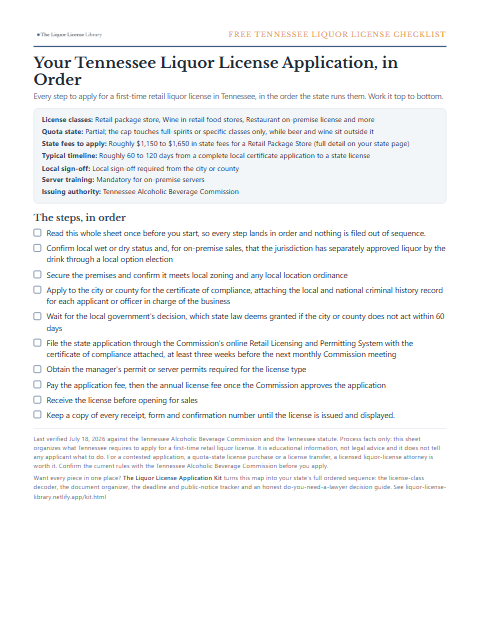
Get the free Tennessee liquor license checklist
The one-page map of the Tennessee application steps, in the order Tennessee runs them.
Instant download, plus Tennessee rule-change alerts. Unsubscribe anytime.
Local approval and public notice in Tennessee
The city or county layer on top of the state license, plus any notice you must post or publish. The public-notice window is often the shortest clock in the whole process.
| Item | Tennessee rule |
|---|---|
| Local sign-off required? | Yes, a city or county sign-off is part of the path |
| What the local layer does | Every Retail Package Store, Retail Food Store Wine and liquor-by-the-drink applicant needs local action before or alongside the state license. For a package store, a certificate of compliance signed by the county mayor or the city mayor or a majority of the city's legislative body must confirm there is no disqualifying felony conviction in the prior 10 years, that the location meets local zoning and location rules and that the applicant complies with any local ordinance capping the number of licenses. On-premise consumption sales additionally require that the jurisdiction has already approved liquor by the drink through its own local option election. |
| Public notice | unverifiable statewide. Tennessee statute does not set a single statewide newspaper-publication or premises-posting requirement for a first-time retail applicant. Individual cities and counties may layer their own notice or hearing step onto the certificate-of-compliance process, but this varies by jurisdiction and is not itemized in state law. |
| Worth knowing | Tennessee alcohol sales are authorized county by county and city by city through local option elections under T.C.A. § 57-3-106, so a location's wet or dry status and whether on-premise consumption is separately approved has to be confirmed before applying. Local certificate-of-compliance review runs before the state Commission vote. A denial can be appealed to chancery court within 60 days. |
Server training in Tennessee
Whether the people pouring or selling alcohol must certify through a state program, plus the deadline.
| Item | Tennessee rule |
|---|---|
| Required for a first-time retailer? | Yes, mandatory for on-premise servers |
| Who must certify | Every server who sells or serves liquor, wine or high-gravity beer at an on-premise establishment must hold a Commission server permit. Retail package store employees who sell alcohol must complete annual Responsible Vendor training. The individual who manages a package store's or a Retail Food Store Wine licensee's alcohol operations must separately hold a manager's permit. |
| State program | The TABC server permit program under T.C.A. § 57-3-701 et seq., which requires a TABC-certified alcohol awareness course of at least three and a half hours covering responsible-service topics. The manager's permit requires alcohol-awareness training approved by the Commission under T.C.A. § 57-3-221. |
| Deadline | A new server has 61 days from the date they begin serving to complete training and obtain the permit; this grace period applies once per individual regardless of employer changes. |
| Worth knowing | Server permits issued before January 1, 2025 run for 5 years. Under a 2024 law change effective January 1, 2025, server permits issued on or after that date run for 2 years while wholesaler-side employee permits keep the 5-year term, a shortened cycle for servers specifically. The required alcohol-awareness curriculum was also expanded effective January 1, 2025 to add sexual assault and human-trafficking awareness content. The server permit fee is $20 and the manager's permit fee is $50, statutory cap $200, with the manager's permit valid for 5 years. |
Background check and renewal in Tennessee
Background check
| Item | Tennessee rule |
|---|---|
| Background check required? | Yes |
| Who is checked | For a Retail Package Store or Retail Food Store Wine license, every applicant or officer who will be in actual charge of the business must submit a local and national criminal history record from a third-party multistate criminal records database along with the certificate of compliance. A manager's permit applicant is separately screened as part of that permit application. |
| Disqualifiers | No felony conviction within the 10 years immediately preceding the application, for the applicant, the officers or those in control of the business. A manager's permit applicant must be at least 18 years old and may not have a conviction for a crime involving the sale or distribution of alcohol within the prior 8 years, any felony within the prior 5 years or a revoked employee, server or similar permit within the prior 3 years. No public officer or public employee may hold a wholesaler's or retailer's license or any direct or indirect interest in one, with a narrow exception for uncompensated municipal board appointees with no vote over alcohol sales. |
| Worth knowing | The criminal history record is obtained by the applicant from a commercial database vendor rather than run directly by the Commission or local police. A local jurisdiction may add a reasonable residency requirement, but under T.C.A. § 57-3-208 may not impose one on an applicant who has been continuously licensed under T.C.A. § 57-3-204 for 7 or more consecutive years. |
Renewal
| Item | Tennessee rule |
|---|---|
| Renewal cycle | annual |
| Worth knowing | A Retail Package Store or Retail Food Store Wine license expires 12 months after issuance and renews on payment of the annual fee; a new certificate of compliance is required only if ownership or the business location changes. Liquor-by-the-drink licenses renew annually on the same privilege tax schedule as the initial year. The separate local beer permit, which is not the retail liquor license covered here, does not expire under state law and carries no periodic state renewal requirement. |