How to Get a Liquor License in Maryland (2026): Cost, Classes and Steps
How do you get a liquor license in Maryland?
In Maryland, retail liquor licenses are issued not by a single state agency but by two dozen local Boards of License Commissioners, one for each of the 23 counties plus Baltimore City and the City of Annapolis, under that jurisdiction's own subtitle of the Alcoholic Beverages and Cannabis Article. A first-time applicant typically applies for a Class A off-premise, Class B restaurant, Class C club or Class D tavern license through the local board where the premises sits and whether a new license is capped depends entirely on that county's own population-ratio quota or moratorium rule. The state-level Alcohol, Tobacco, and Cannabis Commission issues manufacturer, wholesaler and other state permits and sets the statewide alcohol awareness and background-check framework the local boards apply.
In Maryland, retail liquor licenses go through the local Boards of License Commissioners. A first-time applicant files locally, because the city or county is the issuing authority here. Maryland caps only its full-spirits or specific classes, while a beer or beer-and-wine class usually sits outside the cap. Work the page top to bottom and the whole path is visible before any single deadline is due.
Maryland runs a partial control system, handling some spirits wholesale or retail itself while private retailers hold the on-premise and off-premise licenses. On-premise servers must certify through the state's named training program within its window. A city or county sign-off is part of the path. Each piece has its own section below, with the official source beside it.
The parts a Maryland applicant most often misses are the public-notice window, which runs on the state's schedule rather than yours, which classes fall under the cap and which do not and the order of the steps, since several gate the ones after them. The sections below take them in order.
Which liquor license does a Maryland bar, restaurant or store need?
The retail license classes Maryland issues, what each covers and the venue each fits. Match your venue to the class before anything else.
| Class | Covers | Who it fits |
|---|---|---|
| Class A Off-premise package license | off-premise, beer and wine, or beer, wine and liquor depending on the county tier | Package-store license for take-out sale only. Fee and quota exposure are set per county; Anne Arundel County, for example, splits Class A into a beer-and-wine tier and a separate beer-wine-liquor tier with different fees. |
| Class B Restaurant license | both, beer, wine and liquor in most counties | Fits a full-service restaurant, usually with a kitchen and food-service condition set by the county. Commonly the class a county keeps open even where other classes are capped or under moratorium, as in Baltimore City. |
| Class C Club license | on-premise, beer, wine and liquor in most counties | For a nonprofit private club serving members and guests only, subject to membership and dues conditions the county sets. |
| Class D Tavern license | on-premise, beer, wine and liquor in most counties | Bar-style venue. Several counties count Class D against the same population-ratio quota as Class A and Class B. |
Is Maryland a quota or control state?
Whether Maryland caps how many licenses exist, how a capped license is obtained and whether the state runs any part of retail itself. This is where the real cost of a Maryland license can hide.
| Item | Maryland rule |
|---|---|
| Quota state? | Partial, the cap touches some classes only |
| How the cap works | Quota and moratorium rules are set county by county in that county's own subtitle rather than by one statewide formula. Some counties cap classes by a population ratio, for example Washington County limits Class A, B and D licenses per election district to 1 license for each 3,000 residents, excluding an incarcerated population, under Alcoholic Beverages and Cannabis Article Title 31, Subtitle 16. Baltimore City has run a moratorium on most new licenses since 1968, with new issuance currently limited mainly to Class B restaurant, arena and hotel licenses. Many other counties issue non-capped classes such as restaurant licenses under a public need and desire standard the local board applies rather than a hard numeric cap. |
| New licenses issued by | none confirmed in any jurisdiction researched. Capped counties evaluate new applications against the population ratio and a public-need standard rather than a lottery. Where a class is fully closed by moratorium, the only path in is buying and transferring an existing license with board approval. |
| Buying an existing license | Existing licenses in capped or moratorium classes trade privately. In Baltimore City, market-reported prices for existing licenses run roughly $50,000 to $250,000 depending on class and neighborhood; this figure comes from a license-cost aggregator site and is market-reported, not an official state or local fee. |
| State control | Partial control. Montgomery County runs a government monopoly, Alcohol Beverage Services, on off-premise spirits retail and on wholesale distribution of beer, wine and spirits to every licensee in the county. a private off-premise applicant there historically cannot sell spirits for takeaway at all, though private beer and wine off-premise retail still operates. Montgomery County has been moving to widen where alcohol may be sold at retail, so a first-time applicant should confirm the county's current rules on spirits before assuming the monopoly is absolute (verified July 2026: ABS remains the sole county wholesaler and the only authorized off-premise spirits seller per its own agency description). Maryland's ethics regulations also list Dorchester, Howard, Kent, Somerset and Worcester counties as running their own Liquor Control Boards rather than ordinary Boards of License Commissioners, indicating local control functions beyond Montgomery. The rest of the state runs a private-license system with no government retail or wholesale monopoly. |
Not fully settled in one published place. Confirm the exact quota status and, where a cap applies, how a new or existing license is obtained with the local Boards of License Commissioners before you rely on it.
How much does a liquor license cost in Maryland?
| Item | Maryland |
|---|---|
| State and local fees to apply | roughly $340 to $2,700 in local application and first-year license fees depending on county and class |
| Renewal | roughly $120 to $2,060 or more per year depending on county and class, plus any local surcharges |
| What drives the range | The range is driven entirely by which local board has jurisdiction and which class the venue needs. Figures above are drawn from two documented jurisdictions, Baltimore City and Anne Arundel County, as concrete examples, not a statewide fee schedule. The Anne Arundel County class fees and the Baltimore City $600 application fee were re-confirmed from live primary pages July 2026; the Baltimore City annual license fees (Class B $2,060, Class D $1,284 and the surcharges) come from a June 2025 fee-matrix PDF that was no longer reachable on independent re-check and are not re-confirmed live, so the top of the range should be treated as approximate. In a capped or moratorium class the state and local fees above exclude any private purchase price for an existing license; see the quota field. |
The itemized fees a first-time Maryland applicant can expect from the state.
| Fee | Amount |
|---|---|
| Application fee (Baltimore City, includes hearing fee) | $600 |
| Annual license fee, Class B restaurant (Baltimore City) | $2,060 |
| Annual license fee, Class D tavern (Baltimore City) | $1,284 |
| Live entertainment surcharge (Baltimore City) | $500 per year |
| Outdoor table service surcharge (Baltimore City) | $200 per year |
| Class A off-premise license, beer and wine tier (Anne Arundel County) | $240 |
| Class A off-premise license, beer, wine and liquor tier (Anne Arundel County) | $760 |
| Class B restaurant license, beer and wine tier (Anne Arundel County) | $480 |
| Class B restaurant license, beer, wine and liquor tier (Anne Arundel County) | $1,080 |
| Criminal history records check fee (state records fee plus FBI processing fee) | Not published; confirm with the local Boards of License Commissioners |
How long it takes. varies by local board; no single statewide processing-day commitment is published. Baltimore City requires 10 consecutive days of premises posting plus a newspaper advertisement before the board's public hearing and the overall timeline then depends on that board's hearing calendar rather than a fixed statutory count. Every other local board sets its own notice window and hearing schedule under its own subtitle, so the realistic timeline is jurisdiction-specific.
Not published as one current figure. Confirm the exact amount with the local Boards of License Commissioners before you budget for it. The state does not publish a single processing time; confirm the current wait with the local Boards of License Commissioners.
How to apply for a liquor license in Maryland, step by step
Several of these steps gate the ones after them, so the order matters as much as the list.
- Confirm the premises meets local zoning requirements for alcohol sales
- File the license application with the local Board of License Commissioners for the county or city where the premises is located
- Submit fingerprints and criminal history disclosure for owners and officers under Alcoholic Beverages and Cannabis Article Section 4-107
- Post public notice on the premises and complete any required newspaper advertisement per the local board's rule
- Pay the application fee, which some boards combine with the hearing fee
- Appear at the local board's public hearing, where the board weighs public need and any objections
- Receive the board's decision and pay the annual license fee
- Have the license holder or a designated employee complete the alcohol awareness program under Section 4-505 before or shortly after opening
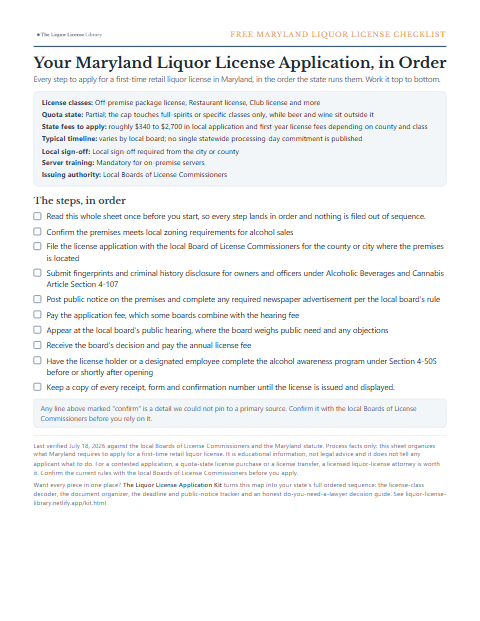
Get the free Maryland liquor license checklist
The one-page map of the Maryland application steps, in the order Maryland runs them.
Instant download, plus Maryland rule-change alerts. Unsubscribe anytime.
Local approval and public notice in Maryland
The city or county layer on top of the state license, plus any notice you must post or publish. The public-notice window is often the shortest clock in the whole process.
| Item | Maryland rule |
|---|---|
| Local sign-off required? | Yes, a city or county sign-off is part of the path |
| What the local layer does | The local Board of License Commissioners is the primary licensing authority for a retail license. Most counties also require a local zoning compliance certification before or alongside the application. |
| Public notice | Varies by local board. Baltimore City requires the applicant to post notice on the premises for 10 consecutive days and requires the board to advertise the application in a newspaper of general circulation before the hearing. |
| Worth knowing | Because retail licensing in Maryland is locally administered rather than state administered, this local layer is not a secondary check on top of a state license: it is the license itself. County fee schedules, license classes, hearing procedures and notice windows can differ from one jurisdiction to the next even though most share the same general Class A, B, C and D naming pattern. |
Confirm the local sign-off and any public-notice window for your jurisdiction with your city or county before you file.
Server training in Maryland
Whether the people pouring or selling alcohol must certify through a state program, plus the deadline.
| Item | Maryland rule |
|---|---|
| Required for a first-time retailer? | Yes, mandatory for on-premise servers |
| Who must certify | The license holder or at least one employee designated by the holder for the licensed premises, as the statewide minimum. Some counties set a stricter local rule. |
| State program | An approved alcohol awareness program certified under Alcoholic Beverages and Cannabis Article Section 4-505. The certificate is valid for 4 years from the date of issuance. |
| Deadline | No fixed number of days after hire is set in the state statute. The license holder or the designated employee must hold a current 4-year certificate covering the license at all times. |
| Worth knowing | Talbot County requires all on-premises employees to complete approved classroom alcohol awareness training rather than just one designated person, a stricter local rule layered on the statewide minimum. A license holder who violates Section 4-505 faces a $100 fine for a first offense and up to a $500 fine or license suspension or revocation for a later offense. |
Background check and renewal in Maryland
Background check
| Item | Maryland rule |
|---|---|
| Background check required? | In some cases (see below) |
| Who is checked | Under Alcoholic Beverages and Cannabis Article Section 4-107, a local licensing board may apply to the state Central Repository for a State and national criminal history records check on a license applicant, submitted with two sets of fingerprints, a state records fee and an FBI processing fee. Baltimore City's application packet requires a criminal background check form and a CJIS privacy rights disclosure for owners and officers as standard practice. |
| Worth knowing | The statute is permissive at the general Division I level, each board may request the check and in practice most boards do. The Central Repository continues reporting new offenses on a checked individual to the local board for as long as that person remains a licensee. Records obtained are confidential and usable only for the licensing purpose. A specific statewide list of disqualifying offenses or a felony lookback window was not located in the sources checked; individual county subtitles set their own good-character and fitness standards for the board's public-need review. |
Confirm exactly who is fingerprinted or checked and the current disqualifiers with the local Boards of License Commissioners before you file.
Renewal
| Item | Maryland rule |
|---|---|
| Renewal cycle | annual |
| Worth knowing | The license year commonly runs May 1 through April 30, with renewal applications generally filed with the local board in March or the first days of April. This window was confirmed for Worcester, Talbot, Howard and Anne Arundel counties as examples. The exact renewal window is set by each local board on its own calendar within that general annual cycle and some jurisdictions attach compliance conditions such as a current alcohol awareness certificate to renewal. |