How to Get a Liquor License in Wisconsin (2026): Cost, Classes and Steps
How do you get a liquor license in Wisconsin?
In Wisconsin, every retail alcohol beverage license is granted and issued by the city, village or town where the premises sits, not by a state board; the Division of Alcohol Beverages inside the Department of Revenue enforces the law and issues only a narrow set of non-retail permits. An off-premise applicant such as a liquor store or grocery store applies for a Class "A" beer license and a "Class A" liquor license, while an on-premise applicant such as a bar or restaurant applies for a Class "B" beer license and a "Class B" liquor license. Wisconsin caps only the "Class B" liquor license by municipality; every other retail class (Class A beer, Class A liquor, Class B beer, Class C wine) has no state-imposed quota.
In Wisconsin, retail liquor licenses go through the municipal governing body. A first-time applicant files locally, because the city or county is the issuing authority here. Wisconsin caps only its full-spirits or specific classes, while a beer or beer-and-wine class usually sits outside the cap. Work the page top to bottom and the whole path is visible before any single deadline is due.
On-premise servers must certify through the state's named training program within its window. Every owner, officer and significant investor clears a background check. A city or county sign-off is part of the path. Each piece has its own section below, with the official source beside it.
The parts a Wisconsin applicant most often misses are the public-notice window, which runs on the state's schedule rather than yours, which classes fall under the cap and which do not and the order of the steps, since several gate the ones after them. The sections below take them in order.
Which liquor license does a Wisconsin bar, restaurant or store need?
The retail license classes Wisconsin issues, what each covers and the venue each fits. Match your venue to the class before anything else.
| Class | Covers | Who it fits |
|---|---|---|
| Class "A" (Beer) Off-premise beer retailer license | off-premise, beer | Covers convenience stores, drug stores, liquor stores and grocery stores selling beer in original packages for off-premise consumption. Fee set by municipal ordinance with no statewide floor or ceiling. Not subject to quota. |
| "Class A" (Liquor) Off-premise liquor store license | off-premise, full spirits | Covers convenience stores, drug stores, liquor stores and grocery stores selling distilled spirits, wine and cider in original packages for off-premise consumption. Fee set by municipal ordinance, at least $50 and no more than $500. Not subject to quota. |
| "Class A" (Cider Only) Off-premise cider-only license | off-premise, cider only | Add-on license for a retailer that already holds a Class A beer license and wants to sell cider only, without the full "Class A" liquor license. No initial or annual fee. Not subject to quota. |
| Class "B" (Beer) On- and off-premise beer license | both, beer | The common bar and restaurant beer license; also required before a business can hold a "Class B" liquor license. Fee set by municipal ordinance, no more than $100. Not subject to quota. |
| "Class B" (Liquor) Liquor license for bars and restaurants, primarily on-premise | both, full spirits | Primarily an on-premise license for spirits and wine by the glass, but by default it also covers off-premise sales of sealed cocktails-to-go and off-premise sales of wine in the original package; off-premise sale of distilled spirits in the original package additionally requires the municipality to allow it by ordinance. Only issued to an applicant who holds or has applied for a Class "B" beer license. Fee set by municipal ordinance, at least $50 and no more than $500 for a regular license; reserve and Premier Economic Development District licenses cost far more. This is the ONLY class subject to the state-imposed municipal quota. |
| "Class C" (Wine Only) On-premise wine-only license | on-premise, wine | Authorizes wine by the glass or an opened original container for on-premise consumption only, typically for a restaurant. Cannot be issued to a premises that fails the state restaurant sanitation standard. Fee set by municipal ordinance, no more than $100. Not subject to quota. |
Is Wisconsin a quota or control state?
Whether Wisconsin caps how many licenses exist, how a capped license is obtained and whether the state runs any part of retail itself. This is where the real cost of a Wisconsin license can hide.
| Item | Wisconsin rule |
|---|---|
| Quota state? | Partial, the cap touches some classes only |
| How the cap works | Only the "Class B" liquor license (on-premise spirits and wine for bars and restaurants) is capped. Each municipality holds its own quota equal to the number of "Class B" liquor licenses granted and in force on December 1 1997, plus reserve licenses added since through population growth (one added per 500-person increase), annexation, a purchased or transferred license from a neighboring municipality in the same county, or a Premier Economic Development District designation. The Division of Alcohol Beverages does not track individual municipal quotas; each municipality calculates and maintains its own count |
| New licenses issued by | none. Wisconsin does not use a statewide lottery or drawing. An applicant takes an open regular-license slot on a first-come basis through the normal application process, purchases a reserve license from the municipality at the statutory minimum fee, or qualifies for an above-quota license as a large restaurant, hotel, nonprofit theater or certified qualifying event venue |
| Buying an existing license | A "Class B" liquor license can change hands through the state's person-to-person transfer process on death, disability, bankruptcy or assignment for creditors, or through a place-to-place transfer approved by the governing body. Up to three reserve licenses can also be sold between municipalities in the same county, with the transferring municipality setting the fee at a $10,000 statutory floor. Private sale prices for an existing license between license holders are not published or tracked by the state; unverifiable at the market level from primary sources |
| State control | No, private licensing throughout. Wisconsin is a private-license state. There is no state-run retail or wholesale monopoly on beer or liquor. The Division of Alcohol Beverages regulates and enforces the law but does not sell alcohol at retail or wholesale. |
How much does a liquor license cost in Wisconsin?
| Item | Wisconsin |
|---|---|
| State and local fees to apply | $50 to $500 in state-set municipal license fees for a regular Class A liquor, Class B beer, Class B liquor or Class C license, plus municipal background-check and newspaper publication fees the clerk sets locally. A first "Class B" liquor license obtained as a reserve license once the municipal quota is full costs at least $10,000, or at least $30,000 inside a Premier Economic Development District |
| Renewal | The same $50 to $500 (or up to $100 for Class B beer and Class C) fee band set by municipal ordinance for the license class, paid annually |
| What drives the range | State law sets only a floor and ceiling for most classes; the exact dollar figure is set by each municipality's own ordinance, so the true cost depends on which city, village or town issues the license. The quota field explains the much higher reserve and Premier Economic Development District minimums that apply only to a "Class B" liquor license obtained above the regular quota count |
The itemized fees a first-time Wisconsin applicant can expect from the state.
| Fee | Amount |
|---|---|
| Class "A" (Beer) license, initial and renewal | set by municipal ordinance, no statewide floor or ceiling stated |
| "Class A" (Liquor) license, initial and renewal | $50 to $500, set by municipal ordinance |
| Class "B" (Beer) license, initial and renewal | up to $100, set by municipal ordinance |
| Regular "Class B" (Liquor) license, initial and renewal | $50 to $500, set by municipal ordinance |
| Reserve "Class B" (Liquor) license, initial issuance | at least $10,000; renewal charged at the regular license fee |
| Premier Economic Development District "Class B" (Liquor) license, initial issuance | at least $30,000; renewal charged at the regular license fee |
| "Class C" (Wine Only) license, initial and renewal | up to $100, set by municipal ordinance |
| Provisional retail license (any class) | up to $15, set by municipal ordinance |
| Background check fee | set by the municipality; amount varies by clerk |
| Newspaper publication fee | varies; applicant pays the Department of Administration legal-notice publication rate |
| Place-to-place license transfer fee | $10 |
How long it takes. At least 15 days from filing with the municipal clerk to a governing body decision; in practice longer once newspaper publication (recommended seven days before the hearing) and the next scheduled governing body meeting are added. The 15-day figure is the statutory floor before the governing body may act, not a processing-time guarantee. Municipalities within Milwaukee County set their own waiting period by local ordinance instead of using the 15-day default. A temporary Class "B" beer license for an event lasting under 4 days also has a municipally set waiting period. There is no statewide processing-time commitment because the decision is a local governing body vote, not a state permit determination
How to apply for a liquor license in Wisconsin, step by step
Several of these steps gate the ones after them, so the order matters as much as the list.
- Complete a Division of Alcohol Beverages approved responsible beverage server training course, unless a training exemption applies
- Obtain a Wisconsin seller's permit from the Department of Revenue, unless the applicant qualifies for an exemption
- Complete Form AB-200 (Alcohol Beverage License Application) and Form AB-100 (Individual Questionnaire) for every required person, plus Form AB-101 (Appointment of Agent) for a corporation, nonprofit or LLC
- File the complete application package with the municipal clerk along with payment for the license, background-check and publication fees
- Publish the application in a newspaper (three times if daily, once if weekly) for Class A, Class B and Class C license types
- Observe the 15-day minimum statutory waiting period after filing before the governing body may decide
- Appear before the municipal governing body (council or board) for review
- Pay the balance of the license fee once the governing body grants the license
- Receive the license certificate document from the municipal clerk
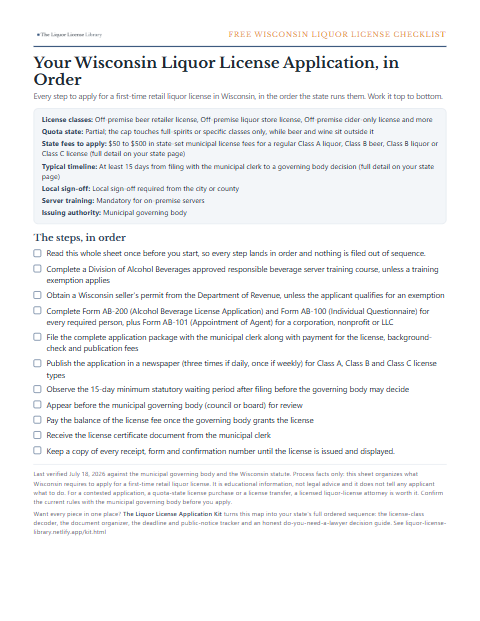
Get the free Wisconsin liquor license checklist
The one-page map of the Wisconsin application steps, in the order Wisconsin runs them.
Instant download, plus Wisconsin rule-change alerts. Unsubscribe anytime.
Local approval and public notice in Wisconsin
The city or county layer on top of the state license, plus any notice you must post or publish. The public-notice window is often the shortest clock in the whole process.
| Item | Wisconsin rule |
|---|---|
| Local sign-off required? | Yes, a city or county sign-off is part of the path |
| What the local layer does | The municipal governing body (city council, village board or town board) reviews and votes on every regular retail license application. It may weigh factors beyond the state's minimum qualifications, such as a business plan, parking or law enforcement access concerns, as long as it does not discriminate and must record its reasons in the meeting minutes if it denies an application |
| Public notice | Newspaper publication is required for new and renewal Class "A" (Beer), Class "B" (Beer), "Class A" (Liquor), "Class B" (Liquor) and "Class C" (Wine) applications: three times in a daily paper or once in a weekly paper, at the applicant's cost. There is no statutory publication timeline, though the Division recommends publishing seven days before the governing body's review. Publication is not required for operator's license or temporary Class B license applications |
| Worth knowing | Wisconsin licensing is local-first and local-only for regular retail licenses; the municipality is the sole body that grants them and there is no separate state retail approval step layered on top. A liquor license also cannot be issued for a premises whose main entrance sits within 300 feet of a school, hospital or church main entrance, unless the governing body waives it by majority vote, with statutory exceptions for premises already licensed before June 30 1947, premises licensed before the nearby building existed and qualifying restaurants under a 50 percent alcohol-sales threshold |
Server training in Wisconsin
Whether the people pouring or selling alcohol must certify through a state program, plus the deadline.
| Item | Wisconsin rule |
|---|---|
| Required for a first-time retailer? | Yes, mandatory for on-premise servers |
| Who must certify | Individual retail license applicants, all partners in a partnership and the appointed agent of a corporation, nonprofit, association, cooperative or LLC applying for a retail license; separately, every operator's (bartender's) license applicant |
| State program | A Division of Alcohol Beverages approved responsible beverage server (RBS) training course, listed on the Division's website under "Alcohol Seller/Server" |
| Deadline | Completed within the two years before a new application. Not required again on a straight renewal and not required if the applicant already held a manager's, operator's or retail alcohol beverage license (or was the agent of an entity that did) in Wisconsin within the past two years |
| Worth knowing | Temporary operator's license applicants, who serve for a nonprofit organization's one-time event, are exempt from the training requirement |
Background check and renewal in Wisconsin
Background check
| Item | Wisconsin rule |
|---|---|
| Background check required? | Yes |
| Who is checked | The individual applicant, all partners in a partnership, all officers and directors of a corporation or nonprofit, all members and managers of an LLC and the appointed agent disclose civil and criminal violations, pending charges and alcohol-related offenses on the state application form; operator's license applicants face the same disclosure standard. No statewide fingerprint or FBI check is documented for a standard retail license; the check is a disclosure-and-review process handled by the municipality and any related fee is set locally |
| Disqualifiers | Must be 21 or older for a retail license (18 for an operator's license), a continuous Wisconsin resident for at least 90 days for a retail license, not a habitual law offender and not convicted of a felony unless pardoned. Under the Wisconsin Fair Employment Act, a felony conviction does not automatically disqualify an applicant unless the municipality finds the offense substantially related to selling alcohol beverages |
| Worth knowing | Municipalities weigh the nature of the offense, the time elapsed and the applicant's community record when deciding whether a criminal history is substantially related to the license. Adding a new officer, director, member or manager after issuance triggers a fresh background disclosure as part of the required 30-day change-of-fact report. A license also cannot issue to an applicant indebted for liquor purchases beyond 30 days or beer purchases beyond 15 days |
Renewal
| Item | Wisconsin rule |
|---|---|
| Renewal cycle | annual |
| Worth knowing | All Wisconsin retail alcohol licenses except those issued by the City of Milwaukee expire June 30 each year and must be renewed annually; the City of Milwaukee may issue at other points in the year but each license still runs for one year from issuance. A licensee who fails to file for renewal simply lets the license expire rather than triggering a formal non-renewal hearing. Responsible beverage server training is required again only if it was not already completed within the prior two years |