How to Get a Liquor License in Vermont (2026): Cost, Classes and Steps
How do you get a liquor license in Vermont?
In Vermont, retail liquor licenses are issued by the Board of Liquor and Lottery through the Division of Liquor Control, but a first-time applicant starts with the local control commissioners (the town or city selectboard acting in that capacity), who must approve the application before the state Board grants it. A restaurant or bar serving beer, wine and ready-to-drink spirits on premises applies for a First Class license, a store selling those same beverages for off-premise consumption applies for a Second Class license. A restaurant or bar wanting to serve full spirits applies for a Third Class license. Vermont sets no population-based quota on these three retail classes, but off-premise sale of full spirits runs only through a fixed, competitively contracted network of about 80 802Spirits agency stores rather than open licensing.
Vermont runs its retail liquor licensing through the Division of Liquor Control. The application runs through the state with a local sign-off alongside it. Vermont caps only its full-spirits or specific classes, while a beer or beer-and-wine class usually sits outside the cap. The page below lays the pieces out in the order the state runs them.
Vermont runs a partial control system, handling some spirits wholesale or retail itself while private retailers hold the on-premise and off-premise licenses. On-premise servers must certify through the state's named training program within its window. Every owner, officer and significant investor clears a background check. Each piece has its own section below, with the official source beside it.
Act 156 took effect July 1, 2026. Vermont's requirement that a licensee carry liquor-liability insurance, delayed under Act 156, took effect July 1, 2026. This page reflects the rule in force today; the full history sits in the law-updates log.
Which liquor license does a Vermont bar, restaurant or store need?
The retail license classes Vermont issues, what each covers and the venue each fits. Match your venue to the class before anything else.
| Class | Covers | Who it fits |
|---|---|---|
| First Class First Class license | on-premise, beer and wine | Covers malt beverages, vinous beverages and ready-to-drink spirits beverages consumed on the licensed premises. Requires premises devoted primarily to dispensing meals to the public with adequate meal-preparation facilities. Fits a restaurant, hotel or club. Not quota-limited. Onsite-consumption licensees must carry liquor liability insurance meeting Division minimums before issuance or renewal, a requirement Act 156 of 2024 delayed to July 1, 2026. |
| Second Class Second Class license | off-premise, beer and wine | Covers malt beverages, vinous beverages, cider and ready-to-drink spirits beverages sold for off-premise consumption. Does not cover full spirits. Fits a retail store. Not quota-limited. No liquor liability insurance mandate applies, since Second Class is off-premise and the insurance requirement is tied to onsite consumption. |
| Third Class Third Class license | on-premise, full spirits | Covers spirits and fortified wines for consumption on the licensed premises, boat or railroad dining car. Requires meal-service facilities except for clubs and manufacturers or rectifiers. Not population quota-limited, but the Division's own how-to-apply guidance and the underlying statute describe different filing paths; see notes. Onsite-consumption licensees must carry liquor liability insurance meeting Division minimums before issuance or renewal, a requirement Act 156 of 2024 delayed to July 1, 2026. |
| 802Spirits Agency 802Spirits agency contract | off-premise, full spirits | The only route to off-premise spirits retail. Not an open first-time retail license: a business submits a letter of interest through the licensing portal and is selected through a competitive bid process only when the Division is adding or updating one of its roughly 80 statewide locations, then signs a contract with the Division rather than holding a Second Class-style license for spirits. |
Is Vermont a quota or control state?
Whether Vermont caps how many licenses exist, how a capped license is obtained and whether the state runs any part of retail itself. This is where the real cost of a Vermont license can hide.
| Item | Vermont rule |
|---|---|
| Quota state? | Partial, the cap touches some classes only |
| How the cap works | Vermont sets no population-based numeric cap on First, Second or Third Class licenses; a qualifying applicant in any town can apply for one. Off-premise full-spirits retail is effectively closed to open application: it exists only through the fixed 802Spirits network of roughly 80 agency store contracts statewide, which expands or changes by Division decision rather than by applicant demand. |
| New licenses issued by | None for First, Second or Third Class licenses, which issue on a qualifying application. 802Spirits agency selection is not a lottery; the Division reviews letters of interest through a competitive bid process only when it is adding or updating a location. |
| Buying an existing license | n/a. Vermont's retail license classes are not scarcity-priced or population-capped and no primary or corroborated source documents a private resale market for First, Second or Third Class licenses. |
| State control | Partial control. Vermont controls the distribution of distilled spirits. Off-premise spirits retail runs only through the Division's 802Spirits agency contract network of roughly 80 independently owned stores under contract with the state, not through an open retail license. Beer, wine, cider and ready-to-drink spirits beverages sold through First and Second Class licenses and on-premise full-spirits sales through Third Class licenses are privately licensed with no state operation of the retail counter. |
How much does a liquor license cost in Vermont?
| Item | Vermont |
|---|---|
| State and local fees to apply | $140 to $1,095 in state and municipal application fees depending on license class, plus a $25 mandatory training seminar fee per certified person |
| Renewal | Same fee schedule as the initial application; Vermont treats the amount as a non-refundable application fee for both new and renewal filings since a November 2017 rule change |
| What drives the range | The range is driven by class: Second Class (store, off-premise beer and wine) is the cheapest at $140 total, First Class (restaurant or bar, beer and wine on-premise) is $230 total and Third Class (full spirits on-premise) is the most expensive at $550 to $1,095 depending on a half-year or full-year term. Local towns may charge their own processing costs beyond the published Division schedule; the Division fee schedule does not itemize those. Figures exclude any 802Spirits agency contract, which is not a license fee. |
The itemized fees a first-time Vermont applicant can expect from the state.
| Fee | Amount |
|---|---|
| First Class license (restaurant, hotel, club) | $115 to the Division plus $115 to the town or city, $230 total |
| Second Class license (retail, off-premise) | $70 to the Division plus $70 to the town or city, $140 total |
| Third Class license, full year | $1,095 to the Division |
| Third Class license, half year | $550 to the Division |
| Mandatory training seminar, First Class server or Second Class seller track | $25 per person |
| Fortified Wines Permit (Second Class add-on) | $100 to the Division |
| Retail Delivery Permit | $100 to the Division |
How long it takes. 2 to 6 weeks after the Division receives a complete application. The Division states this range for both First Class and Second Class applications. Local control commission meeting schedules, incomplete supporting documents and the training-seminar prerequisite can extend it. No separate published range was found for Third Class or for the 802Spirits agency contract process.
How to apply for a liquor license in Vermont, step by step
Several of these steps gate the ones after them, so the order matters as much as the list.
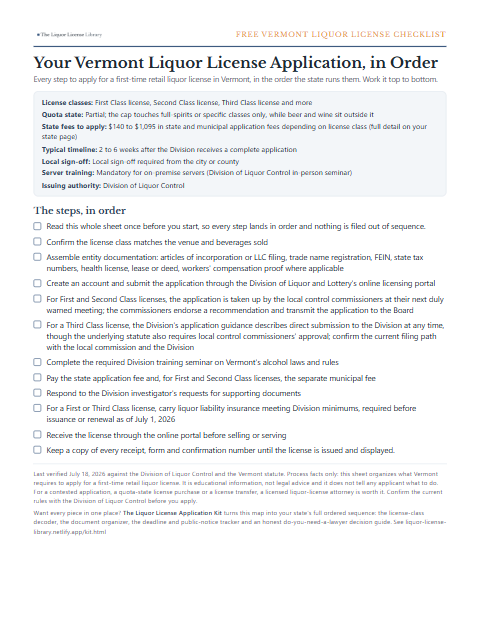
- Confirm the license class matches the venue and beverages sold
- Assemble entity documentation: articles of incorporation or LLC filing, trade name registration, FEIN, state tax numbers, health license, lease or deed, workers' compensation proof where applicable
- Create an account and submit the application through the Division of Liquor and Lottery's online licensing portal
- For First and Second Class licenses, the application is taken up by the local control commissioners at their next duly warned meeting; the commissioners endorse a recommendation and transmit the application to the Board
- For a Third Class license, the Division's application guidance describes direct submission to the Division at any time, though the underlying statute also requires local control commissioners' approval; confirm the current filing path with the local commission and the Division
- Complete the required Division training seminar on Vermont's alcohol laws and rules
- Pay the state application fee and, for First and Second Class licenses, the separate municipal fee
- Respond to the Division investigator's requests for supporting documents
- For a First or Third Class license, carry liquor liability insurance meeting Division minimums, required before issuance or renewal as of July 1, 2026
- Receive the license through the online portal before selling or serving
Get the free Vermont liquor license checklist
The one-page map of the Vermont application steps, in the order Vermont runs them.
Instant download, plus Vermont rule-change alerts. Unsubscribe anytime.
Local approval and public notice in Vermont
The city or county layer on top of the state license, plus any notice you must post or publish. The public-notice window is often the shortest clock in the whole process.
| Item | Vermont rule |
|---|---|
| Local sign-off required? | Yes, a city or county sign-off is part of the path |
| What the local layer does | The town or city selectboard sits as the local control commissioners and reviews First and Second Class applications at a duly warned local meeting, endorsing a recommendation before transmitting the application to the Board of Liquor and Lottery. The statute (7 V.S.A. section 223) conditions a Third Class license on the local control commissioners having approved the application, a requirement confirmed against the primary section 223 text, though the Division's own how-to-apply page describes Third Class applications going directly to the Division without a town step; this discrepancy between the statute and the agency's practical guidance was not resolved by any source reviewed. |
| Public notice | The Division posts notice of pending applications on its website per statute. The local control commission's meeting where the application is considered must be a duly warned public meeting under Vermont's open meeting rules; no separate newspaper-publication or premises-posting window specific to liquor licensing was found in the sources reviewed. |
| Worth knowing | No state-level distance restriction from schools or churches was found in the statute sections reviewed; any siting restriction would run through local zoning rather than a liquor-specific state distance rule. Vermont has no dry towns; all municipalities permit at least some class of alcohol sale. |
Server training in Vermont
Whether the people pouring or selling alcohol must certify through a state program, plus the deadline.
| Item | Vermont rule |
|---|---|
| Required for a first-time retailer? | Yes, mandatory for on-premise servers |
| Who must certify | Every person who sells or serves alcohol or tobacco and the license itself: a new First, Second, Third or Fourth Class license, or a manufacturer's or rectifier's license, is not granted until the applicant has completed the training |
| State program | Division of Liquor Control in-person seminar, online training program, or in-house training delivered by a Division-certified trainer, official reference at https://dllseminars.vermont.gov/ |
| Deadline | Before starting work as a seller or server; the license itself is not issued until the licensee has completed the seminar |
| Worth knowing | Recertification is required at least once every two years. A license cannot be renewed unless Division records show the licensee is current on training. The Division's own education page notes its training materials do not yet reflect changes from the 2025-2026 legislative session, so the requirement described here may be updated. |
Background check and renewal in Vermont
Background check
| Item | Vermont rule |
|---|---|
| Background check required? | Yes |
| Who is checked | Statute authorizes the Commissioner, with Board approval, to obtain Vermont, out-of-state and FBI criminal history records through the Vermont Crime Information Center to review applications for any liquor or tobacco license. The statute text does not itemize which specific principals within an applicant entity are checked. The Division's own listed application document requirements for First and Third Class licenses do not describe a fingerprint-submission step. |
| Disqualifiers | unverifiable. The authorizing statute does not itself set out disqualifying criminal-history standards for liquor license applicants. No separate disqualifier list was found in the sources reviewed. |
| Worth knowing | The background-check authority (7 V.S.A. section 215) was added effective July 1, 2022 and is a comparatively recent addition to Vermont's licensing statute. |
Renewal
| Item | Vermont rule |
|---|---|
| Renewal cycle | annual |
| Worth knowing | A license expires one year after the date of issuance. Renewal is filed through the same online portal. The license cannot be renewed unless Division records show the licensee's alcohol-training certification is current within the two-year recertification cycle. |