How to Get a Liquor License in Pennsylvania (2026): Cost, Classes and Steps
How do you get a liquor license in Pennsylvania?
In Pennsylvania, retail liquor licenses are issued by the Pennsylvania Liquor Control Board. A Restaurant Liquor (R) license covers full spirits service on premise plus limited take-out sales, an Eating Place Retail Dispenser (E) license covers beer only and both classes sit inside a strict county quota tied to population. Pennsylvania is also a control state, so off-premise wine and spirits retail runs only through the state's own Fine Wine and Good Spirits stores, never a private package store.
Pennsylvania runs its retail liquor licensing through the Pennsylvania Liquor Control Board. The application is filed with the state. Pennsylvania caps the number of retail licenses, so a first-time applicant often buys an existing license and transfers it rather than obtaining a brand-new one. The page below lays the pieces out in the order the state runs them.
Pennsylvania is a control state, so a private applicant cannot open a full-spirits package store; spirits move through state stores and the private retail license covers beer, wine or on-premise service. Server training is voluntary here, an incentive rather than a licensing condition. Every owner, officer and significant investor clears a background check. Each piece has its own section below, with the official source beside it.
Act 56 of 2025 was enacted in 2025. Pennsylvania enacted Act 56 of 2025 to require annual auctions of excess quota licenses and to allow a license to move across county lines. This page reflects the rule in force today; the full history sits in the law-updates log.
Which liquor license does a Pennsylvania bar, restaurant or store need?
The retail license classes Pennsylvania issues, what each covers and the venue each fits. Match your venue to the class before anything else.
| Class | Covers | Who it fits |
|---|---|---|
| R Restaurant Liquor license | both, full spirits | The main full-service class for a bar or restaurant, on premise plus limited off-premise take-out with a Wine Expanded Permit at qualifying grocery or convenience retailers. Subject to the county population quota; requires seating, utensils and food service for at least 30 patrons. |
| E Eating Place Retail Dispenser license | on-premise, beer | Beer only, no wine or spirits. Common first license for a small restaurant or tavern. Subject to the same county population quota as the R license. |
| H Hotel Liquor license | both, full spirits | Fits an inn or hotel restaurant meeting the statutory hotel definition (a minimum number of sleeping rooms and dining facilities). Not subject to the retail quota. |
| D Distributor license | off-premise, beer | The private off-premise route for beer sold by the case or keg. Not subject to the retail quota. Pennsylvania has no private off-premise retail license for wine or spirits; that sits with the state-run stores only. |
Is Pennsylvania a quota or control state?
Whether Pennsylvania caps how many licenses exist, how a capped license is obtained and whether the state runs any part of retail itself. This is where the real cost of a Pennsylvania license can hide.
| Item | Pennsylvania rule |
|---|---|
| Quota state? | Yes, the number of licenses is capped |
| How the cap works | One retail license per 3,000 county inhabitants, recalculated after each federal census under section 461 of the Liquor Code. The quota applies to Restaurant Liquor (R), Eating Place Retail Dispenser (E), Club (C) and Catering Club (CC) licenses. Hotel, airport restaurant, golf course, continuing care retirement community, performing arts, public venue and several economic-development license classes sit outside the quota. |
| New licenses issued by | No standing lottery for brand-new licenses. Where a county is genuinely under its quota, an applicant can apply directly to the PLCB for a new license without an auction. Most counties already sit at or above quota because licenses predate the 1939 cap, so a new license cannot be issued there until an existing one lapses. |
| Buying an existing license | Expired restaurant licenses are periodically resold by the PLCB itself through a sealed-bid excess auction, minimum bid $25,000 per license, held at least once a year; the first excess auction under the 2025 reform produced winning bids reported from $105,000 to $557,777, with an average near $284,000 and later auction rounds have averaged closer to $155,000, market-reported. Existing active quota licenses also trade privately between license holders subject to PLCB transfer approval, with market-reported prices reaching several hundred thousand dollars in high-demand counties such as Philadelphia; these figures are market-reported, not an official PLCB fee. |
| State control | Yes, a control state. The Commonwealth operates every off-premise wine and spirits store as Fine Wine and Good Spirits and prohibits private off-premise wine or spirits retail entirely. Beer for off-premise sale goes through privately licensed distributors and on-premise retail licenses such as R, H, E and C are privately owned and operated even though the state controls off-premise wine and spirits. |
How much does a liquor license cost in Pennsylvania?
| Item | Pennsylvania |
|---|---|
| State and local fees to apply | roughly $1,650 to $2,200 or more in direct PLCB filing, license and surcharge fees for a new R license, depending on municipal population and the number of principals who each add a $22 background-check fee; an E license runs somewhat lower, roughly $1,600 to $1,850 |
| Renewal | roughly $280 to $730 per renewal or validation cycle for an R license (filing fee plus the population-based license fee), somewhat lower for an E license, plus late fees if filed after the deadline |
| What drives the range | These figures are the state's own licensing fees only. In a county at or over its quota, a first-time R, E, C or CC applicant also has to acquire an existing license, either through a PLCB excess auction (minimum bid $25,000) or a private purchase; see the quota field for those figures. |
The itemized fees a first-time Pennsylvania applicant can expect from the state.
| Fee | Amount |
|---|---|
| Restaurant Liquor (R) filing fee, new | $700 |
| Restaurant Liquor (R) license fee, new, renewal and validation | $250 to $700, based on municipal population |
| Restaurant Liquor (R) surcharge, new | $700 |
| Eating Place Retail Dispenser (E) filing fee, new | $700 |
| Eating Place Retail Dispenser (E) license fee, new, renewal and validation | $200 to $400, based on municipal population |
| Eating Place Retail Dispenser (E) surcharge, new | $700 |
| Distributor (D) license fee | $700 filing fee plus $600 license fee |
| Renewal or validation filing fee | $30 |
| Criminal history record check | $22 per individual |
| Late renewal fee | $100 if filed less than 60 days before expiration, up to $250 total if filed within two years after expiration |
| Excess auction minimum bid for an expired restaurant license | $25,000 minimum bid plus a bid surety of $5,000 or 5 percent of the bid, whichever is higher |
How long it takes. roughly 8 to 16 weeks for a new license application requiring a full Bureau of Licensing investigation, based on market-reported processing benchmarks rather than a PLCB-published service commitment. The Public Notice of Application must stay posted at least 30 days before the PLCB can approve any action. A protest filed by the municipality or by a nearby church, school, hospital or licensed neighbor within that window extends review and incomplete entity or financial documentation delays the investigator interview.
How to apply for a liquor license in Pennsylvania, step by step
Several of these steps gate the ones after them, so the order matters as much as the list.
- Confirm the license class needed and check the county's quota status for that class with the Bureau of Licensing
- Create or access a PLCB+ account and gather identification and five-year residence and employment history for every principal
- File the license application online through PLCB+, which issues an amendment number for the filing
- Post the Public Notice of Application at the premises' main entrance for at least 30 days, keeping it posted until a final decision
- Assemble entity documents, lease, health license, escrow proof, financial disclosure affidavit and source-of-funds records for the Bureau of Licensing investigator
- Make Pennsylvania-resident principals available for interview and complete a criminal history record check for each individual
- Pass a final premises inspection confirming seating, utensils and food service for at least 30 patrons, or complete prior-approval plan review if construction is not finished
- Resolve any protest from the municipality or from a nearby church, school, hospital or licensed neighbor filed during the notice period
- Receive the PLCB's final action approving the license before opening or advertising
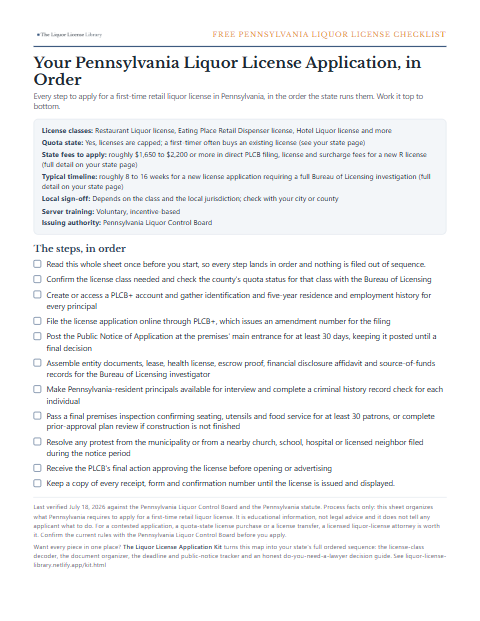
Get the free Pennsylvania liquor license checklist
The one-page map of the Pennsylvania application steps, in the order Pennsylvania runs them.
Instant download, plus Pennsylvania rule-change alerts. Unsubscribe anytime.
Local approval and public notice in Pennsylvania
The city or county layer on top of the state license, plus any notice you must post or publish. The public-notice window is often the shortest clock in the whole process.
| Item | Pennsylvania rule |
|---|---|
| Local sign-off required? | It depends on the class and the jurisdiction |
| What the local layer does | Pennsylvania has no separate local licensing board that approves a new license before the state does. A municipality's role is to file a protest against the application, to supply the health license the premises needs and, in a municipality that has held a local option vote, to have already approved the license class the applicant is seeking. |
| Public notice | Public Notice of Application (PLCB-1296) posted conspicuously at the premises' main entrance, at least 30 days before the PLCB can approve any action, remaining posted until a final decision is issued |
| Worth knowing | A church, hospital, charitable institution, school or public playground within 300 feet of the premises, or a licensee within 200 feet, has the right to file a protest and later to appeal an approval to the county court of common pleas. Local option referenda under section 472 of the Liquor Code let a municipality vote itself wet or dry for specific license types; roughly a quarter of Pennsylvania municipalities were at least partially dry as of mid-2025. |
Server training in Pennsylvania
Whether the people pouring or selling alcohol must certify through a state program, plus the deadline.
| Item | Pennsylvania rule |
|---|---|
| Required for a first-time retailer? | Voluntary, an incentive rather than a licensing condition |
| Who must certify | n/a for obtaining the license itself; a licensee seeking RAMP certification needs at least one owner or PLCB-approved manager to complete owner/manager training and must keep at least 50 percent of alcohol service staff server/seller trained |
| State program | Responsible Alcohol Management Program (RAMP), administered by the PLCB, built on four prerequisites: owner/manager training, server/seller training, new employee orientation and required signage |
| Deadline | n/a for a first-time application; RAMP can become a mandatory condition for a specific licensee only after an Administrative Law Judge finds that licensee guilty of selling to a minor or a visibly intoxicated person |
| Worth knowing | RAMP certification carries civil-penalty mitigation and enforcement benefits but is not a precondition for getting a new retail license. |
Background check and renewal in Pennsylvania
Background check
| Item | Pennsylvania rule |
|---|---|
| Background check required? | Yes |
| Who is checked | Every individual involved in the application: the applicant, all officers, directors and stockholders holding 10 percent or more of a corporate applicant, all LLC members and managers, all general and limited partners and the manager. Pennsylvania-resident principals sit for a Bureau of Licensing investigator interview; principals living outside Pennsylvania file an Individual Questionnaire (PLCB-196) instead. |
| Worth knowing | Applicants provide five years of residence and employment history so the Bureau of Licensing can run an out-of-state criminal record check where needed and pay a $22 criminal history record check fee per individual. The Pennsylvania State Police Bureau of Liquor Control Enforcement reviews the investigation. A club applicant must also show ten years of unincorporated existence, or one year if incorporated. |
Renewal
| Item | Pennsylvania rule |
|---|---|
| Renewal cycle | biennial renewal with an annual validation requirement in the off year |
| Worth knowing | The PLCB assigns each license to one of ten renewal districts. Five districts renew in odd years and validate in even years, the other five renew in even years and validate in odd years, so most licensees file every year even though a full renewal cycle only comes around every two years. The $30 filing fee and the population-based license fee both apply at renewal and at validation. |