How to Get a Liquor License in Ohio (2026): Cost, Classes and Steps
How do you get a liquor license in Ohio?
In Ohio, retail liquor permits are issued by the Division of Liquor Control within the Department of Commerce, with all new applications filed online through the OPAL system. A first-time off-premise store applies for a C-1 (beer) or C-2 (wine and mixed beverages) carryout permit and a first-time on-premise bar or restaurant applies for a D-class permit, up through D-5 for full spirits service. Most C and D classes are capped by a population-based quota per city or township, though several non-quota D-5 sub-classes exist for restaurants and specific locations that meet the state's criteria.
In Ohio, retail liquor licenses go through the Division of Liquor Control. A first-time applicant files with the state directly. Ohio caps only its full-spirits or specific classes, while a beer or beer-and-wine class usually sits outside the cap. Work the page top to bottom and the whole path is visible before any single deadline is due.
Ohio runs a partial control system, handling some spirits wholesale or retail itself while private retailers hold the on-premise and off-premise licenses. Server training is voluntary here, an incentive rather than a licensing condition. Every owner, officer and significant investor clears a background check. Each piece has its own section below, with the official source beside it.
The OPAL system took effect June 4, 2025. Ohio moved every new permit application onto its OPAL online licensing system, replacing the prior paper-and-mail process for first-time applicants. This page reflects the rule in force today; the full history sits in the law-updates log.
Which liquor license does a Ohio bar, restaurant or store need?
The retail license classes Ohio issues, what each covers and the venue each fits. Match your venue to the class before anything else.
| Class | Covers | Who it fits |
|---|---|---|
| C-1 Carryout, beer only | off-premise, beer | Subject to population quota (one per 1,000 population); the base first-time off-premise class for a convenience or grocery store |
| C-2 Carryout, wine and mixed beverages | off-premise, wine and mixed beverages | Subject to population quota; covers wine and prepackaged mixed beverages for carryout, does not cover beer (beer needs a separate C-1) or packaged spirits, per ORC 4303.12 and the DLC Permit Class Types page |
| D-2 Wine and mixed beverages, on-premise or carryout | both, wine and mixed beverages | Subject to population quota (one per 2,000 population); covers wine and mixed beverages on-premise or sealed for carryout, not beer (beer is the D-1 class), per the DLC Permit Class Types page; common first license for a small restaurant not serving spirits |
| D-5 Full spirituous liquor, on-premise | on-premise, full spirits | Subject to population quota (one per 2,000 population, or 1,500 for D-3 in cities of 55,000 or more); the standard class for a bar or full-service restaurant, includes beer, wine, mixed beverages and spirits until 2:30 a.m. |
| D-5i Restaurant permit, quota-exempt | on-premise, full spirits | Not subject to quota; requires a restaurant with at least 140 inside seats, at least 4,000 square feet of floor area, full-course meals and beer plus spirits receipts (wine excluded) capped at 25 percent of gross receipts, in a municipality or township of 100,000 population or less |
| D-1 Beer only, on-premise or carryout | both, beer | Subject to population quota (one per 2,000 population); fits a small tavern or beer-focused restaurant |
Is Ohio a quota or control state?
Whether Ohio caps how many licenses exist, how a capped license is obtained and whether the state runs any part of retail itself. This is where the real cost of a Ohio license can hide.
| Item | Ohio rule |
|---|---|
| Quota state? | Partial, the cap touches some classes only |
| How the cap works | Ohio Revised Code 4303.29 caps most C and D permits by population: one C-1 and C-2 permit per 1,000 population or part of it, one D-1 and D-2 permit per 2,000 population or part of it and one D-3, D-4 or D-5 permit per 2,000 population or part of it (one D-3 per 1,500 population in a city of 55,000 or more). Several categories are exempt, including permits at municipal airports with commercial service, state fairgrounds, capitol square, the Ohio judicial center and qualifying park districts, plus the special-purpose D-5 sub-classes such as D-5i restaurants, hotels, malls and casinos |
| New licenses issued by | none; there is no periodic drawing. A quota slot opens only when an existing permit in that class lapses, is revoked or is voluntarily surrendered in that city or township and a new applicant can then apply for it |
| Buying an existing license | Quota-restricted permits also trade privately between permit holders, subject to division transfer approval; six-figure and mid five-figure prices are market-reported for D-5 class permits in high-demand Columbus, Cleveland and Cincinnati submarkets, this is not an official state fee |
| State control | Partial control. Ohio controls spirituous liquor at the wholesale level: the division and the JobsOhio Beverage System supply spirits on consignment through privately operated contract agencies (Ohio Liquor, OHLQ) and agency compensation is capped by rule at 7 percent of gross sales. Beer and wine move through an ordinary private three-tier system. A standard C or D retail permit lets a business buy and sell within this structure, it does not by itself make a business a state spirits agency |
Not fully settled in one published place. Confirm the exact quota status and, where a cap applies, how a new or existing license is obtained with the Division of Liquor Control before you rely on it.
How much does a liquor license cost in Ohio?
| Item | Ohio |
|---|---|
| State and local fees to apply | roughly $350 to $2,600 in state application, permit class and background-check fees depending on class, from a C-1 beer carryout up to a D-5 full-spirits on-premise permit; excludes any secondary-market purchase price and excludes local business, health or fire permit fees |
| Renewal | the same annual class fee as the initial permit fee, for example $252 for C-1 up to $2,344 for D-5, paid every year at renewal |
| What drives the range | The range is driven almost entirely by permit class, not by county or city population. A permit issued within six months of its expiration date gets a 50 percent refund of the class fee already paid, not the application fee |
The itemized fees a first-time Ohio applicant can expect from the state.
| Fee | Amount |
|---|---|
| Application processing fee (nonrefundable, general to new permit applications) | $100 |
| C-1 permit fee (carryout, beer only) | $252 |
| C-2 permit fee (carryout, wine and mixed beverages) | $376 |
| D-1 permit fee (beer only, on-premise or carryout) | $376 |
| D-2 permit fee (wine and mixed beverages, on-premise or carryout) | $564 |
| D-3 permit fee (spirits, on-premise only) | $750 |
| D-5 permit fee (full spirits, on-premise, extended hours) | $2,344 |
| D-5i permit fee (quota-exempt restaurant) | $2,344 |
| D-6 permit fee (Sunday sales add-on) | $400 to $500 |
| BCI and FBI background check (per owner/officer fingerprinted) | approximately $22 BCI plus approximately $24 to $25 FBI, plus a vendor fingerprinting service fee |
How long it takes. roughly 10 to 12 weeks when no hearing is requested and no adverse background information turns up, with the division unable to issue a permit sooner than 15 days after a complete application is filed. The local objection window (30 days, extendable by 30 more) and any requested hearing extend the timeline; incomplete background or entity paperwork also adds time. This range is drawn from Ohio liquor-law practitioner guidance describing the statutory notice periods rather than from a single dated processing-time statement on a Division of Liquor Control page
Not published as one current figure. Confirm the exact amount with the Division of Liquor Control before you budget for it.
How to apply for a liquor license in Ohio, step by step
Several of these steps gate the ones after them, so the order matters as much as the list.
- Confirm the premises is in a wet area under local option and identify the correct permit class
- Create an OHID account and set up the business entity in OPAL
- Complete the OPAL application, including the federal EIN and Ohio vendor's license number
- Submit entity disclosure forms and personal history background forms, with fingerprints for every owner, officer or 5 percent or greater stockholder
- Submit proof of tenancy (deed, lease, rental contract, or summary of tenancy rights) and any required financial verification
- Pay the nonrefundable application processing fee and the annual permit class fee
- Undergo the division's on-site inspection of the premises
- Await the division's notice to the local legislative authority; the local authority has 30 days to object (extendable by 30 more days on request) and any school, church, library, playground or park within 500 feet gets separate certified-mail notice with a hearing opportunity
- Respond to any division deficiency notice or local objection hearing
- Receive the permit before selling any beer, wine or liquor
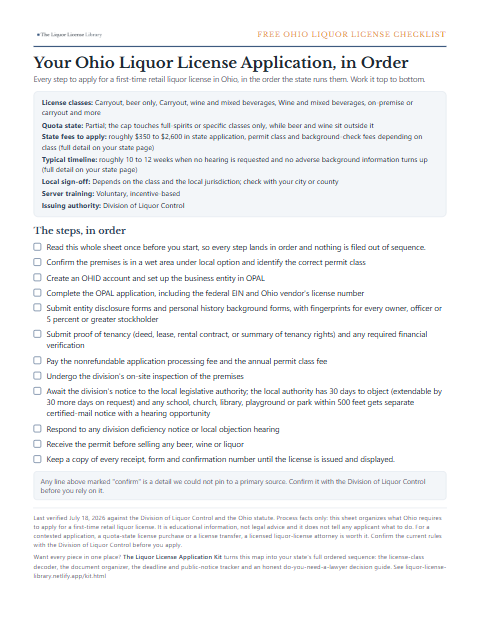
Get the free Ohio liquor license checklist
The one-page map of the Ohio application steps, in the order Ohio runs them.
Instant download, plus Ohio rule-change alerts. Unsubscribe anytime.
Local approval and public notice in Ohio
The city or county layer on top of the state license, plus any notice you must post or publish. The public-notice window is often the shortest clock in the whole process.
| Item | Ohio rule |
|---|---|
| Local sign-off required? | It depends on the class and the jurisdiction |
| What the local layer does | The local legislative authority (city council, township board of trustees, or county commissioners) is not a pre-approval gate. The division notifies it after the application is filed; the authority then has 30 days (extendable by 30 more days on request) to pass a resolution objecting for one of the statutory reasons in Revised Code 4303.292, such as proximity to a school or church or an overconcentration of permits in the neighborhood. An objection triggers a hearing before the objection can block the permit |
| Public notice | Certified-mail or personal-service notice goes to the controlling authority of any school, church, library, public playground or township park within 500 feet of the premises, with an opportunity for that authority to request a hearing; there is no general newspaper-publication requirement in the sources reviewed |
| Worth knowing | Local option elections let voters in a precinct, township or municipality vote an area wet or dry (or restrict specific permit classes such as Sunday sales), so the state permit process only runs where the underlying local option allows sales. Local zoning, building and health permits are separate general business requirements, not part of the liquor permit objection process itself |
Server training in Ohio
Whether the people pouring or selling alcohol must certify through a state program, plus the deadline.
| Item | Ohio rule |
|---|---|
| Required for a first-time retailer? | Voluntary, an incentive rather than a licensing condition |
| Who must certify | n/a; open to anyone involved in the sale or handling of alcohol |
| State program | Alcohol Server Knowledge (ASK) Program, run by the Division of Liquor Control's Ohio Investigative Unit, free and completed online with a certificate of completion |
| Worth knowing | Not a licensing condition. The Ohio Investigative Unit may require server training as part of settling a citation and individual employers or liability insurers commonly require it even though the state does not |
Background check and renewal in Ohio
Background check
| Item | Ohio rule |
|---|---|
| Background check required? | Yes |
| Who is checked | Every partner, officer, managing member, or 5 percent or greater stockholder or member (and, on the sole-proprietor disclosure form, a spouse working on the premises) discloses personal history and is fingerprinted for an Ohio BCI and FBI criminal history check; local police also review the same owners and officers; results go to the division |
| Disqualifiers | The division shall refuse to issue, renew or transfer a permit where the applicant or a listed owner or officer has been convicted of a felony or other crime reasonably related to fitness to operate a liquor business, has a history of operating in disregard of liquor laws, has misrepresented a material fact on the application, or has been found maintaining a nuisance at the premises under Revised Code 3767.05; a prior refusal, revocation or non-renewal in Ohio or another state is also disclosed and reviewed |
| Worth knowing | Deliberate misrepresentation on the application is itself independent grounds for the division to refuse the permit |
Renewal
| Item | Ohio rule |
|---|---|
| Renewal cycle | annual |
| Worth knowing | Retail C and D permits renew on one of three staggered regional dates statewide, February 1, June 1 or October 1, depending on county; all other (non-retail) permit types renew October 1. A holder who timely files for renewal of the same class at the same premises is entitled to renewal unless the division rejects it for good cause; a local legislative authority may object to a renewal on the same statutory grounds as a new application, with any objection due at least 30 days before expiration |