How to Get a Liquor License in North Dakota (2026): Cost, Classes and Steps
How do you get a liquor license in North Dakota?
In North Dakota, the Office of Attorney General licenses retail alcoholic beverage sales, but a first-time applicant must secure a local beer or liquor license from the city, county or tribal government before the state will accept an application. The core split is a liquor license, which under state law covers everything except beer including wine and spirits, versus a beer-only license, with each further split into an on-sale, an off-sale or a combined on-and-off-sale class. North Dakota sets no statewide quota or population-ratio cap on licenses, though state law lets individual cities and counties cap the number of local licenses they grant, so availability can still be locally limited.
North Dakota runs its retail liquor licensing through the Office of Attorney General, Licensing Section. The application is filed locally, with the city or county acting as the issuing authority. North Dakota caps only its full-spirits or specific classes, while a beer or beer-and-wine class usually sits outside the cap. The page below lays the pieces out in the order the state runs them.
Server training is voluntary here, an incentive rather than a licensing condition. Every owner, officer and significant investor clears a background check. A city or county sign-off is part of the path. Each piece has its own section below, with the official source beside it.
The parts a North Dakota applicant most often misses are which classes fall under the cap and which do not and the order of the steps, since several gate the ones after them. The sections below take them in order.
Which liquor license does a North Dakota bar, restaurant or store need?
The retail license classes North Dakota issues, what each covers and the venue each fits. Match your venue to the class before anything else.
| Class | Covers | Who it fits |
|---|---|---|
| On and Off Sale Liquor License Combined on-sale and off-sale liquor license | both, wine and spirits (North Dakota's statutory 'liquor' is any alcoholic beverage except beer) | Common first license for a bar or restaurant that also wants to sell packaged wine or spirits to go. Local fee set by city or county ordinance between $200 and $2,000, or up to $1,000 outside a city's corporate limits. No state quota, but a local governing body may cap the number granted. |
| Exclusive On-Sale Liquor License On-premise only liquor license | on-premise, wine and spirits | Fits a bar or restaurant selling for on-premises consumption only, with no package sales. Same local fee range as the on-and-off sale liquor license. |
| Exclusive Off-Sale Liquor License Off-premise only liquor license | off-premise, wine and spirits | Fits a liquor store or package retailer. Local fee may not exceed the fee charged for an on-and-off sale license. |
| On and Off Sale Beer License Combined on-sale and off-sale beer license | both, beer | Common first license for a smaller restaurant, taproom or convenience store selling only beer. Local fee set by ordinance between $50 and $500. |
| Exclusive On-Sale Beer License On-premise only beer license | on-premise, beer | Fits a bar, taproom or restaurant serving only beer for on-premises consumption with no package sales. Local fee set by ordinance between $50 and $500, the same range as the on and off sale beer license (N.D.C.C. 5-02-03). |
| Exclusive Off-Sale Beer License Off-premise only beer license | off-premise, beer | Fits a grocery, convenience store or gas station selling packaged beer only. State law requires the licensed sales area to be physically separated from the unlicensed part of the store by a wall (N.D.C.C. 5-02-02.1). |
Is North Dakota a quota or control state?
Whether North Dakota caps how many licenses exist, how a capped license is obtained and whether the state runs any part of retail itself. This is where the real cost of a North Dakota license can hide.
| Item | North Dakota rule |
|---|---|
| Quota state? | Partial, the cap touches some classes only |
| How the cap works | No statewide numerical cap or population-ratio formula applies to state licenses. State law expressly authorizes each local governing body (city, county or tribal) to determine by ordinance or resolution the number of local licenses it grants (N.D.C.C. 5-02-09). Because a first-time applicant must secure the local license before the state license can issue, a city that sets a local cap functions as a practical quota in that jurisdiction, while a city that sets no cap has none. |
| New licenses issued by | No statewide lottery or drawing. Where a city caps its license count, that city's own ordinance governs how an opening is filled, not a state mechanism. |
| Buying an existing license | Not documented in the state sources reviewed. In a capped city, transfer of an existing local license between businesses may be locally permitted subject to that city's ordinance and approval, but no statewide or primary-source pricing data exists for this. |
| State control | No, private licensing throughout. License state, not a control state. Retail and wholesale alcoholic beverage businesses are privately owned under a three-tier system; the state does not operate retail or wholesale liquor stores. |
How much does a liquor license cost in North Dakota?
| Item | North Dakota |
|---|---|
| State and local fees to apply | roughly $100 to $2,100 in combined state and local license fees, depending mainly on the license class (beer versus liquor) and the local fee amount the city, county or tribal government sets. State fees alone are only $50 or $100 per class. |
| Renewal | the same recurring state and local fee range annually, plus a $100 state reinstatement fee if renewal is filed after December 31 |
| What drives the range | The range is driven almost entirely by the local ordinance amount rather than the state fee, since the state fee is fixed at $50 or $100 depending on city population while the local fee is set within a wide statutory band by the city, county or tribal government. |
The itemized fees a first-time North Dakota applicant can expect from the state.
| Fee | Amount |
|---|---|
| State annual beer or liquor license fee, city population 500 or fewer at the last federal decennial census | $50 per license |
| State annual beer or liquor license fee, city population over 500 at the last federal decennial census | $100 per license |
| State license reinstatement fee, renewal applied for after December 31 | $100 in addition to the annual license fee |
| Local annual on and off sale liquor license | $200 to $2,000 by city ordinance, not more than $1,000 outside a city's corporate limits |
| Local annual on and off sale beer license | $50 to $500 by city ordinance |
| Local exclusive off sale beer or liquor license | not more than the fee charged for an on and off sale license of the same beverage type |
| Local Sunday sales surcharge | up to an additional $5 per Sunday the licensee sells alcoholic beverages |
How long it takes. The Attorney General's own guidance asks applicants to submit at least four to six weeks before the intended opening date and states that renewal processing runs about two to three weeks. Total time to a first license depends heavily on how long the local license takes to obtain first, which state sources do not quantify. The four-to-six-week figure is the state's stated minimum lead time for submission, not a guaranteed processing ceiling. Securing the local license first, any required township board consent and the health and fire inspections can extend the real-world timeline well beyond the state's stated window.
How to apply for a liquor license in North Dakota, step by step
Several of these steps gate the ones after them, so the order matters as much as the list.
- Obtain the local beer or liquor license from the city, or, outside city limits, from the county board of commissioners or the tribal governing body, including any required township board consent
- Complete the State Application for Retail Alcoholic Beverage License (SFN 11066) and pay the state license fee
- Complete a Personal Information Form (SFN 10866) for every owner, manager, officer, director, shareholder, member, governor and partner
- Complete the Alcoholic Beverage Floor Plan (SFN 14985) showing the licensed area
- Attach the copy of the local license, a recent health inspection report and a recent fire safety inspection report
- Attach proof of premises control and any corporate, LLC, partnership or nonprofit governance documents
- Submit the complete packet to the Attorney General's Licensing Section at least four to six weeks before the intended opening date
- Respond to any deficiency request and await license issuance before selling
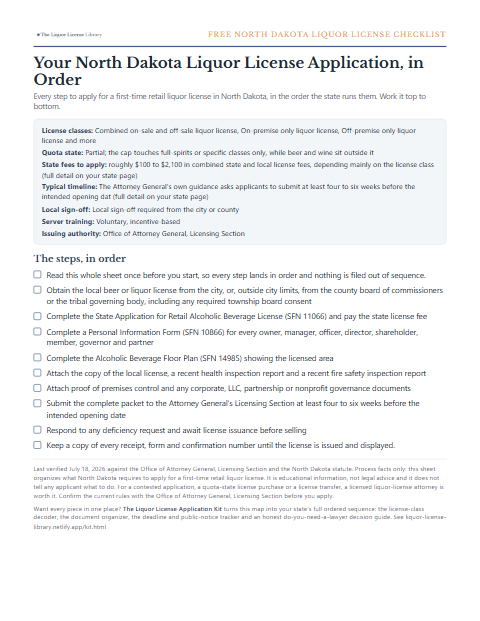
Get the free North Dakota liquor license checklist
The one-page map of the North Dakota application steps, in the order North Dakota runs them.
Instant download, plus North Dakota rule-change alerts. Unsubscribe anytime.
Local approval and public notice in North Dakota
The city or county layer on top of the state license, plus any notice you must post or publish. The public-notice window is often the shortest clock in the whole process.
| Item | North Dakota rule |
|---|---|
| Local sign-off required? | Yes, a city or county sign-off is part of the path |
| What the local layer does | A first-time applicant must hold a local beer or liquor license from the city, or, if the premises sits outside a city's corporate limits, from the county board of commissioners or the tribal governing body, before the state application will be accepted. Local governing bodies also set the local license class fees, may cap the number of licenses issued and regulate hours and other operating conditions. A retail license may not be issued in an organized township without the written consent of the township board of supervisors. |
| Worth knowing | State statute does not itself set a public-notice or posting requirement for a first-time retail application; any such requirement is a local-option matter that varies by city or county ordinance. State law is explicit only that the local license must be secured before the state license (N.D.C.C. 5-02-02(5)) and that local governing bodies may regulate and restrict licensees, including the number of licenses granted (N.D.C.C. 5-02-09). |
Server training in North Dakota
Whether the people pouring or selling alcohol must certify through a state program, plus the deadline.
| Item | North Dakota rule |
|---|---|
| Required for a first-time retailer? | Voluntary, an incentive rather than a licensing condition |
| Who must certify | n/a statewide; an individual employer or a local ordinance may set its own requirement |
| State program | No single named state-run certification program. State law treats employer-provided alcohol server training that addresses intoxication, drunk driving and underage drinking as a mitigating factor in a first licensing violation and in certain civil liability claims (N.D.C.C. 5-02-10.1 and 5-01-06.1). Commonly used third-party courses such as TIPS and ServSafe Alcohol are accepted toward that standard. |
| Worth knowing | Training is not a condition of getting or keeping a state license. Some individual cities require it by local ordinance. Many employers require it for insurance or liability reasons even though the state does not mandate it. |
Background check and renewal in North Dakota
Background check
| Item | North Dakota rule |
|---|---|
| Background check required? | Yes |
| Who is checked | The individual applicant (if not an organization) and, for an organization, the manager of the licensed premises plus its officers, directors, managers, governors, or general and limited partners depending on entity type must be legal residents of the United States and of good moral character (N.D.C.C. 5-02-02). |
| Disqualifiers | A conviction that the Attorney General determines has a direct bearing on the applicant's or manager's ability to serve the public as an alcoholic beverage retailer, unless the person is found sufficiently rehabilitated under N.D.C.C. 12.1-33-02.1. An applicant may not hold any financial interest in a wholesale alcoholic beverage business. |
| Worth knowing | The Attorney General may require written consent to obtain criminal history information and may charge the applicant an advance fee to cover the actual cost of a background check when standard background sources are not readily available, refunding any unused portion within 30 days (N.D.C.C. 5-02-02(8)). The primary sources reviewed do not specify a universal fingerprint-card requirement. The Personal Information Form (SFN 10866) must be refiled on any change of owner, manager, officer, director, shareholder, member, governor or partner. Existing forms must be updated at least every five years, with additional instructions for anyone who lived outside North Dakota during that period. |
Renewal
| Item | North Dakota rule |
|---|---|
| Renewal cycle | annual |
| Worth knowing | The state license renews on a calendar-year basis and must be renewed on or before December 31 using SFN 11066. A license not renewed by close of business on the last working day in February is considered expired. A $100 reinstatement fee applies in addition to the annual fee for any renewal applied for after December 31 (N.D.C.C. 5-02-04). |