How to Get a Liquor License in Nebraska (2026): Cost, Classes and Steps
How do you get a liquor license in Nebraska?
In Nebraska, retail liquor licenses are issued by the Nebraska Liquor Control Commission, but every application also passes through the city council, village board or county board where the premises sits before the commission decides. A bar or restaurant serving beer, wine and spirits applies for a Class C license (on and off sale) or a Class I license (on sale only), while a package or grocery-type retailer applies for Class D or the revenue-limited Class J. Nebraska sets no statewide numeric quota on retail licenses, so approval turns on the commission's public-convenience-and-necessity review rather than a lottery or a waiting list.
Nebraska runs its retail liquor licensing through the Nebraska Liquor Control Commission. The application is filed locally, with the city or county acting as the issuing authority. Nebraska sets no cap on the number of retail licenses, so there is no slot to wait for and no existing license to buy out. The page below lays the pieces out in the order the state runs them.
Server training is required for some classes or roles. Every owner, officer and significant investor clears a background check. Local involvement depends on the class and the jurisdiction. Each piece has its own section below, with the official source beside it.
The parts a Nebraska applicant most often misses are the public-notice window, which runs on the state's schedule rather than yours and the order of the steps, since several gate the ones after them. The sections below take them in order.
Which liquor license does a Nebraska bar, restaurant or store need?
The retail license classes Nebraska issues, what each covers and the venue each fits. Match your venue to the class before anything else.
| Class | Covers | Who it fits |
|---|---|---|
| A Beer, on sale only | on-premise, beer | Bar or restaurant serving beer only for on-premise consumption. No numeric quota. |
| B Beer, off sale only | off-premise, beer | Retailer selling beer in original packages for off-premise consumption. No numeric quota. |
| C Beer, wine and distilled spirits, on and off sale | both, full spirits | Common bar or restaurant class covering both on-premise and off-premise sale of all alcoholic liquor. Its license year runs November 1 through October 31 rather than the standard May 1 through April 30 year every other class uses. |
| D Beer, wine and distilled spirits, off sale only | off-premise, full spirits | Package or liquor store class selling all alcoholic liquor in original packages for off-premise consumption. |
| I Beer, wine and distilled spirits, on sale only | on-premise, full spirits | Bar or restaurant class for on-premise sale of all alcoholic liquor without the off-sale privilege Class C carries. |
| J Limited alcoholic liquor, off sale | off-premise, full spirits | Fits a retailer such as a grocery or convenience store whose alcohol sales do not exceed 20 percent of its total annual gross revenue from all retail sales. No local occupation tax may be added on top of this class's state fee. |
Is Nebraska a quota or control state?
Whether Nebraska caps the number of licenses and whether the state runs any part of retail itself. Both answers are no here, which is a big part of why Nebraska is one of the simpler states to enter.
| Item | Nebraska rule |
|---|---|
| Quota state? | No, there is no cap on the number of licenses |
| State control | No, private licensing throughout. Nebraska is a private license state. The commission does not operate retail stores and does not set wholesale prices. The Liquor Control Act keeps manufacturers, wholesalers and retailers on separate license types (three-tier separation). |
How much does a liquor license cost in Nebraska?
| Item | Nebraska |
|---|---|
| State and local fees to apply | roughly $550 to $950 in state fees for a typical first-time applicant: the flat $400 application fee plus $55 per fingerprinted owner or manager plus a $50 to $300 annual license fee depending on class, before any local occupation tax |
| Renewal | $50 to $300 per year depending on class, plus any local occupation tax up to double that amount |
| What drives the range | The application fee is flat at $400 regardless of class. The annual license fee varies by class from $50 (Class J) to $300 (Class C). Several third-party guides quote higher figures such as $300 to $600 for a Class C license; those do not match the current official fee chart, which sets flat per-class fees rather than ranges after the 2025 rewrite. Local occupation tax and the number of people who need the $55 background check are what actually move the total. |
The itemized fees a first-time Nebraska applicant can expect from the state.
| Fee | Amount |
|---|---|
| Application fee (nonrefundable, per new retail application) | $400 |
| Individual history background check (per person fingerprinted) | $55, effective August 1, 2025 |
| Annual license fee, Class A | $100 |
| Annual license fee, Class B | $100 |
| Annual license fee, Class C | $300 |
| Annual license fee, Class D | $200 |
| Annual license fee, Class I | $250 |
| Annual license fee, Class J | $50 |
| Local occupation tax (optional, set by local ordinance, not charged on Class J) | up to two times the annual license fee |
How long it takes. the local governing body has a statutory 45-day window to submit its recommendation once the commission forwards the application; licensing guides commonly cite roughly 60 to 120 days from a complete application to issuance for a standard permanent license. The 45-day local recommendation window is set by Neb. Rev. Stat. 53-131 and confirmed against the statute text. The commission cannot issue or deny the license until that window closes or a hearing on a timely objection concludes, so a local hearing, an incomplete fingerprint packet or a deficiency notice extends the total. No commission page publishes a single guaranteed total processing time, so the overall range is a licensing-guide estimate rather than an official commitment.
How to apply for a liquor license in Nebraska, step by step
Several of these steps gate the ones after them, so the order matters as much as the list.
- Confirm zoning and secure site control on the premises before applying
- Complete the retail application in the POSSE Customer Portal, including the premises diagram and business plan
- Upload privacy statements and fingerprint cards for the president, the manager, every owner above 25 percent and any participating spouse
- Pay the $400 nonrefundable application fee
- Have the commission forward the application to the local governing body, which may hold a hearing and has 45 days to submit its recommendation
- Complete the individual history background check for each listed owner and manager
- Pay the annual license fee for the class once the commission approves the application
- Receive the license before selling any alcoholic liquor
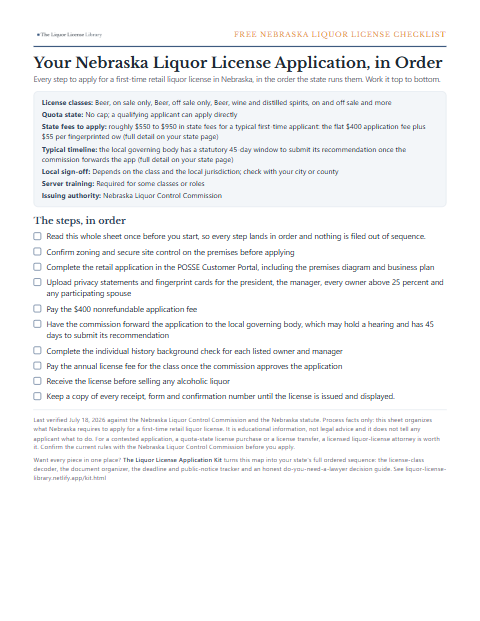
Get the free Nebraska liquor license checklist
The one-page map of the Nebraska application steps, in the order Nebraska runs them.
Instant download, plus Nebraska rule-change alerts. Unsubscribe anytime.
Local approval and public notice in Nebraska
The city or county layer on top of the state license, plus any notice you must post or publish. The public-notice window is often the shortest clock in the whole process.
| Item | Nebraska rule |
|---|---|
| Local sign-off required? | It depends on the class and the jurisdiction |
| What the local layer does | The commission forwards every new retail application to the city council or village board, or the county board outside city and village limits, which may hold a hearing and has 45 days to submit a recommendation to approve or deny. A local recommendation of denial is one factor among ten the commission weighs rather than an automatic veto, though Nebraska case law treats a local denial recommendation as capable of justifying denial on its own. |
| Public notice | New-application notice is published 7 to 14 days before the local hearing date. Annual renewal notice runs once in a legal newspaper: the January 10 to 30 window for non-Class C licenses and the July 10 to 30 window for Class C licenses. |
| Worth knowing | Local governing bodies may also levy an occupation tax up to double the state license fee (none on Class J). Local review runs in parallel with the state POSSE application rather than as a separate license an applicant must obtain first. |
Server training in Nebraska
Whether the people pouring or selling alcohol must certify through a state program, plus the deadline.
| Item | Nebraska rule |
|---|---|
| Required for a first-time retailer? | Required for some classes, roles or local mandates |
| Who must certify | Liquor retailers and their employees where the commission orders training as a corrective condition or a local ordinance mandates it; otherwise training is voluntary statewide |
| State program | Commission-maintained list of Certified Alcohol Training Courses referenced on the NLCC Training and Education page; a completed certificate uploads to the POSSE portal with a $20 state-mandated fee when the commission requires it |
| Deadline | n/a statewide; set by the specific local ordinance or commission order when training is mandated |
| Worth knowing | Several cities layer a local mandate on top of the state's voluntary default, including Lincoln, Kearney, Ogallala, North Platte and the Nebraska City and Otoe County area. Completing an approved course can mitigate penalties after a violation even where it is not required. |
Background check and renewal in Nebraska
Background check
| Item | Nebraska rule |
|---|---|
| Background check required? | Yes |
| Who is checked | A fingerprint-based individual history background check covers the president, the manager, every owner holding more than 25 percent and any participating spouse. Only prints taken at a Nebraska State Patrol Troop Headquarters Livescan location route to the state automatically; prints from any other source must be mailed to the commission. |
| Disqualifiers | Neb. Rev. Stat. 53-125 bars anyone under 21, anyone convicted of or pleading guilty to a felony under Nebraska law, another state's law or federal law and anyone convicted of a Class I misdemeanor under specified chapters of the criminal code, with an exception preserving renewal rights for convictions before May 18, 1983. Applicants must also show good character and reputation in their community. Most license types also require Nebraska residency. |
| Worth knowing | Managers and a participating spouse must also provide a US birth certificate or passport plus proof of Nebraska voter registration. As of the 2026 amendment to 53-132, the commission also weighs whether the applicant is delinquent on federal, state or local taxes as a licensing factor. |
Renewal
| Item | Nebraska rule |
|---|---|
| Renewal cycle | annual |
| Worth knowing | The license year runs May 1 through April 30 for every class except Class C, which runs November 1 through October 31. Clerks publish a one-time renewal notice in a legal newspaper: the January 10 to 30 window for non-Class C licenses and the July 10 to 30 window for Class C licenses. |