How to Get a Liquor License in Wyoming (2026): Cost, Classes and Steps
How do you get a liquor license in Wyoming?
In Wyoming, a first-time retail liquor license is issued locally: the city or town council inside municipal limits, or the county commissioners outside those limits, while the Wyoming Department of Revenue Liquor Division must certify each application is complete before the local authority may act on it and is the state's sole wholesale supplier of spirits and wine. The core retail liquor license covers both on-premise and off-premise sale and is capped by a statewide population formula. A separate bar and grill liquor license carries its own population-based cap, while a restaurant liquor license, a retail malt beverage (beer-only) permit and a resort liquor license sit outside any quota.
In Wyoming, retail liquor licenses go through The city or town council, or the county commissioners. A first-time applicant files locally, because the city or county is the issuing authority here. Wyoming caps only its full-spirits or specific classes, while a beer or beer-and-wine class usually sits outside the cap. Work the page top to bottom and the whole path is visible before any single deadline is due.
Wyoming runs a partial control system, handling some spirits wholesale or retail itself while private retailers hold the on-premise and off-premise licenses. Server training is required for some classes or roles. A city or county sign-off is part of the path. Each piece has its own section below, with the official source beside it.
The parts a Wyoming applicant most often misses are the public-notice window, which runs on the state's schedule rather than yours, which classes fall under the cap and which do not and the order of the steps, since several gate the ones after them. The sections below take them in order.
Which liquor license does a Wyoming bar, restaurant or store need?
The retail license classes Wyoming issues, what each covers and the venue each fits. Match your venue to the class before anything else.
| Class | Covers | Who it fits |
|---|---|---|
| Retail liquor license Retail liquor license | both, full spirits | The core class for a bar, a liquor store or a combined operation. It authorizes sale of alcoholic liquor and malt beverages for use or consumption without the statute itself splitting the class into a separate on-premise and off-premise version. Subject to the statewide population-based quota under W.S. 12-4-201. |
| Restaurant liquor license Restaurant liquor license | on-premise, full spirits | Fits a qualifying restaurant. Requires a valid food service permit at application. Revenue must be derived primarily from food service rather than alcohol sales, reported annually. Population formulas do not apply to this class (W.S. 12-4-407, 12-4-408). |
| Bar and grill liquor license Bar and grill liquor license | on-premise, full spirits | Fits a restaurant that also wants a separate lounge area. Requires a food service permit and proof that at least 60% of the preceding 12 months' gross sales came from food service, entertainment or a combination of the two. Carries its own separate population-based quota, distinct from the general retail liquor license quota (W.S. 12-4-413). |
| Retail malt beverage permit Retail malt beverage (beer-only) permit | both, beer | Beer-only class, commonly used by a convenience store or grocery for off-premise sale or by a small tavern for on-premise sale. County malt beverage permits are issued without regard to population (W.S. 12-4-201(b) and (h)). |
| Resort liquor license Resort liquor license | on-premise, full spirits | Fits a qualifying resort under W.S. 12-4-401. Off-premise sale is prohibited (W.S. 12-4-404) and the population formula does not apply (W.S. 12-4-403). This is a separate, older class from the resort hotel liquor license created in 2025 for large-investment properties; see notes. |
Is Wyoming a quota or control state?
Whether Wyoming caps how many licenses exist, how a capped license is obtained and whether the state runs any part of retail itself. This is where the real cost of a Wyoming license can hide.
| Item | Wyoming rule |
|---|---|
| Quota state? | Partial, the cap touches some classes only |
| How the cap works | Two classes carry a population-based cap. Retail liquor license (W.S. 12-4-201): an incorporated city or town gets 2 licenses up to 500 population, plus 1 more for each additional 500 population (or major fraction) up to 9,500 population, then 1 more for each additional full 3,000 population above that; a county gets 1 retail liquor license per 500 residents living outside city and town limits, capped at 3 within 5 miles of a city or town's limits. Bar and grill liquor license (W.S. 12-4-413): through June 30, 2028, up to 4 licenses in a city or town of 7,500 population or less, up to 10 for 7,501 to 20,000, up to 14 for 20,001 to 30,000, plus 1 more for each additional 5,000 population above 30,000, with a parallel county formula outside city and town limits; from July 1, 2028 the caps rise to 6, 14 and 18, with 1 more for each additional 3,000 population above 30,000. The restaurant liquor license, the retail malt beverage permit and the resort liquor license are not subject to a population formula. |
| New licenses issued by | None. Wyoming does not run a drawing. When a new quota slot opens, the local licensing authority accepts and reviews applications through the standard notice-and-hearing process. If more than one applicant competes for a single open slot, the local authority chooses among them at its discretion rather than by a random draw. |
| Buying an existing license | A quota-class license (retail liquor license or bar and grill license) can be sold or transferred to another party with the local licensing authority's approval under W.S. 12-4-601 through 12-4-604. In high-demand areas, historical private sale prices in the hundreds of thousands of dollars are market-reported, for example in Jackson, Wyoming; some towns have since moved toward a competitive local application process for a newly available slot instead of a private resale. These figures are market-reported, not an official state or local fee. |
| State control | Partial control. Wyoming controls wholesale distribution of alcoholic liquor (spirits) and wine: a retail licensee must purchase those categories from the Wyoming Liquor Division's warehouse rather than a private wholesaler, with a narrow exception under W.S. 12-4-201(j). Malt beverages (beer) are wholesaled by private distributors. Wyoming runs no state-owned retail stores; every retail premises is privately owned and locally licensed. |
How much does a liquor license cost in Wyoming?
| Item | Wyoming |
|---|---|
| State and local fees to apply | $300 to $10,500 in annual, state-bounded local license fees depending on class (retail liquor license $300-$1,500, restaurant $500-$3,000, bar and grill $1,500-$10,500, retail malt beverage permit $100-$1,500, resort $500-$3,000), plus the newspaper publication cost the applicant pays |
| Renewal | The same annual fee range as the class first issued, paid annually in advance; state statute does not set a separately discounted renewal fee |
| What drives the range | The exact fee within each statutory floor and ceiling is set by the local licensing authority, so the figure depends on which city, town or county issues the license. In a quota-class license, these fees exclude any private purchase price paid to acquire an existing license; see the quota field. |
The itemized fees a first-time Wyoming applicant can expect from the state.
| Fee | Amount |
|---|---|
| Retail liquor license, annual | $300 to $1,500 |
| Restaurant liquor license, annual | $500 to $3,000 |
| Bar and grill liquor license, annual | $1,500 to $10,500 |
| Retail malt beverage permit, annual (county) | $100 to $1,500 |
| Resort liquor license, annual | $500 to $3,000 |
| Newspaper publication cost for required notice | unverifiable, paid by the applicant, amount set by the newspaper not the state |
How long it takes. No statewide processing deadline is published in statute; realistically, industry sources report roughly 30 to 120 days from a complete local application to a license being issued, longer when a hearing draws competing applicants or objections. Statute sets only the minimum notice-and-hearing sequence: the local clerk must publish notice once a week for two consecutive weeks before the hearing date. Before the local authority may approve or deny, the Wyoming Liquor Division has 10 working days to object or the application is deemed certified complete (W.S. 12-4-104). The 30 to 120 day realistic range comes from secondary industry sources rather than a state-published service guarantee. A contested hearing or an incomplete disclosure packet extends it further.
How to apply for a liquor license in Wyoming, step by step
Several of these steps gate the ones after them, so the order matters as much as the list.
- Confirm which local licensing authority has jurisdiction (city or town council, or county commissioners) and confirm a quota slot is open if the venue needs a retail liquor license or a bar and grill license
- File the application with the local clerk, signed and verified, disclosing ownership, age, residence, a financial condition statement (new applicants) and any felony or alcohol-law violation history for every applicant, partner, officer, director or 10%-plus owner
- Pay the local publication cost and have the clerk publish notice of the application once a week for two consecutive weeks in a local newspaper
- The Wyoming Liquor Division certifies the application is complete before the local authority may approve or deny it; the application is deemed certified unless the division objects within 10 working days (W.S. 12-4-104)
- Attend the public hearing set in the notice; the local licensing authority may deny the application if it would harm neighborhood welfare or unnecessarily duplicate an existing license
- Receive the local licensing authority's decision and pay the annual license fee for the class granted
- Register the new license with the Wyoming Liquor Division to open a wholesale purchasing account before ordering any spirits or wine for the premises
- Complete locally mandated alcohol server training, where the city or county requires it, before staff serve alcohol
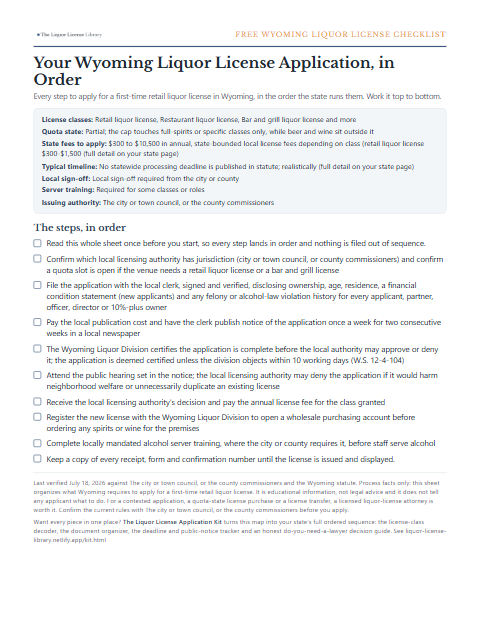
Get the free Wyoming liquor license checklist
The one-page map of the Wyoming application steps, in the order Wyoming runs them.
Instant download, plus Wyoming rule-change alerts. Unsubscribe anytime.
Local approval and public notice in Wyoming
The city or county layer on top of the state license, plus any notice you must post or publish. The public-notice window is often the shortest clock in the whole process.
| Item | Wyoming rule |
|---|---|
| Local sign-off required? | Yes, a city or county sign-off is part of the path |
| What the local layer does | The city or town council inside municipal limits, or the county commissioners outside them, is the licensing authority that reviews and grants every first-time retail application, including whether the venue fits the license class and whether a quota slot is open. Local governments may layer their own zoning or hearing rules on top of the statutory minimum. |
| Public notice | The local clerk publishes notice of the application in a newspaper of local circulation once a week for two consecutive weeks before the hearing date named in the notice. Counties must also post the notice on their website. Cities and towns must do so as well if they maintain one. The applicant pays the publication cost (W.S. 12-4-104). |
| Worth knowing | The local licensing authority is the decision-maker, but it cannot approve or deny until the Wyoming Liquor Division certifies the application is complete, which the division is deemed to do unless it objects within 10 working days. A license cannot be issued until after the published hearing date. No statewide dry-county or local-option provision could be independently confirmed during this research. The same is true of any statewide distance-from-school-or-church rule; treat both as open questions. |
Server training in Wyoming
Whether the people pouring or selling alcohol must certify through a state program, plus the deadline.
| Item | Wyoming rule |
|---|---|
| Required for a first-time retailer? | Required for some classes, roles or local mandates |
| Who must certify | Anyone who sells or serves alcoholic beverages, in the specific counties and cities that have locally adopted a mandatory training ordinance; voluntary for sellers and servers everywhere else in the state |
| State program | A Wyoming Department of Revenue administrative rule (011-20 Wyo. Code R. 20-17, Alcohol Server Training Program) sets the state certification standard: a minimum 4-hour course covering the physiological effects of alcohol, blood alcohol content, relevant law and intervention practice, with a passing score of at least 70% on a written exam. The rule names TIPS, Bar Code and TAMS as example qualifying programs, not as a recommendation of any one provider. |
| Deadline | n/a at the state level; a local jurisdiction that mandates training sets its own compliance deadline |
| Worth knowing | Certification is valid for at least 3 years under the rule. Completing an approved program is framed statewide as an incentive that can mitigate administrative penalties for a licensee, not as a universal licensing condition. |
Background check and renewal in Wyoming
Background check
| Item | Wyoming rule |
|---|---|
| Background check required? | In some cases (see below) |
| Who is checked | Every individual applicant, every partner and, for a corporation or LLC, every officer, director, member and anyone holding 10 percent or more ownership must be disclosed by name, age and residence (W.S. 12-4-102). |
| Disqualifiers | The application must disclose any felony conviction of the applicant or of any partner, officer, director or 10%-plus owner and any alcoholic-beverage-law violation within the preceding 10 years. New applicants must also submit a statement of financial condition and stability. Wyoming statute does not require fingerprint submission for a retail liquor license; a separate DCI fingerprint rule exists but applies to motor vehicle dealers under Title 31, an unrelated licensing scheme, not to liquor licensees. |
| Worth knowing | Corporate and LLC licensees must notify the licensing authority of any change to these ownership or officer disclosures within 30 days. An individual applicant signs and verifies personally; a corporation needs at least two officers or directors to sign unless it is solely owned by one person. |
Renewal
| Item | Wyoming rule |
|---|---|
| Renewal cycle | annual |
| Worth knowing | A license or permit term is one year unless revoked sooner. A licensing authority may pro-rate a first-year term to align with its issuance schedule. A licensee who fails to renew a pro-rated first license becomes ineligible for a new pro-rated license for 2 years. A renewal hearing must be held no later than 30 days before the current license expires. Unlike a new applicant, a renewal applicant denied by the local authority can appeal to district court; a pending renewal appeal blocks the authority from awarding that license to anyone else in the meantime (W.S. 12-4-104, 12-4-106). |