How to Get a Liquor License in Utah (2026): Cost, Classes and Steps
How do you get a liquor license in Utah?
In Utah, retail liquor licenses are issued by the Department of Alcoholic Beverage Services (DABS) and voted on by its seven-member Alcoholic Beverage Services Commission at a monthly meeting. A first-time restaurant applicant chooses between a Full-Service Restaurant license (spirits, wine and beer with meals), a Limited-Service Restaurant license (wine and beer, no spirits) or a Beer-Only Restaurant license, while a stand-alone bar needs a Bar Establishment license and a beer-only bar needs a Tavern license; all five of these on-premise classes are capped by a state population formula. Utah is also a control state: off-premise sale of wine, spirits and heavy beer runs only through state-run Liquor and Wine stores or contracted Package Agencies, so a private store selling packaged alcohol for take-home use is realistically limited to an Off-Premise Beer Retailer license for beer at 5 percent alcohol by volume or less.
In Utah, retail liquor licenses go through the Alcoholic Beverage Services Commission. A first-time applicant files with the state directly. Utah caps the number of retail licenses, so a first-time applicant often buys an existing license and transfers it rather than obtaining a brand-new one. Work the page top to bottom and the whole path is visible before any single deadline is due.
Utah is a control state, so a private applicant cannot open a full-spirits package store; spirits move through state stores and the private retail license covers beer, wine or on-premise service. On-premise servers must certify through the state's named training program within its window. Every owner, officer and significant investor clears a background check. Each piece has its own section below, with the official source beside it.
The parts a Utah applicant most often misses are the quota, which can make the license itself a far bigger cost than the state fee and the order of the steps, since several gate the ones after them. The sections below take them in order.
Which liquor license does a Utah bar, restaurant or store need?
The retail license classes Utah issues, what each covers and the venue each fits. Match your venue to the class before anything else.
| Class | Covers | Who it fits |
|---|---|---|
| Full-Service Restaurant Full-Service Restaurant License | on-premise, full spirits | For a restaurant serving beer, wine and spirits with meals. Quota class capped under Utah Code 32B-6-203 at 30 plus population divided by a divisor that steps down in statutory stages from 4,467 (before July 1, 2024) to 3,167 (fiscal year 2031 onward). At least 70 percent of gross revenue must come from food sales, or an alternate markup-cost test capping alcohol cost of goods at 30 percent; mixer cost can count on the alcohol side of that ratio as of a May 6, 2026 amendment. License year runs November 1 to October 31. |
| Limited-Service Restaurant Limited-Service Restaurant License | on-premise, beer and wine | For a restaurant serving wine, heavy beer and beer with meals; spirits and flavored malt beverages are not permitted. Quota class capped under Utah Code 32B-6-303 at population divided by a fixed 6,817, with no step-down schedule. Same 70 percent food-revenue test as the Full-Service class. |
| Beer-Only Restaurant Beer-Only Restaurant License | on-premise, beer only, 5 percent ABV or less | For a restaurant serving only beer with meals. Requires at least 70 percent of gross revenue from food sales. License year runs March 1 to the last day of February. |
| Bar Establishment Bar Establishment License | on-premise, full spirits | For a bar, tavern, private club or similar venue not built around a restaurant. Quota class capped under Utah Code 32B-6-403 at 15 plus population divided by a divisor that steps down in statutory stages from 10,200 (before July 1, 2024) to 7,246 (fiscal year 2031 onward). The commission designates the license as an equity, fraternal, dining-club-converted or bar sub-type at issuance; food must be available whenever alcohol is served. License year runs July 1 to June 30. |
| Tavern (On-Premise Beer Retailer) On-Premise Beer Retailer License, designated as a tavern | on-premise, beer only | For a beer bar, lounge or nightclub. Quota class capped under Utah Code 32B-6-703 at population divided by a fixed 73,666. No food-revenue requirement, but no minor may be employed or admitted. |
| Off-Premise Beer Retailer Off-Premise Beer Retailer License | off-premise, beer, 5 percent ABV or less | For a grocery, convenience or gas station store selling beer at 5 percent alcohol by volume or less for take-home consumption. This is the only off-premise liquor license a private first-time retail applicant can obtain directly from the state. DABS lists this class as quota-limited; the specific numeric population divisor was not independently located in the statute sections reviewed. Exempt by statute from the individual fingerprint background-check requirement that applies to every other retail license class. |
| Package Agency Package Agency Contract | off-premise, full spirits | Not an ordinary open retail license. A Package Agency is a private operator under a direct DABS contract, capped statewide at one agency per roughly 18,000 residents, used mainly to reach communities too small for a state-run Liquor and Wine store, licensed manufacturers and resort or hotel guest outlets. New opportunities open when DABS identifies an underserved area and selects an operator; a private applicant cannot simply file an open application for a wine-and-spirits store off-premise outside this contract process. |
Is Utah a quota or control state?
Whether Utah caps how many licenses exist, how a capped license is obtained and whether the state runs any part of retail itself. This is where the real cost of a Utah license can hide.
| Item | Utah rule |
|---|---|
| Quota state? | Yes, the number of licenses is capped |
| How the cap works | Utah caps the total number of licenses in force for several classes by statute: a fixed base number (where set) plus one license per a set population divisor, calculated from the state's official population count. The Bar Establishment cap is 15 plus population divided by a divisor that steps down annually from 10,200 (before July 1, 2024) to 7,246 (fiscal year 2031 and after), which raises the numeric ceiling each year as the divisor shrinks. The Full-Service Restaurant cap is 30 plus population divided by a divisor stepping down from 4,467 to 3,167 on the same fiscal-year schedule. The Limited-Service Restaurant cap is population divided by a fixed 6,817. The Tavern (on-premise beer retailer) cap is population divided by a fixed 73,666. On-Premise Banquet and Reception Center licenses also carry their own numeric population-based caps in their specific-license statute sections (32B-6-603 and 32B-6-803). Statute 32B-1-201 separately defines a narrower list of quota retail license classes, used to calculate a statewide enforcement ratio of licensed premises per state alcohol-related law enforcement officer; if that ratio exceeds 52, new quota license issuance can pause statewide for a 12-month period starting July 1. Hotel and arena licenses are not subject to this quota. Package Agencies are capped separately at roughly one per 18,000 residents statewide; this is a distinct contract cap, not part of the on-premise quota. |
| New licenses issued by | none; Utah does not use a lottery or drawing for its quota licenses. A license becomes available when the population formula opens capacity or an existing license is surrendered or revoked, at which point DABS accepts and the commission reviews a complete first-time application at its monthly meeting on a first-filed basis. |
| Buying an existing license | Utah's statute ties a quota license to the licensed business rather than describing a freely tradable certificate. On a change of ownership of the business, the commission may issue the new owner a license under the same class even if no quota capacity is technically open, subject to conditions in Utah Code 32B-6-403(3)(f) and subject to Commission approval of the ownership change. |
| State control | Yes, a control state. Utah controls both the wholesale distribution and the off-premise retail sale of wine, spirits and heavy beer (over 5 percent ABV): DABS operates more than 50 state Liquor and Wine stores and contracts with more than 100 private Package Agencies for areas a state store does not reach. Every retail licensee, including a private on-premise Bar or Restaurant licensee, must also buy its liquor inventory from a state store or package agency rather than from a private wholesaler. Only beer at 5 percent ABV or less moves through a private wholesale and retail channel for both on-premise and off-premise sale. There is no open, ordinary private license for a store to sell wine or spirits off-premise for take-home use; a private off-premise applicant is realistically limited to the Off-Premise Beer Retailer license. |
Not fully settled in one published place. Confirm the exact quota status and, where a cap applies, how a new or existing license is obtained with the Alcoholic Beverage Services Commission before you rely on it.
How much does a liquor license cost in Utah?
| Item | Utah |
|---|---|
| State and local fees to apply | roughly $250 to $3,050 in state application plus initial license fees depending on class, from the Off-Premise Beer Retailer license at the low end to the Bar Establishment license at the high end, plus a surety bond of $5,000 to $10,000 for most on-premise classes, the $42-per-person background check fee and the city or county's own separate business license fee |
| Renewal | $175 to $2,000 per year by class |
| What drives the range | The range is driven mainly by license class, not county population, unlike some other control states. Package Agency and Off-Premise Beer Retailer costs are lower but those are not ordinary open licenses for wine or spirits off-premise; see the quota and controlState fields. In a class that is at its statutory cap, a first-time applicant who buys an existing license or acquires a business with a license attached pays a separately negotiated price on top of these state fees; see the quota field. |
The itemized fees a first-time Utah applicant can expect from the state.
| Fee | Amount |
|---|---|
| Full-Service Restaurant application fee | $330 |
| Full-Service Restaurant initial license fee | $2,200, prorated to the license's October 31 expiration |
| Full-Service Restaurant renewal fee | $1,650 per year |
| Limited-Service Restaurant application fee | $330 |
| Limited-Service Restaurant initial license fee | $1,275 |
| Limited-Service Restaurant renewal fee | $750 |
| Beer-Only Restaurant application, initial and renewal fees | $330 application, $825 initial, $605 renewal |
| Bar Establishment application fee | $300 |
| Bar Establishment initial license fee | $2,750, prorated to the license's June 30 expiration |
| Bar Establishment renewal fee | $2,000 per year |
| Tavern application, initial and renewal fees | $300 application, $1,500 initial, $1,250 renewal |
| Off-Premise Beer Retailer application fee | $75 |
| Off-Premise Beer Retailer initial license fee | $250, refundable if the commission does not issue the license |
| Off-Premise Beer Retailer renewal fee | $175 per year |
| Package Agency application fee | $125 |
| Criminal background check fee | $42 per person fingerprinted |
| Bond, Full-Service Restaurant and Bar Establishment | $10,000 penal sum |
| Bond, Limited-Service Restaurant and Beer-Only Restaurant | $5,000 penal sum |
| Late renewal fee | $300 (commonly cited; commission-set fee, not primary-confirmed) |
How long it takes. generally 60 to 90 days from a complete application to a commission decision; DABS materials note a more complex application can be deferred to a later monthly meeting. DABS reviews retail applications only at the Alcoholic Beverage Services Commission's monthly meeting. A complete application must be submitted by the 10th of a month to reach that month's agenda; an incomplete application, a quota-capacity question, or a proximity issue can be deferred to a later month, which extends the real-world timeline beyond a single cycle.
Not published as one current figure. Confirm the exact amount with the Alcoholic Beverage Services Commission before you budget for it.
How to apply for a liquor license in Utah, step by step
Several of these steps gate the ones after them, so the order matters as much as the list.
- Confirm the premises meets the state proximity rule from a community location and check for any added local proximity rule
- Obtain the local business license and a signed local consent form from the city or county
- Create an account in the DABS online licensing and permitting system and select the correct retail license class
- Complete the online application, including the food-revenue calculation for a restaurant class, a floor plan, a surety bond where required and a written responsible alcohol service plan
- Have every hired retail manager complete the Alcohol Training and Education Seminar and gather proof of completion for the application
- Submit fingerprints and pay the background check fee for each owner, officer, director and manager the law requires to be checked, a step skipped for the Off-Premise Beer Retailer license because it is exempt by statute
- Pay the nonrefundable application fee by the 10th of the month for that month's commission agenda
- Respond to any DABS deficiency request during department investigation and review
- Have the application heard at a monthly Alcoholic Beverage Services Commission meeting
- Pay the initial license fee and post any required bond once the commission approves the license
- Complete any remaining local business-license or health-department steps before selling
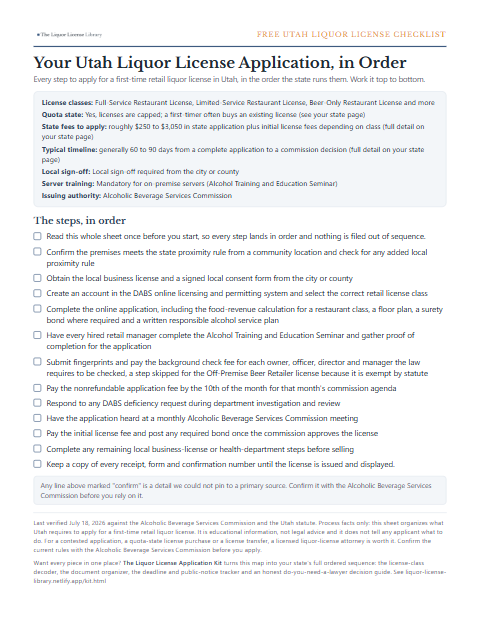
Get the free Utah liquor license checklist
The one-page map of the Utah application steps, in the order Utah runs them.
Instant download, plus Utah rule-change alerts. Unsubscribe anytime.
Local approval and public notice in Utah
The city or county layer on top of the state license, plus any notice you must post or publish. The public-notice window is often the shortest clock in the whole process.
| Item | Utah rule |
|---|---|
| Local sign-off required? | Yes, a city or county sign-off is part of the path |
| What the local layer does | A local business license and a signed local consent form from the city or county are required parts of the DABS application for every retail class, including Off-Premise Beer Retailer and a Package Agency contract. If a city will not grant consent until the state license is approved, DABS may accept the application without it and, at the commission's discretion, issue a conditional license, with local consent supplied afterward. |
| Public notice | none required for a standard first-time application; a local public meeting is required only when the applicant needs a proximity variance from the community-location buffer |
| Worth knowing | State proximity law (Utah Code 32B-1-202) sets minimum distances from a community location, defined as a church, public or private school, public park, public playground or library. A restaurant may not be within 300 feet of ordinary pedestrian travel or 200 feet in a straight line of a community location; all other retail outlets, including bars, taverns, package agencies and state stores, may not be within 600 feet of pedestrian travel or 200 feet in a straight line. A local authority may add stricter proximity or other rules on top of the state minimum. Utah has no wet or dry county option; local governments cannot ban alcohol sales outright, but they set zoning, local licensing conditions and hours within state limits. Local approval effectively runs in parallel with, not strictly before, the state filing. |
Confirm the local sign-off and any public-notice window for your jurisdiction with your city or county before you file.
Server training in Utah
Whether the people pouring or selling alcohol must certify through a state program, plus the deadline.
| Item | Utah rule |
|---|---|
| Required for a first-time retailer? | Yes, mandatory for on-premise servers |
| Who must certify | every individual employed to sell, serve or furnish alcohol for on-premise consumption and anyone who manages or supervises that service; for an off-premise beer retailer, every employee who sells beer or directly supervises beer sales |
| State program | Alcohol Training and Education Seminar (ATES) under Utah Code Title 32B, Chapter 1, Part 7, the Alcohol Training and Education Act, completed through a DABS-approved private training provider rather than one specific named vendor; a separate track applies to retail managers and to off-premise retail managers and staff |
| Deadline | for the license application itself, DABS requires evidence that each hired retail manager has already completed ATES; for ongoing employment, a retail manager must complete ATES no later than the later of 30 days after hire or the day the retail license is obtained, while staff who serve alcohol must complete training within 30 days of hire |
| Worth knowing | Failure of a manager or staff member to complete ATES exposes the license to suspension, revocation or non-renewal by the Commission and can separately expose the local business license to action by the city, town or county. |
Confirm the exact server-training requirement and the providers the Alcoholic Beverage Services Commission accepts before you enroll.
Background check and renewal in Utah
Background check
| Item | Utah rule |
|---|---|
| Background check required? | Yes |
| Who is checked | Fingerprint and criminal-history background check through the Utah Bureau of Criminal Identification and the FBI, required of an individual applying to the Commission for a license, other than the Off-Premise Beer Retailer license which is exempt by statute (Utah Code 32B-1-305(2)(c)); the check also applies to any partner, managing agent, manager, officer, director, a stockholder holding at least 20 percent of a corporation's stock, or a member owning at least 20 percent of an LLC applying for a license, plus anyone employed in a supervisory or managerial capacity. |
| Disqualifiers | The Commission may not issue a license to a person convicted of a felony within the 7 years before issuance, a federal, state or local violation concerning the sale, warehousing, manufacture, distribution, transport or adulteration of an alcoholic product or a crime of moral turpitude within the 4 years before issuance, two or more convictions for driving under the influence within the 5 years before issuance, or to a minor. The Commission also may not issue a license to a person who has had any Title 32B package agency, license or permit revoked within the last 3 years, or who was a controlling owner or manager of an entity whose license was revoked within that period (Utah Code 32B-1-304). |
| Worth knowing | The background check itself is a $42-per-person fingerprint fee paid to DABS, using either a live-scan provider or a completed FBI FD-258 fingerprint card, plus a signed informed consent and waiver form submitted through the DABS Learning Portal. Disclosure requirements reach beyond the named applicant to owners and managers who exercise day-to-day control, with the same standards applying again at renewal whenever a new person moves into a covered role. |
Renewal
| Item | Utah rule |
|---|---|
| Renewal cycle | annual, with the specific expiration date set by license class rather than a licensee-specific anniversary |
| Worth knowing | Full-Service Restaurant and Limited-Service Restaurant licenses expire October 31 and must be renewed by September 30. Bar Establishment licenses expire June 30 and must be renewed by May 31. Beer-Only Restaurant, Tavern and Off-Premise Beer Retailer licenses run March 1 through the last day of February and must be renewed by January 31. A late renewal is accepted only until the 10th day of the month that follows the statutory renewal deadline under Utah Admin Code R82-2-202.1; missing that window means the department may not accept the renewal, so a new first-time application is required. A late fee applies (commonly cited as $300, a commission-set fee under Section 63J-1-504 rather than a figure fixed in statute; the specific amount was not primary-confirmed). Renewal also requires a current responsible alcohol service plan and compliance certification. |