How to Get a Liquor License in South Carolina (2026): Cost, Classes and Steps
How do you get a liquor license in South Carolina?
In South Carolina, retail liquor licenses are issued by the Alcohol Beverage Licensing section of the Department of Revenue, not by a standalone ABC board. A first-time applicant chooses between an off-premise Retail Liquor Store License for a package store or an on-premise Business Liquor by the Drink License for a qualifying restaurant or hotel. South Carolina does not cap the number of retail liquor licenses available in a county, so a first-time single-store applicant is not competing for a scarce slot; the only numeric limit is a per-owner concentration cap of three retail liquor stores, extendable to six for one owner in the largest counties. Both classes require a state application through MyDORWAY, a background check on every principal and a public newspaper notice before the Department of Revenue issues the license.
In South Carolina, retail liquor licenses go through the South Carolina Department of Revenue, Alcohol Beverage Licensing section. A first-time applicant files with the state directly. South Carolina sets no cap on the number of retail licenses, so there is no slot to wait for and no existing license to buy out. Work the page top to bottom and the whole path is visible before any single deadline is due.
On-premise servers must certify through the state's named training program within its window. Every owner, officer and significant investor clears a background check. Local involvement depends on the class and the jurisdiction. Each piece has its own section below, with the official source beside it.
The Responsible Alcohol Server Training Act took effect January 1, 2026. South Carolina made alcohol-server training mandatory statewide for the first time, effective January 1, 2026, with an existing-staff certification deadline extended to May 1, 2026. This page reflects the rule in force today; the full history sits in the law-updates log.
Which liquor license does a South Carolina bar, restaurant or store need?
The retail license classes South Carolina issues, what each covers and the venue each fits. Match your venue to the class before anything else.
| Class | Covers | Who it fits |
|---|---|---|
| PRL Retail Liquor Store License | off-premise, liquor and wine, sealed for off-premise sale | Package-store class for take-home sales only, Monday through Saturday from 9 a.m. to 7 p.m. with no Sunday sales. There is no county population quota on how many of these licenses may be issued; the only numeric limit is a per-owner cap of three stores generally, extendable to six for one owner if the fourth through sixth stores sit in a county with population over 250,000 and with no more than two per such county (SC Code Section 61-6-141). |
| PLB Business (Restaurant and Hotel) Liquor by the Drink License | on-premise, full spirits | For a restaurant primarily engaged in serving meals, with at least 40 seated covers, a fixed kitchen, a Grade A Restaurant License from the Department of Agriculture and a current menu, or for a place of lodging with at least 18 rooms. Does not cover beer or wine, curbside pickup, delivery or sealed bottle sales to customers. Gated by food-service and seating conditions rather than by any cap on the number of licenses. |
Is South Carolina a quota or control state?
Whether South Carolina caps the number of licenses and whether the state runs any part of retail itself. Both answers are no here, which is a big part of why South Carolina is one of the simpler states to enter.
| Item | South Carolina rule |
|---|---|
| Quota state? | No, there is no cap on the number of licenses |
| How the cap works | South Carolina does not limit the number of retail liquor licenses available in a county or statewide, so a first-time applicant does not compete for a scarce slot. The only numeric restriction is a per-owner concentration cap under SC Code Section 61-6-141: the department may not issue more than three retail dealer (off-premise) licenses to one licensee, extendable to a total of six for one licensee if the fourth through sixth stores sit in counties with populations over 250,000, with no more than two stores per such county. This caps how many stores one person or entity may own; it does not cap how many licenses a county may hold or bar a new single-store applicant. The earlier across-the-board limits were struck down as unconstitutional economic protectionism in Retail Services and Systems Inc. v. SCDOR (SC Supreme Court, 2017); the current per-owner cap was enacted in response as 2018 Act No. 147. The on-premise Business Liquor by the Drink License carries no license-number limit at all. |
| New licenses issued by | None. New retail liquor licenses issue on ordinary application; there is no lottery, drawing or waiting list because license availability is not capped. |
| Buying an existing license | Because the state does not cap license availability, a newcomer applies for a new license rather than buying one. An existing licensed business can be sold with its license transferred to an approved buyer through the standard department approval process. No statutory transfer-fee figure is established in current law; a widely circulated $5,000 transfer fee and a one-per-5,000-residents population ratio both come from a 2018 proposed amendment (Amendment No. 3 to H.4729) that was not enacted, so neither is stated here as current law. |
| State control | No, private licensing throughout. Private retail and wholesale state. Retail liquor stores and restaurants are privately owned and licensed; the state does not run its own retail liquor stores. |
How much does a liquor license cost in South Carolina?
| Item | South Carolina |
|---|---|
| State and local fees to apply | roughly $1,650 to $1,950 in state filing and license fees for a single-principal applicant, the $200 filing fee plus the $1,400 off-premise or $1,705 on-premise license fee prorated at approval, plus $25 per additional principal for the SLED background check and a variable newspaper publication cost the state does not set |
| Renewal | $1,400 every two years for the off-premise Retail Liquor Store License or $1,705 every two years for the on-premise Business Liquor by the Drink License, the same figure as the initial license fee |
| What drives the range | The range is driven by license class rather than county population or city. Because the state does not cap license availability, a first-time applicant obtains a new license by application rather than by buying one on a secondary market; see the quota field. |
The itemized fees a first-time South Carolina applicant can expect from the state.
| Fee | Amount |
|---|---|
| Filing fee (either retail liquor class, non-refundable, due at application) | $200 |
| License fee, Retail Liquor Store License (PRL), due every two years | $1,400 |
| License fee, Business Liquor by the Drink License (PLB), due every two years | $1,705 |
| SLED criminal records check, per principal | $25 (plus a $1 online convenience fee if ordered online) |
How long it takes. 6 to 8 weeks. Figure is published by the SC Business One Stop state portal rather than set as a guaranteed statutory deadline. The three-week newspaper notice and the 15-day SLED premises sign run inside that window rather than adding to it. A county resident's request for a hearing before permanent issuance can extend review. A 120-day temporary license is available when an applicant is taking over an already-licensed location.
How to apply for a liquor license in South Carolina, step by step
Several of these steps gate the ones after them, so the order matters as much as the list.
- Confirm the SC Retail License is active and in good standing at the licensed address
- Confirm the location clears the 300-foot (inside a municipality) or 500-foot (outside a municipality) school, church and playground distance rule
- Gather proof of premises control, a lease, deed or enforceable written contract
- Complete ABL-901 (Application for Retail Beer, Wine and Liquor) with ABL-920 (verification of lawful presence) and ABL-946 (applicant and principal consent and waiver)
- Submit a SLED criminal records check for every principal
- Submit the application through MyDORWAY, or by mail or district office, with the filing fee
- Publish the legal newspaper notice once weekly for three consecutive weeks and obtain an affidavit of publication
- Allow SLED to post its notice sign at the premises for at least 15 days
- Pay the prorated license fee once the application is approved
- Receive the license before selling; a 120-day temporary license is available when taking over an already-licensed location
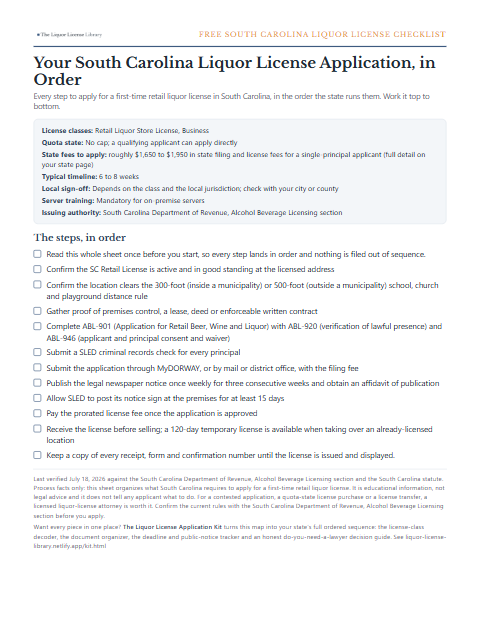
Get the free South Carolina liquor license checklist
The one-page map of the South Carolina application steps, in the order South Carolina runs them.
Instant download, plus South Carolina rule-change alerts. Unsubscribe anytime.
Local approval and public notice in South Carolina
The city or county layer on top of the state license, plus any notice you must post or publish. The public-notice window is often the shortest clock in the whole process.
| Item | South Carolina rule |
|---|---|
| Local sign-off required? | It depends on the class and the jurisdiction |
| What the local layer does | The state application does not route through a separate local alcohol licensing board. A separate local zoning clearance and a local business license or certificate of occupancy are required by the city or county where the business sits, checked against that jurisdiction's own zoning ordinance rather than a uniform statewide rule. |
| Public notice | A legal newspaper advertisement once weekly for three consecutive weeks in the paper's legal notices section (at least one column wide and two inches deep), plus an SLED sign posted at the premises for a minimum of 15 days that only SLED may remove. |
| Worth knowing | Any county resident may request a hearing in writing during the notice period. The department must then give interested persons an opportunity to be heard before a permanent license issues. This protest layer functions in place of a separate local licensing board vote. |
Server training in South Carolina
Whether the people pouring or selling alcohol must certify through a state program, plus the deadline.
| Item | South Carolina rule |
|---|---|
| Required for a first-time retailer? | Yes, mandatory for on-premise servers |
| Who must certify | Anyone who works at least 10 hours a week serving alcohol for on-premises consumption plus any manager who oversees alcohol service |
| State program | SCDOR-approved alcohol server training program under the Responsible Alcohol Server Training Act, SC Code Section 61-3-120. The department maintains a list of approved providers; a qualifying course runs at least four hours, is offered in English and Spanish and ends in a proctored test. Certificates are SCDOR-issued and valid for three years under Section 61-3-130. |
| Deadline | Existing employees and managers by May 1, 2026 (extended by Joint Resolution 5261, signed March 9, 2026); new hires within 30 days of the start of employment |
| Worth knowing | A 2025 law (effective January 1, 2026) created this mandate; South Carolina previously had no statewide training requirement. Licensees face a $100 per-violation penalty for a server who cannot produce a valid SCDOR certificate. Full staff training also reduces the liquor liability insurance minimum a licensee must carry under the same law. |
Background check and renewal in South Carolina
Background check
| Item | South Carolina rule |
|---|---|
| Background check required? | Yes |
| Who is checked | Every principal (owners and officers with a qualifying interest in the business) submits a SLED criminal records check less than 90 days old, along with lawful-presence verification and a signed consent and waiver form. |
| Disqualifiers | No felony conviction within the ten years before application. Applicants and principals must be at least 21 years old, a legal United States resident and a South Carolina resident for at least 30 days before applying. The department may not issue a license unless the applicant and all principals are of good moral character. No principal may owe delinquent South Carolina state taxes, penalties or interest. |
| Worth knowing | A corporate applicant is judged on its reputation for peace and good order in the community rather than an individual moral-character standard. Disclosure covers every person with a qualifying ownership or officer interest, not just the named applicant. |
Renewal
| Item | South Carolina rule |
|---|---|
| Renewal cycle | biennial |
| Worth knowing | Renewal fee equals the original license fee for the class. The Department of Revenue sends a renewal notice about two months ahead of the deadline. The deadline date itself is set by county rather than by the license's original issue date, ranging from late February through November depending on where the business sits. Online renewal through MyDORWAY is available when there is no change in ownership or location. |