How to Get a Liquor License in Rhode Island (2026): Cost, Classes and Steps
How do you get a liquor license in Rhode Island?
In Rhode Island, retail liquor licenses are issued by the city or town council where the business sits rather than by a single state board, with the Department of Business Regulation limited to licensing manufacturers and wholesalers and hearing appeals from local decisions. A first-time off-premise applicant applies for a Class A license to sell sealed packages, while a first-time on-premise applicant applies for a Class B license (a tavern or a food-serving restaurant) or a Class C license (a bar with no food-service requirement). Rhode Island caps the number of Class A and Class C licenses by municipal population, so an applicant in a built-out city or town may find no license available under the cap.
Rhode Island runs its retail liquor licensing through the Rhode Island Department of Business Regulation, Division of Commercial Licensing. The application is filed locally, with the city or county acting as the issuing authority. Rhode Island caps the number of retail licenses, so a first-time applicant often buys an existing license and transfers it rather than obtaining a brand-new one. The page below lays the pieces out in the order the state runs them.
On-premise servers must certify through the state's named training program within its window. Every owner, officer and significant investor clears a background check. A city or county sign-off is part of the path. Each piece has its own section below, with the official source beside it.
The parts a Rhode Island applicant most often misses are the public-notice window, which runs on the state's schedule rather than yours, the quota, which can make the license itself a far bigger cost than the state fee and the order of the steps, since several gate the ones after them. The sections below take them in order.
Which liquor license does a Rhode Island bar, restaurant or store need?
The retail license classes Rhode Island issues, what each covers and the venue each fits. Match your venue to the class before anything else.
| Class | Covers | Who it fits |
|---|---|---|
| Class A Retail package license | off-premise, full spirits | Sealed-container sales only, not to be opened or consumed on the premises; the class a first-time liquor store or package store applies for. Capped by municipal population under the statewide quota. |
| Class B Tavern or victualer license | on-premise, full spirits | Issued to a licensed tavern keeper or a victualer (food-serving establishment); the common class for a first-time restaurant or bar that also serves food. Hours run roughly 9 a.m. to 1 a.m. Not subject to the same statewide population formula as Class A and C, though a city or town may cap it locally. |
| Class C On-premise license, no food service required | on-premise, full spirits | Fits a bar or tavern with no kitchen requirement. Beverages may not be sold after midnight. Capped by municipal population under the statewide quota, at one license for each 1,000 inhabitants. |
Is Rhode Island a quota or control state?
Whether Rhode Island caps how many licenses exist, how a capped license is obtained and whether the state runs any part of retail itself. This is where the real cost of a Rhode Island license can hide.
| Item | Rhode Island rule |
|---|---|
| Quota state? | Yes, the number of licenses is capped |
| How the cap works | State law caps license counts by municipal population. A Class C license is capped at one for each 1,000 inhabitants. A Class A license is capped so that new licenses are not issued until the existing count falls under one for each 6,000 inhabitants, or one for each 4,000 inhabitants in a municipality under 20,000 population and every municipality may issue at least two Class A licenses regardless of population. |
| New licenses issued by | none. Rhode Island does not use a lottery or drawing. A town council may grant a license only while the municipality is under its statutory population cap for that class and a license becomes available when population growth raises the cap or an existing license lapses or is surrendered. |
| Buying an existing license | A transfer of an existing license to a new holder is not treated as the issuance of a new license under R.I. Gen. Laws 3-5-16, so an existing Class A or Class C license in a built-out municipality can change hands through a sale approved by the local authority. No state-published or spot-verified secondary-market price data was found; unverifiable. |
| State control | No, private licensing throughout. Private license state. There is no state-run retail store; city and town councils issue retail licenses to private businesses and DBR licenses manufacturers and wholesalers. |
Not fully settled in one published place. Confirm the exact quota status and, where a cap applies, how a new or existing license is obtained with the Rhode Island Department of Business Regulation, Division of Commercial Licensing before you rely on it.
How much does a liquor license cost in Rhode Island?
| Item | Rhode Island |
|---|---|
| State and local fees to apply | $400 to $2,000 in state-schedule class license fees for the common retail classes, plus a local processing fee where the city or town charges one, commonly $25, plus the applicant-borne newspaper advertising cost |
| Renewal | $400 to $2,000 per year by class and municipality, plus the optional $25 local processing fee under R.I. Gen. Laws 3-7-6 where the council charges it |
| What drives the range | The range is driven by the license class and by the population-tiered fee schedule the local authority sets within the statutory floor and ceiling for that class. A city or town may add its own local fee on top of the statewide figures. |
The itemized fees a first-time Rhode Island applicant can expect from the state.
| Fee | Amount |
|---|---|
| Class A annual license fee | $400 in a city or town under 10,000 population; $500 to $1,000 in a city or town of 10,000 or more, set within that range by the local authority |
| Class B annual license fee | $400 to $2,000, set within that range by the local authority; as low as $300 in a town under 2,500 population |
| Class C annual license fee | $400 to $800, set within that range by the local authority |
| Local processing fee, set by the city or town | $25 authorized by statute as an optional renewal processing fee at local option; many municipalities also charge a $25 nonrefundable fee on a new application under local rule |
| Late renewal fee | reported as 10 percent of the license fee, not less than $25; exact statutory citation not independently confirmed |
How long it takes. no single statewide timeline is published; the two-week publication requirement sets a rough floor of about 3 to 4 weeks from a complete application to the public hearing. Hearing notice must run once a week for at least two weeks under R.I. Gen. Laws 3-5-17, so a hearing cannot be scheduled faster than that publication window. The statute does not set a fixed number of days between the first publication and the hearing, so the exact floor tracks the council's calendar. Total time to a decision depends on the individual city or town council's meeting calendar and any objection raised at the hearing. A denial or a contested grant can be appealed to DBR within ten days for a new, independent hearing, which adds further time.
Not published as one current figure. Confirm the exact amount with the Rhode Island Department of Business Regulation, Division of Commercial Licensing before you budget for it. The state does not publish a single processing time; confirm the current wait with the Rhode Island Department of Business Regulation, Division of Commercial Licensing.
How to apply for a liquor license in Rhode Island, step by step
Several of these steps gate the ones after them, so the order matters as much as the list.
- Confirm the premises fits local zoning and any distance rule from a school or place of worship that applies to the license class
- Confirm a license of the needed class is available under the city or town's population-based cap, for Class A and Class C
- File the application with the city or town council or its board of license commissioners, with the annual license fee for the class plus any local processing or advertising fee the council charges, commonly a twenty-five dollar processing fee
- Disclose every owner, officer, director and any stockholder holding 50 percent or more of a corporate applicant for a criminal-record and compliance review
- Publish the hearing notice once a week for at least two weeks in a local newspaper and mail notice of the application to all owners of property within 200 feet of the premises
- Attend the town council's public hearing, where neighboring property owners have the right to object before a decision
- Receive the council's decision; a denial or a contested grant can be appealed to DBR within ten days for a new hearing
- Pay the balance of the fee and receive the license before selling any alcoholic beverage
- Complete DBR-approved alcohol server training for every covered employee within sixty days of hire
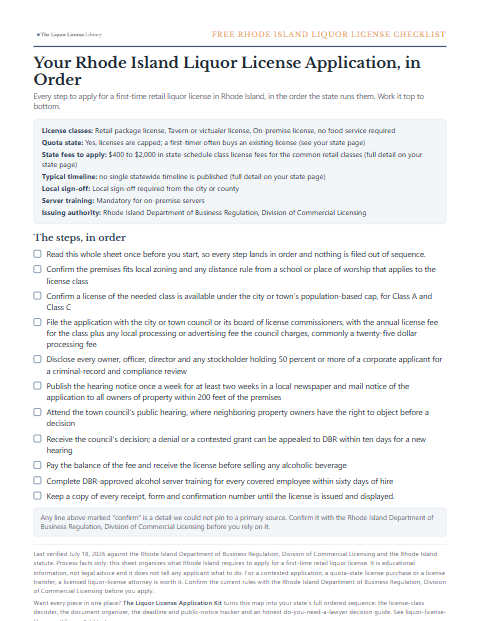
Get the free Rhode Island liquor license checklist
The one-page map of the Rhode Island application steps, in the order Rhode Island runs them.
Instant download, plus Rhode Island rule-change alerts. Unsubscribe anytime.
Local approval and public notice in Rhode Island
The city or county layer on top of the state license, plus any notice you must post or publish. The public-notice window is often the shortest clock in the whole process.
| Item | Rhode Island rule |
|---|---|
| Local sign-off required? | Yes, a city or county sign-off is part of the path |
| What the local layer does | The city or town council, or its board of license commissioners, is the actual issuing authority for a retail license. It confirms zoning and location fit, including a distance rule from a school or place of worship that applies to on-premise classes and holds the public hearing before granting or denying the license. |
| Public notice | Notice of the application must be published once a week for at least two weeks in a newspaper published in or of general circulation in the city or town. Notice must also be mailed to all owners of property within 200 feet of the premises under R.I. Gen. Laws 3-5-17, an obligation that applies to every application and not only to a relocation. |
| Worth knowing | Local approval is not a separate layer added on top of a state filing. In Rhode Island the local hearing and decision is the primary licensing act itself; the state DBR only becomes involved if a party appeals the local decision within ten days. |
Server training in Rhode Island
Whether the people pouring or selling alcohol must certify through a state program, plus the deadline.
| Item | Rhode Island rule |
|---|---|
| Required for a first-time retailer? | Yes, mandatory for on-premise servers |
| Who must certify | Every person who sells or serves alcoholic beverages, anyone acting in a supervisory capacity over servers, anyone who checks identification and valet staff at a licensed establishment |
| State program | A DBR-certified alcohol server training program under R.I. Gen. Laws 3-7-6.1, 2 to 4 hours long, covering the physiological effects of alcohol, legal requirements, spotting impairment, refusing service and detecting fraudulent identification; DBR maintains the list of certified providers |
| Deadline | Within 60 days of the start of employment, with a minimum passing score of 75 percent; recertification is required every 3 years |
| Worth knowing | At renewal, the licensee must verify that every covered employee who worked more than 60 days in the license year completed certified training within the last 3 years. Enforcement runs from a written warning up through license suspension for the licensee and decertification for the training program. |
Background check and renewal in Rhode Island
Background check
| Item | Rhode Island rule |
|---|---|
| Background check required? | Yes |
| Who is checked | Owners, officers, directors and any stockholder holding 50 percent or more of a corporate applicant are reviewed for criminal record and compliance history; acquiring 50 percent or more of a licensed corporation's stock requires the issuing authority's prior approval |
| Disqualifiers | The local licensing authority may deny an application from a person with a criminal record or a record of repeated alcoholic-beverage law violations, applied as a discretionary character and suitability standard rather than a fixed statutory lookback list |
| Worth knowing | Since January 1 2021, criminal background information is reviewed under the state's Fair Chance Act; an applicant recommended for denial receives notice and a full opportunity to defend suitability at the public hearing. Full disclosure of every direct or indirect ownership interest is required and concealment or a false statement can result in denial or revocation. |
Renewal
| Item | Rhode Island rule |
|---|---|
| Renewal cycle | annual |
| Worth knowing | The license year runs December 1 through November 30. A renewal application for the same class for the next license year is due before October 1, together with proof that server-training compliance is current. |