How to Get a Liquor License in North Carolina (2026): Cost, Classes and Steps
How do you get a liquor license in North Carolina?
In North Carolina, retail alcohol permits are issued by the North Carolina Alcoholic Beverage Control Commission, but the state is a control state where spirituous liquor is sold at retail only through ABC stores run by 171 local ABC boards, so a private applicant cannot get an off-premise spirits license at all. A restaurant or bar applies to the Commission for an on-premise permit such as the Mixed Beverages permit or a malt beverage or wine permit and private off-premise retail is limited to beer and wine. There is no numeric population quota on these state-issued permits, but the local city or county must first be wet under a local-option election and gets a 15-day objection window on every application.
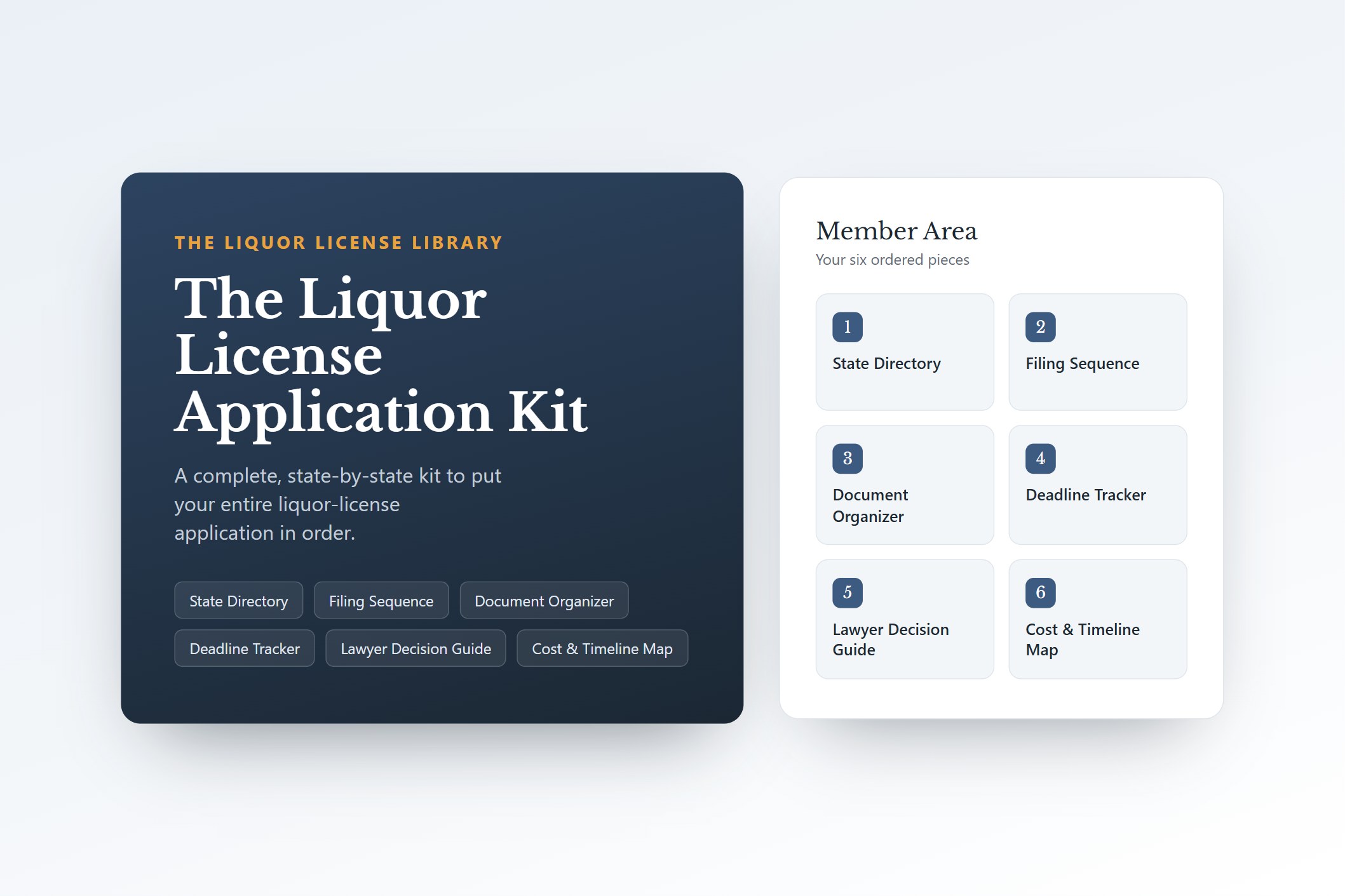
North Carolina runs its retail liquor licensing through the North Carolina Alcoholic Beverage Control Commission. The application is filed with the state. North Carolina sets no cap on the number of retail licenses, so there is no slot to wait for and no existing license to buy out. The page below lays the pieces out in the order the state runs them.
North Carolina is a control state, so a private applicant cannot open a full-spirits package store; spirits move through state stores and the private retail license covers beer, wine or on-premise service. On-premise servers must certify through the state's named training program within its window. Every owner, officer and significant investor clears a background check. Each piece has its own section below, with the official source beside it.
The parts a North Carolina applicant most often misses are the order of the steps, since several gate the ones after them. The sections below take them in order.
Which liquor license does a North Carolina bar, restaurant or store need?
The retail license classes North Carolina issues, what each covers and the venue each fits. Match your venue to the class before anything else.
| Class | Covers | Who it fits |
|---|---|---|
| Mixed Beverages Permit Mixed beverages permit | on-premise, full spirits | Fits a restaurant, bar or hotel selling mixed drinks by the glass. Requires the location's city or county to have passed a mixed beverage local-option election. Spirits must be purchased from the local ABC store. Annual permit, expires April 30. |
| On-Premises Malt Beverage On-premise malt beverage permit | on-premise, beer | Fits a bar or restaurant serving beer for consumption on site. No local election required in most wet jurisdictions. Valid indefinitely, not an annual renewal, but carries an annual registration obligation. |
| Off-Premises Malt Beverage Off-premise malt beverage permit | off-premise, beer | Fits a grocery or convenience store selling packaged beer. Valid indefinitely with annual registration. |
| On-Premises Unfortified Wine / On-Premises Fortified Wine On-premise wine permit | on-premise, wine | Two separate permit classes cover unfortified and fortified wine; a restaurant serving wine typically holds both alongside the malt beverage permit. Valid indefinitely with annual registration. |
| Off-Premises Unfortified Wine / Off-Premises Fortified Wine Off-premise wine permit | off-premise, wine | Fits a store selling packaged wine. Valid indefinitely with annual registration. |
| Brown-Bagging Permit Brown-bagging permit | on-premise, full spirits | Allows patrons to bring their own spirits or fortified wine, up to 8 liters combined, to a permitted establishment that does not hold a Mixed Beverages permit. Annual, expires April 30. |
| Special Occasion Permit Special occasion permit | on-premise, full spirits | For an event host bringing beverages for guests rather than a permanent retail operation. Annual for the standard version; a limited special occasion version runs 48 hours around a single event. |
| Off-Premise Spirituous Liquor No private off-premise spirits retail permit exists | off-premise, full spirits | North Carolina is a control state for spirituous liquor. Packaged spirits are sold at retail only through ABC stores operated by local ABC boards, which are government subdivisions, not private permit applicants. A private business cannot apply for an off-premise liquor license for spirits. |
Is North Carolina a quota or control state?
Whether North Carolina caps the number of licenses and whether the state runs any part of retail itself. North Carolina sets no cap, though its control structure still shapes which license a private business can hold.
| Item | North Carolina rule |
|---|---|
| Quota state? | No, there is no cap on the number of licenses |
| How the cap works | n/a for state-issued on-premise and off-premise beer and wine permits; there is no statutory cap on the number of these permits in a given city or county |
| Buying an existing license | n/a for on-premise permits, which are issued directly by the Commission rather than capped and traded. Off-premise retail of spirituous liquor is not available to private applicants at all because it runs exclusively through government-operated local ABC stores, which is a control-state restriction rather than a quota a private applicant can enter |
| State control | Yes, a control state. North Carolina is one of 17 control states and the only one with local government control of retail liquor sales. Spirituous liquor may be sold at retail only through ABC stores run by local ABC boards, which are independent political subdivisions appointed by city or county government, plus permitted distilleries. A private off-premise applicant can hold a beer or wine license but cannot hold a private retail spirits license; on-premise permittees such as Mixed Beverages holders must buy their spirits from the local ABC store. |
Not fully settled in one published place. Confirm the exact quota status and, where a cap applies, how a new or existing license is obtained with the North Carolina Alcoholic Beverage Control Commission before you rely on it.
How much does a liquor license cost in North Carolina?
| Item | North Carolina |
|---|---|
| State and local fees to apply | roughly $440 to $1,040 in state fees for a single permit class (the $400 to $1,000 permit fee plus the $38 per-person fingerprint fee), before any local privilege fee |
| Renewal | the same as the initial permit fee for annually renewed classes (for example $1,000 for Mixed Beverages), while indefinite classes such as malt beverage and wine carry an annual registration fee rather than a full reapplication |
| What drives the range | The range is driven by permit class, not county population, since NC state permit fees are flat statewide. Many venues hold more than one class at once, such as a Mixed Beverages permit plus malt beverage and wine permits, which multiplies the total. Local governments may also charge a separate privilege license fee that varies by city or county. |
The itemized fees a first-time North Carolina applicant can expect from the state.
| Fee | Amount |
|---|---|
| Mixed Beverages permit, application and annual fee | $1,000 |
| On-premise or off-premise malt beverage permit | $400 |
| On-premise or off-premise unfortified or fortified wine permit | $400 per permit |
| Brown-bagging permit | $400 standard, $200 for a restaurant with under 50 seats |
| Special occasion permit | $400 standard, $50 limited special occasion |
| Culinary permit | $200 |
| Mixed Beverages Catering permit | $200 |
| Guest Room Cabinet permit | $1,000 |
| Fingerprint processing fee | $38.00 per person |
| Late renewal fee | 25% of the renewal fee if paid after April 30 |
How long it takes. about 7 to 10 days for Commission processing of a complete application, plus the 15-day local government objection window that runs in the same period. A temporary permit can be issued while the full review is pending in some cases and becomes permanent after 90 days. Incomplete fingerprint packets, an unresolved local government objection or a contested suitability review extend the timeline beyond the base processing estimate.
Not published as one current figure. Confirm the exact amount with the North Carolina Alcoholic Beverage Control Commission before you budget for it.
How to apply for a liquor license in North Carolina, step by step
Several of these steps gate the ones after them, so the order matters as much as the list.
- Verify the premises location is in a jurisdiction that has voted wet for the needed beverage category
- Obtain the Local Government Opinion form (Form 001) and the Inspection and Zoning Compliance form (Form 002) from the city or county
- Complete an approved responsible alcohol seller and server training course and get proof of completion
- Complete the Commission's notarized retail permit application for the chosen class
- Submit a full fingerprint card for each qualifying owner, officer or manager, paid at the FBI/SBI processing rate
- Submit the application by mail or in-person appointment with the required certified check, cashier's check or money order for the application fee
- The Commission and the Alcohol Law Enforcement Division investigate the applicant and the premises
- The Commission sends notice to the city or county governing body, which has 15 days to file a written objection
- Receive the permit, or a temporary permit while the full review completes
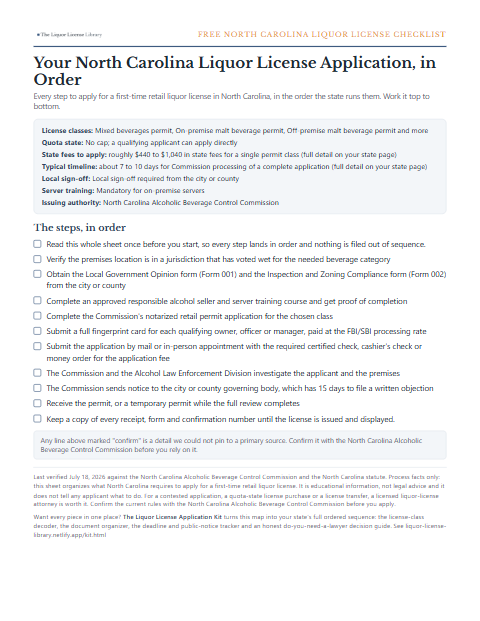
Get the free North Carolina liquor license checklist
The one-page map of the North Carolina application steps, in the order North Carolina runs them.
Instant download, plus North Carolina rule-change alerts. Unsubscribe anytime.
Local approval and public notice in North Carolina
The city or county layer on top of the state license, plus any notice you must post or publish. The public-notice window is often the shortest clock in the whole process.
| Item | North Carolina rule |
|---|---|
| Local sign-off required? | Yes, a city or county sign-off is part of the path |
| What the local layer does | The applicant must obtain a Local Government Opinion form and a zoning and inspection compliance form from the city or county before or during the state application and the jurisdiction must already be wet for the beverage category under a prior local-option election. The Commission also sends formal notice of the application to the city or county governing body, which may file a written objection. |
| Public notice | none required as an applicant-run publication or posting; the notice instead runs government-to-government, with the Commission notifying the city or county governing body and allowing 15 days for a written objection |
| Worth knowing | Wet/dry status is set jurisdiction by jurisdiction through elections that can be petitioned by registered voters. A mixed beverage election has its own separate rules tied to whether the county already operates an ABC store. Local privilege fees and zoning distance rules (for example a proximity limit from certain schools and churches) sit on top of the state process. |
Server training in North Carolina
Whether the people pouring or selling alcohol must certify through a state program, plus the deadline.
| Item | North Carolina rule |
|---|---|
| Required for a first-time retailer? | Yes, mandatory for on-premise servers |
| Who must certify | every retail ABC permit applicant, as a condition of the application, under the responsible alcohol seller/server training rule |
| State program | Commission-approved Responsible Alcohol Seller/Server training course under 14B NCAC 15B .0113, authorized by N.C. Gen. Stat. 18B-100, 18B-122 and 18B-207 |
| Deadline | proof of completed training must be submitted with the retail permit application, before the permit is issued |
| Worth knowing | Course approval is valid for three years and covers North Carolina-specific age and sale law. This is a statewide mandatory condition of permitting, not a voluntary incentive program. |
Background check and renewal in North Carolina
Background check
| Item | North Carolina rule |
|---|---|
| Background check required? | Yes |
| Who is checked | Every qualifying owner, officer, member or manager named on the application signs and swears to the application and submits a full set of fingerprints, processed through the State Bureau of Investigation and the FBI |
| Disqualifiers | No felony conviction within the past three years unless citizenship was restored, no alcoholic beverage offense or misdemeanor controlled substance conviction within the past two years, no ABC permit revocation within the past three years and North Carolina residency with limited exceptions for corporate officers |
| Worth knowing | Applicants must also be current on state tax filings and have no unsatisfied judgment tied to alcohol law violations. The Commission has sole discretion to judge the reputation, character and criminal record of the applicant and the suitability of the location, including proximity to schools and churches. |
Renewal
| Item | North Carolina rule |
|---|---|
| Renewal cycle | annual for Mixed Beverages, brown-bagging, special occasion, guest room cabinet and several other retail classes, running May 1 to April 30; indefinite (no expiration date) for on-premise and off-premise malt beverage, unfortified wine, fortified wine and culinary permits, which instead carry an annual registration obligation |
| Worth knowing | Renewal notices go out in early May for annually expiring classes. A 25 percent late fee applies to renewal payments made after April 30 and the Commission cannot revoke a permit for nonpayment before June 1. |