How to Get a Liquor License in New Jersey (2026): Cost, Classes and Steps
How do you get a liquor license in New Jersey?
In New Jersey, retail liquor licenses are Class C licenses issued by the municipality where the business will operate, not by the state, though the Division of Alcoholic Beverage Control within the Department of Law and Public Safety sets the rules and hears appeals. A bar or restaurant applies for a Plenary Retail Consumption License and a package store applies for a Plenary Retail Distribution License; both classes are capped by a municipal population quota, so most first-time applicants buy an existing license from a current holder and apply for a person-to-person transfer rather than obtain a brand-new one. A qualifying non-profit club can instead hold a non-quota Club License.
New Jersey runs its retail liquor licensing through the Division of Alcoholic Beverage Control. The application is filed locally, with the municipality acting as the issuing authority. New Jersey caps the number of retail licenses, so a first-time applicant often buys an existing license and transfers it rather than obtaining a brand-new one. The page below lays the pieces out in the order the state runs them.
Server training is voluntary here, an incentive rather than a licensing condition. Every owner, officer and significant investor clears a background check. A city or county sign-off is part of the path. Each piece has its own section below, with the official source beside it.
The parts a New Jersey applicant most often misses are the public-notice window, which runs on the state's schedule rather than yours, the quota, which can make the license itself a far bigger cost than the state fee and the order of the steps, since several gate the ones after them. The sections below take them in order.
Which liquor license does a New Jersey bar, restaurant or store need?
The retail license classes New Jersey issues, what each covers and the venue each fits. Match your venue to the class before anything else.
| Class | Covers | Who it fits |
|---|---|---|
| 33 Plenary Retail Consumption License | both, full spirits | The standard bar or restaurant license; sells for on-premise consumption and, from the public barroom only, for off-premise consumption. Counted against the municipal population quota of one license per 3,000 residents. |
| 32 Plenary Retail Consumption License with Broad Package Privilege | both, full spirits | Same as Class 33 except off-premise package sales are not confined to the public barroom. Counted in the same population quota as Class 33. |
| 34/35 Seasonal Retail Consumption License | both, full spirits | Carries the same privileges as a Plenary Retail Consumption License but for a fixed season (May 1 to November 14, or November 15 to April 30). Fee is 75 percent of the Plenary Retail Consumption fee. Counted in the same population quota. |
| 44 Plenary Retail Distribution License | off-premise, full spirits | The package-store (liquor store) license; sale only for consumption off the premises. Counted against a separate municipal population quota of one license per 7,500 residents. |
| 43 Limited Retail Distribution License | off-premise, beer and wine | Confined to premises operated primarily as a food store; sells only warm malt beverages in quantities of 72 fluid ounces or more (a six-pack or larger). No longer newly issued by the state; existing licenses can still be renewed or transferred. |
| 31 Club License | on-premise, full spirits | Issued to a non-profit fraternal, social, veterans or similar organization for sale to bona fide members and their guests only. Falls outside the population quota, though a municipality may cap or refuse club licenses by ordinance. |
| 36 Hotel/Motel License | both, full spirits | A Plenary Retail Consumption License issued under N.J.S.A. 33:1-12.20 as an exception to the population quota for a hotel or motel with 100 or more guest sleeping rooms (50 or more for licenses issued before January 1, 1969). |
| 37 Theater License | on-premise, full spirits | Issued to a qualifying non-profit corporation that conducts musical or theatrical productions; alcohol is sold for on-premise consumption during a performance and for one hour before and after it. Falls outside the population quota. A 2020 amendment opened eligibility to non-profit theaters with 50 or more seats, down from the prior 1,000-seat floor. |
| shopping mall Shopping Mall Special License | on-premise, full spirits | A retail consumption license the 2024 reform created (P.L. 2023 c.290, N.J.S.A. 33:1-12.55 and 33:1-12.56, effective August 1, 2024) for a food and beverage establishment inside a qualifying enclosed shopping mall. It sits outside the population quota. Only an eligible municipality that already has a mall and has reached its cap may issue it: up to two in a mall of at least 750,000 square feet or up to four in a mall of 1,500,000 square feet or more. A strip mall does not qualify. The fee is at least $250,000, half on issuance and half a year later. |
Is New Jersey a quota or control state?
Whether New Jersey caps how many licenses exist, how a capped license is obtained and whether the state runs any part of retail itself. This is where the real cost of a New Jersey license can hide.
| Item | New Jersey rule |
|---|---|
| Quota state? | Yes, the number of licenses is capped |
| How the cap works | A municipality may not issue a new Plenary Retail Consumption License (Class 33/32 and the Seasonal Class 34/35 counted with it) once it already has one such license for every 3,000 residents by the most recent census figures. It may not issue a new Plenary Retail Distribution License (Class 44) once it already has one for every 7,500 residents. Every municipality is entitled to at least one of each regardless of population. Licenses that already exceeded these ratios when the limits took effect were grandfathered in. |
| New licenses issued by | None. New Jersey does not run a statewide drawing for new quota licenses. When a municipality's population growth opens a new slot, the municipality decides how to award it under its own ordinance, commonly by auction to the highest bidder or by accepting applications tied to municipal-set conditions (for example, operating a restaurant or hotel). |
| Buying an existing license | Existing quota licenses (Plenary Retail Consumption and Plenary Retail Distribution) trade privately between a willing buyer and seller, subject to the local issuing authority's approval of a person-to-person transfer. Prices are not tracked in any official state database and vary enormously by municipality demand; treat any specific dollar figure for New Jersey license resales as market-reported, not an official state figure. |
| Classes outside the cap | Club License, Hotel/Motel License, Theater License and Shopping Mall Special License sit outside the quota. Confirm which class fits your venue against the class table above, because a standard bar or restaurant license usually is not one of them. |
| State control | No, private licensing throughout. New Jersey is a private-license state. All retail sale of alcoholic beverages, on-premise and off-premise, runs through privately owned Class C licensees; there is no state-run retail store system. |
How much does a liquor license cost in New Jersey?
| Item | New Jersey |
|---|---|
| State and local fees to apply | roughly $450 to $2,700 in combined state and municipal fees for a first-time application, before any private purchase price paid for an existing quota license |
| Renewal | roughly $325 to $2,700 per year in combined state and municipal fees, depending on class and municipality |
| What drives the range | The range is driven mainly by the municipality's own fee ordinance (the state statute only sets the floor and ceiling a town may charge) and by the license class; a municipality may raise its fee in a single year by no more than 20 percent above the prior year or $500, whichever is the lesser (N.J.S.A. 33:1-12). State fees and municipal license fees exclude any private purchase price paid for an existing quota license; see the quota field. |
The itemized fees a first-time New Jersey applicant can expect from the state.
| Fee | Amount |
|---|---|
| State filing fee (new license, transfer, or renewal) | $200 |
| Municipal annual fee, Plenary Retail Consumption License (Class 33/32) | $250 to $2,500, set by municipal ordinance |
| Municipal annual fee, Plenary Retail Distribution License (Class 44) | $125 to $2,500, set by municipal ordinance |
| Municipal annual fee, Limited Retail Distribution License (Class 43) | $31 to $63, set by municipal ordinance |
| Municipal annual fee, Club License (Class 31) | $63 to $188, set by municipal ordinance |
| Municipal annual fee, Seasonal Retail Consumption License (Class 34/35) | 75 percent of the municipality's Plenary Retail Consumption fee |
| License transfer fee (person-to-person or place-to-place) | $200 state filing fee, plus a municipal transfer fee of 10 percent of the annual license fee (20 percent if both transfer types apply at once) |
| Appeal filing fee to the Division of ABC | $100 |
How long it takes. No single statewide average is published. State regulation instead sets outer deadlines for the LOCAL issuing authority to act, after which non-action can itself be treated as a denial and appealed to the Division of ABC: 45 days for a new-license application, 60 days for a transfer application and 90 days after the prior term's expiration for a renewal application. These are regulatory backstops, not a typical or average issuance time. Actual time to a decision varies by municipality and is commonly extended by the required published notice window, a hearing if a written objection is filed and the background investigation of every disclosed owner. A first-time buyer completing a person-to-person transfer of an existing quota license should expect the local process alone to run at least 60 to 90 days absent complications.
How to apply for a liquor license in New Jersey, step by step
Several of these steps gate the ones after them, so the order matters as much as the list.
- Confirm the license class that fits the venue and check with the municipal clerk or local ABC Board whether a new quota license is available
- If no new license is available, identify an existing license to purchase and prepare a person-to-person (and, if the site is moving, place-to-place) transfer application instead of a new-license application
- Complete the 12-page Retail Alcoholic Beverage License Application in triplicate, disclosing every owner, partner, officer and stockholder with a 1 percent or greater interest and any prior criminal conviction
- Publish the required legal notice(s) of intent to apply in a local newspaper, timed no sooner than the date of filing
- File the original and two copies of the application with the municipal clerk or ABC Board secretary, along with the municipal fee and a separate state filing fee payable to the Division of ABC
- Respond to the local issuing authority's background investigation of the application and the premises, commonly conducted by the local police department
- Attend a hearing before the governing body or local ABC Board if any written objection is filed
- Receive approval by municipal resolution, after which the license certificate is issued and must be displayed on the premises before any sale
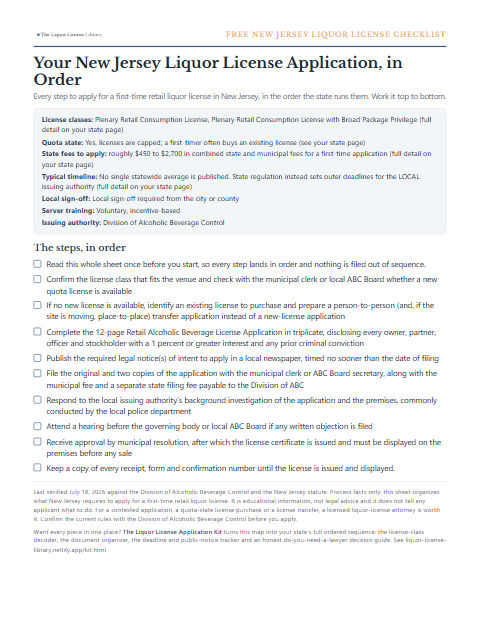
Get the free New Jersey liquor license checklist
The one-page map of the New Jersey application steps, in the order New Jersey runs them.
Instant download, plus New Jersey rule-change alerts. Unsubscribe anytime.
Local approval and public notice in New Jersey
The city or county layer on top of the state license, plus any notice you must post or publish. The public-notice window is often the shortest clock in the whole process.
| Item | New Jersey rule |
|---|---|
| Local sign-off required? | Yes, a city or county sign-off is part of the path |
| What the local layer does | The municipality is the issuing authority for nearly every Class C retail license: its governing body, or, in the 20 municipalities that have created one, a local Alcoholic Beverage Control Board. It investigates the applicant and the premises (commonly through the local police department), sets and collects the local license fee by ordinance and approves, renews, transfers or disciplines the license by resolution. |
| Public notice | Two published legal notices of intent to apply are required for a new license or a transfer, timed no sooner than the filing date; one published notice is required when a corporate stock change hands a new stockholder 1 percent or more of a licensed company. Renewal applications do not require published notice. |
| Worth knowing | A municipality can, by ordinance, decide to issue no retail licenses at all; it separately sets its own hours of sale, whether Sunday sales are allowed and any local distance rule from a school or church. The state application itself asks whether the premises is within 200 feet of a church or school entrance and, if so, requires an attached waiver from the appropriate local official. |
Server training in New Jersey
Whether the people pouring or selling alcohol must certify through a state program, plus the deadline.
| Item | New Jersey rule |
|---|---|
| Required for a first-time retailer? | Voluntary, an incentive rather than a licensing condition |
| Who must certify | n/a; no New Jersey statute or Division of ABC regulation mandates alcohol-server or seller certification for a first-time retail license |
| State program | n/a; New Jersey has no state-run or state-designated mandatory training program. Some municipalities and most liquor-liability insurers require or reward completion of a private responsible-service course as a condition of local operation or insurance coverage, but this sits outside the state licensing requirement itself. |
| Worth knowing | This is corroborated by the absence of any server-training section in the Division of ABC's own retail licensee handbook, consistent with the state having no such mandate. |
Background check and renewal in New Jersey
Background check
| Item | New Jersey rule |
|---|---|
| Background check required? | Yes |
| Who is checked | Every individual with a disclosed ownership or beneficial interest of 1 percent or more (owners, partners, corporate officers and stockholders) discloses any criminal conviction on the license application. The local issuing authority's investigation, commonly run by the local police department or by investigators employed by a municipal ABC Board, typically verifies that disclosure and often includes fingerprinting; municipalities may separately require fingerprinting of certain employees by local ordinance. |
| Disqualifiers | A conviction for a crime involving moral turpitude, broadly an indictable New Jersey Code of Criminal Justice offense punishable by more than one year in state prison, disqualifies a person from holding an interest in or being employed by a licensed business, unless the Division of ABC has issued an Order Removing Criminal Disqualification (available after a minimum five-year wait from the conviction or release, whichever is later) or a Rehabilitation Employment Permit for employment only. A disorderly-persons conviction, an arrest without conviction, or placement in pretrial intervention does not by itself trigger disqualification, though it can still weigh on the local finding that an applicant is reputable. The minimum age to own a license is 18; the minimum age to purchase or consume is 21. |
| Worth knowing | An owner can also be disqualified by already holding an interest in two other New Jersey retail licenses (the statewide two-license limit, with exceptions for a qualifying hotel, restaurant, 20-lane-or-larger bowling facility or international airport location), by an undisclosed interest in the license, or by a prohibited 'tied-house' interest in a manufacturer or wholesaler. |
Renewal
| Item | New Jersey rule |
|---|---|
| Renewal cycle | annual |
| Worth knowing | The license term runs July 1 to June 30 of the following year (the Summer Seasonal Retail Consumption License runs May 1 to November 14 and renews by May 1). Renewal applications and fees are due to the local issuing authority by June 30, with a further 30-day grace window; a licensee who still has not filed by June 30 plus 30 days can file a late Verified Petition with the Division of ABC by July 30 of the new term, explaining that the delay was due to circumstances beyond their control, after which the license lapses and ceases to exist. A license that sits inactive at an operating premises for more than two full license terms must be activated, transferred to a bordering municipality for a qualifying redevelopment project, or is subject to the phased expiration schedule under P.L. 2023, c.290. |