How to Get a Liquor License in Maine (2026): Cost, Classes and Steps
How do you get a liquor license in Maine?
In Maine, retail liquor licenses are issued by the Bureau of Alcoholic Beverages and Lottery Operations (BABLO) within the Department of Administrative and Financial Services. An on-premise applicant such as a bar, restaurant or hotel needs sign-off from the municipal officers (or county commissioners in unorganized territory) before the bureau will act, while an off-premise beer and wine retailer applies directly to the bureau with no local vote. Maine sets no cap on ordinary on-premise or off-premise beer and wine licenses, but off-premise sale of spirits runs only through a population-capped network of state-appointed Agency Liquor Stores.
In Maine, retail liquor licenses go through the Bureau of Alcoholic Beverages and Lottery Operations. A first-time applicant files locally, because the city or county is the issuing authority here. Maine caps only its full-spirits or specific classes, while a beer or beer-and-wine class usually sits outside the cap. Work the page top to bottom and the whole path is visible before any single deadline is due.
Maine runs a partial control system, handling some spirits wholesale or retail itself while private retailers hold the on-premise and off-premise licenses. Server training is required for some classes or roles. Every owner, officer and significant investor clears a background check. Each piece has its own section below, with the official source beside it.
The parts a Maine applicant most often misses are the public-notice window, which runs on the state's schedule rather than yours, which classes fall under the cap and which do not and the order of the steps, since several gate the ones after them. The sections below take them in order.
Which liquor license does a Maine bar, restaurant or store need?
The retail license classes Maine issues, what each covers and the venue each fits. Match your venue to the class before anything else.
| Class | Covers | Who it fits |
|---|---|---|
| Class I Spirits, wine and malt liquor, on-premise | on-premise, full spirits | The general on-premise class; fits most bars, taverns, clubs and hotels with food service and Class A restaurants. Not quota-limited. |
| Class XI Class A restaurant/lounge | on-premise, full spirits | Fits a restaurant built around a bar. At least 10 percent of gross annual income must come from food sales under 28-A M.R.S. section 1063, checked at initial issuance and again at every renewal. Not quota-limited. |
| Class VI Malt liquor, off-premise | off-premise, beer | Fits a grocery, convenience or package store selling beer only for off-premise consumption. Requires the standard retail stock of groceries or compatible merchandise; a Class VI-A variant covers a premises that does not carry that stock. Not quota-limited. |
| Class VII Wine, off-premise | off-premise, wine only | Off-premise counterpart to Class VI for wine instead of beer. Not quota-limited. |
| Class VIII Agency Liquor Store | off-premise, full spirits | The only route to off-premise spirits retail. The premises must be appointed by the bureau as an Agency Liquor Store selling spirits at state-set prices; the number of stores allowed per municipality is capped by a population formula and new appointments open only when the bureau opens a municipality for selection, not through an ordinary application. |
Is Maine a quota or control state?
Whether Maine caps how many licenses exist, how a capped license is obtained and whether the state runs any part of retail itself. This is where the real cost of a Maine license can hide.
| Item | Maine rule |
|---|---|
| Quota state? | Partial, the cap touches some classes only |
| How the cap works | No cap applies to on-premise licenses (Class I through Class XI) or to standard off-premise beer and wine licenses (Class VI or Class VII). The only capped channel is off-premise spirits retail, sold exclusively through Agency Liquor Stores (Class VIII). The number of agency stores allowed per municipality is set by a population formula in 28-A M.R.S. section 453, ranging from one store in a municipality under 2,000 people up to twelve stores in a municipality over 60,000, with the bureau able to authorize one additional store per municipality at its discretion. |
| New licenses issued by | No lottery or drawing. The bureau opens a municipality for new Agency Liquor Store selection when a slot becomes available and runs a competitive application and inspection process among interested retailers in that municipality. Industry counsel commentary describes this as historically running roughly twice a year, though a 2024 wholesale-contract renewal reportedly delayed a selection round; that cadence is corroboration only, not bureau-published. |
| Buying an existing license | unverifiable. Primary sources describe Agency Liquor Store slots as bureau-awarded appointments tied to the state's wholesale spirits distribution contract, not as licenses described in the statutes as freely transferable on an open private market. No primary or spot-verified market-price source for reselling an agency store appointment was found. |
| State control | Partial control. Maine does not run its own retail stores, but off-premise sale of spirits is limited by law to state-appointed Agency Liquor Stores (Class VIII), private retailers under contract with the bureau that sell spirits at state-set prices. Wholesale distribution of spirits also runs under a single state contract, held by Pine State Trading Co. effective December 1, 2024 for a 10-year term. Off-premise sale of wine or malt liquor and on-premise sale of spirits by a licensed bar or restaurant are privately licensed and not state-controlled. |
How much does a liquor license cost in Maine?
| Item | Maine |
|---|---|
| State and local fees to apply | $200 to $1,500 in state license fees for an ordinary first-time on-premise or off-premise beer and wine retailer, depending on class, running from a $200 Class VI or Class VII off-premise beer or wine license up to a $1,500 Class XI on-premise Class A restaurant/lounge, plus any local fee the municipality sets for its own approval step. A first-time Agency Liquor Store appointment, the only path to off-premise spirits, carries a $2,000 initial state fee on top of the competitive appointment process. |
| Renewal | The same annual class fee: for example $200 for Class VI or Class VII, $900 for Class I, $1,500 for Class XI and $700 for an Agency Liquor Store |
| What drives the range | The range is driven by beverage scope (beer or wine only versus full spirits) and venue type. A statewide schedule of local municipal approval fees was not found; those vary by municipality. |
The itemized fees a first-time Maine applicant can expect from the state.
| Fee | Amount |
|---|---|
| Class I on-premise license (spirits, wine and malt liquor) | $900 per year |
| Class XI on-premise license (Class A restaurant/lounge) | $1,500 per year |
| Class VI off-premise license (malt liquor only) | $200 per year |
| Class VII off-premise license (wine only) | $200 per year |
| Class VIII Agency Liquor Store license (spirits, wine and malt liquor, off-premise) | $2,000 initial, $700 annual renewal |
| Temporary on-premise license (ownership transfer) | $100 |
| County application fee, premises in an unorganized township | $10 |
How long it takes. unverifiable as a single bureau-published total. The local step for an on-premise applicant is capped by statute at 60 days, after which approval is deemed granted if the municipality has not acted. Industry sources report roughly 4 to 8 weeks for the bureau's own review once a complete application reaches BABLO, which is corroboration only. A local hearing and its newspaper notice window can add time before the state stage even starts. Off-premise beer and wine applicants skip the municipal step and file directly with the bureau, which shortens their path.
How to apply for a liquor license in Maine, step by step
Several of these steps gate the ones after them, so the order matters as much as the list.
- Confirm the license class and beverage scope that matches the venue
- For an on-premise applicant, file with the municipal officers or county commissioners and, if a hearing is held, post the required newspaper notice at the applicant's expense
- Receive municipal or county approval, which is deemed granted if no decision issues within 60 days
- Complete and submit the state application through the bureau's BELLS online portal
- Pay the application and license fee for the class
- Undergo the bureau's eligibility review, background check and premises inspection
- Receive the license from the bureau before selling any liquor
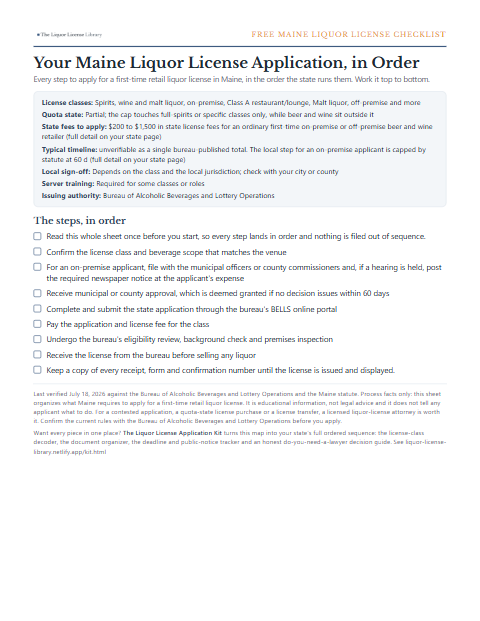
Get the free Maine liquor license checklist
The one-page map of the Maine application steps, in the order Maine runs them.
Instant download, plus Maine rule-change alerts. Unsubscribe anytime.
Local approval and public notice in Maine
The city or county layer on top of the state license, plus any notice you must post or publish. The public-notice window is often the shortest clock in the whole process.
| Item | Maine rule |
|---|---|
| Local sign-off required? | It depends on the class and the jurisdiction |
| What the local layer does | An on-premise applicant must be approved and signed by the municipal officers of the municipality, or the county commissioners in unorganized territory, before the bureau will act on the application. The local body may hold a public hearing. An off-premise beer and wine applicant files directly with the bureau with no local approval step. |
| Public notice | Where a hearing is held, notice must run at least 3 consecutive days in a daily newspaper, or one week ahead in a weekly newspaper with local circulation, at the applicant's expense, under 28-A M.R.S. section 653. Standard off-premise retail carries no public notice requirement. |
| Worth knowing | A renewal hearing can be waived after 5 years of a clean license record. Local approval comes before the state stage for on-premise applicants. Off-premise beer and wine applicants pay no local fee unless the premises sit in an unorganized township, where a $10 county fee applies instead of a municipal vote. |
Server training in Maine
Whether the people pouring or selling alcohol must certify through a state program, plus the deadline.
| Item | Maine rule |
|---|---|
| Required for a first-time retailer? | Required for some classes, roles or local mandates |
| Who must certify | Sellers and servers of liquor, where a municipal or county ordinance imposes the requirement |
| State program | Bureau-certified Alcohol Seller and Server online certification program, run through the bureau's own online training portal, $18 fee covering materials, exam and certificate |
| Deadline | n/a statewide; set by the local ordinance where one exists |
| Worth knowing | State law does not put a blanket training mandate on every licensee. It authorizes municipalities and counties to require bureau-certified server training by local ordinance under 28-A M.R.S. section 653(2)(G) and failure to complete required training where an ordinance is in force is grounds the bureau can weigh in a licensing decision. |
Background check and renewal in Maine
Background check
| Item | Maine rule |
|---|---|
| Background check required? | Yes |
| Who is checked | The bureau reviews applicant eligibility and conducts a background check as part of application review and inspects the premises before issuing a license. An individual applicant, each partner or association member and the principal officers of a corporate applicant must each independently qualify. |
| Disqualifiers | The applicant must be at least 21 years old and a United States citizen, or, for a business entity, properly organized or authorized to do business in Maine. Disqualifying history under 28-A M.R.S. section 601 includes a liquor license or certificate of approval revocation within the applicable look-back period, a conviction for violating a liquor manufacture, transport, importation, possession or sale law within 5 years of applying, an illegal Sunday-sales conviction while employed by a licensee within 5 years, a license denial within the previous 6 months unless overturned on appeal and a close family relationship used to route around another person's revocation or denial. |
| Worth knowing | A golf course, or a restaurant on golf course property, that the Maine Human Rights Commission has found denied membership on a prohibited basis is also ineligible until the finding is corrected. |
Renewal
| Item | Maine rule |
|---|---|
| Renewal cycle | annual |
| Worth knowing | Every class fee set in the statute is a one-year fee and licenses run on an annual cycle. |