How to Get a Liquor License in Indiana (2026): Cost, Classes and Steps
How do you get a liquor license in Indiana?
Indiana issues retail alcohol permits through the Indiana Alcohol and Tobacco Commission, working with a local alcoholic beverage board in the applicant's county. A first-time retailer chooses between an on-premise retailer permit (beer only, beer and wine or the full beer, wine and liquor class most bars and restaurants use) and an off-premise dealer permit for a package store or grocery-type retailer. Indiana caps nearly all of these standard classes by county population, so an applicant in a saturated county may have to win a permit at the commission's competitive auction rather than filing a routine application.
In Indiana, retail liquor licenses go through the Indiana Alcohol and Tobacco Commission. A first-time applicant files with the state directly. Indiana caps the number of retail licenses, so a first-time applicant often buys an existing license and transfers it rather than obtaining a brand-new one. Work the page top to bottom and the whole path is visible before any single deadline is due.
On-premise servers must certify through the state's named training program within its window. Every owner, officer and significant investor clears a background check. A city or county sign-off is part of the path. Each piece has its own section below, with the official source beside it.
The parts a Indiana applicant most often misses are the public-notice window, which runs on the state's schedule rather than yours, the quota, which can make the license itself a far bigger cost than the state fee and the order of the steps, since several gate the ones after them. The sections below take them in order.
Which liquor license does a Indiana bar, restaurant or store need?
The retail license classes Indiana issues, what each covers and the venue each fits. Match your venue to the class before anything else.
| Class | Covers | Who it fits |
|---|---|---|
| Beer Retailer - Restaurant On-premise beer retailer permit | on-premise, beer | Fits a restaurant, club or similar venue serving beer only for on-site consumption. Quota-limited under the standard population formula of one one-way permit per 1,500 residents or fraction of that in the city or town. |
| Beer & Wine Retailer - Restaurant On-premise beer and wine retailer permit | on-premise, beer and wine | Common first license for a small restaurant serving beer and wine but not spirits. Quota-limited on the same 1,500-resident formula as the beer-only and full-spirits retailer classes. |
| Beer, Wine & Liquor Retailer - 210 On-premise full spirits retailer permit (three-way) | on-premise, full spirits | The class most bars and full-service restaurants use to serve beer, wine and liquor on premises. Quota-limited by the 1,500-resident formula; where the county quota has no open permit, a new one is obtained through the commission's competitive auction (minimum bid $35,000) instead of a routine application. The commission also lists closely related three-way classes such as 209 and 210-1 for related premises circumstances. |
| Beer Dealer - Grocery Off-premise beer dealer permit | off-premise, beer | Fits a grocery, convenience store or similar off-premise retailer selling beer only for consumption elsewhere. Quota-limited on a sliding population scale that runs by city size. |
| Beer & Wine Dealer Off-premise beer and wine dealer permit | off-premise, beer and wine | Off-premise retailer class covering beer and wine but not liquor. Quota-limited on the same sliding population scale as the beer dealer and package liquor store classes. |
| Beer, Wine & Liquor Dealer - Package Store Off-premise package liquor store permit | off-premise, full spirits | Indiana's package liquor store class, also available to a qualifying drug store. Quota-limited on the sliding population scale set out in the dealer's permit statute. |
Is Indiana a quota or control state?
Whether Indiana caps how many licenses exist, how a capped license is obtained and whether the state runs any part of retail itself. This is where the real cost of a Indiana license can hide.
| Item | Indiana rule |
|---|---|
| Quota state? | Yes, the number of licenses is capped |
| How the cap works | The commission caps ordinary retailer permits at one three-way permit, one two-way permit and one one-way permit for every 1,500 residents or fraction of that within an incorporated city or town or an unincorporated town. Off-premise dealer permits (beer, beer and wine and package liquor stores) are capped on a sliding population scale that runs from roughly one permit per 2,000 to 2,500 residents in small cities and unincorporated county areas up to one per 6,000 residents in cities of 80,000 or more, each tier carrying a stated permit minimum. The commission recalculates the quota after each decennial census. |
| New licenses issued by | New quota permits are not issued by lottery. When a quota permit becomes available in a county with no open slot, the commission holds a competitive bidding auction open to every qualified applicant who has asked to bid and the highest qualified bidder is awarded the permit. |
| Buying an existing license | Existing quota permits can also be sold and transferred between qualified holders with commission approval, for a $250 to $500 state transfer fee depending on whether the transfer covers ownership, location or both. |
| State control | No, private licensing throughout. Indiana is a private license state. Retail and wholesale alcohol sales run through privately owned, ATC-permitted businesses rather than any state-run store or warehouse. |
How much does a liquor license cost in Indiana?
| Item | Indiana |
|---|---|
| State and local fees to apply | $500 to $1,000 in standard state permit fees for a beer, beer and wine or liquor retailer or dealer permit obtained through a routine application, or the same statutory fee plus a competitive auction price starting at a $35,000 minimum bid when a three-way or package liquor permit must be won at the commission's quota auction |
| Renewal | $500 to $1,350 per year depending on class |
| What drives the range | The auction price is a separate, additional cost that applies only when the county quota for that class has no open permit. The initial range above covers the standard statutory fee, not any private secondary-market purchase price. |
The itemized fees a first-time Indiana applicant can expect from the state.
| Fee | Amount |
|---|---|
| Beer retailer permit (on-premise, beer only) | $500 per year |
| Beer and wine retailer permit (on-premise) | $750 per year |
| Beer, wine and liquor retailer permit (three-way, class 210) | $1,000 initial statutory fee, $1,350 per year renewal |
| Minimum competitive auction bid for a three-way retailer permit when the county quota has no open slot | $35,000 |
| Beer dealer permit (off-premise, beer only) | $500 per year |
| Beer and wine dealer permit (off-premise) | $750 per year |
| Beer, wine and liquor dealer permit (package store) | $1,000 per year |
| Public notice sign | $2 |
| Employee permit (server) | $45 for three years |
| Restricted employee permit (ages 18 to 20) | $30 for two years or until the holder turns twenty-one, whichever comes first |
| Permit transfer of ownership and location | $500 |
How long it takes. About 10 to 12 weeks for a new permit and 8 to 10 weeks for a renewal after a complete application, per the commission's own processing estimate. A separate commission page puts the full process at up to 90 days. The 10-day public notice posting window before the local board hearing and the commission's monthly voting meeting (the first Tuesday of the month) are the main fixed steps that set the pace. An incomplete application, a contested local hearing or a competitive quota auction extends it further.
How to apply for a liquor license in Indiana, step by step
Several of these steps gate the ones after them, so the order matters as much as the list.
- Confirm the license class and check the county quota for an open permit in that class
- Secure the premises location and confirm ownership or a bona fide lease covering the full permit period
- Obtain proof of liquor liability insurance of at least $500,000
- Complete the New or Transfer Permit Application and supporting forms through the ATC's MyLicenseOne online portal
- Pay the state application and permit fees
- Post the ATC-approved orange notice sign at the premises at least 10 days before the local board hearing date
- Appear before the county local alcoholic beverage board, which investigates the application and holds a public hearing
- Receive the local board's recommendation, which goes to the full commission
- Await the commission's vote at its monthly meeting
- Pass the final floor plan inspection by the Indiana State Excise Police
- Receive the permit and complete server training for any employee who serves, sells or checks identification for alcohol before that employee begins work
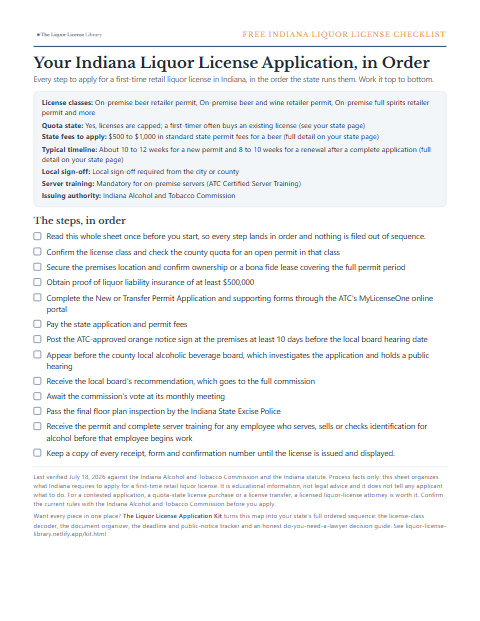
Get the free Indiana liquor license checklist
The one-page map of the Indiana application steps, in the order Indiana runs them.
Instant download, plus Indiana rule-change alerts. Unsubscribe anytime.
Local approval and public notice in Indiana
The city or county layer on top of the state license, plus any notice you must post or publish. The public-notice window is often the shortest clock in the whole process.
| Item | Indiana rule |
|---|---|
| Local sign-off required? | Yes, a city or county sign-off is part of the path |
| What the local layer does | Every application is investigated and heard by the local alcoholic beverage board of the county where the premises sits. Each of Indiana's 92 counties has a 4-member local board made up of one member appointed by the county commissioners, one appointed by the chief executive of the county's largest city or town, one appointed by the county fiscal body and one designated by the commission, typically an Indiana State Excise Police officer. The local board votes on a recommendation to approve or deny. The full commission must follow that recommendation unless it was arbitrary, contrary to law, unsupported by substantial evidence or otherwise defective. |
| Public notice | The applicant posts a commission-approved orange notice sign at or near the premises, visible from the nearest public road, at least 10 days before the local board hearing date. |
| Worth knowing | The state application and the local board review run on the same file rather than one waiting on the other. The applicant files with the ATC and the same application is what the county local board investigates and hears. Marion County (Indianapolis) applicants also follow an additional local board checklist. |
Server training in Indiana
Whether the people pouring or selling alcohol must certify through a state program, plus the deadline.
| Item | Indiana rule |
|---|---|
| Required for a first-time retailer? | Yes, mandatory for on-premise servers |
| Who must certify | Every employee who holds or must hold an Employee Permit to serve, sell or check identification for alcohol. Since July 1 2025 this expressly includes door staff and bouncers who verify age or identification before entry or service, not only bartenders and servers. |
| State program | ATC Certified Server Training, offered free through the commission's own online program or through commission-approved third-party providers |
| Deadline | Within 120 days of the alcohol server's start date, with a refresher course required every 3 years. An applicant for a restricted employee permit (ages 18 to 20) must complete the training before the permit is issued. |
| Worth knowing | House Enrolled Act 1275 (2025) widened the legal definition of alcohol server to reach ID-checking door staff and bouncers, who must now also hold an Employee Permit. |
Background check and renewal in Indiana
Background check
| Item | Indiana rule |
|---|---|
| Background check required? | Yes |
| Who is checked | Owners, officers and the managing agent of the applicant business are screened for good repute in the community and for the statutory disqualifying convictions below. The same standard reaches anyone with a direct interest in the permit. |
| Disqualifiers | No permit issues to a person convicted, within 10 years of the application, of a federal crime carrying a sentence of at least one year, an Indiana felony (Class A, B or C, or a Level 1 through 5 felony committed after June 30 2014) or an equivalent out-of-state crime, unless the conviction has been expunged. An applicant also cannot be a sitting law enforcement or municipal officer, an employee of an unpermitted out-of-state beverage distributor, a minor with an exception for stock ownership or a person adjudicated incompetent. The applicant must own or hold a bona fide lease on the premises covering the full permit period. |
| Worth knowing | Industry corroboration describes a standard criminal history background check and fingerprint submission for owners and officers alongside the statutory disqualifiers above. |
Renewal
| Item | Indiana rule |
|---|---|
| Renewal cycle | annual |
| Worth knowing | Renewal runs through the same local board hearing process as a new application. The commission will not issue, renew or transfer a permit if the applicant owes delinquent state tax, property tax or innkeeper's tax or appears on the Department of Revenue's tax warrant list. A property tax clearance and a state tax clearance are required with the renewal filing. |