How to Get a Liquor License in Illinois (2026): Cost, Classes and Steps
How do you get a liquor license in Illinois?
Illinois licenses retail alcohol in two layers. The local liquor control commissioner for the city, village or county issues the local license first, then the Illinois Liquor Control Commission issues the state retailer's license, a single class covering beer, wine and spirits that is designated on-premise, off-premise or both. Illinois sets no state quota, though each local government fixes the number and kind of local licenses by ordinance.
In Illinois, retail liquor licenses go through the Illinois Liquor Control Commission. A first-time applicant files locally, because the city or county is the issuing authority here. Illinois sets no cap on the number of retail licenses, so there is no slot to wait for and no existing license to buy out. Work the page top to bottom and the whole path is visible before any single deadline is due.
On-premise servers must certify through the state's named training program within its window. Every owner, officer and significant investor clears a background check. A city or county sign-off is part of the path. Each piece has its own section below, with the official source beside it.
Public Act 103-1071 took effect July 1, 2025. Illinois now requires an on-premise retailer to carry liquor-liability (dram-shop) insurance as a condition of eligibility. A later act made cocktails-to-go permanent. This page reflects the rule in force today; the full history sits in the law-updates log.
Which liquor license does a Illinois bar, restaurant or store need?
The retail license classes Illinois issues, what each covers and the venue each fits. Match your venue to the class before anything else.
| Class | Covers | Who it fits |
|---|---|---|
| Retailer (1A) State retailer's license | both, full spirits | The single state retail class for every bar, restaurant and store. Designated at application as on-premise, off-premise or combined; the operating detail sits in the local license class. Not quota-limited. An on-premise designation requires proof of liquor liability insurance. |
| Special event retailer Special event retailer's license, not-for-profit | on-premise, full spirits | Not-for-profit organizations only, for specific events at specific locations. $25 fee. Exempt from the BASSET mandate. |
| Special use permit Special use permit license | on-premise, full spirits | Lets an existing retailer take inventory to a temporary off-site event for 1 to 15 days per location each year. |
| Caterer retailer Caterer retailer's license | on-premise, full spirits | Serves alcohol as part of catered food service on-site or off-site. State fee for a first-time caterer retailer's license is $500 under 235 ILCS 5/5-3; the $350 figure is the online-renewal rate, not an initial-application rate. |
Is Illinois a quota or control state?
Whether Illinois caps the number of licenses and whether the state runs any part of retail itself. Both answers are no here, which is a big part of why Illinois is one of the simpler states to enter.
| Item | Illinois rule |
|---|---|
| Quota state? | No, there is no cap on the number of licenses |
| How the cap works | n/a at the state layer. Each city, village or county decides the number, kind and classification of local retail licenses under 235 ILCS 5/4-1, so many towns cap licenses by ordinance and a new applicant may wait for the local board to create one. |
| Buying an existing license | n/a for the state license, which issues on application. In a Chicago moratorium district an existing licensed business can change hands only with the consent of more than half of the registered voters within 500 feet, a local transfer rule rather than a license market. |
| State control | No, private licensing throughout. Illinois is a license state. Private businesses handle retail and wholesale; the state runs no liquor stores. |
How much does a liquor license cost in Illinois?
| Item | Illinois |
|---|---|
| State and local fees to apply | $750 to the state for a first-time retailer's license (an initial application pays the higher figure whether filed online or on paper; the reduced $600 rate in 235 ILCS 5/5-3 is an online-renewal rate), plus a local fee set by each city, village or county; the local fee varies widely and Chicago's common retail classes run $4,400 plus $40 per two-year period |
| Renewal | $600 to the state for a renewal filed online or $750 for a paper (non-online) renewal each year, plus the local renewal set by ordinance |
| What drives the range | The 235 ILCS 5/5-3 fee schedule has two columns, 'Online renewal' and 'Initial license or non-online renewal'; a first-time application always falls in the higher column, so the reduced rate is reachable only on a renewal filed online. The remaining spread comes from the local layer where each municipality sets its own classes and fees. No quota purchase exists in Illinois. |
The itemized fees a first-time Illinois applicant can expect from the state.
| Fee | Amount |
|---|---|
| State retailer's license, initial (first-time) application, filed online or on paper | $750 per year |
| State retailer's license, renewal filed online | $600 per year |
| State retailer's license, renewal filed by any other means (paper) | $750 per year |
| Caterer retailer's license, initial application or non-online renewal | $500 per year; the reduced $350 rate applies only to a renewal filed online |
| Local license fee | varies by ordinance; Chicago's Tavern, Packaged Goods and Consumption on Premises-Incidental Activity classes are $4,400 plus a $40 one-time publication fee per two-year period |
| Special event retailer's license, not-for-profit | $25 |
| Liquor liability insurance, on-premise applicants | premium varies; coverage must at least equal the dram shop limits in 235 ILCS 5/6-21(a) |
How long it takes. varies. The commission publishes no processing commitment. Licensing attorneys report about 2 to 4 weeks of state review once the local license exists and 6 to 12 weeks for the full local plus state sequence; treat those as market-reported figures. Local steps such as Chicago's voter notice and comment period set the real pace.
How to apply for a liquor license in Illinois, step by step
Several of these steps gate the ones after them, so the order matters as much as the list.
- Verify the premises: a wet precinct, local zoning and the 100-foot distance rule in 235 ILCS 5/6-11
- Register the business and gather the identifiers the applications require: FEIN, Secretary of State file number for an entity and an Illinois sales tax account
- Apply to the local liquor control commissioner for the local license class the venue needs and complete any local hearing or notice step
- For on-premise service, bind liquor liability insurance at least equal to the 235 ILCS 5/6-21(a) limits and obtain the certificate
- File the state retailer application through the ILCC Liquor Control and Compliance Portal using ILogin; the location details must match the local license and the application asks for the local license number with its issue and expiration dates
- Disclose all owners, partners and officers with 5 percent or more interest and answer the eligibility questions
- Pay the state fee for a first-time retailer's license, $750 under 235 ILCS 5/5-3 (the $600 figure applies only to an online renewal, not an initial application), by ACH debit; new-license payments cannot go on a credit card
- Await commission review; retail sale requires both the local and the state license in hand
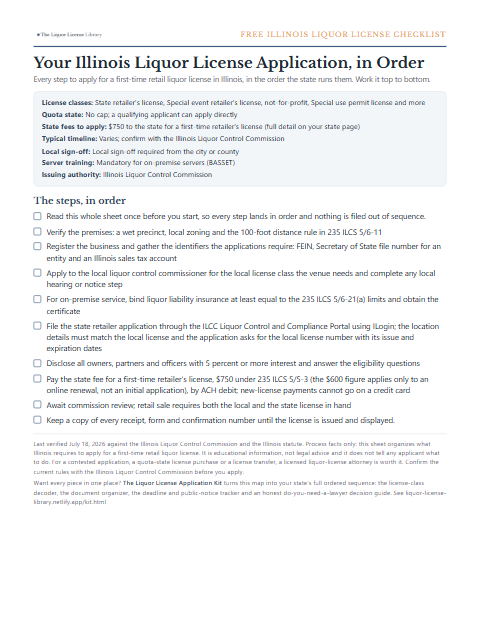
Get the free Illinois liquor license checklist
The one-page map of the Illinois application steps, in the order Illinois runs them.
Instant download, plus Illinois rule-change alerts. Unsubscribe anytime.
Local approval and public notice in Illinois
The city or county layer on top of the state license, plus any notice you must post or publish. The public-notice window is often the shortest clock in the whole process.
| Item | Illinois rule |
|---|---|
| Local sign-off required? | Yes, a city or county sign-off is part of the path |
| What the local layer does | Every retail applicant needs a local liquor license before the state license. The mayor or village president serves as the local liquor control commissioner in a municipality and the county board chair covers unincorporated areas. Local ordinance sets the license classes, fees, license counts and hours. State law bars retail sale within 100 feet of a church, school, hospital or home for aged or indigent persons or veterans, with exceptions for restaurants, hotels, clubs and food shops and an exemption for municipalities over 500,000 unless a local ordinance applies it. |
| Public notice | None at the state layer. Notice rules are local; Chicago mails notice to registered voters within 250 feet of the premises and opens a public comment period before a new license issues. |
| Worth knowing | Local before state, always. The state application asks for the local license number with its issue and expiration dates and the premises details must match the local license. Precincts can vote themselves dry under the local option article of the Act. |
Server training in Illinois
Whether the people pouring or selling alcohol must certify through a state program, plus the deadline.
| Item | Illinois rule |
|---|---|
| Required for a first-time retailer? | Yes, mandatory for on-premise servers |
| Who must certify | Anyone who sells or serves open containers of alcohol at retail and anyone whose job includes checking IDs for alcohol purchases. Special event retailers, distributor tasting staff and charitable event volunteers are excluded. |
| State program | BASSET, the Beverage Alcohol Sellers and Servers Education and Training program, delivered by ILCC-licensed trainers under 235 ILCS 5/6-27.1 |
| Deadline | Within 120 days after the employee begins employment; the certificate is valid for 3 years |
| Worth knowing | The mandate phased in by county population from July 2015 in Cook County to July 1, 2018 in the smallest counties, so it now runs statewide. The open-container wording aims at on-premise service while the ID-checking clause reaches store staff who check IDs. |
Background check and renewal in Illinois
Background check
| Item | Illinois rule |
|---|---|
| Background check required? | Yes |
| Who is checked | The state application discloses every owner, partner, officer and anyone holding 5 percent or more of the business under the heading Corporate Officer/Ownership Information and all must meet the eligibility rules in 235 ILCS 5/6-2. The published retailer application form asks disclosure and eligibility questions with no fingerprint or fingerprint-fee line anywhere on it, confirming a disclosure-based state review rather than a fingerprint submission. |
| Disqualifiers | A felony conviction unless the commission finds after its Section 6-2.5 review that the conviction does not impair fitness; certain alcohol, gambling and prostitution-related convictions; a prior license revoked for cause; law enforcement officials; an individual who does not reside in the city, village or county of the premises; an on-premise applicant without liquor liability insurance at the 235 ILCS 5/6-21(a) limits. |
| Worth knowing | The insurance eligibility item entered Section 6-2 with Public Act 103-1071 effective July 1, 2025. Local commissioners can layer their own vetting on top of the state review. |
Renewal
| Item | Illinois rule |
|---|---|
| Renewal cycle | annual |
| Worth knowing | The state retailer's license renews yearly at $600 online or $750 on paper. Renewals moved to the ILCC Liquor Control and Compliance Portal in February 2026. Local cycles differ; Chicago runs a two-year local term. |