How to Get a Liquor License in Connecticut (2026): Cost, Classes and Steps
How do you get a liquor license in Connecticut?
In Connecticut, retail liquor permits are issued by the Liquor Control Division of the Department of Consumer Protection through its online eLicense portal. A bar or restaurant applies for an on-premise class such as the restaurant permit or the cafe permit, while a liquor store needs a package store permit, the one retail class Connecticut caps at one permit per 2,500 town residents. There is no lottery; in a town at its cap the practical path is renewing the permit of an existing store whose premises change hands.
In Connecticut, retail liquor licenses go through the Liquor Control Division. A first-time applicant files with the state directly. Connecticut caps only its full-spirits or specific classes, while a beer or beer-and-wine class usually sits outside the cap. Work the page top to bottom and the whole path is visible before any single deadline is due.
On-premise servers must certify through the state's named training program within its window. Every owner, officer and significant investor clears a background check. A city or county sign-off is part of the path. Each piece has its own section below, with the official source beside it.
The parts a Connecticut applicant most often misses are the public-notice window, which runs on the state's schedule rather than yours, which classes fall under the cap and which do not and the order of the steps, since several gate the ones after them. The sections below take them in order.
Which liquor license does a Connecticut bar, restaurant or store need?
The retail license classes Connecticut issues, what each covers and the venue each fits. Match your venue to the class before anything else.
| Class | Covers | Who it fits |
|---|---|---|
| Restaurant permit (CGS 30-22(a)) Restaurant permit, full liquor | on-premise, full spirits | The standard full-bar class for a restaurant; requires hot meals, an adequate kitchen and dining room and, where the barroom and dining room are not separated, at least 400 square feet of dining space seating 20. Annual fee $1,450. Not quota-limited. |
| Restaurant permit for wine and beer (CGS 30-22(b)) Restaurant permit, wine and beer | on-premise, beer and wine, plus cider up to 6 percent | Lower-cost restaurant class without spirits. Annual fee $700. Not quota-limited. |
| Cafe permit (CGS 30-22a) Cafe permit, full liquor | on-premise, full spirits | The bar and tavern-style class; food must be available most open hours but no food-revenue percentage applies and outside vendors can satisfy the food rule. Annual fee $2,000, with a phased-in fee schedule for former tavern permit holders. Not quota-limited. |
| Cafe permit for wine, beer and cider (CGS 30-22g) Cafe permit, wine, beer and cider | on-premise, beer and wine, plus cider up to 6 percent | New class created effective July 1, 2024 for a bar that skips spirits. Annual fee $1,000. Not quota-limited. |
| Package store permit (CGS 30-20(b)) Package store permit | off-premise, full spirits | The liquor store class and the only quota-limited retail class: one permit per 2,500 town residents. Annual fee $535. Sampling and tasting on the premises is allowed within statutory limits. |
| Grocery store beer permit (CGS 30-20(c)) Grocery store beer permit | off-premise, beer | Beer-only sales for delis, food stores, grocery stores and supermarkets; wine and spirits are not allowed in grocery stores. Annual fee $170, or $1,500 for a grocery with at least $2,000,000 in annual food sales. Not quota-limited. |
Is Connecticut a quota or control state?
Whether Connecticut caps how many licenses exist, how a capped license is obtained and whether the state runs any part of retail itself. This is where the real cost of a Connecticut license can hide.
| Item | Connecticut rule |
|---|---|
| Quota state? | Partial, the cap touches some classes only |
| How the cap works | Only the package store class is capped: the department may issue one package store permit for every 2,500 residents of a town under the most recent decennial census (CGS 30-14a). The department publishes a per-town list of available package store permits. Since June 6, 2024 it may refuse incomplete package store applications and set an open-by deadline to stop placeholding on a town's last permit. |
| Buying an existing license | There is no license auction or drawing. In a town at its cap, a transferee or purchaser of premises operating under an existing package store permit may renew that permit under CGS 30-14a, so the practical route is buying an operating store. The permit itself is a personal privilege rather than a tradable asset, so any value rides with the business sale and no official price scale exists. |
| State control | No, private licensing throughout. Private license state. Chapter 545 sets up private manufacturer, wholesaler and retail permits with no state-run stores at any tier. |
How much does a liquor license cost in Connecticut?
| Item | Connecticut |
|---|---|
| State and local fees to apply | $290 to $2,120 in state and town fees for the common retail classes (the $100 application fee plus the annual permit fee plus the $20 town filing fee), from a small grocery beer permit at the bottom to a full cafe permit at the top; the optional 90-day provisional permit adds $500 |
| Renewal | $170 to $2,055 per year by class; $535 for a package store and $1,450 for a full restaurant permit |
| What drives the range | The annual permit fee is set in each class's own statute rather than one fee schedule. Newspaper publication and placard printing are paid to third parties at market cost. The package store cap does not add a state fee; see the quota field. |
The itemized fees a first-time Connecticut applicant can expect from the state.
| Fee | Amount |
|---|---|
| Initial application fee, all retail classes | $100 nonrefundable |
| Package store permit, annual | $535 |
| Grocery store beer permit, annual | $170, or $1,500 for a grocery with at least $2,000,000 in annual food sales |
| Restaurant permit, annual | $1,450 |
| Restaurant permit for wine and beer, annual | $700 |
| Cafe permit, annual | $2,000 |
| Cafe permit for wine, beer and cider, annual | $1,000 |
| Hotel permit, annual | $2,055 |
| Ninety-day provisional permit, optional | $500 nonrefundable |
| Town clerk permit filing fee | $20 |
How long it takes. About 3 to 4 weeks from a complete application to an optional provisional permit and about 3 months to the final permit. Department-published estimates. Incomplete files and placard or publication errors extend review. An application with no permit issued within 12 months of the filing date may be deemed withdrawn (CGS 30-39(d)).
How to apply for a liquor license in Connecticut, step by step
Several of these steps gate the ones after them, so the order matters as much as the list.
- Verify the town is wet for the intended permit class and confirm zoning at the premises before filing
- Create an eLicense account and complete the online application (an On-Premise or Off-Premise permit application) with the $100 nonrefundable application fee; paper applications are not accepted
- Upload the required documents, including a personal history form for the permittee and every backer owner, a financial statement, a premises sketch, interior photos and the signature pages from the town clerk, zoning officer, fire marshal and health department
- Complete the Liquor Law Education Program and submit the certificate through eLicense (applications on or after January 1, 2026)
- After the application is accepted for processing, post the placard on the premises facing the public way and publish the notice in a local newspaper once a week for two successive weeks
- Await department review, the public remonstrance window and any suitability hearing; an optional 90-day provisional permit ($500) can allow opening while the final review runs
- Pay the annual permit fee, then file the permit duplicate with the town clerk ($20) before operating under it
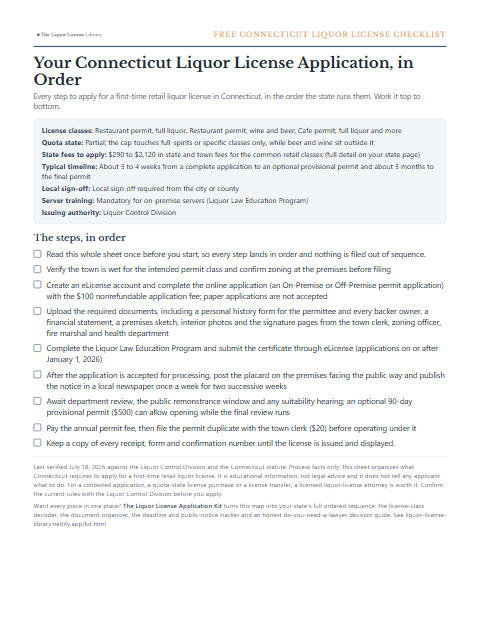
Get the free Connecticut liquor license checklist
The one-page map of the Connecticut application steps, in the order Connecticut runs them.
Instant download, plus Connecticut rule-change alerts. Unsubscribe anytime.
Local approval and public notice in Connecticut
The city or county layer on top of the state license, plus any notice you must post or publish. The public-notice window is often the shortest clock in the whole process.
| Item | Connecticut rule |
|---|---|
| Local sign-off required? | Yes, a city or county sign-off is part of the path |
| What the local layer does | Local sign-off happens inside the state application: the town clerk, zoning officer, fire marshal and local health department each certify the premises on the application documents. The department may also weigh location suitability, including proximity to schools, churches, hospitals and charitable institutions and the number of outlets in the neighborhood (CGS 30-46). |
| Public notice | Newspaper publication once a week for two successive weeks, the first within 7 days and the last within 14 days of the filing date, plus a placard posted at the premises visible from the public way. Any ten town residents age 18 or older may file a remonstrance within three weeks of the last publication, which triggers a hearing (CGS 30-39). |
| Worth knowing | Connecticut towns can be dry or partially dry by local-option referendum (CGS 30-9 to 30-13) and local ordinances can set hours and days of sale. The issued permit takes effect only after a duplicate is filed with the town clerk for a $20 fee (CGS 30-53). A town may also adopt an ordinance requiring notice of on-premise renewal applications to its police chief (CGS 30-39b). |
Server training in Connecticut
Whether the people pouring or selling alcohol must certify through a state program, plus the deadline.
| Item | Connecticut rule |
|---|---|
| Required for a first-time retailer? | Yes, mandatory for on-premise servers |
| Who must certify | The applicant, permittee and each backer-entity owner on new on-premise and off-premise retail applications; the rule does not cover servers or bartenders |
| State program | Liquor Law Education Program, the department's own online course delivered through the state ctlms-dcp.ct.gov learning system under Public Act 25-51 |
| Deadline | Completed during the application, with the certificate submitted through eLicense, for applications filed on or after January 1, 2026 |
| Worth knowing | Connecticut has no statewide server or seller certification mandate; the bartender certificate statute (CGS 30-39a) was repealed in 1982. After a violation the commissioner may order a permittee's employees through an approved alcohol seller and server training program or accept it in lieu of suspension (CGS 30-47(b) and (c)). The department lists exemptions from the education program for certain permit types. |
Background check and renewal in Connecticut
Background check
| Item | Connecticut rule |
|---|---|
| Background check required? | Yes |
| Who is checked | The permittee and every backer owner file a personal history form; the application itself is affirmed and discloses criminal convictions and a full financial statement. The department may investigate the suitability of the applicant, the backer and the proposed premises (CGS 30-39, 30-47). No fingerprint requirement appears in the Liquor Control Act or in the application checklist. |
| Disqualifiers | Mandatory refusal applies to judges, prosecutors, police officers, state and judicial marshals, certain constables and anyone under 21 (CGS 30-45). Discretionary refusal grounds include liquor-law or felony convictions weighed against the nature of the offense, rehabilitation and time elapsed, financial irresponsibility, false statements and lack of full authority over the premises (CGS 30-47). |
| Worth knowing | A person denied as unsuitable may not reapply for one year (CGS 30-40). Anyone with a conviction may ask the commissioner in advance whether it disqualifies them, for a fee of up to $15 (CGS 30-47(d)). The permittee must be a director, employee, member, officer, partner or shareholder of the backer (CGS 30-48(f)). |
Renewal
| Item | Connecticut rule |
|---|---|
| Renewal cycle | annual |
| Worth knowing | Every retail permit expires annually (CGS 30-14) and renews online through eLicense at the class's annual fee with no application fee. An expired permit may be renewed with a nonrefundable late fee under CGS 21a-4(c). A purchaser or transferee of package store premises renews that store's permit under CGS 30-14a. |