How to Get a Liquor License in Colorado (2026): Cost, Classes and Steps
How do you get a liquor license in Colorado?
In Colorado, a first-time retail applicant files with the local city or county licensing authority first, then the Liquor and Tobacco Enforcement Division inside the Department of Revenue issues the state license after local approval. On-premise venues use classes such as hotel and restaurant, tavern or beer and wine, while a package store applies for a retail liquor store license and a beer-only store applies for a fermented malt beverage license. Colorado is not a quota state and approval turns on local zoning, spacing rules for off-premise classes and a fingerprint background check; a formal public hearing on a new application became a local option rather than a fixed requirement in 2024.
In Colorado, retail liquor licenses go through the Colorado Department of Revenue, Liquor and Tobacco Enforcement Division. A first-time applicant files locally, because the city or county is the issuing authority here. Colorado sets no cap on the number of retail licenses, so there is no slot to wait for and no existing license to buy out. Work the page top to bottom and the whole path is visible before any single deadline is due.
Server training is voluntary here, an incentive rather than a licensing condition. Every owner, officer and significant investor clears a background check. A city or county sign-off is part of the path. Each piece has its own section below, with the official source beside it.
SB 24-231 took effect August 7, 2024. Colorado made the local licensing hearing discretionary rather than automatic and added an optional two-year retail license, so a qualifying applicant can renew every other year instead of annually. This page reflects the rule in force today; the full history sits in the law-updates log.
Which liquor license does a Colorado bar, restaurant or store need?
The retail license classes Colorado issues, what each covers and the venue each fits. Match your venue to the class before anything else.
| Class | Covers | Who it fits |
|---|---|---|
| Hotel and Restaurant (H&R) Hotel and restaurant license | on-premise, full spirits | Fits a full-service restaurant or a hotel with a restaurant. State summary materials describe a sanitary-kitchen requirement and roughly 25 percent of gross income from food and drink sales, with sandwiches or light snacks required after the kitchen closes. Combined annual license fee runs $575 in a city. Not numerically quota-limited. |
| Tavern Tavern license | on-premise, full spirits | Fits a bar whose primary business is alcohol sales. Sandwiches and light snacks must stay available whenever alcohol is sold and pouring employees must be 21 unless full meals are served. Combined annual license fee runs $575 in a city. Not numerically quota-limited. |
| Beer and Wine (B&W) Beer and wine license | on-premise, beer and wine | Common first license for a small restaurant or cafe that will not pour spirits, for consumption on premises only. Combined annual license fee runs $400 in a city. Not numerically quota-limited. |
| Retail Liquor Store (RLS) Retail liquor store license | off-premise, full spirits | Fits a stand-alone package or liquor store selling sealed malt, vinous and spirituous liquor for off-premise consumption. Nonalcohol merchandise is capped at 20 percent of gross annual revenue, with carve-outs for tobacco, lottery, ice, soft drinks, mixers and bar accessories. A new store generally must sit at least 1,500 feet from another off-premise liquor license, or 3,000 feet in a municipality of 10,000 people or fewer. Ownership currently tops out at 3 licenses per person; a narrow group of pre-2016 Colorado-resident holders can add a fourth starting January 1, 2027. Not numerically quota-limited but the spacing rule functions as a practical local cap. |
| Fermented Malt Beverage and Wine (FMB&W) Fermented malt beverage and wine retailer license | off-premise, beer and wine | The grocery and convenience store class for beer and wine sales off premises. Combined annual license fee runs roughly $100 in a city. Not numerically quota-limited. |
| Fermented Malt Beverage On Premises (FMB) Fermented malt beverage on-premises license | on-premise, beer | Beer-only service, licensed separately from the malt, vinous and spirituous classes above. Combined annual license fee runs roughly $100 in a city. Not numerically quota-limited. |
| Liquor-Licensed Drugstore (LLDS) Liquor-licensed drugstore license | off-premise, full spirits | Closed to new applicants. Senate Bill 25-033 prohibits the state and local authorities from issuing any new liquor-licensed drugstore license on or after April 10, 2025. Existing licenses can still renew and ownership stays capped at 8 per person. A first-time off-premise applicant selling spirits uses the retail liquor store class instead. |
Is Colorado a quota or control state?
Whether Colorado caps the number of licenses and whether the state runs any part of retail itself. Both answers are no here, which is a big part of why Colorado is one of the simpler states to enter.
| Item | Colorado rule |
|---|---|
| Quota state? | No, there is no cap on the number of licenses |
| How the cap works | Colorado does not cap retail licenses to a fixed number per population and runs no license lottery. A new off-premise retail liquor store must instead clear a spacing rule of at least 1,500 feet from another off-premise liquor license, or 3,000 feet in a municipality of 10,000 people or fewer. Every new retail license, regardless of class, must also clear the general 500-foot school distance rule. An application at a location where the same license class was denied for lack of neighborhood need within the past two years (one year for a fermented malt beverage class) cannot reapply at that address in that window. |
| Buying an existing license | n/a. Colorado retail licenses do not trade at quota premiums the way a hard-quota state's licenses do. A change of owner instead runs through a transfer-of-ownership application ($750 local plus $1,100 state). |
| State control | No, private licensing throughout. Colorado is a license state with private manufacturing, wholesale and retail tiers. There is no state-run store for spirits, wine or beer. |
How much does a liquor license cost in Colorado?
| Item | Colorado |
|---|---|
| State and local fees to apply | Roughly $1,350 to $2,800 in combined state and local application and first-year license fees for the common retail classes, plus per-person fingerprint vendor charges, depending on the license class and how much the local authority charges for its up-to-$1,000 application fee. |
| Renewal | Roughly $450 to $925 a year in combined state and local fees: the $350 annual renewal application fee plus the class license fee, which runs from about $100 for a fermented malt beverage class up to $575 for a Hotel and Restaurant or Tavern class in a city. Paid annually, or on a two-year cycle where the local licensing authority has adopted the biennial option. |
| What drives the range | Driven by the license class and by whether the premises sits in a city or a county fee tier. The state fee is identical across city and county for most classes but the local fee differs. County premises generally pay a higher combined total than city premises for the same class. |
The itemized fees a first-time Colorado applicant can expect from the state.
| Fee | Amount |
|---|---|
| Initial application fee, state | $1,100 (or $1,200 with concurrent state and local review) |
| Initial application fee, local | up to $1,000, set by the local licensing authority |
| Annual license fee, Retail Liquor Store | $250 combined in a city ($227.50 state plus $22.50 local); $350 combined in a county |
| Annual license fee, Beer and Wine | $400 combined in a city; $500 combined in a county |
| Annual license fee, Hotel and Restaurant or Tavern | $575 combined in a city or a county |
| Annual license fee, Fermented Malt Beverage classes | roughly $100 combined in a city, $125 combined in a county |
| Annual renewal application fee (effective July 1, 2024) | $350 total ($250 state plus $100 local), charged in addition to the class license fee |
| Manager registration | $30 state plus $30 local, for classes that require a registered manager |
| Fingerprint and background check vendor fee | unverifiable, set by the state's approved fingerprint vendors and not published on the state fee schedule |
| Late renewal fee (within 90 days of expiration) | $500 state plus $500 local |
How long it takes. State law sets a floor of at least 30 days from filing to any local hearing that is held, plus a 10-day public notice window before that hearing. Total time to a state license commonly runs 60 to 120 days for a straightforward application; some local authorities publish longer minimums for their own review. The 30-day and 10-day windows only apply when the local authority chooses to hold a hearing, an option rather than a fixed step since Senate Bill 24-231 (2024). An incomplete application, a scheduled hearing or an objection extends the timeline. The state stage generally follows local approval unless the applicant paid for concurrent review.
How to apply for a liquor license in Colorado, step by step
Several of these steps gate the ones after them, so the order matters as much as the list.
- Confirm zoning with the city or county and check location rules, including the 500-foot school distance rule and any off-premise spacing rules for the chosen class
- Complete the Colorado Liquor Retail License Application (form DR 8404) with a premises diagram and proof of legal possession of the premises
- Attach the business entity documents and disclose every lender or person sharing in the business's profits
- Have each principal with more than 10 percent ownership, along with officers, directors, partners and members, complete form DR 8404-I and book fingerprints through an approved state vendor
- File the complete packet with the local licensing authority for the city or county, along with the local application fee, the state application fee and the class license fee
- Ask whether the local authority will hold a public hearing on the application, an option local authorities have held since Senate Bill 24-231 made hearings discretionary rather than mandatory in 2024
- If a hearing is scheduled, the local authority posts a sign on the premises and publishes notice in a local newspaper at least 10 days before the hearing, which state law keeps no sooner than 30 days after filing
- After local approval, the Liquor and Tobacco Enforcement Division completes state review and issues the license, which is mailed to the local licensing authority
- Register a manager where the class requires it and pay the first year's local and state license fee before selling
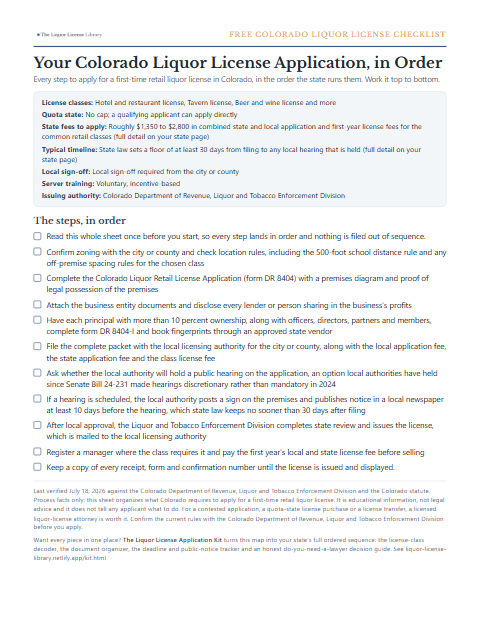
Get the free Colorado liquor license checklist
The one-page map of the Colorado application steps, in the order Colorado runs them.
Instant download, plus Colorado rule-change alerts. Unsubscribe anytime.
Local approval and public notice in Colorado
The city or county layer on top of the state license, plus any notice you must post or publish. The public-notice window is often the shortest clock in the whole process.
| Item | Colorado rule |
|---|---|
| Local sign-off required? | Yes, a city or county sign-off is part of the path |
| What the local layer does | The local city or county licensing authority is the first and heaviest layer. It takes the filing, investigates the applicants, verifies zoning and the 500-foot school rule and decides whether to hold a public hearing where the reasonable requirements of the neighborhood and the desires of the adult inhabitants are weighed. Senate Bill 24-231 made that hearing a local option rather than a mandatory step starting August 7, 2024, though most local authorities are still expected to hold one for a genuinely new location. |
| Public notice | Where a hearing is held, notice runs through a sign at least 22 by 26 inches posted on the premises plus publication in a newspaper of general circulation, both at least 10 days before the hearing. Where the local authority skips the hearing, no separate posting or publication requirement applies. |
| Worth knowing | Local fees add up to $1,000 on application plus a local share of the annual renewal fee. Local hearings, fees and any petition practice vary by city or county. Some jurisdictions such as Denver also require a separate zone-use permit before the application can complete. |
Server training in Colorado
Whether the people pouring or selling alcohol must certify through a state program, plus the deadline.
| Item | Colorado rule |
|---|---|
| Required for a first-time retailer? | Voluntary, an incentive rather than a licensing condition |
| Who must certify | n/a statewide for most retail servers; the designation applies only when a licensee opts into the Responsible Vendor Program |
| State program | Responsible Vendor Program under the Responsible Alcohol Beverage Vendor Act (C.R.S. 44-3-1001 to 44-3-1002), with trainers approved and listed by the Liquor and Tobacco Enforcement Division |
| Worth knowing | The designation mitigates penalties in a disciplinary action rather than serving as a licensing condition for most retail classes. Some local licensing authorities layer their own training expectations on top of the voluntary state scheme. |
Background check and renewal in Colorado
Background check
| Item | Colorado rule |
|---|---|
| Background check required? | Yes |
| Who is checked | Every principal with more than 10 percent ownership, plus officers, directors, partners and members, completes form DR 8404-I and submits fingerprints through an approved state vendor for a Colorado Bureau of Investigation and FBI check. |
| Disqualifiers | State law requires that the applicant's character, record and reputation satisfy the licensing authority, applying the fair-consideration standard in C.R.S. 24-5-101 to any criminal history rather than a fixed felony lookback window. A licensing authority employee or inspector cannot hold a license. Specified peace officers cannot hold a license at all, or cannot hold one within the jurisdiction that employs them, depending on the officer's role. |
| Worth knowing | The application also asks about prior license denials, suspensions or revocations in any state and requires disclosure of every lender or profit-sharer in the business. |
Renewal
| Item | Colorado rule |
|---|---|
| Renewal cycle | annual, with an optional two-year period available since Senate Bill 24-231 (2024) |
| Worth knowing | A licensee applies to the local licensing authority at least 45 days before expiration and to the state at least 30 days before expiration, paying the $350 renewal application fee on top of the class license fee. A local licensing authority is not required to adopt the two-year option unless it passes its own resolution or ordinance, so many licensees still renew locally every year even where the state allows two-year terms. A late renewal within 90 days of expiration costs $500 to each of the state and local authority; beyond 90 days the license lapses and a reissue costs another $500 to each plus a $25-a-day fine beyond the 90th day. |