How to Get a Liquor License in Louisiana (2026): Cost, Classes and Steps
How do you get a liquor license in Louisiana?
In Louisiana, retail alcohol permits are issued by the Office of Alcohol and Tobacco Control (ATC), a division of the Department of Revenue, alongside a separate permit from the parish or municipality where the premises sits. The state splits beverages into a low-content system for beer and malt beverages up to 6 percent alcohol by volume and a high-content system for wine and spirits over 6 percent, so a bar or store selling both often needs a permit under each. Louisiana issues permits to any qualifying applicant without a population-based quota or lottery, though local zoning, distance rules and any parish wet-dry status still apply.
Louisiana runs its retail liquor licensing through the Office of Alcohol and Tobacco Control. The application runs through the state with a local sign-off alongside it. Louisiana sets no cap on the number of retail licenses, so there is no slot to wait for and no existing license to buy out. The page below lays the pieces out in the order the state runs them.
Server training is required for some classes or roles. Every owner, officer and significant investor clears a background check. A city or county sign-off is part of the path. Each piece has its own section below, with the official source beside it.
The parts a Louisiana applicant most often misses are the public-notice window, which runs on the state's schedule rather than yours and the order of the steps, since several gate the ones after them. The sections below take them in order.
Which liquor license does a Louisiana bar, restaurant or store need?
The retail license classes Louisiana issues, what each covers and the venue each fits. Match your venue to the class before anything else.
| Class | Covers | Who it fits |
|---|---|---|
| Class A-General (high content) General on-premise consumption permit, full spirits | on-premise, full spirits | Standard bar permit for beverages over 6 percent alcohol by volume; requires a permanent wet bar and a minimum public floor area (375 square feet for post-2001 applicants); not quota-limited |
| Class A-Restaurant (high content) Restaurant on-premise permit, full spirits | on-premise, full spirits | Issued alongside the Class R food-service permit; the restaurant must derive more than 50 percent of average monthly revenue from food; not quota-limited |
| Class B (Package House, high content) Package house permit, full spirits for off-premise sale | off-premise, full spirits | Fits a grocery, convenience or drug store selling factory-sealed liquor alongside other merchandise; alcohol is not the principal commodity; minimum 500 square feet of public floor area; not quota-limited |
| Class C (Package Store, high content) Dedicated package store permit, full spirits for off-premise sale | off-premise, full spirits | Fits a store where alcohol is the principal commodity sold; minimum 1,000 square feet of public floor area; no motor fuel sales at the location and no one under 18 permitted on the premises; not quota-limited |
| Class A-General (low content) Beer and malt beverage permit, up to 6 percent alcohol by volume | both, beer | Common first permit for a small bar, restaurant, grocery or convenience store selling only beer and other beverages of low alcoholic content; regulated under a separate parallel statute from the high-content classes above; not quota-limited |
Is Louisiana a quota or control state?
Whether Louisiana caps the number of licenses and whether the state runs any part of retail itself. Both answers are no here, which is a big part of why Louisiana is one of the simpler states to enter.
| Item | Louisiana rule |
|---|---|
| Quota state? | No, there is no cap on the number of licenses |
| Buying an existing license | n/a; Louisiana permits are not capped, so first-time applicants apply directly rather than purchasing an existing license |
| State control | No, private licensing throughout. Private license state; the state does not run retail or wholesale alcohol distribution |
How much does a liquor license cost in Louisiana?
| Item | Louisiana |
|---|---|
| State and local fees to apply | roughly $70 to $1,200 in state permit fees depending on class, plus up to $500 in local permit fees, plus a fingerprint/background-check fee per required individual |
| Renewal | the same annual state permit fee by class plus up to $500 in local fees; no separate renewal-specific fee was found beyond late-filing penalties |
| What drives the range | The range is driven by which class or classes the business needs (high-content spirits classes run $50 to $200 by class and city size; the low-content beer class is $70), whether the local authority charges up to its $500 cap and how many owners or officers require fingerprinting |
The itemized fees a first-time Louisiana applicant can expect from the state.
| Fee | Amount |
|---|---|
| Class A-General state permit (high content, city) | $200 per year |
| Class A-General state permit (high content, town or village) | $100 per year |
| Class A-Restaurant state permit (high content) | $200 per year |
| Class B Package House state permit (high content, city) | $100 per year |
| Class B Package House state permit (high content, town or village) | $50 per year |
| Class C Package Store state permit (high content, city) | $100 per year |
| Class C Package Store state permit (high content, town or village) | $50 per year |
| Class A-General state permit (low content, beer) | $70 per location per year |
| Class B state permit (low content, beer, off-premise) | $70 per location per year |
| Class C Package Store state permit (low content, beer) | $70 per location per year |
| Local parish or municipal permit fee, maximum | up to $500 per year |
| Fingerprint-based background check | approximately $39 to $96 depending on method (direct-to-ATC state check versus IdentoGO Livescan) |
How long it takes. La. R.S. 26:79 sets no fixed review deadline. The commissioner may issue a permit after investigation. The 35 calendar days the statute references are a post-issuance probationary period rather than a review clock. Actual review time varies with application completeness plus the local permit process. The Notice of Intent 15-day posting window (when required) and the local permit process run before or alongside the state review and add to total time. A newly issued permit also runs on a 35-day probationary basis during which it remains subject to opposition or final action
How to apply for a liquor license in Louisiana, step by step
Several of these steps gate the ones after them, so the order matters as much as the list.
- Confirm local zoning approval and the state distance restriction for the premises
- Apply for and obtain the local parish or municipal alcohol permit
- Post the Notice of Intent poster at the premises for at least 15 days before filing the state application, if no permit existed at that address in the prior 6 months
- Complete the ATC state application for the chosen class or classes
- Submit fingerprints for every required owner, officer, director or qualifying stockholder or member through IdentoGO or directly to ATC
- Verify no delinquent state sales tax, penalties or interest are owed
- Pay the state permit fee for each class and the local permit fee
- Receive the permit, which operates on a 35-day statutory probationary basis subject to opposition or final action
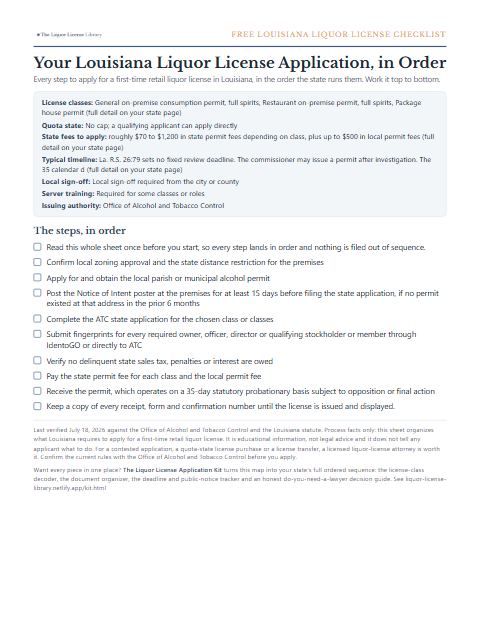
Get the free Louisiana liquor license checklist
The one-page map of the Louisiana application steps, in the order Louisiana runs them.
Instant download, plus Louisiana rule-change alerts. Unsubscribe anytime.
Local approval and public notice in Louisiana
The city or county layer on top of the state license, plus any notice you must post or publish. The public-notice window is often the shortest clock in the whole process.
| Item | Louisiana rule |
|---|---|
| Local sign-off required? | Yes, a city or county sign-off is part of the path |
| What the local layer does | Each parish or municipality issues its own alcohol permit separate from the state permit. Applicants must also meet local zoning rules and the state distance restriction from schools, churches, playgrounds, libraries, daycare centers and correctional facilities |
| Public notice | A Notice of Intent poster must be displayed at the premises for at least 15 days before the application is filed, unless an alcohol permit already existed at that address within the preceding 6 months; the poster is valid for 90 days |
| Worth knowing | Parishes and municipalities may hold local option elections to prohibit alcohol sales, so wet and dry areas exist within the state. Local permit fees are capped at $500 per year. Whether the local permit must be finalized before the state application is filed, or the two can run in parallel, varies by parish |
Server training in Louisiana
Whether the people pouring or selling alcohol must certify through a state program, plus the deadline.
| Item | Louisiana rule |
|---|---|
| Required for a first-time retailer? | Required for some classes, roles or local mandates |
| Who must certify | Servers, sellers and security personnel of a vendor holding a Class A-General, Class A-Restaurant or Class B permit that elects to become a certified Responsible Vendor |
| State program | Responsible Vendor Program, La. R.S. 26:931 through 26:939, administered by ATC |
| Deadline | within 45 days after commencing employment at a vendor pursuing or holding certification; the server permit is valid for 4 years with refresher training required at least once every 4 years, all per La. R.S. 26:934 |
| Worth knowing | The statute frames this as an election: a vendor qualifies for and maintains Responsible Vendor certification by meeting the training and record-keeping requirements. Certification carries a liability benefit, limited protection against suspension or revocation for a first violation within 12 months. Many training-provider sites describe server certification as a flat statewide mandate for anyone who sells or serves alcohol; the statute's own language ties the requirement to vendors pursuing certification rather than stating a universal mandate, so this is recorded as an ambiguity rather than resolved either way |
Background check and renewal in Louisiana
Background check
| Item | Louisiana rule |
|---|---|
| Background check required? | Yes |
| Who is checked | Owners, partners, corporate officers, directors and any stockholder or LLC member holding more than a 5 percent interest are fingerprinted for a Louisiana State Police and FBI check; not required again if the applicant submitted prints for a valid ATC permit within the preceding 5 years |
| Disqualifiers | A felony conviction under Louisiana, federal or another state's law (with a limited rehabilitation exception for a non-violent felony after 10 or more years and a pardon or restoration of rights); a lifetime bar for a conviction of distributing or possessing a controlled substance on licensed premises; convictions involving prostitution, pandering, contributing to juvenile delinquency or keeping a disorderly place; a permit revocation within the preceding 2 years; any delinquent state or local sales tax, penalty or interest owed |
| Worth knowing | Individual applicants and any partner who is a natural person must be a United States citizen and a Louisiana resident for the 2 years preceding the filing date. This residency rule does not apply to a corporation or LLC applicant, which need only be organized under Louisiana law or registered to do business in the state, or to that entity's officers, directors, members or stockholders, so most applicants structured as a business entity are not personally bound by the residency rule |
Renewal
| Item | Louisiana rule |
|---|---|
| Renewal cycle | annual |
| Worth knowing | The renewal application is due on or before the current permit's expiration date. A renewal filed on time lets the business keep operating on the expired permit until ATC acts, unless denied or withheld. A renewal filed after expiration gets no grace period: the business cannot operate until a new permit issues. Late filing also carries monetary penalties |