How to Get a Liquor License in California (2026): Cost, Classes and Steps
How do you get a liquor license in California?
In California, retail liquor licenses are issued by the Department of Alcoholic Beverage Control (ABC) through its local district offices. A restaurant or bar wants an on-sale license (beer-only Type 40, beer-and-wine Type 41 or 42, or full-spirits general Type 47 or 48) and a store wants an off-sale license (beer-and-wine Type 20 or full-spirits general Type 21). California caps the number of general (full-spirits) licenses by county population, so a restaurant or bar limited to beer and wine can usually apply directly, while a full-liquor license often requires the state's annual priority drawing in a county that has reached its quota.
In California, retail liquor licenses go through the Department of Alcoholic Beverage Control. A first-time applicant files with the state directly. California caps only its full-spirits or specific classes, while a beer or beer-and-wine class usually sits outside the cap. Work the page top to bottom and the whole path is visible before any single deadline is due.
On-premise servers must certify through the state's named training program within its window. Every owner, officer and significant investor clears a background check. Local involvement depends on the class and the jurisdiction. Each piece has its own section below, with the official source beside it.
AB 1013 took effect July 1, 2024. California now requires a Type 48 on-sale general public premises licensee to offer drink-spiking drug test devices for sale and post a warning sign under Business and Professions Code Section 25624. This page reflects the rule in force today; the full history sits in the law-updates log.
Which liquor license does a California bar, restaurant or store need?
The retail license classes California issues, what each covers and the venue each fits. Match your venue to the class before anything else.
| Class | Covers | Who it fits |
|---|---|---|
| Type 20 Off-Sale Beer and Wine | off-premise, beer and wine | Issued to retail stores for consumption off the premises. Minors are allowed on the premises. Not a 'general' license, so it is not counted against the county general-license quota. |
| Type 21 Off-Sale General | off-premise, full spirits | Issued to retail stores (liquor stores, grocery, convenience) for beer, wine and distilled spirits sold for off-premise consumption. A 'general' license, capped at one per 2,500 county inhabitants under Business and Professions Code Section 23817; obtained through the priority drawing in counties at or over that ratio. |
| Type 40 On-Sale Beer | both, beer | Issued to bars and taverns for beer only, consumed on or off the premises. No wine or distilled spirits on the premises. Sandwiches or snacks must be available; a full meal is not required. Minors are allowed on the premises. Not a general license, so no county quota applies. |
| Type 41 On-Sale Beer and Wine, Eating Place | both, beer and wine | Issued to restaurants for beer and wine consumed on the premises plus beer and wine for off-premise consumption. Must operate as a bona fide eating place with suitable kitchen facilities and substantial meal sales. Minors are allowed. Not a general license, so no county quota applies; this is the common first license for a small restaurant that does not pour spirits. |
| Type 42 On-Sale Beer and Wine, Public Premises | both, beer and wine | Issued to bars and taverns for beer and wine consumed on or off the premises. No distilled spirits on the premises, food service not required. Minors are not allowed to enter and remain (narrow musician exception). Not a general license, so no county quota applies. |
| Type 47 On-Sale General, Eating Place | both, full spirits | Issued to restaurants for beer, wine and distilled spirits consumed on the premises, plus beer and wine for off-premise consumption. Must operate as a bona fide eating place with suitable kitchen facilities and substantial meal sales. Minors are allowed. A 'general' license, capped at one per 2,000 county inhabitants under Section 23816; ABC's own priority-drawing list includes Type 47 among the license types that require the drawing once a county is at or over quota. |
| Type 48 On-Sale General, Public Premises | on-premise, full spirits | Issued to bars and nightclubs for beer, wine and distilled spirits consumed on the premises, plus beer and wine for off-premise consumption. Food service not required. Minors are not allowed to enter and remain (narrow musician exception). A general license subject to the same county population quota and priority drawing as Type 47. Since July 1, 2024, a new or existing Type 48 licensee must also offer drink-spiking drug test devices for sale to patrons and post the required warning sign under Business and Professions Code Section 25624. |
Is California a quota or control state?
Whether California caps how many licenses exist, how a capped license is obtained and whether the state runs any part of retail itself. This is where the real cost of a California license can hide.
| Item | California rule |
|---|---|
| Quota state? | Partial, the cap touches some classes only |
| How the cap works | General (full-spirits) license classes are capped by county population: on-sale general classes such as Type 47 and 48 are limited to one license per 2,000 county inhabitants under Business and Professions Code Section 23816 while off-sale general Type 21 is limited to one per 2,500 inhabitants under Section 23817. New original general licenses become available mainly as county population grows. Beer-and-wine-only classes (Type 20, 40, 41, 42) are not general licenses and are not counted against this cap. |
| New licenses issued by | When a county already holds as many general licenses as its population ratio allows, ABC opens an annual statewide filing window for the counties and license types that are over the ratio (most recently September 8 to 19, 2025) and holds a virtual drawing in the following weeks to set priority order among applicants. A participant must have been a California resident for at least 90 days before the drawing and pays a participation fee equal to the general license application fee, refunded less a $100 service charge if no formal application follows. A county that is still under its population ratio does not require a drawing and a general license there can be applied for directly. |
| Buying an existing license | In a county where the general license quota is full, an existing Type 47 or Type 48 license can be purchased from a current holder and transferred instead of applying for a new one; the full purchase price is placed in escrow before the transfer application is filed and a notice of intended transfer is recorded with the county recorder. Prices themselves are market-reported by license brokers, typically well into five figures in lower-demand counties and commonly $100,000 to $400,000 or more in high-demand counties such as Los Angeles and San Francisco. These figures are market-reported, not an official ABC fee. |
| State control | No, private licensing throughout. California is a private licensing state, not a control state. Retail sale and wholesale distribution of alcoholic beverages are handled by privately owned, ABC-licensed businesses; there is no state-run retail store or state monopoly on distribution. |
How much does a liquor license cost in California?
| Item | California |
|---|---|
| State and local fees to apply | Roughly $1,135 to $2,000 in state fees for a beer-and-wine-only class such as Type 20, 40, 41 or 42 (application fee plus first-year annual fee). Roughly $20,825 to $21,385 in state fees for a full-spirits general class such as Type 21, 47 or 48 obtained through the priority drawing, not counting any private purchase price paid for an existing license on the secondary market. |
| Renewal | Roughly $500 to $1,545 per year depending on license class and, for the general on-sale classes, the population of the city where the premises sits. |
| What drives the range | The gap between the two ranges is driven entirely by license class: general (full-spirits) classes carry a much higher application fee once a priority drawing applies, while beer-and-wine-only classes do not go through the drawing. Local zoning, conditional use permit and business license fees are separate city or county charges not included in these ABC figures. Application and annual fees may be adjusted periodically under the Business and Professions Code Section 23320 inflation formula. As of this verification the live published ABC schedule is still the one effective January 1, 2022 (the figures above), while ABC's upcoming-fee pages reflect a scheduled increase for a later cycle (roughly $20,495 application for a general license and $1,170 for a non-general license, with higher annual fees), so these figures should be re-checked against the current ABC fee schedule pages each verification cycle. See the quota field for the private secondary-market price of an existing general license. |
The itemized fees a first-time California applicant can expect from the state.
| Fee | Amount |
|---|---|
| Application fee, general license by priority drawing (Types 21, 47, 48 and other general classes) | $19,840 |
| Application fee, non-general license (Types 20, 40, 41, 42 and most others) | $1,135 |
| Priority drawing participation fee | Equal to the general license application fee, refunded less a $100 service charge if the participant does not go on to file a formal application |
| Annual license fee, Type 20 (Off-Sale Beer and Wine) | $500 |
| Annual license fee, Type 21 (Off-Sale General) | $1,009 |
| Annual license fee, Type 40 (On-Sale Beer) | $500 |
| Annual license fee, Type 41 (On-Sale Beer and Wine Eating Place) | $565 |
| Annual license fee, Type 42 (On-Sale Beer and Wine Public Premises) | $705 |
| Annual license fee, Type 47 and Type 48 (On-Sale General) | $985 to $1,545 depending on the population of the city where the premises sits |
| Fingerprinting fee | $63 |
| Temporary permit (per license type, except Type 58) | $100 |
| Interim operating permit | $180 |
How long it takes. A minimum of 30 days by law, with most ABC investigations taking approximately 55 to 65 days from a complete application. ABC's own guidance states most investigations take roughly 55 to 65 days and that the license cannot be issued for a minimum of 30 days after the required notices go out; a local protest, an incomplete application, or a general-license county quota can extend this well beyond that range. A general license in an over-quota county adds the annual priority filing window and drawing period before the standard investigation timeline even begins.
How to apply for a liquor license in California, step by step
Several of these steps gate the ones after them, so the order matters as much as the list.
- Confirm the license class with the local ABC district office and identify local zoning or conditional use permit requirements before filing
- Obtain a seller's permit from the California Department of Tax and Fee Administration and any required federal TTB basic permit
- File the Application Questionnaire (Form ABC-217) with personal history and financial affidavits, premises diagrams and the zoning affidavit at the district office, or through ABC's online licensing portal, then pay the application and first-year annual fee
- Post the Public Notice of Application at the premises for 30 consecutive days and notify ABC of the first posting date
- Complete any required newspaper publication or mailed notice to residents and property owners within 500 feet of the premises
- Await ABC's investigation of the applicant and the premises; ABC mails a copy of the application to local law enforcement, the planning department and the city council or board of supervisors
- Resolve any local protest, requested condition, or public-convenience-and-necessity determination if the premises sits in a high-crime or over-concentrated area
- For a general (full-spirits) license in a county at or over its population quota, apply during the state's annual priority registration window (open to applicants who have been California residents for at least 90 days) and, if oversubscribed, take part in the drawing before an original application can proceed
- Receive the license once the investigation and the minimum 30-day statutory wait are complete, then begin operating within 30 days of issuance
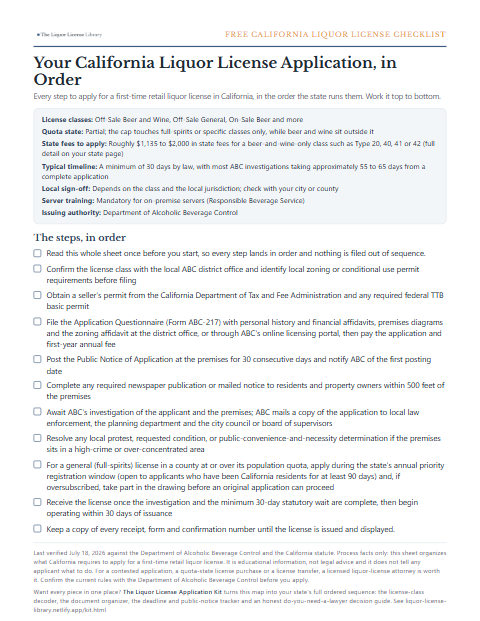
Get the free California liquor license checklist
The one-page map of the California application steps, in the order California runs them.
Instant download, plus California rule-change alerts. Unsubscribe anytime.
Local approval and public notice in California
The city or county layer on top of the state license, plus any notice you must post or publish. The public-notice window is often the shortest clock in the whole process.
| Item | California rule |
|---|---|
| Local sign-off required? | It depends on the class and the jurisdiction |
| What the local layer does | No retail license may be issued for premises where the use is contrary to a valid local zoning ordinance (Business and Professions Code Section 23790); most cities and counties require a zoning clearance or a conditional use permit before ABC will complete the application. ABC also mails a copy of every application to local police or the sheriff, the district attorney, the planning department and the city council or board of supervisors, who may request conditions or file a protest (Section 23987). ABC may refuse a license within roughly 600 feet of a school or public playground and in the immediate vicinity of a church or hospital (Section 23789). |
| Public notice | The applicant must post a Public Notice of Application at the premises for at least 30 consecutive days (Section 23985). In some cases ABC also requires newspaper publication or, where the local jurisdiction provides address data free of charge, mailed notice to residents and property owners within a 500-foot radius (Section 23985.5). Protests may be filed within 30 days of whichever notice event happens last (Section 24013). |
| Worth knowing | Zoning and conditional use permit approval is typically pursued locally in parallel with the state application, often starting first, since ABC generally holds the application until zoning compliance is confirmed. If a local governing body finds the premises would add to crime or sits in an already over-concentrated area, it has 90 days to notify ABC of that finding before ABC can proceed on its own public-convenience-and-necessity determination. |
Server training in California
Whether the people pouring or selling alcohol must certify through a state program, plus the deadline.
| Item | California rule |
|---|---|
| Required for a first-time retailer? | Yes, mandatory for on-premise servers |
| Who must certify | On-premises alcohol servers and the managers who directly supervise them, at any licensee authorized to sell alcohol for on-site consumption |
| State program | Responsible Beverage Service (RBS) Training Program, established by the Responsible Beverage Service Training Program Act of 2017 (Assembly Bill 1221, later amended by Assembly Bill 82) at Business and Professions Code Section 25680 and following, administered by ABC through the RBS Portal with ABC-approved training providers and the ABC Alcohol Server Certification Exam |
| Deadline | Certification within 60 days of an employee's first date of service; certification is valid for three years before recertification is required |
| Worth knowing | The mandatory program took effect July 1, 2022, with a phase-in deadline of August 31, 2022 for servers and managers already employed at that time. Off-sale-only classes such as Type 20 and Type 21 are not on-premises service and fall outside this on-sale requirement. |
Background check and renewal in California
Background check
| Item | California rule |
|---|---|
| Background check required? | Yes |
| Who is checked | The applicant discloses on the Application Questionnaire (Form ABC-217) whether any applicant has ever been convicted of a felony or has ever violated the Alcoholic Beverage Control Act. ABC then conducts a statutory investigation of the applicant and the premises under Business and Professions Code Section 23958 before a license can issue. |
| Disqualifiers | Grounds for denial include a conviction for a felony or a crime involving moral turpitude and the other statutory grounds listed in Section 24200, evaluated by ABC case by case rather than as an automatic bar; a licensee generally must be at least 21 years of age. |
| Worth knowing | Misrepresenting the purchase price on a person-to-person transfer is itself a separate statutory ground for denial or revocation. |
Renewal
| Item | California rule |
|---|---|
| Renewal cycle | annual |
| Worth knowing | ABC mails a renewal notice ahead of the license's expiration date showing the fee due, but payment is the licensee's responsibility whether or not a notice arrives. A payment received up to 60 days after the deadline carries a 50 percent penalty on top of the annual fee while a payment received more than 60 days after the deadline carries a 100 percent penalty. Industry and licensing-broker sources describe the license as subject to cancellation and eventual revocation if it stays unpaid past that 90-day mark, though ABC's own fee-schedule page documents only the 50 percent and 100 percent penalty tiers directly. |