How to Get a Liquor License in Arkansas (2026): Cost, Classes and Steps
How do you get a liquor license in Arkansas?
In Arkansas, retail alcohol permits are issued by the Alcoholic Beverage Control Division inside the Department of Finance and Administration. A package store needs a quota-limited retail liquor permit, capped by statute at one permit for every 7,500 residents of the county, while beer, grocery store wine, restaurant beer and wine, restaurant mixed drink and private club permits issue outside that quota. Every permit expires on June 30 and renews annually and permits issue only in territory that has voted wet under the local option law.
In Arkansas, retail liquor licenses go through the Alcoholic Beverage Control Division. A first-time applicant files with the state directly. Arkansas caps the number of retail licenses, so a first-time applicant often buys an existing license and transfers it rather than obtaining a brand-new one. Work the page top to bottom and the whole path is visible before any single deadline is due.
Server training is voluntary here, an incentive rather than a licensing condition. Every owner, officer and significant investor clears a background check. Local involvement depends on the class and the jurisdiction. Each piece has its own section below, with the official source beside it.
Act 156 of 2025 was enacted in 2025. Arkansas raised the number of retail liquor permits a single person may hold from one to three, capped at one per county, with extra permits only in counties over 200,000 residents. This page reflects the rule in force today; the full history sits in the law-updates log.
Which liquor license does a Arkansas bar, restaurant or store need?
The retail license classes Arkansas issues, what each covers and the venue each fits. Match your venue to the class before anything else.
| Class | Covers | Who it fits |
|---|---|---|
| Retail Liquor Permit Package store, full spirits plus wine and beer lines under companion permits | off-premise, full spirits | The quota class, capped at one permit per 7,500 county residents under A.C.A. 3-4-201; the store must be a standalone liquor business and cannot operate inside a grocery or general store; new permits release only when census population growth opens slots |
| Off-Premises Retail Beer Permit Beer for carry-out | off-premise, beer | Non-quota; the common class for convenience and grocery stores; also requires a county or city beer permit under A.C.A. 3-5-211 |
| Grocery Store Wine Permit Wine and hard cider in grocery stores | off-premise, beer and wine | Non-quota; created by Act 508 of 2017 for stores already qualified for an off-premises beer permit, with the fee scaled to floor space under A.C.A. 3-5-1802 |
| Hotel, Motel or Restaurant Mixed Drink Permit Mixed drink permit for on-premises service | on-premise, full spirits | Non-quota; for restaurants and hotels in wet territory, with the fee set by seating capacity or room count under A.C.A. 3-9-212 |
| Restaurant Beer and Wine Permit Beer, hard cider and wine with meals | on-premise, beer and wine | Non-quota; a common first on-premise class for a restaurant that does not serve spirits, under A.C.A. 3-4-1001 |
| On-Premises Retail Beer Permit Beer by the drink | on-premise, beer | Non-quota; taverns and restaurants serving beer only; also requires the local beer permit layer |
| Private Club Permit Members-only on-premises service | on-premise, full spirits | The route to on-premises service in dry territory; the application goes to the county or city governing body first under A.C.A. 3-9-222 and Act 762 of 2025 removed the former nonprofit 501(c)(3) requirement |
Is Arkansas a quota or control state?
Whether Arkansas caps how many licenses exist, how a capped license is obtained and whether the state runs any part of retail itself. This is where the real cost of a Arkansas license can hide.
| Item | Arkansas rule |
|---|---|
| Quota state? | Yes, the number of licenses is capped |
| How the cap works | A.C.A. 3-4-201 caps off-premises retail liquor permits at one permit for every 7,500 residents of the county or political subdivision, counted from the most recent federal decennial census and including residents of dry areas within the county |
| New licenses issued by | The statute sets no lottery; the division decides how to allocate released permits. In practice ABC announced new retail liquor permits for Benton, Saline and Washington counties on October 20 2025 and held a lottery among applicants who filed a complete retail liquor application. |
| Buying an existing license | Existing retail liquor permits change hands through a replacement application with division approval under the same notice and qualification rules; no verified market price scale is recorded for |
| State control | No, private licensing throughout. License state; private businesses hold retail and wholesale permits and the state runs no stores |
How much does a liquor license cost in Arkansas?
| Item | Arkansas |
|---|---|
| State and local fees to apply | $350 to $2,500 in state permit fees for most first-time retail classes, up to $5,000 for the largest grocery store wine tier, plus fingerprint and local beer-permit costs |
| Renewal | the same annual fee per class, $350 to $2,500 for most classes, due by June 30 each year |
| What drives the range | The class drives the figure: beer and restaurant beer and wine sit at $350, a package store at $400, mixed drink at $750 to $2,500 and a private club at $1,500. Mixed drink and private club permits issued between January 1 and July 1 pay half the annual fee for that part year. Winning a quota slot carries no separate lottery fee in the statute; see the quota field. |
The itemized fees a first-time Arkansas applicant can expect from the state.
| Fee | Amount |
|---|---|
| Retail liquor permit, annual | $400 |
| Retail beer dealer privilege tax, annual, on-premises or off-premises | $350 |
| Restaurant beer and wine permit, annual | $350 |
| Grocery store wine permit, annual, scaled by floor space | $1,000 to $5,000 |
| Hotel, motel or restaurant mixed drink permit, annual, by rooms or seating | $750 to $1,500, large attendance facility $2,500 |
| Private club permit, annual | $1,500, bed and breakfast club $75 |
| Temporary beer or wine permit, up to 5 days | $50 |
| State Police and FBI fingerprint background check | Not published; confirm with the Alcoholic Beverage Control Division |
| County or city beer permit | varies by locality |
How long it takes. varies; the state publishes no processing commitment. By rule the application must remain on file at least 30 consecutive days before the director acts, after two weeks of newspaper publication and the premises posting. A protested or appealed application goes to the monthly Alcoholic Beverage Control Board hearing, which extends the wait. FBI fingerprint results can also lag the decision; a permit issued before an adverse result is subject to cancellation.
How to apply for a liquor license in Arkansas, step by step
Several of these steps gate the ones after them, so the order matters as much as the list.
- Check the ABC and Arkansas GIS wet-dry map to confirm the address is in territory that allows the intended sales
- For a retail liquor store, confirm the premises is at least 1,000 feet from any church or school building measured property line to property line
- Register with the Secretary of State, obtain the state tax accounts and clear any delinquent state taxes
- Call or email the division for the retail application packet and instruction guide, since in-state retail applications are not posted online
- Attend the ABC educational seminar, which is required before the director may act
- Complete the application listing every owner, partner, officer, director, managing agent and stockholder over five percent, with the premises floor plan
- Submit fingerprints to the Arkansas State Police for the state and FBI checks
- Publish notice in a legal newspaper once a week for two consecutive weeks and post the notice at the front entrance within five days of filing
- Obtain the county or city beer permit or the governing body's private club approval where the class requires it
- Pay the annual permit fee for the class
- Await the director's decision; the application must sit on file at least 30 consecutive days and a protested application goes to the board
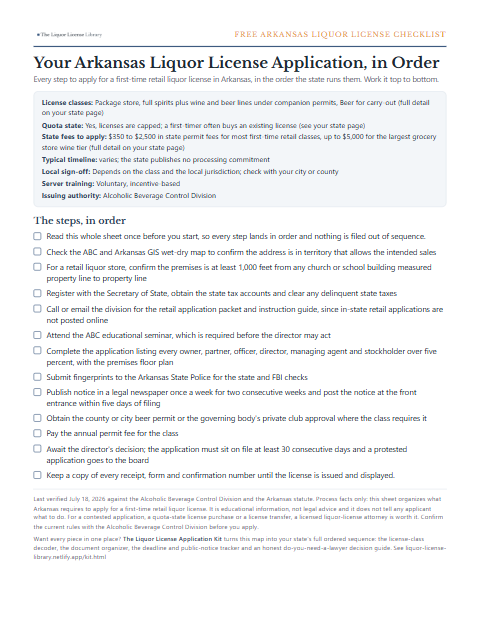
Get the free Arkansas liquor license checklist
The one-page map of the Arkansas application steps, in the order Arkansas runs them.
Instant download, plus Arkansas rule-change alerts. Unsubscribe anytime.
Local approval and public notice in Arkansas
The city or county layer on top of the state license, plus any notice you must post or publish. The public-notice window is often the shortest clock in the whole process.
| Item | Arkansas rule |
|---|---|
| Local sign-off required? | It depends on the class and the jurisdiction |
| What the local layer does | There is no separate city or county license for the retail liquor and mixed drink classes, but the premises must sit in wet territory under the Title 3 chapter 8 local option and a retail liquor store must be at least 1,000 feet from any church or school. Beer retailers must also obtain a county or city beer permit under A.C.A. 3-5-211. A private club applies to the county or city governing body before the division acts. |
| Public notice | Newspaper publication at least once a week for two consecutive weeks for standard retail applications under 3 CAR 1-211, four consecutive weeks for a private club under A.C.A. 3-9-222, plus a notice posted at the front entrance within five days of filing and a minimum 30-day file period under 3 CAR 1-214 |
| Worth knowing | 31 of Arkansas's 75 counties are dry per the joint ABC and Arkansas GIS wet-dry map published February 2025 and city or subdivision level wet-dry lines exist inside wet counties. The director mails notice of applications to the sheriff, chief of police, prosecuting attorney and local governing bodies. Signed petitions for or against an application are accepted. |
Server training in Arkansas
Whether the people pouring or selling alcohol must certify through a state program, plus the deadline.
| Item | Arkansas rule |
|---|---|
| Required for a first-time retailer? | Voluntary, an incentive rather than a licensing condition |
| State program | The Arkansas Responsible Permittee Program under A.C.A. 3-4-801 through 3-4-807 and 3 CAR 6-105: board-approved providers teach a certified course and certification renews annually |
| Worth knowing | Certification is an opt-in incentive the board weighs in mitigation of administrative penalties; a permittee that enrolls must put each employee authorized to sell alcohol through the course within 30 days of hire, with a maximum $25 attendance fee. Separate from server training, the license applicant must attend a mandatory ABC educational seminar before the director acts under 3 CAR 1-302 and Act 157 of 2025 requires training for third-party alcohol delivery drivers. |
Background check and renewal in Arkansas
Background check
| Item | Arkansas rule |
|---|---|
| Background check required? | Yes |
| Who is checked | Every permit applicant submits fingerprints through the Division of Arkansas State Police for a state check and FBI national check under A.C.A. 3-2-103; on entity applications the qualification rules reach every partner, officer, director, managing agent and stockholder holding more than five percent |
| Disqualifiers | Any felony conviction, being under sentence within the past five years for an alcohol possession, sale, manufacture or transportation offense, a permit revoked within the past five years, age under 21, false statements on the application and delinquent state taxes, all under 3 CAR 1-301 |
| Worth knowing | The named permit holder, who may be the owner or a manager, must be an Arkansas resident with an Arkansas ID whose primary residence is in the same county as the business or within 35 miles of it, per the division's FAQ. If FBI results later show a disqualification the division starts cancellation proceedings. |
Renewal
| Item | Arkansas rule |
|---|---|
| Renewal cycle | annual |
| Worth knowing | Every permit expires June 30 and renews for the fiscal year starting July 1, with renewal filed through the division's online renewal portal; the renewal fee equals the annual permit fee for the class |